Before AI vs After AI: Why Judgment Is Becoming More Valuable Than Execution
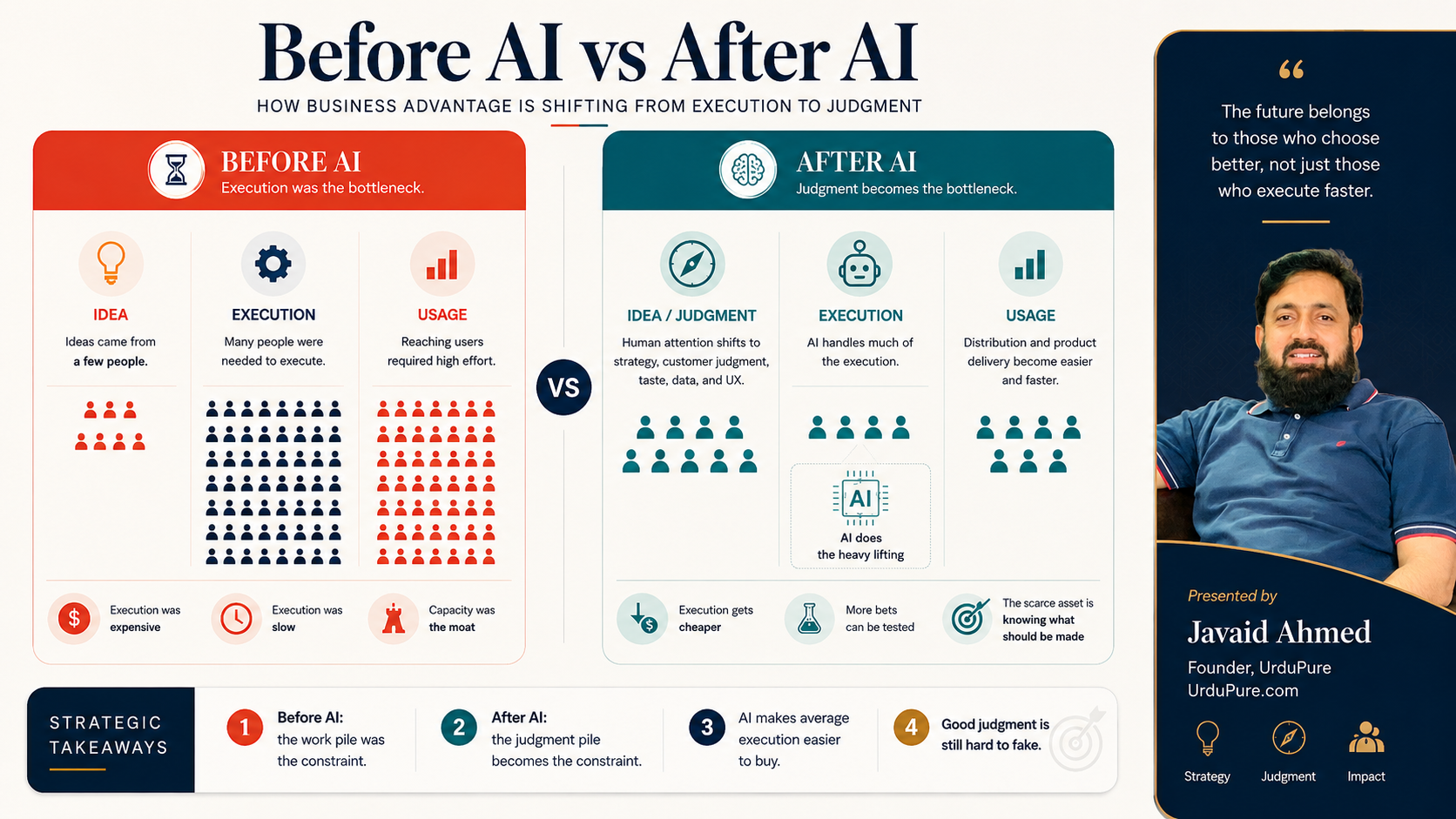
The chart looks simple.
Before AI, teams needed many people to execute work. After AI, execution becomes easier, faster and cheaper. But the real shift is much deeper than productivity. AI is not only changing how work gets done. It is changing where business advantage comes from. For years, companies treated execution capacity as the main bottleneck. If you wanted to build more, publish more, sell more or serve more customers, you usually needed more people. More engineers. More writers. More designers. More operators. More agencies. More managers.
Execution was expensive.
Execution was slow. Execution was hard to scale. AI changes that.
Now drafts can be written faster. Code can be generated faster. Research can be summarized faster. Campaigns can be assembled faster. Internal tools can be prototyped faster. Customer workflows can be automated faster. That sounds like good news, and it is.
But it also creates a harder question:
If everyone can create faster, what actually separates great teams from average teams?
The answer is no longer just execution. The answer is judgment.
Key Takeaways
Before AI, execution was often the biggest business bottleneck.
After AI, the cost of execution is falling quickly.
Teams can now create drafts, code, research, campaigns and workflows much faster.
The scarce skill is shifting from “Can we make it?” to “Should we make it?”
Strategy, customer judgment, product taste, data interpretation and UX thinking are becoming more important.
AI can increase output, but it does not automatically improve decisions.
The best teams will use AI to reduce friction, not just reduce headcount.
The real advantage belongs to people who know what is worth building.
Before AI, Execution Was the Bottleneck
Before AI became widely available, most teams were constrained by execution. You needed people who could build the product. People who could ship the feature. People who could fix bugs. People who could write copy. People who could design screens. People who could set up workflows. People who could analyze research. People who could get the product into the hands of users.
Every new idea created a new workload. A leader might say, “We should test this campaign.” Then someone had to write the copy. Someone had to design the creative. Someone had to build the landing page. Someone had to set up tracking. Someone had to review performance. Someone had to make changes.
Even a small idea could become a long chain of tasks. That made execution capacity feel like a moat. If your company had more engineers, more marketers, more operators and more budget, you could move faster than smaller teams. More people meant more output. More output meant more chances to win.
At least, that was the old logic.
After AI, Execution Gets Cheaper
AI weakens that old logic. A small team can now do work that once required a larger team. A founder can draft a landing page in minutes. A marketer can create 20 headline options instantly. A developer can use AI to speed up coding and debugging. A researcher can summarize long documents quickly.
A sales team can turn rough notes into professional emails. A manager can convert messy meeting notes into action items. A creator can turn one idea into a blog post, social post, newsletter and video script. AI does not remove all work. But it reduces the friction between idea and first version. That is a huge change.
The first draft used to be expensive. Now it is cheap. The first prototype used to take days or weeks. Now it can sometimes take hours. The first research summary used to require deep manual reading. Now AI can help compress the material quickly. This changes the pace of business. But faster execution creates a new problem.
More Output Does Not Mean Better Strategy
A faster factory does not automatically create a better product. It only produces more things. This is where many teams will misunderstand AI. They will think the goal is simply to automate more work. More articles. More campaigns. More product ideas. More features. More emails. More dashboards. More experiments. But more output is not always progress. Sometimes it is just more noise. AI makes it easier to create, but it does not automatically tell you what is worth creating. A team can publish 100 posts and still miss the customer. A product team can build 20 features and still make the product worse.
A startup can launch quickly and still solve the wrong problem. A company can automate workflows and still have a weak strategy. Execution is getting easier. Choosing the right execution is getting more important.
The New Bottleneck Is Judgment
Before AI, the work pile was the constraint. After AI, the judgment pile becomes the constraint. That means the most valuable people on a team may not be the ones who simply produce the most.
They will be the ones who can decide:
What problem actually matters?
Which customer pain is worth solving?
Which idea should we ignore?
Which feature will create real value?
Which message will connect with the market?
Which data point matters?
Which trend is noise?
Which opportunity is worth the risk?
Which experiment should be scaled?
Which output is good enough?
Which output is just average?
This is not easy work.
AI can help with options.
AI can help with drafts.
AI can help with summaries.
But judgment still belongs to humans.
Good judgment comes from experience, taste, context, customer understanding and strategic clarity.
AI can make average execution easier to buy.
It cannot make good judgment easy to fake.
The Idea Layer Matters More
When execution was expensive, teams had to be careful about which ideas entered the system.
There was only so much capacity.
Now, because AI makes execution faster, more ideas can be tested.
That sounds useful.
But it also means teams may drown in half-baked ideas.
The idea layer becomes more important.
A good idea is not just something interesting.
A good idea is something that connects with a real need, a real audience and a real business goal.
Leaders need to ask:
Is this idea useful?
Is it urgent?
Is it different?
Does the customer care?
Can we test it quickly?
Does it support our strategy?
Is it worth attention?
AI can help generate ideas.
But humans must decide which ideas deserve energy.
Customer Judgment Becomes a Superpower
AI can produce content, code and campaigns quickly.
But it does not automatically understand your customer better than you do.
The best teams will still win through customer judgment.
They will know:
What customers are trying to do
What frustrates them
What language they use
What they fear
What they value
What they ignore
What makes them trust a product
What makes them leave
This kind of understanding does not come only from prompts.
It comes from conversations, support tickets, sales calls, analytics, interviews, behavior and observation.
AI can help organize customer insight.
But humans must earn the insight first.
A company with weak customer understanding will simply use AI to create faster wrong answers.
A company with strong customer understanding will use AI to move faster in the right direction.
Taste Becomes More Important
AI can create many versions of something.
Ten headlines.
Twenty designs.
Five product descriptions.
A full campaign.
A first draft.
A working prototype.
But who decides which one is good?
That is taste.
Taste is the ability to recognize quality.
It is knowing when something is clear, useful, elegant, trustworthy or memorable.
It is knowing when something feels generic.
It is knowing when a design looks polished but confuses the user.
It is knowing when a message sounds clever but does not sell.
It is knowing when a feature works technically but does not improve the experience.
As AI increases the amount of output, taste becomes more valuable.
Because someone still needs to choose.
Someone still needs to edit.
Someone still needs to say:
“This is not good enough.”
Or:
“This is the direction.”
Data Still Needs Interpretation
AI can summarize data.
It can find patterns.
It can generate charts.
It can explain reports.
But data is not strategy by itself.
A dashboard can show what happened.
It does not always explain why it happened.
A metric can rise.
But that does not mean the business is healthier.
A campaign can get clicks.
But that does not mean it attracted the right people.
A feature can get usage.
But that does not mean it created long-term value.
AI can help teams process information faster.
But leaders still need to ask better questions.
What does this data really mean?
What is missing?
What are we assuming?
What would change our decision?
What is the risk of acting too early?
What is the risk of waiting too long?
The data layer matters more because AI gives teams more information to interpret.
But interpretation is still a human responsibility.
UX Becomes a Bigger Advantage
When more teams can build quickly, user experience becomes a major differentiator.
A product that works is no longer enough.
It must be easy.
It must be clear.
It must feel natural.
It must reduce confusion.
It must help users reach value quickly.
AI can help generate interfaces, copy and workflows, but it does not automatically create a great experience.
Good UX requires empathy.
It requires understanding where users hesitate.
Where they get lost.
Where they misunderstand.
Where they abandon the process.
Where the product creates friction.
As execution gets cheaper, users will have more options.
That means they will tolerate less confusion.
The teams that win will not only build faster.
They will make things easier to use.
AI Should Not Only Mean Fewer People
Some companies will look at AI and see only one opportunity:
Reduce headcount.
Do the same work with fewer people.
That may happen in some areas.
But if that is the only goal, they may miss the bigger opportunity.
The real opportunity is not just fewer people doing the same work.
It is better people making sharper decisions with less friction between insight and output.
AI can free smart people from repetitive tasks.
That gives them more time for strategy, customer thinking, quality control, creative direction and judgment.
The strongest teams will not simply ask:
“How can we automate more work?”
They will ask:
“Which decisions deserve more human attention now that execution is cheaper?”
That is the strategic shift.
What Leaders Should Do Now
Leaders need to rethink how work is organized.
The old model was often:
Idea → approval → execution → review → launch
AI compresses the execution stage.
So leaders need to strengthen the stages around it.
That means better problem definition before work begins.
Better criteria for choosing ideas.
Better customer research.
Better review standards.
Better measurement.
Better decisions about what to stop doing.
A useful AI-enabled workflow might look like this:
First, clarify the problem.
Second, use AI to generate possible solutions.
Third, use human judgment to select the strongest options.
Fourth, use AI to prototype quickly.
Fifth, test with real users.
Sixth, use data and judgment to decide what to improve, scale or delete.
The goal is not to let AI drive the company.
The goal is to make better human decisions faster.
What Teams Should Stop Doing
Teams should stop treating AI like a magic output machine.
They should stop measuring success only by volume.
More drafts do not mean better marketing.
More features do not mean better product.
More reports do not mean better decisions.
More automation does not mean better operations.
Teams should also stop pretending every task deserves the same attention.
If AI makes execution cheaper, then human attention should move toward the highest-value questions.
What should we build?
Who is it for?
Why now?
What does success look like?
What should we not do?
Where could this fail?
What would make this truly useful?
These questions matter more than ever.
What Teams Should Start Doing
Teams should start building a shared judgment system.
That means creating clear standards for decisions.
For example:
Before launching a feature, ask:
What customer problem does this solve?
How do we know the problem is real?
What is the smallest test?
What does success look like?
What could go wrong?
What will we stop doing if this works?
What will we stop doing if this fails?
Before publishing content, ask:
Who is this for?
What question does it answer?
Is it useful or just more noise?
Does it offer original insight?
Is it clear?
Would a real person share it?
Before automating a workflow, ask:
Is this workflow worth preserving?
Are we automating a good process or a bad one?
What human review is still needed?
What happens if the automation fails?
How will we measure improvement?
AI makes action easier.
So teams need stronger filters.
The Real Competitive Advantage After AI
The real advantage after AI will belong to teams that combine speed with judgment.
Not just fast teams.
Not just automated teams.
Not just lean teams.
The winners will be teams that know what matters.
They will use AI to move faster, but they will not let speed replace thinking.
They will produce more, but they will also delete more.
They will test faster, but they will choose better.
They will automate tasks, but protect judgment.
They will reduce busywork, but increase strategic attention.
They will treat AI as a force multiplier, not a replacement for leadership.
Final Thought
Before AI, execution was the obvious bottleneck.
After AI, judgment becomes the bottleneck.
That is the shift every leader needs to understand.
The question is no longer only:
“Can we make this?”
Increasingly, the question is:
“Is this worth making?”
AI can help build the draft, the prototype, the workflow and the campaign.
But it cannot fully replace the human responsibility to choose the right problem, understand the customer, define quality and decide what deserves attention.
A faster factory is useful.
But only if someone wise is deciding what it should produce.
That is where the advantage moves.



Discussion
Comments
Approved comments are published after moderation to keep discussion useful and spam-free.
No comments yet. Start the discussion below.