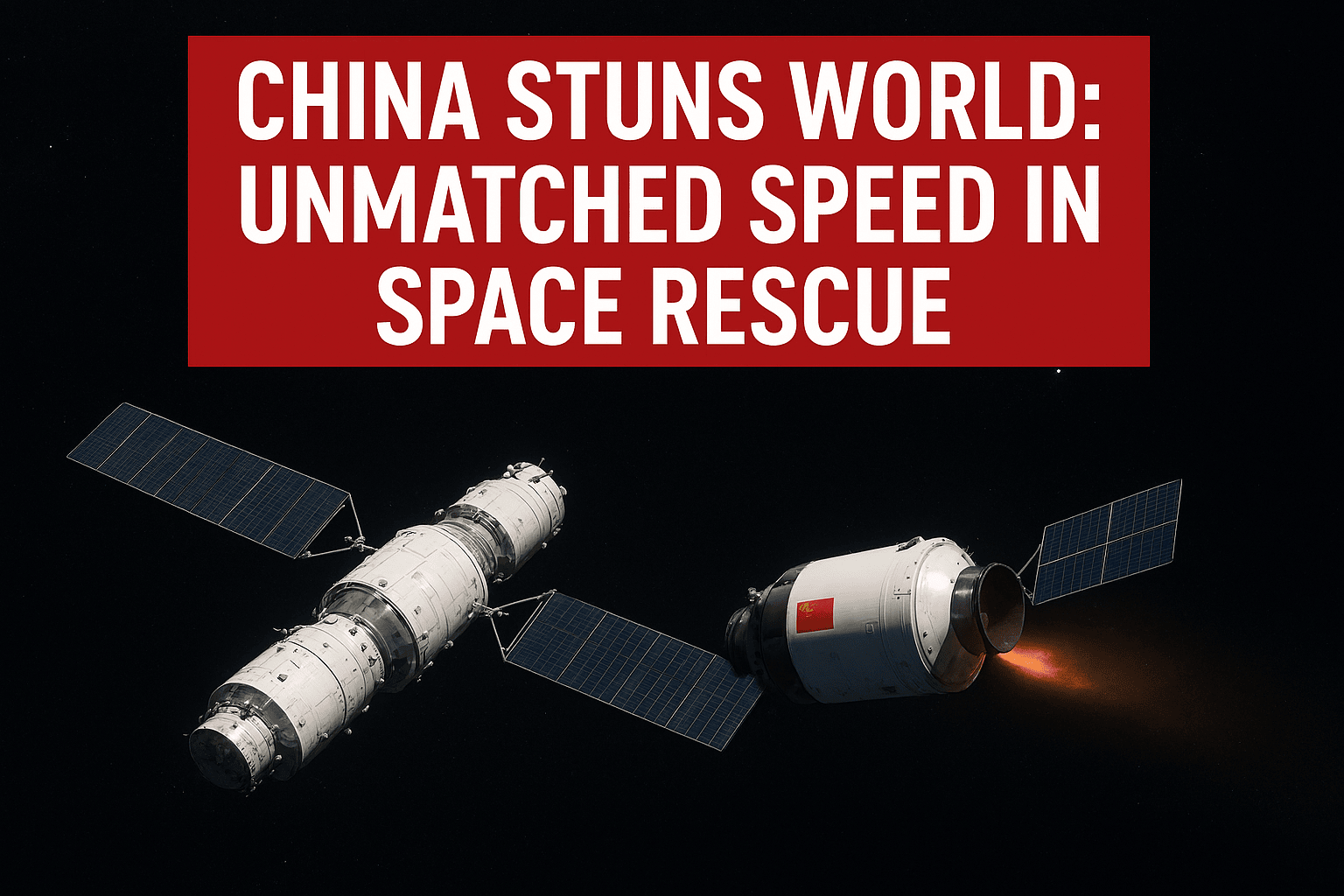
In a development that has sent ripples of astonishment through the global space community, China has recently showcased an emergency space-rescue capability that stands unparalleled in terms of speed and efficiency. This groundbreaking achievement not only underscores China's rapidly advancing prowess in space technology but also sets a formidable new benchmark for orbital safety and emergency response worldwide. The unveiling of this capability has prompted a re-evaluation of national space strategies and sparked intense discussions about the future of human spaceflight.
The Dawn of a New Era in Space Safety
For decades, the concept of a rapid, on-demand space rescue mission has remained largely in the realm of science fiction or theoretical discussions. While spacefaring nations have always prioritized astronaut safety, the logistical and technological hurdles involved in launching a dedicated rescue mission within hours or even days have been immense. Current protocols often rely on the International Space Station (ISS) serving as a safe haven or planning for return vehicles that are already docked. The prospect of an unexpected emergency, such as a major system failure on an independent spacecraft or a critical injury to an astronaut, has always presented a terrifying 'what if' scenario.
The challenges are multifaceted:
- Launch Readiness: Preparing a rocket for launch typically takes weeks, if not months.
- Orbital Mechanics: Matching orbits with a distressed spacecraft requires precise calculations and propulsion.
- Rendezvous and Docking: Automated or manual docking procedures are complex and time-consuming.
- Crew Transfer: Safely transferring astronauts from one vessel to another in a vacuum.
China's recent demonstration appears to have significantly compressed this timeline, moving from emergency alert to potential rescue deployment at a speed previously considered unattainable. This capability represents a monumental leap forward, fundamentally altering the calculus of risk in outer space.
China's Unprecedented Showcase
While the specific details of the demonstration remain closely guarded, initial reports and expert analyses suggest China has developed a highly integrated and automated system. This system reportedly allows for the rapid preparation and launch of a dedicated rescue vehicle, capable of reaching a distressed orbital asset in a fraction of the time conventional methods would require.
Rapid Response Vehicles
Central to this capability is believed to be a new generation of modular, pre-fueled, and pre-integrated rescue spacecraft. These vehicles are likely kept in a state of near-readiness, perhaps utilizing advanced solid-propellant rockets or highly automated liquid-propellant systems that can be fueled and checked out in record time. The design likely focuses on minimizing human intervention during the initial launch phase, allowing for immediate liftoff once an emergency is declared.
Autonomous Operations and AI Integration
Experts speculate that the speed is largely enabled by sophisticated automation and artificial intelligence. From automated launch sequence checks to real-time orbital trajectory adjustments, AI likely plays a crucial role in reducing decision-making time and executing complex maneuvers with unprecedented efficiency. This would include:
- Automated fault detection and diagnostic systems on potential rescue targets.
- Rapid mission planning algorithms that can generate optimal rescue trajectories in minutes.
- Autonomous rendezvous and proximity operations systems for precise docking.
This level of integration speaks to a profound investment in smart space technologies and a commitment to leveraging cutting-edge computational power for critical missions.
Technological Marvels Behind the Speed
The implications of this speed suggest several key technological advancements that China has likely perfected:
Next-Gen Launch Systems
The ability to launch a rescue mission so swiftly points to either a new class of highly responsive launch vehicles or significant modifications to existing ones. These could feature:
- "Hot-standby" rockets: Kept fueled and ready on the launchpad for immediate liftoff.
- Modular payload fairings: Allowing quick integration of different rescue payloads depending on the specific emergency.
- Automated ground support: Reducing the human personnel and time needed for pre-launch operations.
This contrasts sharply with the typical multi-day or multi-week preparation periods for most orbital launches globally.
Precision Orbital Mechanics
Achieving a rapid rendezvous requires incredibly precise and fast orbital calculations. This necessitates advanced sensor arrays, highly accurate tracking networks, and sophisticated propulsion systems capable of performing swift and accurate orbital adjustments. The rescue vehicle must not only reach the same altitude as the distressed spacecraft but also perfectly match its velocity and phase angle.
Modular and Adaptable Designs
A true emergency rescue capability would need to be adaptable to various scenarios, whether rescuing astronauts from a damaged space station module, a commercial crew vehicle, or even a future lunar lander in Earth orbit. The rescue craft itself likely features modular components that can be quickly configured for different tasks, such as carrying additional life support, repair equipment, or specialized medical kits.
Global Implications and the New Space Race
China's demonstration has profound global implications, not just for space exploration but also for geopolitical dynamics.
Setting a New Benchmark
This unmatched speed immediately sets a new standard for what is considered achievable in space emergency response. Other spacefaring nations, including the United States, Russia, and the European Space Agency, will undoubtedly scrutinize China's achievement and feel pressure to develop similar capabilities to ensure the safety of their own astronauts and assets.
Geopolitical Repercussions
The ability to deploy a rescue mission so quickly also carries potential dual-use implications. While presented as a humanitarian effort, the underlying technologies for rapid orbital deployment could theoretically be adapted for military or strategic purposes, adding another layer of complexity to the already competitive space environment. It signifies a tangible shift in global space power, showcasing China's technical leadership in a critical domain.
A Call for Collaboration or Competition?
The immediate question on many minds is whether this advancement will foster greater international collaboration in space safety or intensify the ongoing space race. On one hand, the sheer difficulty and cost of developing such a system might push nations towards sharing resources and expertise for common safety protocols. Imagine a global space safety network where assets from multiple nations could be brought to bear in an emergency.
On the other hand, the competitive nature of space exploration, coupled with national security concerns, might drive a race for similar, independent capabilities. The world now watches to see how this unparalleled achievement will shape future dialogues on international space law, safety regulations, and multilateral cooperation agreements.
China's unveiling of an emergency space-rescue capability with unmatched speed marks a pivotal moment in human space exploration. It not only underscores the nation's rapid technological ascent but also compels the entire global community to reconsider the possibilities and responsibilities inherent in venturing beyond Earth. This feat promises to make space travel safer, yet simultaneously raises critical questions about global cooperation and competition in the final frontier. The 'space rescue' paradigm has shifted, and the world is now witnessing the dawn of an entirely new era.






Discussion
Comments
Approved comments are published after moderation to keep discussion useful and spam-free.
No comments yet. Start the discussion below.