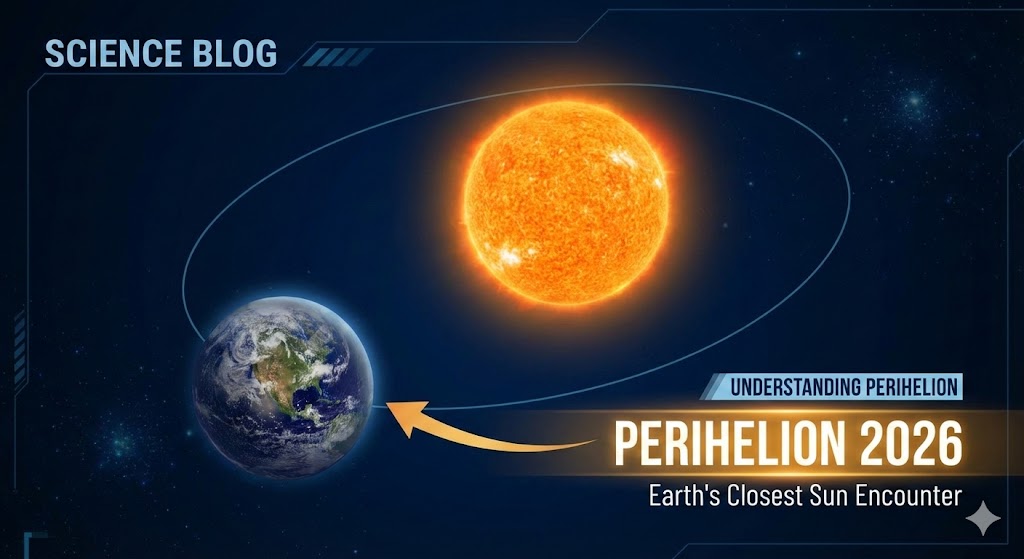
Earth's journey around the Sun is a marvel of celestial mechanics, a precise ballet governed by gravity and momentum. While we often perceive our orbit as a perfect circle, it is, in fact, an ellipse. This elliptical path means there are times when our planet is closer to the Sun and times when it is farther away. The point of closest approach is known as perihelion. In 2026, Earth will once again reach this significant orbital milestone, offering a fascinating opportunity to explore the intricacies of our solar system's dynamics. This blog post delves into what perihelion truly means, unpacks the details of Earth's 2026 encounter, and addresses common misconceptions surrounding this pivotal astronomical event. Join us as we journey into the heart of our planet's cosmic rhythm, understanding the forces that shape our existence and the subtle implications of our closest rendezvous with our star.
Understanding Perihelion: Earth's Orbital Dance
At its core, perihelion is the point in a planet's (or any celestial body's) orbit where it is nearest to the star it orbits. The term itself is derived from Greek: 'peri' meaning near, and 'helios' meaning Sun. This phenomenon is a direct consequence of Kepler's First Law of Planetary Motion, which states that planets orbit the Sun in ellipses, with the Sun at one of the two foci.
For Earth, this means that once a year, our planet draws closest to its gravitational anchor, the Sun. This event is not unique to Earth; every planet, dwarf planet, asteroid, and comet in our solar system experiences its own perihelion relative to the Sun. The precise timing and distance of perihelion vary slightly year by year due to gravitational perturbations from other planets and the slow precession of Earth's orbit.
- Definition: The point in an orbit where a celestial body is closest to its primary star.
- Cause: Elliptical nature of orbits, as described by Kepler's Laws.
- Frequency: Occurs once per orbital period for any orbiting body.
Perihelion vs. Aphelion: The Extremes of Orbit
To fully grasp perihelion, it's essential to understand its counterpart: aphelion. Aphelion (from 'apo' meaning away from, and 'helios' meaning Sun) is the point in an orbit where a celestial body is farthest from its primary star. Together, perihelion and aphelion mark the two extreme points of an elliptical orbit, defining the major axis of the ellipse.
For Earth, the difference in distance between perihelion and aphelion is approximately 5 million kilometers (about 3.1 million miles). While this might seem like a substantial difference, it represents only about 3.3% of Earth's average distance from the Sun. These slight variations in distance have fascinating, albeit often misunderstood, implications for our planet's environment and orbital dynamics.
- Perihelion: Closest approach to the Sun, typically occurring in early January for Earth.
- Aphelion: Farthest point from the Sun, typically occurring in early July for Earth.
- Distance Variation: Earth's distance from the Sun varies by roughly 3% between these two points.
Earth's 2026 Perihelion: A Closer Look
In 2026, Earth will once again swing closest to the Sun. While the exact date can shift by a day or two each year, perihelion typically occurs around January 3rd or 4th. For 2026, the specific date and time will be precisely calculated by astronomical observatories, allowing for an accurate understanding of this celestial event.
At this point, Earth will be approximately 147.09 million kilometers (91.4 million miles) from the Sun. This is in contrast to its aphelion, when it will be around 152.1 million kilometers (94.5 million miles) away. At perihelion, Earth's orbital speed also increases, a consequence of Kepler's Second Law, which states that a line segment joining a planet and the Sun sweeps out equal areas during equal intervals of time. To cover more area in a shorter time when closer to the Sun, Earth must accelerate.
- Approximate Date: Early January 2026.
- Distance from Sun: Approximately 147.09 million kilometers (91.4 million miles).
- Orbital Speed: Earth moves fastest in its orbit at perihelion, traveling roughly 30.29 km/s (18.82 miles/s).
- Solar Energy: Receives about 7% more solar radiation than at aphelion.
Dispelling a Common Myth: Perihelion and Seasons
One of the most persistent misconceptions in astronomy is the idea that Earth's seasons are caused by its varying distance from the Sun. Many people assume that when Earth is closest to the Sun (perihelion), it must be summer, and when it's farthest (aphelion), it must be winter. However, the reality is quite different, and the timing of perihelion in January clearly illustrates this.
For the Northern Hemisphere, January is the height of winter, despite Earth being at its closest point to the Sun. Conversely, July, when Earth is at aphelion and farthest from the Sun, is summer in the Northern Hemisphere. This paradox is resolved by understanding that Earth's seasons are primarily caused by its axial tilt, an approximately 23.5-degree inclination of its rotational axis relative to its orbital plane.
This tilt means that as Earth orbits the Sun, different parts of the planet receive more direct sunlight at different times of the year. When the Northern Hemisphere is tilted towards the Sun, it experiences summer (longer days, more direct sunlight). When it's tilted away, it experiences winter (shorter days, less direct sunlight). The Southern Hemisphere experiences the opposite seasons due to this same tilt. While perihelion does mean a slight increase in received solar energy, this effect is minimal compared to the profound influence of axial tilt on sunlight intensity and duration, which dictate our seasonal cycles.
The Science Behind the Orbit: Kepler's Laws and Gravitational Pull
The elliptical orbits and varying speeds of planets are not random but are precisely governed by fundamental laws of physics. Johannes Kepler, in the early 17th century, formulated his three laws of planetary motion empirically, describing how planets move. Later, Isaac Newton provided the theoretical framework with his law of universal gravitation, explaining why planets behave this way.
At perihelion, Earth's increased speed is a direct consequence of the stronger gravitational pull it experiences from the Sun when closer. As per Newton's law, gravitational force is inversely proportional to the square of the distance between two objects. Therefore, the closer Earth is to the Sun, the stronger the gravitational attraction, which in turn accelerates the planet along its orbital path. This constant interplay of gravitational force and inertia keeps Earth perpetually in orbit, never spiraling into the Sun nor flying off into deep space.
Subtle Impacts of Perihelion on Earth
While perihelion does not cause our seasons, it does have a few subtle, measurable effects:
- Increased Solar Radiation: At perihelion, Earth receives approximately 6.9% more solar energy than at aphelion. This slight increase in energy contributes to slightly warmer global average temperatures, though this effect is largely masked by seasonal variations and atmospheric factors.
- Orbital Speed: As mentioned, Earth moves faster at perihelion. This means that the Northern Hemisphere's winter (which occurs during perihelion) is slightly shorter than its summer, and conversely, the Southern Hemisphere's summer is slightly shorter than its winter. The northern winter lasts about 89 days, while the northern summer lasts about 93 days.
- Apparent Size of the Sun: The Sun appears slightly larger in the sky during perihelion compared to aphelion due to the closer proximity. However, this difference is imperceptible to the naked eye.
The Dynamic Nature of Orbits: Precession and Long-Term Changes
Earth's orbit is not entirely static. Over millennia, the timing of perihelion gradually shifts. This phenomenon is known as the precession of the equinoxes, but more specifically, it's the precession of the perihelion. The major axis of Earth's elliptical orbit slowly rotates in space. Currently, perihelion is drifting later in the year by about one day every 58 years.
Tens of thousands of years ago, perihelion occurred during the Northern Hemisphere's summer. This slow orbital wobble, along with changes in orbital eccentricity and axial tilt, are collectively known as Milankovitch Cycles. These cycles are thought to be significant drivers of long-term climate change and glacial periods on Earth, demonstrating the profound long-term impact of seemingly small orbital variations.
Observing the Unseen: Experiencing Perihelion
Unlike a solar eclipse or a meteor shower, perihelion is not a visual event that can be directly observed through a telescope or with the naked eye. It is an astronomical milestone defined by our planet's position in its orbit. We experience its effects indirectly through the subtle variations in solar energy and orbital speed.
However, understanding perihelion allows us to appreciate the intricate clockwork of our solar system. It reminds us of the universal laws that govern celestial motion and how our home planet is constantly engaged in a cosmic dance around its star. It's a testament to the predictive power of science and the profound beauty of orbital mechanics.
A Moment of Cosmic Proximity
Earth's closest encounter with the Sun in 2026, its perihelion, is more than just a date on the calendar. It's an annual reminder of our planet's elliptical journey and the fundamental forces that shape our existence. While it doesn't dictate our seasons, perihelion underscores the elegant complexity of orbital mechanics, the power of gravity, and the subtle variations that influence our planet.
By understanding perihelion, we gain a deeper appreciation for the precision of the cosmos and our unique place within it. It's a moment to reflect on the scientific principles that allow us to predict and comprehend these grand celestial events, reinforcing the endless wonder of our universe.






Discussion
Comments
Approved comments are published after moderation to keep discussion useful and spam-free.
No comments yet. Start the discussion below.