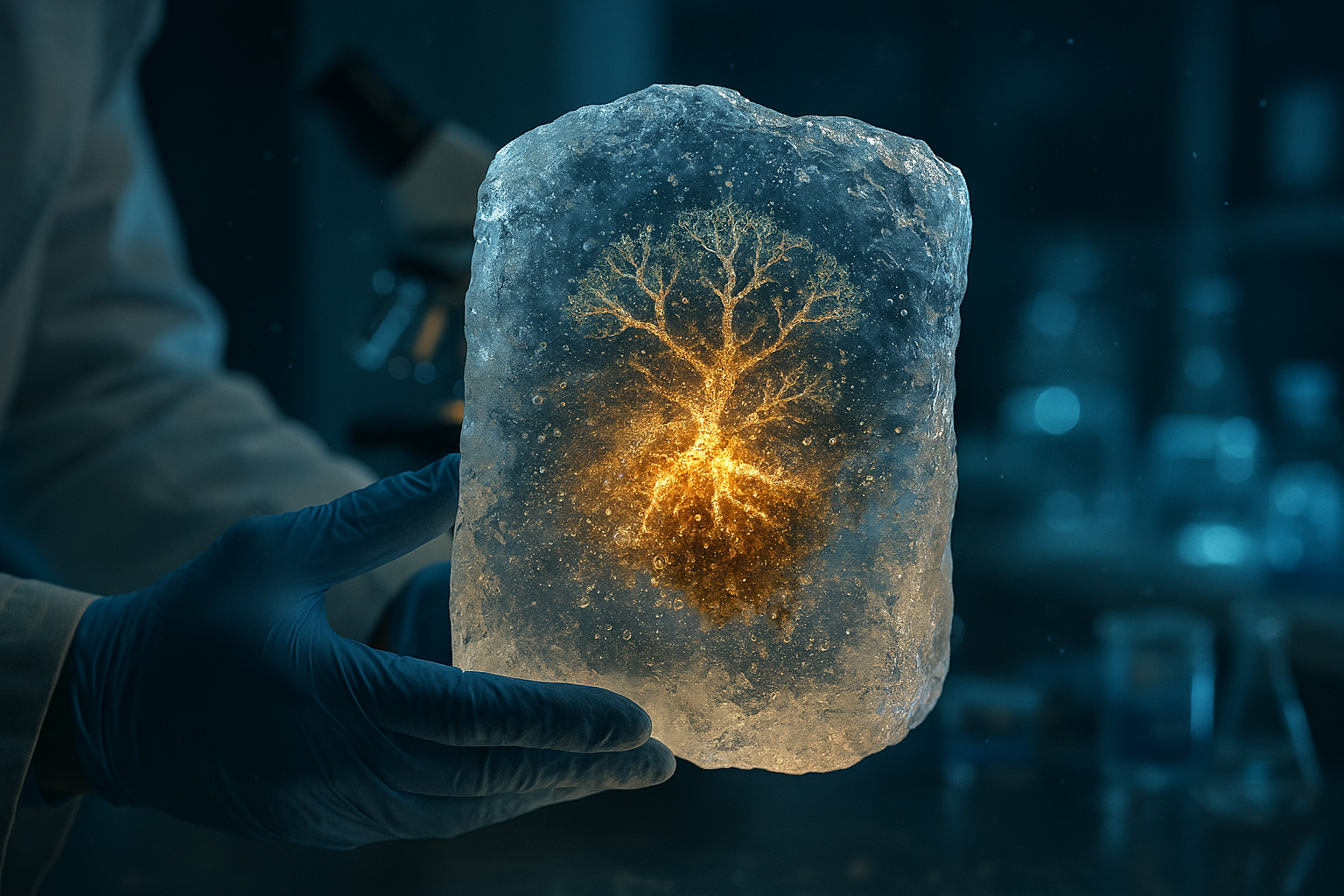
A breathtaking scientific achievement has unfolded in the laboratories of Norway, where researchers have successfully examined ancient bacteria preserved for an astonishing nearly 40,000 years. This remarkable discovery, extracted from the frosty depths of Arctic permafrost, opens a new window into the resilience of life on Earth and presents both exhilarating possibilities and pressing concerns for the future.
The journey began deep within the frozen expanses of the Arctic, a region increasingly under the global spotlight due to rapidly changing climatic conditions. Scientists from various Norwegian institutions collaborated on this ambitious project, meticulously drilling into permafrost layers that have remained undisturbed for millennia. Their goal: to retrieve pristine samples of ancient biological material, locked away in a natural deep freeze, offering a rare glimpse into ecosystems long past.
Unearthing the Millennia-Old Survivors
Permafrost, ground that remains completely frozen for at least two consecutive years, acts as nature's ultimate time capsule. It preserves organic matter, including microorganisms, in a state of suspended animation, safe from decomposition and the ravages of time. The sheer age of these bacterial samples – nearly 40,000 years – places them firmly in the Late Pleistocene epoch, a period characterized by significant glacial cycles and the dominance of megafauna like woolly mammoths and saber-toothed tigers.
The process of extracting and studying these ancient microbes is fraught with challenges. Researchers employed stringent sterile techniques to prevent contamination from modern bacteria, ensuring the integrity of their samples. Core samples were carefully extracted from hundreds of meters below the surface, where temperatures remain consistently below freezing, providing ideal conditions for long-term preservation.
The Scientific Methodology: A Delicate Revival
Once transported to specialized laboratories, the delicate work of analyzing the ancient bacteria began. Scientists did not merely observe inert cells; their research focused on understanding the molecular mechanisms that allowed these microorganisms to survive for such an unimaginable duration. Advanced genomic sequencing technologies were employed to map their DNA, revealing their genetic makeup and evolutionary relationships to modern bacteria. This involved:
- Sterile Extraction: Carefully isolating the bacterial cells from the permafrost matrix under ultra-clean conditions.
- Gradual Thawing: Slowly bringing the samples to conditions conducive for microbial activity, mimicking a natural thawing process.
- Nutrient Introduction: Providing a controlled environment with specific nutrients to encourage metabolic processes without promoting unchecked growth.
- Genomic Sequencing: Analyzing the ancient DNA to identify the species, its unique characteristics, and potential survival strategies.
- Microscopic Analysis: Using powerful electron microscopes to study cellular structures and signs of life.
The initial findings indicate that these bacteria possess extraordinary resilience, exhibiting unique adaptations that allowed them to endure extreme cold, nutrient deprivation, and high pressure for tens of thousands of years. Their metabolic pathways and cellular repair mechanisms are of particular interest, hinting at novel survival strategies unknown in contemporary organisms.
Implications for Ancient Life and Evolution
This discovery profoundly impacts our understanding of the limits of life and the evolutionary history of microorganisms. It demonstrates that life can persist, dormant but viable, for periods far exceeding previous estimations. For scientists studying extremophiles – organisms that thrive in extreme conditions – these ancient bacteria represent a goldmine of information.
Key insights include:
- Long-Term Viability: Confirming that certain bacterial species can enter a state of deep dormancy, effectively pausing their biological clocks for millennia.
- Evolutionary Snapshots: Providing a direct sample of microbial life from a past epoch, allowing for comparative studies with modern counterparts and insights into evolutionary rates.
- Ecosystem Reconstruction: Helping scientists reconstruct ancient Arctic ecosystems and understand their microbial inhabitants.
- Resilience of Life: Underscoring life's remarkable ability to adapt and survive even the most hostile environments and prolonged periods of inactivity.
The Permafrost Paradox: Climate Change and Potential Risks
While the scientific implications are thrilling, the context of this discovery—Arctic permafrost—also raises significant concerns, especially in an era of rapid climate change. The Arctic is warming at an accelerated rate, causing permafrost to thaw at unprecedented speeds. This thawing process not only releases vast quantities of greenhouse gases, further exacerbating global warming, but also has the potential to unlock other ancient biological entities.
The thawing permafrost acts like a geological alarm clock, potentially reactivating dormant microbes and viruses that have been entombed for thousands, or even hundreds of thousands, of years. While the specific bacteria discovered by the Norwegian scientists are not reported to be pathogenic, the broader phenomenon poses a non-trivial risk:
- Release of Unknown Pathogens: There is a risk that ancient, dormant viruses or pathogenic bacteria, to which modern populations have no immunity, could be released.
- Historical Precedents: Past incidents, such as the 2016 anthrax outbreak in Siberia linked to thawing permafrost and infected reindeer carcasses, serve as stark reminders of this potential danger.
- Ecological Disruption: The introduction of novel ancient microbes could disrupt existing ecosystems, though the full extent of this risk is still being investigated.
Scientists emphasize the need for continued monitoring and research into permafrost dynamics and its biological contents. Understanding what lies dormant beneath the ice is crucial for developing proactive strategies to mitigate potential health and ecological risks.
Future Frontiers: Medical and Astrobiological Applications
Beyond the immediate excitement and concerns, this discovery also opens doors to groundbreaking applications in diverse fields:
- Novel Biotechnology: The unique survival mechanisms and genetic material of these ancient bacteria could lead to the discovery of new enzymes, antibiotics, or other bioactive compounds with significant medical or industrial applications. Imagine enzymes that function efficiently at extreme cold, or antibiotics effective against modern resistant strains.
- Astrobiology: The findings have profound implications for the search for extraterrestrial life. If life can persist for tens of thousands of years in the frozen subsurface of Earth, it strengthens the hypothesis that similar forms of dormant life could exist beneath the ice caps of Mars or in the subsurface oceans of icy moons like Europa or Enceladus. The methods developed to study Earth's ancient permafrost bacteria could directly inform techniques for extraterrestrial sample return missions.
The Norwegian scientists' work contributes invaluable data to these nascent fields, pushing the boundaries of what we consider possible for life's endurance.
A Call for Continued Research and Vigilance
The discovery of 40,000-year-old bacteria in Arctic permafrost by Norwegian scientists is a momentous occasion in biology. It is a testament to the perseverance of life, offering an unprecedented look into the planet's distant past. However, it also serves as a potent reminder of the complex and often unforeseen consequences of climate change.
As the Arctic continues to thaw, the scientific community faces a dual imperative: to accelerate research into these ancient ecosystems to unlock their secrets for the benefit of humanity, and to remain vigilant about the potential environmental and health risks that may emerge from the awakening of long-dormant life forms. This discovery is not just about a few ancient bacteria; it's about understanding the deep history of our planet and preparing for its uncertain future.






Discussion
Comments
Approved comments are published after moderation to keep discussion useful and spam-free.
No comments yet. Start the discussion below.