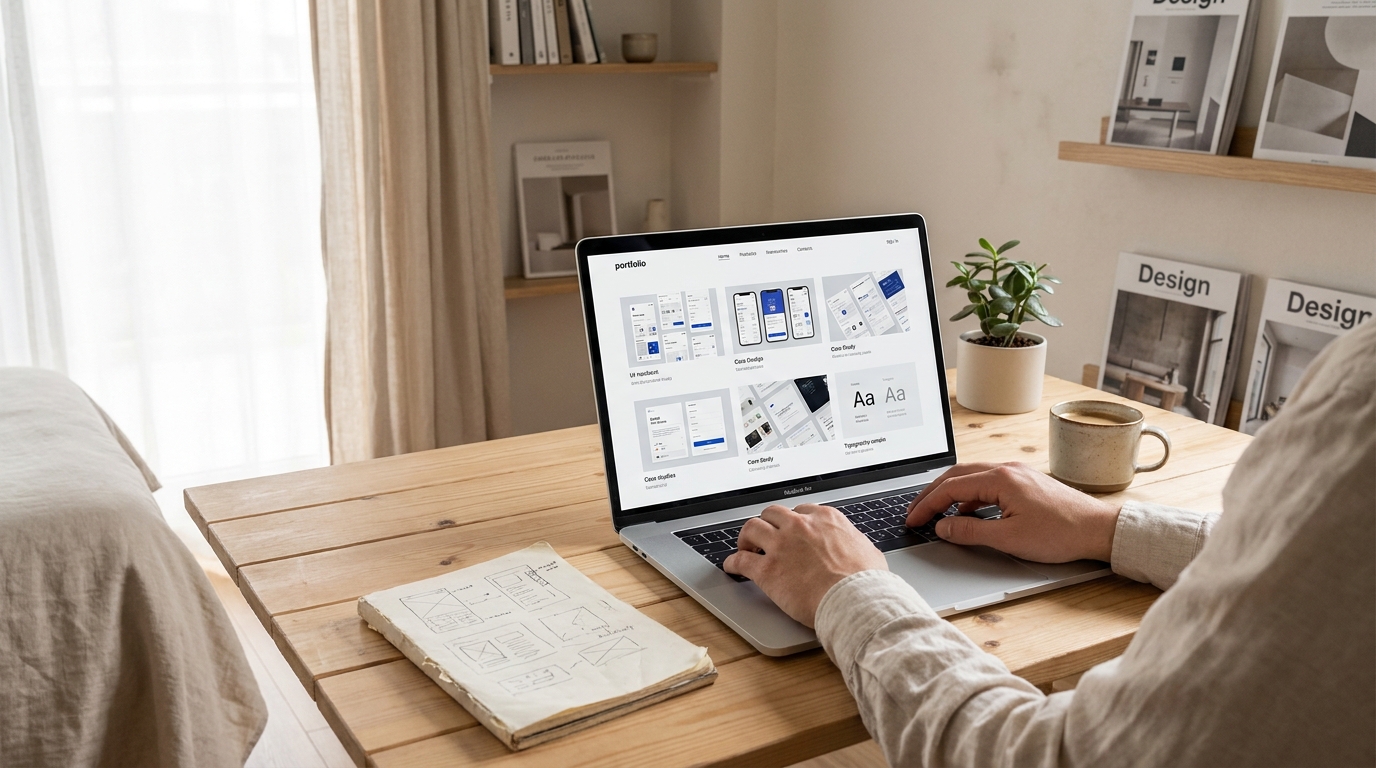
How to Build a Stunning Design Portfolio With Zero Budget in 2026
Your portfolio is your most important sales tool — and you don't need to spend anything to make it great. Here's exactly how to build, fill, and present a design portfolio that wins clients and jobs, starting from nothing.
The Portfolio Paradox — and How to Solve It
Every aspiring designer faces the same catch-22: you need a portfolio to get work, but you need work to build a portfolio. This isn't actually a paradox — it just feels like one because the solution requires creating work differently from the way most design education suggests.
A design portfolio doesn't require paid client work. It requires good work. The distinction matters: spec work, personal projects, concept redesigns, open-source contributions, and volunteer projects all produce portfolio-worthy output that hiring managers and potential clients evaluate on exactly the same terms as paid client work. What's being assessed is the quality of your thinking and execution — not the provenance of the brief.
This guide shows you how to build a portfolio that demonstrates genuine design competence, on zero budget, using free tools and a systematic approach to creating and presenting work.
Step 1: Choose Your Niche Before Building Your Portfolio
The most common portfolio mistake is attempting to demonstrate competence across every design discipline simultaneously. A portfolio that includes brand identity work, mobile app UI, editorial layout, motion graphics, and web design communicates that you've tried everything but mastered nothing. Hiring managers and clients looking for a specific type of designer filter out generalist portfolios immediately.
The most hireable portfolios in 2026 demonstrate clear focus on a specific area: UI/UX for SaaS products, brand identity for small businesses, editorial design for publications, social media design for content creators, or packaging design for consumer goods. The niche focuses your portfolio, focuses your skill development, and makes you easier to recommend when someone needs exactly what you do.
How to choose your niche: Identify the intersection of what you find most interesting and where genuine market demand exists. UI/UX has the highest demand and highest compensation in 2026. Brand identity has strong freelance market demand. Editorial and print design has more limited but passionate market demand. Choose based on genuine interest — the work required to develop real competence is substantial, and sustained motivation matters.
Step 2: Create Work — Even Without Clients
Spec Work and Concept Projects
Spec (speculative) work — designing solutions for real problems without being commissioned — is the most accessible way to build a portfolio from scratch. The brief writes itself: pick a product, brand, or experience you use regularly and find genuinely frustrating or poorly designed, and redesign it better.
Effective spec project approaches:
App redesign concepts: Choose a popular app with a genuinely suboptimal UX — banking apps, government services, transit apps, health apps — and redesign specific flows (onboarding, core task completion, navigation). Document your research, your identified problems, and your design decisions. The most impressive portfolio pieces show thinking, not just aesthetics.
Brand identity for fictional businesses: Create a complete brand identity — logo, colour palette, typography, brand guidelines, mockups — for a fictional business in a category you're interested in. The fictional nature is transparent and acceptable; the quality of the work is what's evaluated.
Redesign existing brands: "Redesigning" existing brands (clearly labelled as a speculative concept exercise) is legitimate portfolio content. The most compelling versions include documented rationale: what's wrong with the current brand, what brief you were working to, and the decisions you made.
Volunteer and Pro-Bono Work
Local charities, community organisations, small non-profits, and local businesses often need design help they can't afford to pay for. Offering your services for free in exchange for testimonials, the ability to include the work in your portfolio, and real-world experience with brief-taking and client communication produces genuine client projects with the same portfolio value as paid work.
Catchafire (US) and Do-it.org (UK) both connect skilled volunteers with non-profit organisations seeking design help. These platforms are specifically designed to produce meaningful project work that builds professional portfolios.
Design Challenges and Competitions
Daily design challenges (Daily UI, 100 Days of UI), hackathon competitions, and design awards (Awwwards, CSS Design Awards, D&AD New Blood) all produce credentialled or competitive portfolio work. Placing or being shortlisted in any recognised competition is portfolio-qualifying in its own right; the work produced even without placing is portfolio-worthy.
Step 3: The Free Portfolio Platforms — Compared
Behance (Adobe) — Free
Behance is the largest design portfolio platform in the world and the default first portfolio for most design students and early-career designers. The audience — recruiters, creative directors, and potential clients actively searching for design talent — is unmatched on any other free platform. The platform's integration with Adobe Creative Cloud allows direct publishing from Photoshop and Illustrator.
Best for: Graphic design, illustration, photography, brand identity, print design
SEO benefit: Behance projects rank well in Google search — a Behance portfolio is more discoverable than a personal website for most early-career designers
Limitation: The template is standardised; differentiation through layout is limited
Dribbble — Free (Basic)
Dribbble is the dominant platform for UI/UX and product design portfolios. The community skews toward digital product design; the audience includes hiring managers from technology companies. The free tier allows posting "shots" (individual design pieces or screens) without the full case study format that Behance supports.
Best for: UI/UX design, product design, visual/graphic design
Limitation: The free tier is limited; the Pro tier (£5 / $5 per month) unlocks full case study presentation and job listing visibility
Notion — Free
Notion has become an increasingly popular portfolio format, particularly for UI/UX designers who want more control over presentation than Behance or Dribbble provide without the complexity of building a custom website. A well-structured Notion portfolio page — with clearly organised case studies, embedded Figma prototypes, and readable process documentation — is a credible and increasingly common portfolio format in 2026.
Best for: UX designers who want to showcase process and research; designers comfortable with a text-forward, documentation-style portfolio
Limitation: Less visual impact than purpose-built portfolio platforms; custom domain requires Notion's paid plan
Framer — Free Tier
Framer's free tier allows building genuinely impressive interactive portfolio websites with no code — the drag-and-drop builder produces sophisticated layouts with animation and interaction that make a portfolio feel like a demonstration of design capability in itself. The free tier allows one published site with a Framer subdomain.
Best for: Designers who want a portfolio that demonstrates interactive design capability; UI/UX designers
Limitation: Custom domain requires paid plan (£14 / $15 per month)
Step 4: Writing Case Studies That Actually Win Work
The portfolio piece that wins work is never the one with the most beautiful final screens. It's the one that demonstrates the designer's thinking process most clearly. A case study that shows how you identified a problem, what research you conducted, what alternatives you considered and rejected, and why you made the specific decisions you made is worth ten portfolios of polished final screens with no context.
The case study structure that works:
The problem (100–150 words): What problem were you solving? Who experiences it? What was the impact of the problem? Why did it matter?
My role and constraints (50–75 words): What were you responsible for? What were the time, resource, and technical constraints?
Research and discovery (150–250 words + supporting visuals): What did you do to understand the problem? User interviews, competitive analysis, heuristic evaluation, analytics review? What did you find?
Design process (200–350 words + sketches, wireframes, iterations): How did you move from insight to solution? Show the iterations — the rejected directions, the pivots, the decisions made under constraint.
Final solution (visuals + 100–150 words): The polished output with context for why these specific choices were made.
Results or reflection (100–150 words): What happened after launch? What would you do differently? What did you learn?
A portfolio of three case studies structured this way is more compelling than a portfolio of fifteen final screens with no context.
Step 5: Getting Your First Clients With No Track Record
Warm outreach first: Before approaching strangers, exhaust your existing network. Former classmates, family businesses, local community organisations — everyone knows someone who needs a logo, a website, or a flyer.
LinkedIn cold outreach with a specific offer: Identify 10 businesses in your niche whose design you find genuinely suboptimal. Send a personalised message identifying one specific problem you noticed and one specific solution you could provide. Not "I'm a designer looking for work" — "I noticed your website's navigation makes [specific task] difficult for users — I'd like to show you how I'd fix it."
Freelance platforms as a launch pad (not a destination): Upwork and Fiverr allow building initial reviews and references at lower prices than your long-term rate — the goal is testimonials and case study material, not sustainable income. Transition off platforms once a direct client base is established.
design portfolio 2026, how to build design portfolio, free portfolio website designers, Behance vs Dribbble, UX portfolio case study, graphic design portfolio tips, get first design clients, spec work portfolio, design portfolio no experience, Notion portfolio designers


Discussion
Comments
Approved comments are published after moderation to keep discussion useful and spam-free.
No comments yet. Start the discussion below.