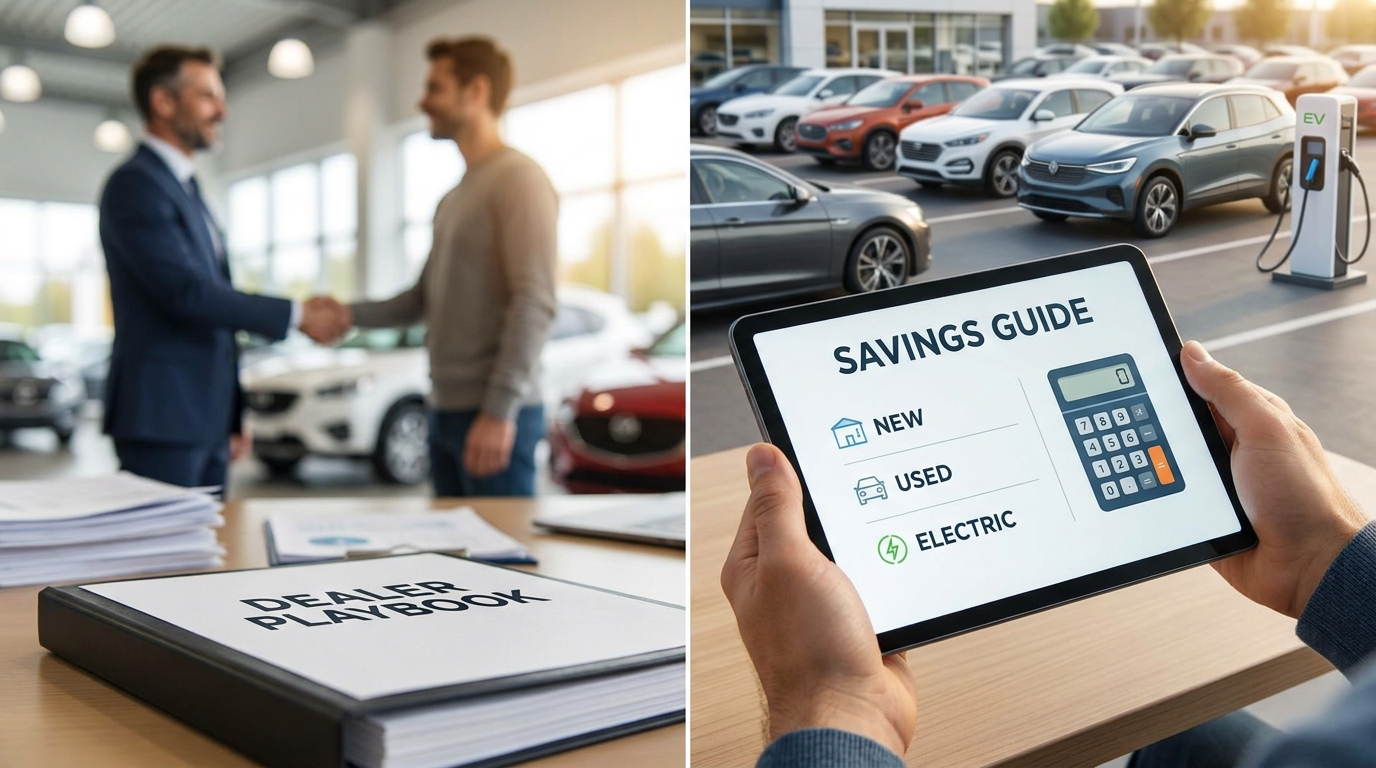
How to Negotiate the Best Car Deal in 2026 (Dealers Hate This Playbook)
Car dealers have playbooks refined over decades. Now you have one too. A step-by-step guide to walking away with thousands saved — whether buying new, used, or electric.
Why Most People Overpay for Cars
The average person buys a car six to eight times in their lifetime. The average car salesperson sells six to eight cars every week. This asymmetry — inexperience on one side, deep professional expertise on the other — is why most buyers leave dealerships having paid more than they needed to.
Car dealerships are not adversaries. They are businesses with legitimate margins to protect and staff who are often working to commission structures that incentivise maximising profit per transaction. Understanding how the system works is not cynical — it is simply the preparation that transforms a nerve-wracking financial negotiation into a process you can navigate confidently.
In 2026, the negotiation landscape has shifted in several important ways. The rise of online sales (Tesla's direct model, Cazoo-style digital used car platforms, and manufacturer direct programmes) has created new reference points for pricing. Post-pandemic supply normalisation means inventory has largely returned to pre-2020 levels at traditional dealers, restoring buyer leverage that evaporated during the shortage years of 2021–2023. And the information available to buyers online — dealer invoice prices, real transaction data, financing benchmarks — has never been more accessible.
Here is how to use all of it.
Phase 1: Before You Visit Any Dealership
Step 1: Know Exactly What You Want — and What It Actually Costs
The most powerful negotiating position is knowing the market value of the specific vehicle you want before any conversation with a salesperson begins. For new cars, two numbers matter:
MSRP (Manufacturer's Suggested Retail Price) / OTR (On The Road price): The list price — the ceiling, not the target
Invoice price / dealer cost: What the dealer paid the manufacturer. In the US, tools like Edmunds True Market Value, TrueCar, and CarGurus show average transaction prices (what people are actually paying) alongside invoice prices. In the UK, What Car? and Auto Trader's market valuation tools serve the same purpose.
The gap between invoice and MSRP is your negotiating room on new cars. In a normal market (which 2026 is, for most models), the realistic target for a new car is invoice price or within £200–£500 / $250–$600 of it — not MSRP.
Step 2: Research Finance Rates Before the Dealer Offers Theirs
Dealer finance is one of the highest-margin products in the dealership. The finance manager who appears after you've agreed on a vehicle price is a second negotiation that many buyers treat as an administrative formality. It is not. Dealers mark up finance rates — they borrow money from lenders at a wholesale rate and charge you more, keeping the difference.
Before visiting any dealership, get a pre-approval from your own bank or credit union. In the US, credit union rates are typically 1–2% lower than dealer-arranged finance. In the UK, comparison sites (MoneySuperMarket, CompareTheMarket) show PCP and HP rates available elsewhere. Walking in with an external pre-approval gives you a genuine benchmark and often prompts the dealer's finance department to match or beat it to retain the finance business.
Step 3: Know Your Trade-In Value Independently
If you have a vehicle to part-exchange, get independent valuations before setting foot in a showroom. In the UK, webuyanycar.com, Motorway, and Cazoo all provide instant online valuations that represent real offers you can use as a floor. In the US, CarMax, Carvana, and Edmunds Instant Cash Offer provide the same function.
The critical rule: negotiate the purchase price of the new vehicle and the trade-in value as completely separate transactions. Dealers profit by conflating them — offering an attractive trade-in value while inflating the vehicle price, or discounting the vehicle price while undervaluing the trade-in. Keep them separate until both are agreed independently.
Phase 2: At the Dealership
The Opening Move: Never Reveal Your Budget
The first question most salespeople ask is some version of "what are you looking to spend monthly?" This is a trap. Monthly payment focus allows dealers to structure deals that look affordable while maximising total cost through longer loan terms, higher interest rates, and inflated vehicle prices. Never anchor the conversation to monthly payments until the vehicle price, trade-in value, and finance rate are all separately agreed.
When asked about budget, a simple redirect works well:
"I'd rather focus on the out-the-door price of the vehicle first, then we can look at financing separately. What's the best price you can do on this specific car?"
The Offer and Counter-Offer Dance
The salesperson's first price will not be their best price. In most dealerships, the first offer is designed to establish a high anchor and assess how willing you are to push back. Your response should be a specific counter based on your research:
"Based on what I've found for this model — invoice price and current transaction data — I was expecting something around £X / $X. That's what I'm comfortable with. Can you get there?"
Then be quiet. The pause after your counter is uncomfortable — let the salesperson fill it. The person who speaks first after a price is named is almost always the person who concedes ground.
The Manager Visit
Almost every dealership uses a "manager visit" structure — the salesperson disappears to "check with the manager" before returning with a revised offer. This is a standard technique designed to introduce a second authority figure, create the impression that concessions required effort, and add time pressure. Understand it for what it is and don't feel rushed by it. You have no deadline. They do — monthly sales targets, end-of-quarter pressures, and today's floor traffic all create urgency on the dealer's side, not yours.
Using Competing Quotes
The most powerful tool in any new car negotiation is a genuine competing quote from another dealer for the same or equivalent vehicle. Call or email three to four dealers for their best out-the-door price on the specific model and spec before visiting your preferred dealer. Use the lowest legitimate quote as your benchmark:
"I've had a quote of £X / $X from [Dealer Name] for the same specification. I'd prefer to buy from you — can you match or beat that?"
This approach is particularly effective at end of month when individual salespeople and dealerships are working against monthly targets.
Phase 3: The Finance Office
The finance office — called the F&I (Finance and Insurance) office in the US — is where dealer profit margins are highest. After agreeing on a vehicle price, a finance manager will present a series of add-on products. Understanding each one:
Extended Warranty (Service Plan)
Dealer-sold extended warranties are almost always significantly more expensive than equivalent coverage available from third-party providers or through the manufacturer's own aftermarket programme. Get the price, note the coverage details, and compare online before accepting. Never agree in the moment.
Paint Protection / Fabric Protection / GAP Insurance
Paint and fabric protection products sold in the finance office are typically marked up 200–400% over their actual cost. Reputable aftermarket suppliers offer equivalent products at a fraction of the price. GAP insurance — which covers the difference between an insurance payout and outstanding finance if a car is written off — is legitimately useful but can be purchased from specialist insurers for £50–£150 / $60–$180 annually versus the £300–£600 / $400–$800 typically charged in the finance office.
The Right Response to All Add-Ons
"I'll think about the add-ons separately — I'd like to focus on the core vehicle finance today. Can we proceed without them for now?"
Negotiating Used Cars: The Specific Differences
Used car negotiation follows the same principles but with different reference points. Key differences:
Check the vehicle history first: HPI Check (UK) or Carfax/AutoCheck (US) reveal previous owners, accident history, outstanding finance, and mileage discrepancies. Never negotiate on a used car without this data — it costs approximately £20 / $30 and eliminates significant risk.
Get an independent inspection: The AA or RAC (UK) and AAA (US) offer pre-purchase inspections for approximately £100–£200 / $120–$250. Any defects found become negotiating leverage — documented issues that cost money to rectify justify price reductions.
Research what comparable cars sold for: Auto Trader (UK) and CarGurus (US) show not just asking prices but market value indicators based on actual transactions. A car priced above market value is where your opening offer should reflect the discount to market average.
The EV-Specific Negotiation in 2026
Electric vehicles add specific considerations to the negotiation:
Federal tax credits (US): The $7,500 federal EV tax credit applies at point of sale in 2026 for eligible vehicles and buyers. Ensure the dealer is factoring this correctly — it should reduce the out-the-door price, not be used as justification for a higher vehicle price.
UK government grants: The Plug-in Van Grant remains available in 2026 for eligible commercial EVs. For passenger vehicles, no direct purchase grant is currently available — factor this into total cost comparisons.
Tesla's no-negotiation model: Tesla sells direct at fixed prices. There is no negotiation on new Tesla vehicles. Focus instead on timing (end of quarter pricing adjustments are real), specification optimisation, and the used Tesla market (Tesla Certified Pre-Owned vehicles offer warranty coverage at meaningfully reduced prices).
The Walk-Away: Your Most Powerful Tool
The single most powerful negotiating tool available to any car buyer is the genuine willingness to leave without buying. This is not a bluff — it is a real option that you should be prepared to exercise. Buyers who have genuinely decided they will walk away if their target price isn't met almost always get closer to their target than those who have mentally committed to leaving with a car that day.
Before entering any dealership, decide your absolute maximum price. Write it down. When the negotiation approaches that number from above, say clearly:
"I appreciate the effort — I think we're just not going to get there today. I'll keep looking and come back if I can't find a better deal elsewhere."
Then stand up. The number of times this results in the salesperson or manager suddenly finding additional discount capacity is remarkable. And if it doesn't — you've genuinely protected yourself from overpaying.
Keywords: how to negotiate car price 2026, car buying tips UK US, best car deal negotiation, how to buy a car without overpaying, car dealer tactics, negotiate used car price, EV buying guide 2026, car finance negotiation tips, how to get discount on new car, car dealership negotiation playbook





Discussion
Comments
Approved comments are published after moderation to keep discussion useful and spam-free.
No comments yet. Start the discussion below.