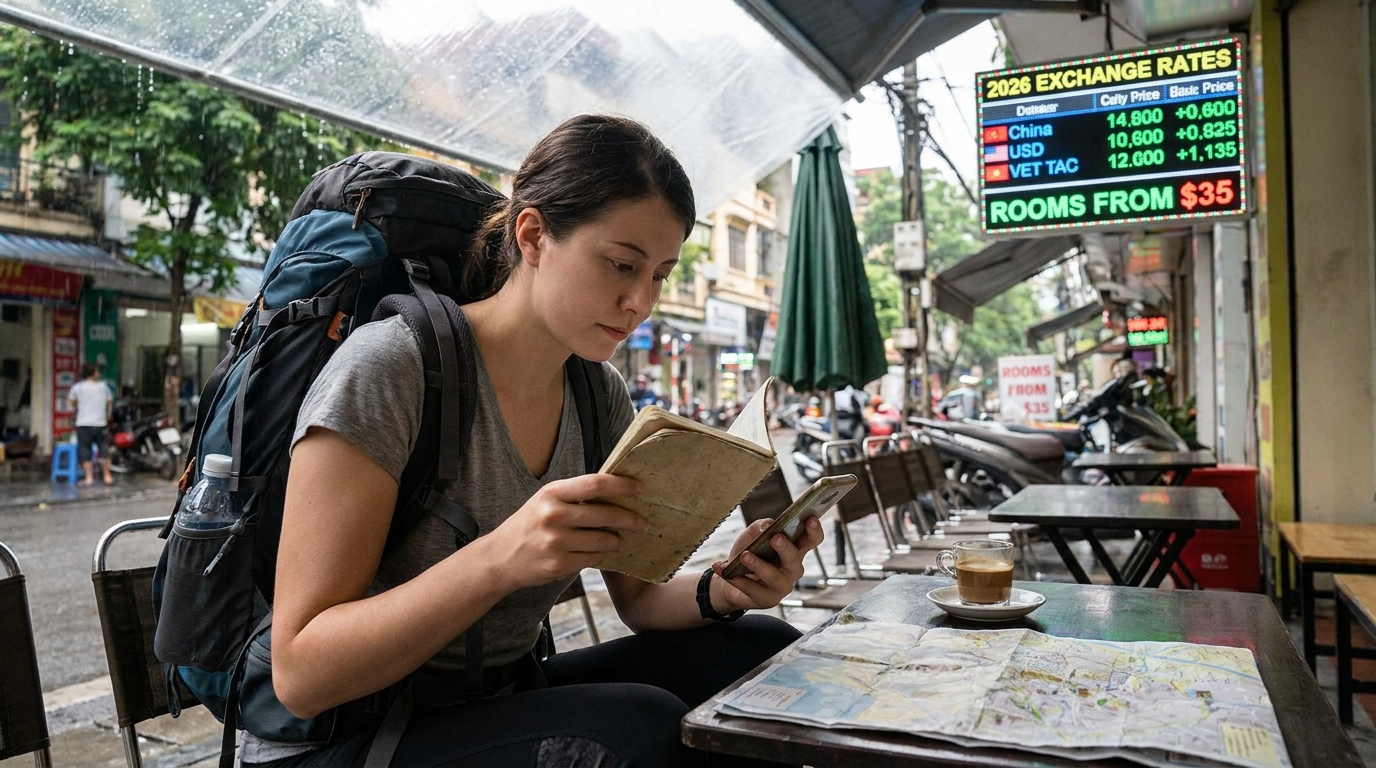
How to Travel the World on $50 / £40 a Day in 2026: The Complete Budget Guide
$50 a day is still entirely possible in 2026 — if you know which destinations, strategies, and tools to use. Here's the complete system for travelling well on almost nothing.
Budget Travel in 2026: Harder but Still Achievable
The honest starting point: budget travel is harder in 2026 than it was five years ago. Inflation, post-pandemic pricing resets in many popular destinations, and the disappearance of some of the cheapest accommodation options have raised the floor for independent travel. The $50 / £40 per day benchmark that was comfortably achievable in most of Southeast Asia in 2019 now requires more care and more strategic destination selection.
But the fundamental economics of budget travel haven't changed. The traveller who books flights strategically, chooses value destinations, eats local food, uses free activities, and stays in hostels or budget guesthouses can still travel extensively and well on $50 / £40 per day in a surprising number of places. This guide shows you exactly how.
The Budget Breakdown: Where the Money Goes
Understanding where daily travel spend actually goes is the prerequisite for controlling it. For a $50 / £40 daily budget, a workable allocation looks like this:
Accommodation: $15–$20 / £12–£16 — the largest variable, most controllable through accommodation type choice
Food: $12–$15 / £10–£12 — eating local street food and markets rather than tourist restaurants
Local transport: $3–$5 / £2.50–£4 — public buses, local tuk-tuks, metro systems
Activities and entrance fees: $5–£8 / £4–£6 — a combination of free and paid activities
Buffer / miscellaneous: $5–£8 / £4–£6 — SIM cards, laundry, small purchases
Flights are excluded from the daily budget — they're a fixed cost calculated separately and averaged across the length of the trip.
The Best Countries for $50 / £40 a Day in 2026
Southeast Asia
Vietnam — £25–£45 / $30–$55 per day achievable
Still the benchmark for affordable travel quality. A clean private room in a guesthouse costs £10–£18 / $12–$22; a bowl of pho from a street vendor costs £1–£2 / $1.25–$2.50; a local bus between cities costs pennies per kilometre. The food quality at the cheapest end of the market is exceptional — Vietnam's street food is world-class at every price point.
Cambodia — £25–£40 / $30–$48 per day achievable
Phnom Penh and Siem Reap (gateway to Angkor Wat) remain among the most affordable capitals and tourist cities in Asia. The US dollar is widely accepted alongside the Riel, simplifying currency management for American travellers. Angkor Wat entrance fees (approximately $37 for a one-day pass) are the most significant single expense and worth factoring into the average.
Indonesia (outside Bali peak season) — £30–£50 / $36–$60 per day
Bali's popular areas have experienced significant price inflation but remain viable on budget. Lombok, the Gili Islands outside peak season, Java, and Flores all offer exceptional value. The diversity of Indonesia's islands — from rice terraces to volcanic craters to pristine dive sites — is unmatched at this price point.
Eastern Europe
Albania — £35–£55 / $42–$66 per day
The cheapest destination in Europe with genuinely impressive value. Accommodation in Tirana or along the Riviera can be found for £15–£25 / $18–$30 for a clean private room; local restaurants serve full meals for £4–£8 / $5–$10; and the country's dramatic landscapes are either free or very cheaply accessed.
Georgia — £30–£55 / $36–$66 per day
One of the world's great budget travel destinations. Tbilisi's accommodation market is competitive, the food culture is extraordinary (and cheap), local wine is exceptional and sold for less than a coffee in many Western cities, and the mountain regions offer world-class trekking with minimal cost.
Serbia and North Macedonia — £35–£55 / $42–$66 per day
Belgrade and Skopje are among Europe's cheapest capitals. Exceptionally good food (Serbian grilled meats and the Macedonian taverna culture), vibrant nightlife, and a growing range of cultural and outdoor activities at very low cost.
Central and South America
Colombia — £38–£60 / $45–$72 per day
Medellín in particular offers extraordinary value relative to experience quality. The metro system costs approximately 30p / $0.38 per journey; excellent local restaurants (corrientazos — fixed lunch menus) cost £3–£5 / $4–$6; and the city's cultural offerings include free museums, excellent street art, and the best café culture in Latin America.
Bolivia — £25–£45 / $30–$54 per day
The cheapest destination in South America. The Salar de Uyuni — the world's largest salt flat and one of the most visually extraordinary places on earth — is accessible via organised tours from Uyuni town for approximately £40–£60 / $48–$72 for a three-day trip including accommodation.
Accommodation: The Biggest Lever
Hostels
The hostel dorm bed remains the lowest-cost legitimate accommodation option available. Modern hostels in 2026 are dramatically better than the reputation suggests — many operate boutique properties with private curtained pods, lockers, en-suite bathrooms, and quality common areas. Dorm beds in Southeast Asia: £5–£10 / $6–$12 per night. Dorm beds in Eastern Europe: £8–£15 / $10–$18. Dorm beds in South America: £8–£14 / $10–$17.
The social infrastructure of hostels — common rooms, organised activities, reception staff who know the local area — makes them particularly valuable for solo travellers. The best hostels are found through Hostelworld, HostelBookers, and Booking.com filtered by rating — aim for 8.5/10 or above.
Guesthouses and Family-Run B&Bs
In most developing world destinations, locally owned guesthouses consistently offer better value than international budget hotel chains. A clean private room with en-suite bathroom, ceiling fan, and breakfast in Vietnam or Cambodia costs £10–£20 / $12–$24 per night — far better value than the equivalent in a branded budget property.
Couchsurfing and House Sitting
Couchsurfing has declined significantly from its peak but remains a viable option in many destinations — primarily valuable for the local connection and insider knowledge rather than purely the accommodation saving. House sitting platforms (TrustedHousesitters, Nomador) offer free accommodation in exchange for looking after a home and pets — a genuine zero-cost option that also provides the comfort of private space. Both require profile building and relationship development before becoming consistently available.
Overnight Trains and Buses
The overnight train or bus — a staple of Southeast Asian and Eastern European budget travel — serves double duty as both transport and accommodation. A sleeper train from Hanoi to Da Nang costs approximately £12–£20 / $15–$24 and removes the need for a night's accommodation while covering several hundred kilometres. Budget-conscious travellers time their inter-city movements to coincide with overnight travel wherever practical.
Food: Eating Well for Almost Nothing
The Street Food Principle
In almost every developing world destination, the best food is found not in restaurants but at street stalls and market vendors. Vietnamese pho for £1, Georgian khinkali (dumplings) for £2, Colombian arepas for £0.50, Turkish simit (sesame bread rings) for £0.20. These are not compromises — they're frequently the best-tasting food available in the destination.
The practical guide: eat where locals eat. If a restaurant has an English menu prominently displayed and a tout outside trying to attract customers, it is almost certainly not where local people eat and is priced accordingly. Walk a few streets further from the tourist area and the prices halve — usually with better quality.
Markets and Supermarkets
Local markets for fresh fruit, vegetables, bread, and prepared foods consistently offer the best price-to-quality ratio after street food. A supermarket run for breakfast and snack items further reduces daily food spend without sacrificing quality. Travellers who eat one restaurant meal, one street food meal, and one market/supermarket meal per day can eat extremely well on £10–£12 / $12–$15 daily in most budget destinations.
Transport: Getting Around for Almost Nothing
Flights: The Budget Traveller's Strategy
Cheap flights remain available in 2026 but require strategy. The most consistently effective approaches:
Be flexible on dates: Google Flights' calendar view shows price variation across an entire month — shifting travel by two to three days regularly saves 30–50%
Use budget carriers for short-haul: AirAsia, Cebu Pacific, and IndiGo in Asia; Ryanair, Wizz Air, and EasyJet in Europe; Spirit and Frontier in the US — accept the limitations (hand luggage only, no frills) and the savings are substantial
Book 6–8 weeks ahead for short-haul: The sweet spot between early-bird pricing and last-minute premium
Set fare alerts: Google Flights and Skyscanner both offer fare alert emails when prices drop on specific routes
Local Transport
In developing world destinations, the rule is simple: use what locals use. Grab (Southeast Asia's Uber equivalent), local buses, shared minibuses (called by different names in different countries), and metro systems all deliver excellent value. Tourist-oriented taxis and transfers from airports can cost five to ten times more for the same journey.
Activities: Travelling Richly on Almost Nothing
The assumption that budget travel means missing the best experiences is consistently wrong. Many of the world's greatest travel experiences are free or nearly free:
Hiking in national parks (small entrance fees or free in many countries)
Exploring old towns, medinas, and historic neighbourhoods on foot
Free museum days — most major museums globally offer free entry on specific days or to specific groups
Street food markets and local festivals
Beach and coastline access (almost always free)
Sunrise and sunset viewpoints — often the most memorable moments of any trip, always free
Keywords: budget travel 2026, travel on 50 dollars a day, cheapest countries to travel 2026, backpacking guide 2026, budget travel destinations, how to travel cheap, affordable travel tips 2026, best budget travel countries, travel Southeast Asia on budget, Europe on a budget 2026


Discussion
Comments
Approved comments are published after moderation to keep discussion useful and spam-free.
No comments yet. Start the discussion below.