
A founder can lose a lot of time inside a private idea.
They sketch the product, polish the name, buy the domain, design the logo, talk to friends, imagine the launch and slowly build confidence in something the market has not yet touched. From the inside, it feels productive. From the outside, it may be avoidance.
Building in secret is attractive because it protects the idea from rejection. No customer can say no. No one can ignore the landing page. No payment can fail to arrive. No uncomfortable question has to be answered yet.
That safety is also the danger.
A business does not become real because the founder believes in it. It becomes real when people care enough to change their behavior. The cleanest signal is not praise, encouragement or polite interest. It is payment, commitment or a credible step toward buying.
This is why pre-orders matter. They test whether an idea has moved from "interesting" to "worth paying for."
Compliments are not demand
Most founders begin by asking the wrong people the wrong question.
They ask friends, family members, colleagues or social followers: "Would you buy this?"
The answer is often yes. Not because people are lying, but because the question costs them nothing. It is easy to support someone in theory. It is harder to part with money, join a waitlist, sign a letter of intent, place a deposit or commit to a pilot.
That difference matters.
A friend saying "I love this idea" is a social response. A customer entering card details is a market response. The two should never be treated as equal.
This is especially important for first-time founders, because early encouragement can create false confidence. A person may spend months building a product because seven friends and one parent said they would buy it. Later, when the product launches, those same people may delay, forget, avoid the purchase or quietly admit it is not really for them.
The founder then feels betrayed by the market. But the market never promised anything. The founder accepted weak evidence.
The better question is not "Do you like this?"
The better question is: "Is this painful, useful, urgent or desirable enough that you would pay for it now?"
The market speaks through behavior
People often do not know what they want until the decision becomes real.
They may say they want a cheaper product but buy the premium one because it feels better. They may claim they care about features but choose the option that looks more trustworthy. They may say they support sustainable packaging but still abandon the cart when shipping costs appear. They may tell a founder the idea is brilliant and then do nothing when asked to pre-order.
This is not because people are foolish. It is because buying decisions are emotional, practical and contextual. What people say in a conversation often changes when money, risk, convenience and timing enter the room.
That is why behavior is more valuable than opinion.
Watch what people already do. Notice what they already pay for. Study what annoys them enough to create workarounds. Look for the moment when they complain, improvise, delay, avoid, overpay or accept a bad solution because no better one exists.
Those moments are often more useful than survey answers.
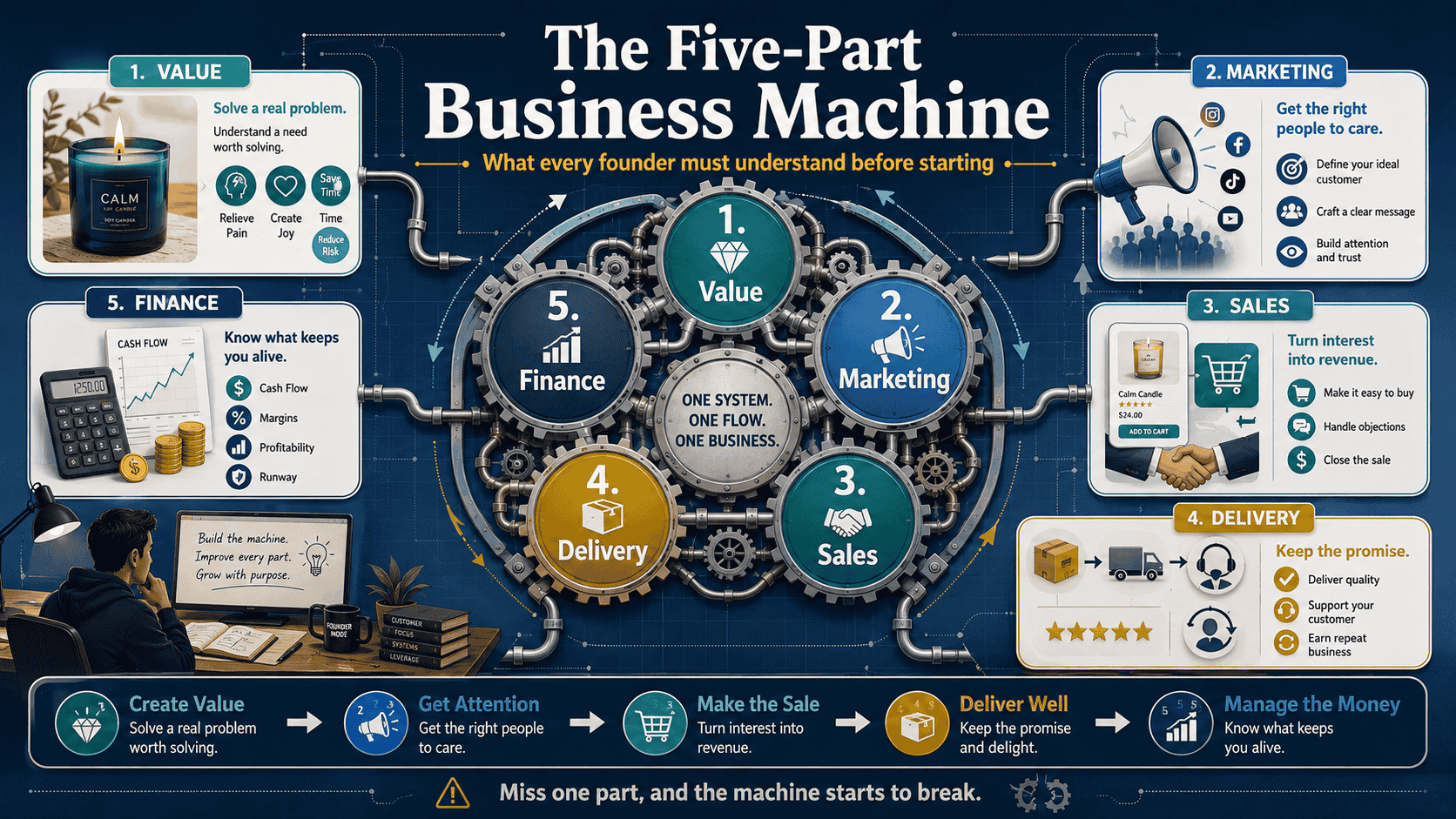
A founder trying to build a candle brand, for example, should not only ask whether people like candles. They should notice how people choose them. Do they smell them before buying? Do they care about the jar? Are they buying for themselves or as gifts? Do they want luxury, comfort, scent strength, clean ingredients, long burn time, decoration or price?
A customer may not explain this clearly. Their behavior often will.
Build around a real problem, not a private fantasy
An idea can feel exciting and still fail to become a business.
The question is whether it solves a problem or creates a desire strong enough for a real customer. That customer must be specific. "Everyone" is not a market. "People who like nice things" is not enough. A strong early market usually has a clearer shape.
Busy parents who need fast healthy meals.
Independent podcasters who struggle with audio vibration.
Small business owners who hate bookkeeping.
Professionals who want better work bags that do not look too casual.
Homeowners who want a room to smell good without synthetic heaviness.
The sharper the customer, the easier the test.
Founders often avoid this narrowing because they fear excluding people. But broad ideas are harder to validate. A specific customer gives you something useful: a person to talk to, observe, serve and sell to.
Once you know who the product is for, you can ask better questions.
What are they using now?
What do they dislike about it?
How often does the problem appear?
What have they already tried?
How much are they already spending?
What would make them switch?
What would make them trust a new option?
Those questions move the founder away from fantasy and toward evidence.
Pre-orders force honesty
A pre-order is not magic, but it changes the conversation.
When someone pays before the full product is available, they are giving the founder a stronger signal than approval. They are saying the promise is clear enough, the problem matters enough and the risk feels acceptable enough to act.
That does not mean every pre-order campaign will work. Many will fail. That failure is useful if it comes early.
A failed pre-order can save a founder from building the wrong thing for a year. It can reveal that the price is wrong, the promise is unclear, the audience is too broad, the product is not urgent or the founder is speaking to the wrong customer.
That is painful information. It is also valuable information.
The founder who refuses to test demand early may still face rejection later, only with more money spent, more inventory stored, more pride attached and fewer options left.
Pre-orders reduce uncertainty. They do not remove risk, but they make risk visible sooner.
Not every test needs to be big
Many founders imagine validation as a dramatic launch.
A polished website. A big announcement. A countdown. A product video. A paid ad campaign. A warehouse full of stock. A launch day where everything depends on one moment.
That is a dangerous way to learn.
Early testing can be much smaller. A founder can create a simple landing page with a clear offer and a payment option. They can sell a limited first batch. They can ask for deposits. They can run a paid pilot. They can offer a prototype to a small group. They can collect letters of intent from business customers. They can take appointments before building the full service.
The purpose is not to look impressive. The purpose is to answer one question at a time.
Will anyone pay?
At what price?
For which version?
With what objection?
Through which channel?
After seeing which message?
A small test gives the founder learning without pretending the business is already mature.
This is where many people confuse entrepreneurship with performance. They think they need the full brand before they have the first customer. In reality, the early customer often teaches the founder what the brand should become.
The wrong work feels productive
Building in secret often feels like progress because there is always something to do.
You can adjust the logo. Rewrite the about page. Compare website templates. Research packaging. Watch videos about scaling. Build spreadsheets. Plan social content. Think about future hires. Choose brand colors. Imagine investor conversations.
Some of that work will matter eventually. Early on, much of it can become a hiding place.
The difficult work is usually closer to the customer. Asking someone to pay. Hearing objections. Watching someone ignore the offer. Learning that the problem is weaker than you thought. Discovering that people want a different version. Admitting that a beautiful idea does not yet have a buyer.
That work is less comfortable because it involves judgment from the outside world.
It is also the work that makes the business real.
A founder should be careful with any task that feels satisfying but does not reduce uncertainty. The early stage of business is not about looking like a company. It is about proving that the company should exist.
Use competitors as evidence, not excuses
Many people stop when they discover that someone else is already solving the problem.
They search the market, find competitors and decide the opportunity is gone. That is often the wrong conclusion.
Competition can be a useful signal. It shows that customers already understand the category. It shows people are already spending money. It gives the founder examples to study: pricing, packaging, positioning, reviews, complaints, sales channels, customer language and unmet needs.
A crowded candle market does not prove a new candle brand will win. But it does prove that people buy candles. The founder’s job is not to be the only one in the world selling candles. The job is to find a sharper promise, a clearer customer, a better experience or a stronger emotional position.
The more dangerous market is sometimes the one with no competitors at all. That may mean the founder has discovered something new. It may also mean there is no real demand.
A founder should not fear competition too quickly. They should learn from it.
Buy competitors' products. Read their reviews. Study their complaints. Notice what customers praise and what they tolerate. Look at how the category talks to buyers. Then ask where the opening might be.
The market often leaves clues.
A waiting list is not the same as a business
A waiting list can be useful, but it can also mislead.
An email address is a weaker signal than payment. It shows curiosity, not commitment. A person may join a waitlist because it is free, fast and low-risk. That does not mean they will buy.
This does not make waitlists useless. They can help measure interest, test messaging and build an audience before launch. But founders should treat them as early signals, not proof.
A stronger version is a paid waitlist, refundable deposit or pre-order. Even a small amount of money changes the quality of the signal. It forces the customer to make a real decision.
For business-to-business products, a letter of intent can serve a similar role if it is specific enough. A vague "we would be interested" is weak. A signed statement that says the company intends to buy under defined conditions is stronger. A paid pilot is stronger still.
The principle stays the same: look for commitment that costs the customer something.
Money is not the only signal, but it is one of the clearest.
Start small to protect the business
A good pre-order does not give the founder permission to overbuild.
It gives permission to take the next step.
If 100 people pre-order a product, the founder does not need to build a factory. They may need a small production run, careful delivery, feedback, revision and another test. Early demand should lead to controlled learning, not reckless expansion.
This is where discipline matters.
A founder should ask: what is the smallest version that can honestly deliver the promised value? How can we fulfill it without taking on too much inventory, debt or operational complexity? What must be tested before producing at scale?
The first batch should teach. It should reveal product issues, customer expectations, shipping problems, support questions, pricing resistance and repeat-purchase potential.
Many founders want validation to mean "go big." Often it means "go carefully, but keep going."
Real validation includes disappointment
A serious test may show that the idea is weaker than expected.
That is not failure in the deeper sense. It is information arriving before the founder has spent too much.
A landing page may not convert. A pre-order page may get traffic but no buyers. A prototype may attract compliments but no deposits. A business customer may like the demo but refuse to sign. A product may sell once but fail to bring repeat buyers.
Each result points somewhere.
Maybe the audience is wrong. Maybe the offer is too expensive. Maybe the pain is not urgent. Maybe the product is hard to explain. Maybe the benefit is emotional, not functional. Maybe the founder is selling a feature when the customer wants an outcome. Maybe the product is useful but not differentiated.
A founder who treats every disappointing test as humiliation will struggle. A founder who treats it as data can adapt.
The market is not insulting you. It is answering you.
Do not confuse secrecy with strategy
There are times when confidentiality matters. A founder may need to protect intellectual property, avoid regulatory issues, manage sensitive partnerships or delay public details until the product is ready.
That is different from hiding from customers.
A founder can protect certain details while still testing the problem, the audience, the promise and the willingness to pay. Most early business risk is not that someone steals the idea. It is that nobody wants the idea enough.
Ideas are rarely the scarce part. Execution, customer insight, trust, timing, delivery and economics are harder.
A founder who stays silent for too long may think they are protecting the business. They may actually be protecting their own assumptions.
What to test before you build
Before investing heavily, a founder should test the parts that can break the business.
First, test the problem. Is it real, frequent or painful enough?
Second, test the customer. Who cares most? Who is already spending? Who has the strongest reason to switch?
Third, test the promise. Can you explain the value in one clear sentence?
Fourth, test the price. Will people pay enough for the business to work?
Fifth, test the channel. Can you reach buyers at a cost that makes sense?
Sixth, test delivery. Can you provide the value consistently without destroying your time, cash or reputation?
These tests do not need to be perfect. They need to be honest enough to expose weak assumptions.
A founder who answers these questions early is not moving slowly. They are avoiding expensive confusion.
The better way to begin
The better way to start a business is not to disappear for a year and return with a finished product.
Begin with observation. Find a problem or desire that appears repeatedly. Speak to people who live with it. Study what they already buy. Build a small offer. Ask for money earlier than feels comfortable. Deliver to the first customers carefully. Listen to what happens after the sale. Improve. Repeat.
This is not glamorous, but it works better than guessing in private.
The founder’s goal is not to prove they were right from the beginning. The goal is to build something customers value enough to support.
That requires humility. It also requires courage, because asking the market for a real decision is harder than collecting compliments.
But it is the decision that matters.
A business does not begin when the founder feels ready. It begins when the customer responds.




Discussion
Comments
Approved comments are published after moderation to keep discussion useful and spam-free.
No comments yet. Start the discussion below.