Most people make business feel more mysterious than it needs to be.
They talk about vision, disruption, funding, branding, leadership, hustle, culture and timing. All of those things can matter, but they can also become noise. A business does not become real because it has a logo, a pitch deck or a founder who talks confidently about the future. It becomes real when it creates something people want, reaches those people, convinces them to buy, delivers what was promised and keeps enough money to survive.
That is the useful starting point.
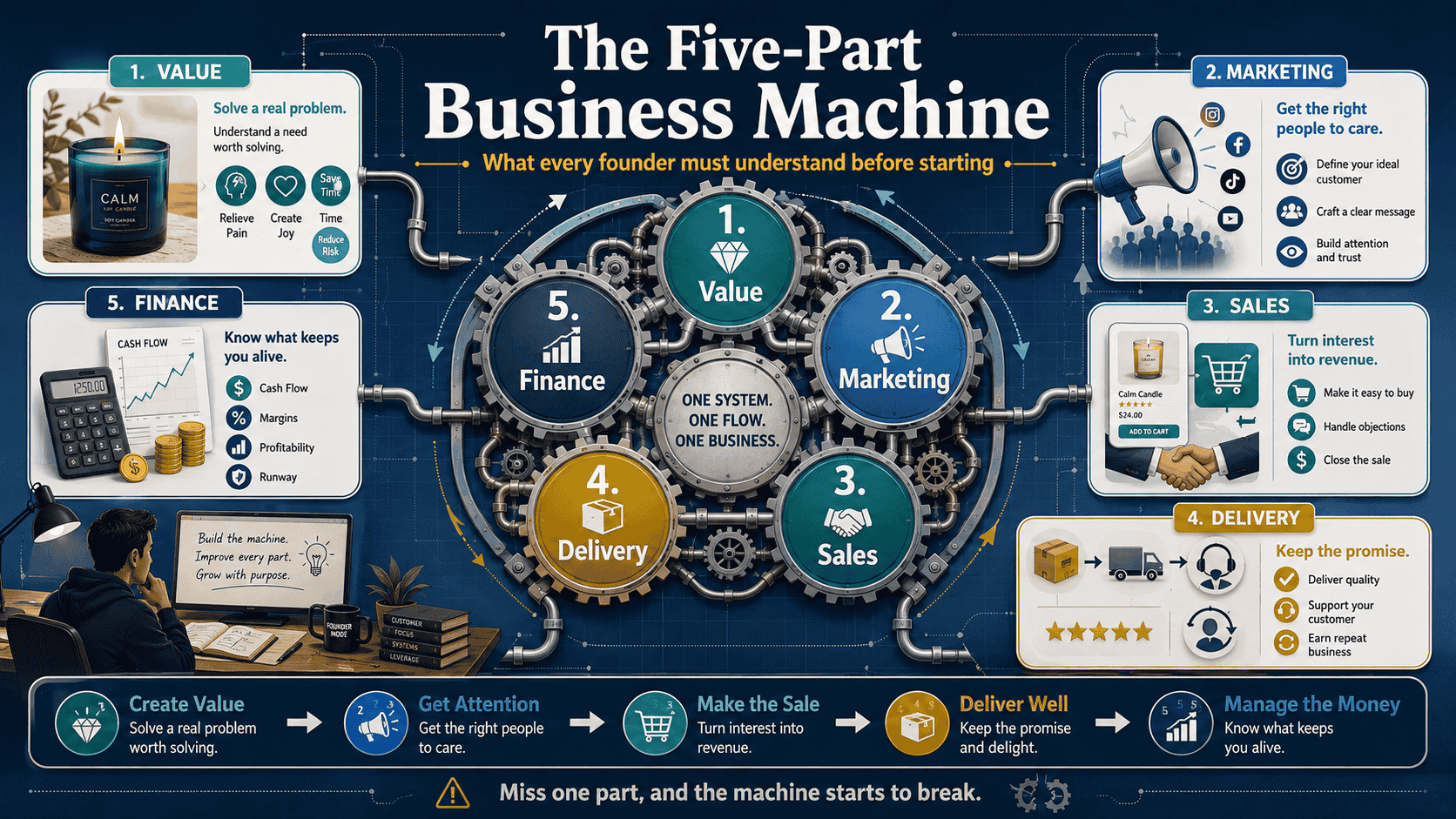
Every business, whether it is a one-person online store or a global company, depends on the same basic machine. It must create value. It must market that value. It must sell. It must deliver. It must handle money well enough to keep going.
Miss one part, and the machine starts to break.
A founder can have a beautiful product and no customers. That is a marketing problem. A founder can attract attention but fail to turn interest into revenue. That is a sales problem. A business can sell well but disappoint customers after purchase. That is a delivery problem. It can make sales and still run out of cash. That is a finance problem. It can manage everything else and still fail if the thing being offered does not solve a meaningful problem. That is a value problem.
This is why business is not as complicated as many people think, but it is more connected than beginners expect.
Start with value, not the logo
The first question is not "What should we call it?" or "What should the website look like?"
The first question is: what valuable thing are we making for someone else?
That question sounds simple, but it removes a lot of fantasy. A business is not built around what the founder enjoys making. It is built around what a customer values enough to choose, use and pay for.
Take a simple candle business. A beginner might say, "I want to sell candles because I love scents." That is a start, but it is not yet a business. The better question is: why do people buy candles?
Some people buy them because they want a room to smell better. Some want atmosphere at dinner. Some want a gift that feels personal but not too risky. Some want a beautiful object for a shelf. Some care about natural wax, packaging, slow burning, price, brand identity or the feeling of calm attached to lighting one.
Those are not the same needs. A candle made for a luxury gift buyer is not the same product as a candle made for someone who wants the cheapest pleasant scent in a supermarket. A founder who does not understand that difference may spend months building something that sits between markets and excites nobody.
Value creation is the discipline of choosing which customer need to serve and deciding what trade-offs to make.
No product can be best at everything. The best-smelling candle may cost more to produce. The cheapest candle may not feel premium. The most beautiful packaging may reduce margin. The longest burn time may require different materials. The founder has to decide which value matters most to the intended customer.
This is where many businesses begin to separate themselves. Not by adding more features, but by choosing the right promise.
The customer’s behavior matters more than their compliment
Many new founders get misled by politeness.
They share an idea with friends. The friends say it sounds great. A parent says they would buy one. A colleague says, "You should definitely do that." The founder takes those comments as proof.
They are not proof.
People are generous with encouragement because encouragement is cheap. Buying is different. Paying exposes whether the problem is real enough, urgent enough or desirable enough to change behavior.
This is why pre-orders, deposits, letters of intent and early paid tests are so valuable. They replace imaginary demand with a stronger signal.
A person who says "I love it" may only be trying to be kind. A person who enters card details, joins a paid waitlist, signs a purchase agreement or places an order is telling you something more useful.
That does not mean every business must take pre-orders before launch. Some products require prototypes, regulation, safety testing or deeper preparation. But the principle still holds: the founder needs evidence that customers will act, not merely approve.
The earlier you learn that, the less time you waste.
Marketing is attention with a purpose
Once a business has something valuable, the next problem is attention.
People cannot buy what they do not know exists. Marketing is the work of reaching the right people and making them curious enough to care.
That does not mean shouting at everyone. Good marketing starts by asking where the right customers already are, what they already pay attention to, what they already worry about and what language they use to describe the problem.
A candle business could market around scent, design, calm, gifting, sustainability, romance, home atmosphere or status. Each angle attracts a slightly different buyer. A founder who tries to speak to everyone often ends up saying nothing specific enough to matter.
The strongest marketing usually connects with a human drive. People buy to acquire something useful or beautiful. They buy to bond with others. They buy to learn, feel, protect themselves or express identity. A product that touches more than one of those drives often becomes easier to remember.
This is why a bottle of water can become a brand, not just a commodity. The water itself may be simple. The packaging, attitude, identity and social signal change how people feel about buying it.
Marketing is not decoration placed on top of the business. It is part of the value itself because it shapes how customers understand what is being offered.
Sales is where the business becomes real
Marketing creates attention. Sales turns attention into revenue.
Many founders are uncomfortable with sales because they imagine it as pressure or manipulation. That is a narrow version of selling. In a healthy business, sales is the process of helping the right customer make a clear decision.
The customer has a problem, desire or goal. The business has an offer. Sales connects the two.
For a small consumer product, sales may happen through a product page, a retail shelf, a market stall, a subscription offer or a checkout flow. For a service business, sales may involve calls, proposals and follow-up. For a software company, it may involve demos, trials and onboarding.
The form changes, but the question is the same: have we made it easy for the customer to understand the benefit, trust the offer and complete the purchase?
This is where many founders talk too much about features.
A feature describes what something has. A benefit describes what it does for the customer.
"Made with soy wax" is a feature. "A cleaner-burning candle for a calmer home ritual" is closer to a benefit, if the product can honestly support that claim. "One gigabyte of storage" is a feature. "A thousand songs in your pocket" is a benefit. The second version helps people imagine the product in their life.
Customers usually do not buy technical details first. They buy a better version of a moment, a task, a feeling or an outcome. Features matter when they make that promise believable.
Delivery decides whether customers come back
A sale is not the finish line.
It is the beginning of the customer’s judgment.
Did the product arrive when promised? Did it match the description? Was the packaging damaged? Did the candle burn properly? Did the scent match expectation? Was customer support helpful when something went wrong?
Value delivery is the part of the business that turns the promise into experience.
This part is less glamorous than marketing, but it can be more important over time. A business that delivers well earns repeat customers, referrals and trust. A business that delivers badly has to keep spending more money to replace disappointed buyers.
Repeat customers are powerful because the first sale is often the hardest and most expensive. Once someone has bought from you, trusts you and likes the product, it is easier to sell to them again. That is why lifetime value matters.
A customer who buys one candle and never returns is worth one sale. A customer who buys every month, gives candles as gifts and recommends the brand to friends may be worth many times more.
Founders who ignore delivery often mistake revenue for health. Sales can rise while trust quietly falls. That is dangerous because the damage may not show up immediately. It appears later in poor reviews, refund requests, weak repeat purchase rates and rising marketing costs.
A good business does not only ask, "Can we get the sale?"
It asks, "Will the customer be glad they bought?"
Finance is not optional
Many creative founders avoid finance because they think it belongs to accountants.
That mistake can kill a business.
Finance is not only tax, spreadsheets or investor reports. At the founder level, it is the discipline of knowing what money comes in, what money goes out, what is left, how long the business can survive and whether the effort is worth it.
The basic questions are not complicated.
How much does it cost to make the product?
How much does it cost to sell it?
How much does it cost to deliver it?
What fixed costs must be paid every month?
How much cash is available?
How many months can the business operate if sales are slow?
How much profit remains after everything is paid?
A founder does not need to love mathematics to understand these questions. Most early business finance is addition, subtraction, multiplication and division. The difficulty is not the arithmetic. It is the honesty.
A candle founder may sell a product for $20 and feel successful. But if materials, packaging, shipping, platform fees, advertising, refunds and overhead consume nearly all of that $20, the business may not be healthy. It may only look active.
Revenue is not profit. Growth is not survival. Busy is not the same as viable.
The founder needs to know the number that keeps the business alive. They also need to know the number that makes the business worth continuing. Those are not always the same.
A business can technically make money and still be a poor use of the founder’s life if it requires 80 hours a week and leaves almost nothing at the end of the month.
Business is complex, not mystical
A business has many moving parts, but the core ideas are plain enough.
Create value.
Get attention.
Make the sale.
Deliver well.
Manage the money.
The challenge is that each part affects the others.
A marketing promise affects delivery. A pricing decision affects finance. A finance constraint affects product quality. A customer service problem affects future sales. A weak product makes marketing harder. A strong product with poor attention still goes unnoticed.
That is why founders need to understand the whole machine, even if they eventually hire specialists.
A marketer should understand delivery. A product person should understand sales. A founder should understand finance. A finance person should understand customer behavior. The best businesses do not treat these as separate worlds. They understand that one weak part can limit the entire system.
This is also why "hard work" is an incomplete answer.
A founder can work hard on the wrong part of the machine. They can spend months perfecting packaging before proving demand. They can build a website before understanding the customer. They can chase followers without having a clear offer. They can make sales while ignoring margins. They can launch loudly and deliver poorly.
That kind of work feels productive until the numbers expose it.
Smart work is not lazy. It is directed.
The founder’s first real job
The first job of a founder is not to appear like an entrepreneur.
It is to reduce uncertainty.
Does the customer care?
Will they pay?
Can we reach them?
Can we sell repeatedly?
Can we deliver consistently?
Can we make enough profit to keep going?
Every early decision should help answer one of those questions.
That means starting smaller than the fantasy version of the company. Sell a batch before building a factory. Test a landing page before building a full platform. Speak to real buyers before ordering thousands of units. Learn from competitors before assuming the market is closed. Use early customers to improve the offer before scaling.
This is not a lack of ambition. It is how ambition survives contact with reality.
A million-dollar business is rarely built by doing random hard work for years. It is built by finding a valuable problem, testing demand, creating a clear offer, reaching the right market, selling honestly, delivering well and managing the money with discipline.
There will still be effort. There will still be setbacks. There will still be long days.
But the work becomes more useful when the founder understands the machine.
That is where a business begins.






Discussion
Comments
Approved comments are published after moderation to keep discussion useful and spam-free.
No comments yet. Start the discussion below.