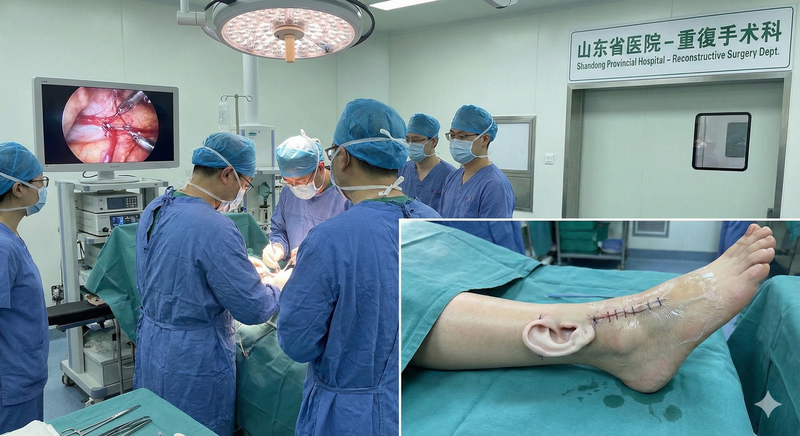
A New Frontier in Reconstructive Surgery: Ear Grafted to Foot
A groundbreaking medical feat has captivated the world, pushing the boundaries of reconstructive surgery. At Shandong Provincial Hospital in China, surgeons have performed what they assert to be the world's first operation of its kind: temporarily grafting a woman's severed ear onto her foot. This extraordinary procedure, while seemingly unconventional, represents a monumental leap in the fight to salvage and restore complex avulsion injuries, offering new hope to patients facing severe trauma and disfigurement. This detailed account delves into the innovative technique, its profound medical rationale, and the significant implications it holds for the future of microsurgery and tissue reconstruction.
The Urgent Challenge of Avulsion Injuries
Traumatic avulsion injuries, where a body part is completely torn away from its connection, present an immediate and severe challenge to medical professionals. The primary concern is preserving the severed tissue's viability. Without a continuous blood supply, tissue quickly begins to die, making successful reattachment impossible. When Ms. Ji suffered a complete ear avulsion due to an accident, the surgical team was faced with a critical dilemma: how to keep the delicate cartilaginous structure alive while preparing for a successful reattachment to its original site. Traditional methods often fail when the surrounding tissue at the injury site is too damaged to support immediate revascularization, or when the severed part itself is compromised by extended periods of ischemia (lack of blood flow).
Innovation in Action: The Foot as a "Biological Incubator"
The ingenuity of the Shandong Provincial Hospital team, led by Dr. Shuai Han and Professor Guo Shu-zhu, lay in their decision to utilize Ms. Ji's own foot as a temporary "biological incubator." This unconventional approach was not merely a spectacle but a meticulously planned strategy based on fundamental principles of microvascular surgery. The foot offered several crucial advantages for the temporary preservation of the severed ear:
- Rich Blood Supply: The human foot possesses a dense network of superficial blood vessels, providing an ideal environment for rapidly re-establishing circulation to the severed ear. This critical step ensured the ear tissue received sufficient oxygen and nutrients, preventing irreversible cellular damage and necrosis.
- Proximity and Accessibility: While seemingly distant from the head, the foot allowed for relatively straightforward surgical access to create the necessary microvascular connections without unduly stressing the patient or the delicate ear tissue during the initial grafting phase.
- Sterile Environment: The foot could be kept sterile and protected with relative ease, minimizing the risk of infection to the fragile graft, a common complication in severe trauma cases.
- Time for Healing: By temporarily preserving the ear, surgeons gained vital time for Ms. Ji's original ear site to heal and for the surgical plan for permanent reattachment to be meticulously prepared. This waiting period is often crucial in complex reconstructive cases where immediate reattachment might be compromised by inflammation, swelling, or infection at the primary injury site.
The Multi-Stage Surgical Process Explained
The groundbreaking procedure involved a series of intricate surgical stages, demanding exceptional precision and foresight:
- Initial Preservation and Assessment: Immediately after the injury, the severed ear was carefully preserved under optimal conditions. A thorough assessment of the ear's condition and the primary injury site on the head was conducted to determine the best course of action and the feasibility of the innovative grafting strategy.
- Temporary Grafting to the Foot (Stage One): The first major surgical intervention involved meticulously attaching the severed ear to the top of Ms. Ji's foot. This required precision microvascular surgery to connect the tiny blood vessels of the ear (typically arteries and veins less than 1mm in diameter) to suitable vessels in the foot. The paramount goal was to establish a robust blood flow to the ear, ensuring its survival and preventing tissue death.
- The Waiting Period: Following the successful temporary graft, a period of watchful waiting ensued. During this critical time, the ear tissue integrated with the foot's blood supply, healing and strengthening. This also allowed the original injury site on the head to recover significantly, reducing inflammation, swelling, and scar tissue formation, thereby creating a more favorable environment for the eventual permanent reattachment.
- Reattachment to the Head (Stage Two): Once the ear was deemed viable and robust, and the original site on the head was ready, the second, equally complex operation took place. The ear, now revitalized and robust, was carefully detached from the foot along with a segment of its newly established vascular pedicle (the blood vessels that were supplying it). This vascularized ear was then meticulously reattached to the side of Ms. Ji's head. Again, advanced microvascular techniques were indispensable to connect the ear's blood vessels to those in the scalp, ensuring a continuous and permanent blood supply.
Overcoming Significant Surgical Challenges
This pioneering procedure presented numerous formidable challenges, highlighting the exceptional skill and innovative spirit of the surgical team:
- Microvascular Anastomosis: Connecting minuscule blood vessels, sometimes less than a millimeter in diameter, requires unparalleled precision, specialized microsurgical instruments, and extensive training. A single error or clot formation could lead to vessel blockage and complete graft failure.
- Preventing Ischemia-Reperfusion Injury: Restoring blood flow to tissue that has been deprived of oxygen for an extended period can sometimes paradoxically cause further damage. Careful management and pharmacological interventions were necessary to minimize this risk during both grafting stages.
- Maintaining Sterility: Operating on the foot and then the head required exceptionally rigorous infection control protocols to prevent complications that could jeopardize the entire process.
- Patient Compliance and Comfort: Living with an ear temporarily grafted to one's foot is undoubtedly a significant physical and psychological challenge for the patient. Specialized care, psychological support, and pain management were essential throughout the multi-stage process.
- Anatomical Reconstruction: Beyond establishing vascular supply, the surgeons also had to meticulously consider the structural integrity and aesthetic outcome of the ear, preserving its intricate cartilaginous framework for a natural appearance post-reattachment.
Broader Implications for Reconstructive Medicine
The success of this extraordinary operation carries profound implications for the field of reconstructive surgery, particularly in several key areas:
- Complex Traumatic Injuries: It offers a viable, innovative strategy for salvaging body parts that might otherwise be deemed unrecoverable due to extensive damage at the primary injury site or prolonged periods of ischemia.
- Advancements in Micro-Reconstruction: This case demonstrates the power of innovative thinking in applying established microvascular techniques to novel anatomical situations. It significantly expands the possibilities for complex tissue transfer and grafting.
- Potential for Tissue Preservation: While not direct 'banking' in the traditional sense, the concept of temporarily preserving and nourishing a severed body part on a living host opens new avenues for thinking about maintaining tissue viability for extended periods, beyond current cold ischemia limits.
- Future Research: This pioneering work will undoubtedly inspire further research into optimizing temporary grafting sites, improving graft survival rates, and exploring applications for other complex tissue defects, potentially including fingers, noses, or even more intricate structures.
- Hope for Patients: For individuals suffering from severe avulsion injuries, this technique represents a beacon of hope, offering the potential for restoration of function and appearance that was previously unimaginable, significantly improving quality of life.
Shandong Provincial Hospital: A Hub of Innovation
The surgeons at Shandong Provincial Hospital have cemented their reputation as pioneers in reconstructive medicine. This operation is a profound testament to their dedication to pushing the boundaries of what is medically possible, combining intricate surgical skills with innovative problem-solving. Their work adds to a growing legacy of Chinese medical advancements that are contributing significantly to global healthcare. This achievement underscores the critical role of specialized surgical teams, advanced medical infrastructure, and a commitment to innovation in tackling some of the most challenging cases in modern medicine.
A Blueprint for Future Medical Breakthroughs
The temporary grafting of a severed ear onto a patient's foot before successful reattachment is more than just a remarkable surgical anecdote; it is a powerful testament to human ingenuity and the relentless pursuit of medical progress. This world-first procedure from Shandong Provincial Hospital demonstrates an incredibly innovative solution to the age-old problem of tissue viability in severe trauma. By transforming the foot into a temporary bio-incubator, surgeons not only saved a vital body part but also opened new frontiers in reconstructive surgery, offering a blueprint for future interventions that could redefine recovery for countless patients worldwide. This truly groundbreaking achievement stands as a shining example of how professional excellence and creative thinking can lead to life-changing medical breakthroughs, providing hope and new possibilities for complex trauma victims globally.






Discussion
Comments
Approved comments are published after moderation to keep discussion useful and spam-free.
No comments yet. Start the discussion below.