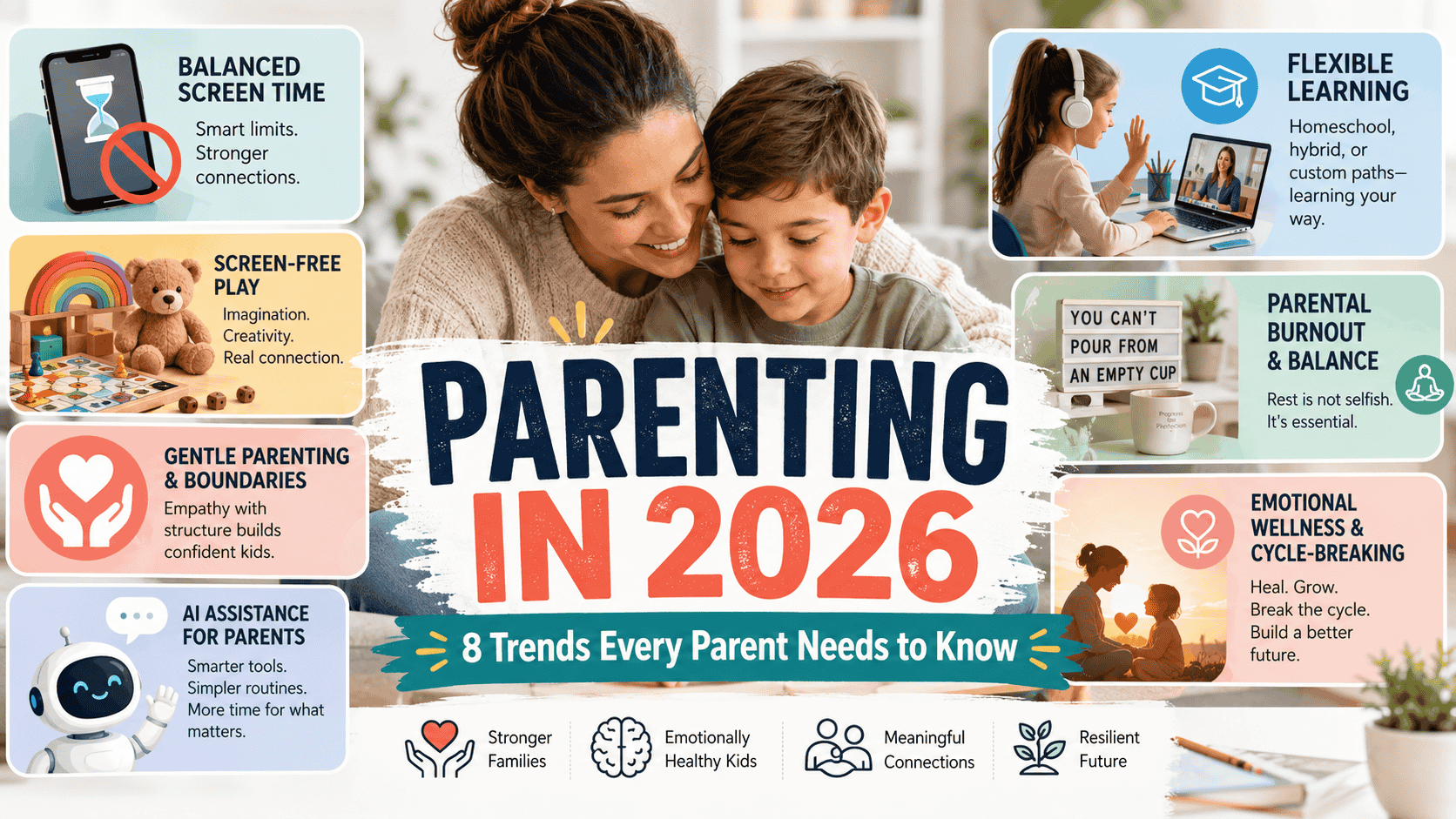
The Ultimate Guide to Parenting in 2026: 8 Trending Discussions Every Parent Needs to Know
From screen-free childhoods to the gentle parenting
backlash — discover the parenting trends shaping 2026 and how to navigate them
with confidence.
Introduction: Parenting in 2026 Has Changed — Are You Keeping Up?
Parenting in 2026 looks nothing like it did five years ago. From the explosion of AI companion apps to the growing movement of analog childhoods, modern parents are navigating a landscape that is evolving faster than ever before. Whether you are a first-time parent, raising a teenager, or somewhere in between, staying informed about the latest parenting trends is no longer optional — it is essential.
In this comprehensive guide, we dive deep into the 8 most trending parenting discussions dominating social media, parenting forums, and expert panels in 2026. These are the conversations that millions of parents are having right now — and the ones that will shape how we raise the next generation.
1. The "Going Analog" Movement: Why Parents Are Ditching Screens for VHS Players and Board Games
The analog parenting trend is taking 2026 by storm. In a world saturated with tablets, smart TVs, and algorithm-driven content, a growing number of families are making a radical choice: going back to basics.
Parents across the globe are replacing streaming services with VHS players, swapping smartphones for landline phones, and filling playrooms with wooden Montessori toys instead of interactive screens. The movement is not about being anti-technology — it is about creating intentional boundaries that protect childhood development.
The rise of the Tin Can kids’ phone in 2025 exemplified this shift. Designed as a simple, screen-free communication device for children, it became one of the best-selling kids’ gadgets of the year. In 2026, "screen-free childhood" is no longer fringe — it is aspirational.
Why this matters for your family: Research consistently shows that low-stimulation environments promote creativity, longer attention spans, and healthier emotional regulation in children. The analog movement gives parents permission to slow down and prioritize real-world experiences over digital ones.
2. Social Media Bans for Kids and the Rise of AI Companion Apps: The New Parental Nightmare
If 2025 was the year AI became helpful, 2026 is the year AI becomes terrifying for parents.
Jonathan Haidt’s best-selling book, The Anxious Generation, ignited a global conversation about the devastating effects of smartphones and social media on children’s mental health. The result? Australia became the first country to ban social media for children under 16 in December 2025. Denmark, the UK, and several US states are now considering similar legislation. School phone bans rolled out across America with the 2025–2026 academic year.
But here is the new frontier that is keeping parents up at night: AI companion apps. These digital "friends," "boyfriends," and "girlfriends" are designed to form emotional bonds with children and teenagers. Experts warn that these apps could replace real human connection, create unhealthy attachment patterns, and expose vulnerable young people to manipulation.
What parents can do
right now:
·
Start conversations early
about AI relationships versus real relationships.
·
Monitor app downloads and
set up parental controls.
·
Advocate for regulation at
the school and community level.
·
Create a family media
agreement that specifically addresses AI tools.
· Talk to your children about emotional manipulation tactics used by AI.
3. The Gentle Parenting Backlash: Why Parents Are Embracing "Hybrid Parenting" in 2026
Gentle parenting dominated the parenting conversation for
years. But in 2026, the tide is turning — and turning fast.
·
Acknowledging your child’s
emotions: "I understand you are frustrated."
·
Holding firm boundaries:
"And the answer is still no."
·
Using natural consequences
instead of endless negotiation.
·
Being calm, confident, and
kind — without being a pushover.
·
Modeling emotional
regulation, not emotional suppression.
4. AI as a Parenting Assistant: How Smart Parents Are Using Technology to Their Advantage
Here is the paradox of 2026 parenting: while parents are limiting their children’s tech exposure, they are simultaneously embracing AI to streamline their own lives.
From AI-powered meal planning and grocery lists to smart
scheduling tools that coordinate family calendars, parents are using artificial
intelligence as a behind-the-scenes assistant. AI tutoring tools are helping
with homework. AI-generated bedtime stories are personalizing nighttime
routines. Even pediatric symptom checkers powered by AI are reducing
unnecessary emergency room visits.
·
Automated weekly meal plans
based on family dietary needs and budgets.
·
Smart family calendars that
sync school events, activities, and appointments.
·
AI-powered homework help
and tutoring for school-age children.
·
Personalized bedtime story
generators.
·
Symptom checkers that help
parents decide when to call the pediatrician.
·
Birthday gift
recommendation engines based on child’s age and interests.
5. The Homeschooling and Hybrid Schooling Surge: A Response to Broken Systems
Homeschooling is no longer a niche choice for religious families or rural communities. In 2026, it has gone mainstream — and the reasons are complex and deeply personal.
Parents are pulling
their children from traditional schools due to:
·
Persistent bullying that
schools fail to address adequately.
·
Rising childhood anxiety
and school refusal behaviors.
·
A desire for
neurodiversity-affirming education that meets their child where they are.
·
Frustration with
one-size-fits-all curricula that ignore individual learning styles.
·
Growing safety concerns in
the school environment.
· Dissatisfaction with how schools handle social media and phone issues.
Hybrid schooling — where children attend traditional school part-time and learn at home part-time — is emerging as the practical middle ground. While not without its challenges (scheduling, socialization, and cost remain real concerns), the hybrid model is expected to grow significantly in the coming years.
The rise of online learning platforms, co-op homeschool groups, and micro-schools is making alternative education more accessible than ever before. Parents no longer have to choose between all-or-nothing — they can design an education that fits their child.
6. Breaking Intergenerational Trauma: The "Cycle Breaker" Generation
"I will not raise my children the way I was raised."
This sentence has become the rallying cry of millennial and Gen Z parents who are actively working to break patterns of emotional neglect, authoritarianism, and trauma passed down through generations. The cycle-breaking movement is one of the most powerful — and emotionally charged — parenting trends of 2026.
Parents are investing in therapy, reading about attachment theory, learning about emotional intelligence, and creating households where children feel safe expressing their emotions. Social media platforms are filled with content creators sharing their journeys of healing while parenting — and millions of parents are finding comfort in knowing they are not alone.
What cycle-breaking
looks like in daily life:
·
Apologizing to your
children when you make a mistake.
·
Validating emotions instead
of dismissing them ("Stop crying" becomes "I see you are
hurting").
·
Seeking therapy not just
for crisis — but for growth.
·
Learning your own
attachment style and how it affects your parenting.
· Creating safety for big emotions instead of punishing them.
The challenge: Breaking cycles is exhausting. It requires constant self-awareness, professional support, and grace for the inevitable moments when old patterns resurface. But the payoff — raising emotionally healthy children who do not carry your wounds — is immeasurable.
7. Split-Shift Parenting: The Modern Solution to Parental Burnout
Parental burnout is at an all-time high. With less village support, rising costs of childcare, and the demands of dual-income households, parents are drowning. Enter: split-shift parenting.
The concept is simple but revolutionary in practice. Instead of both parents being "on" simultaneously during non-work hours (which often leads to neither parent getting a real break), couples divide their time into clear, intentional shifts:
·
One parent is fully
responsible for childcare and is "on duty."
·
The other parent works,
exercises, handles household tasks, or simply rests.
· Then they switch.
This approach reduces resentment, prevents burnout, and
ensures that each parent gets dedicated time for self-care — something that is
no longer seen as selfish but as essential for sustainable parenting.
8. Ditching Parenting Perfectionism: The Rise of "Good Enough" Parenting
The Instagram-perfect parenting aesthetic is dying — and
parents are relieved.
·
Inchstone parties and
over-the-top milestone celebrations for social media.
·
Pinterest-worthy birthday
parties that cost more than a mortgage payment.
·
Posting children’s most
vulnerable moments online for engagement.
·
Comparing their family to
curated highlight reels of other families.
·
The pressure to make every
moment "educational" or "enriching."
Conclusion: The Future of Parenting Is Intentional
If there is one word that defines parenting in 2026, it is intentionality. Parents are no longer passively following trends or blindly repeating what their own parents did. They are making deliberate, informed choices about how they raise their children — from the technology they allow in their homes to the emotional environments they create.
Whether you are embracing the analog movement, navigating AI concerns, breaking generational cycles, or simply trying to survive the toddler years without burning out, know this: you are not alone. Millions of parents around the world are having these exact conversations right now.
The best parenting advice for 2026? Stay curious. Stay flexible. Give yourself grace. And remember that showing up imperfectly is always better than not showing up at all.
───────────────────────────────────────────────────────────
Did this article resonate with you? Share it with a fellow parent who
needs to read this. Join the conversation — which 2026 parenting trend has
impacted your family the most? Leave a comment below or tag us on social media.
Frequently Asked Questions (FAQ)
What are the biggest
parenting trends in 2026?
The biggest parenting trends in 2026 include the analog parenting
movement, social media bans for kids, the gentle parenting backlash and rise of
hybrid parenting, AI parenting tools, homeschooling surges, breaking
intergenerational trauma, split-shift parenting, and the rejection of parenting
perfectionism.
Gentle parenting is not dead, but it is evolving. Most Gen Z
parents now practice "hybrid parenting," which combines the empathy
of gentle parenting with clear boundaries and consistent limits. The pure,
no-limits version of gentle parenting is being replaced by a more balanced
approach.
Split-shift parenting is a scheduling approach where parents
take turns being "on duty" for childcare while the other parent
rests, works, or handles other responsibilities. It helps prevent burnout and
ensures both parents get dedicated personal time.
Experts are raising significant concerns about AI companion
apps for children and teenagers. These apps, which create digital
"friends" or "romantic partners," may interfere with real
human connection and emotional development. Parents should monitor usage and
have open conversations about AI relationships.
·
The Every Mom — 2026
Parenting Trends We’re Excited to Embrace This Year (theeverymom.com)
·
The Bump — 6 Parenting
Trends to Keep on Your Radar in 2026 (thebump.com)
·
Moms Who Think — Parenting
Trends for 2026: What’s In and What’s Out (momswhothink.com)
·
Vitabiotics — 5 New
Parenting Trends for 2026 (vitabiotics.com)
·
Happy Families — Parenting
in 2026: What We Learned Last Year (happyfamilies.com.au)
·
MSN / What to Expect — The
Biggest Parenting Trends for 2026 (msn.com)
· SheKnows — 15 Parenting Debates Guaranteed to Start Discussion (sheknows.com)
analog parenting 2026, screen-free childhood, low-stimulation toys for kids, Montessori toys, parenting without screens, play-based childhood, social media ban for kids 2026, AI companion apps dangers, The Anxious Generation, smartphone ban children, kids and AI safety, school phone ban, gentle parenting backlash, hybrid parenting 2026, parenting with boundaries, Gen Z parenting style, is gentle parenting dead, authoritative parenting, AI parenting tools 2026, artificial intelligence for parents, smart parenting technology, AI meal planning families, best parenting apps 2026, homeschooling 2026, hybrid schooling benefits, why parents homeschool, alternative education, school refusal solutions, micro-schools, neurodiversity education, breaking generational trauma, cycle breaker parents, intergenerational trauma parenting, healing while parenting, attachment theory parenting, millennial parents therapy, split-shift parenting, parental burnout solutions 2026, shared parenting schedule, co-parenting strategies, preventing parent burnout, work-life balance parents, good enough parenting, ditching parenting perfectionism, stop sharenting 2026, authentic parenting, parenting without guilt, realistic parenting



Discussion
Comments
Approved comments are published after moderation to keep discussion useful and spam-free.
No comments yet. Start the discussion below.