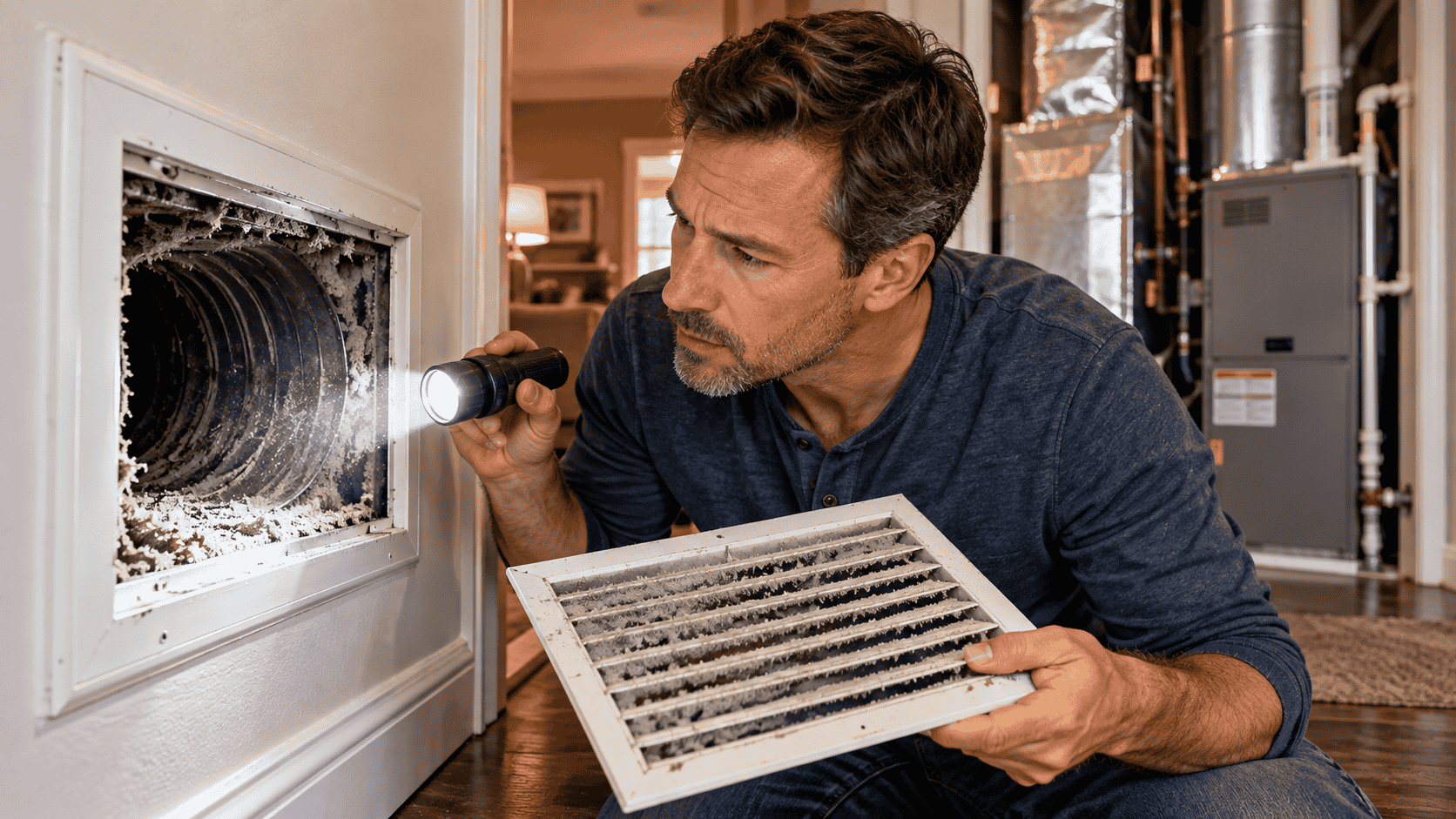
You remove a vent cover and see dust inside. Maybe the return grille looks gray, someone in the house keeps sneezing, or a service company warns that years of dirt are circulating through every room. Paying to clean the entire duct system sounds like an obvious solution—but the evidence is far less straightforward.
The Surprising Answer: Not Routinely
The U.S. Environmental Protection Agency does not recommend cleaning residential air ducts on a routine schedule. Instead, duct cleaning should generally be considered when there is a specific reason for it.
Air ducts inevitably collect some dust. Return grilles become dirty, and particles settle on internal surfaces.
But seeing dust does not automatically prove that the ductwork is harming indoor air quality.
EPA says duct cleaning has not been shown to prevent health problems, and research has not conclusively demonstrated that ordinary household dust inside ducts significantly increases particle levels in living spaces.
Much of the dust that settles inside ducts may simply remain attached to internal surfaces.
A dusty duct and a contaminated duct are not the same thing.
When Air-Duct Cleaning May Actually Make Sense
EPA identifies several situations where homeowners should seriously consider cleaning.
These include substantial visible mold growth inside hard-surface ducts or HVAC components, infestation by rodents or insects, and excessive accumulations of dust or debris that are actually being released into rooms through supply registers.
Those situations are very different from finding a light coating of ordinary household dust.
The useful question is not simply:
“Are my ducts dirty?”
Almost every duct system eventually becomes somewhat dirty.
The better question is:
“Is there evidence that contamination is affecting the system or the home?”
Visible Mold Changes the Conversation
Mold is one of the stronger reasons to investigate an HVAC system.
But something dark or fuzzy inside a duct is not automatically mold.
If a service provider claims mold is present, ask to see exactly where it is.
If identification is uncertain, professional assessment or testing may sometimes be appropriate.
That matters because few phrases create faster panic than:
“You have black mold.”
If someone makes that claim, ask where the suspected growth is, what evidence supports the claim, and what allowed moisture to reach that location.
Cleaning mold without correcting the moisture source may only produce a temporary result.
Moisture Is Usually the Bigger Problem
Mold requires moisture.
That moisture may come from condensation, leaks, poorly draining cooling equipment, damaged insulation or other HVAC problems.
If mold is present, two questions matter.
How should the contamination be removed?
And why did that area become wet enough for mold to grow?
If the second question is ignored, the problem can return.
Cleaning without fixing the source of moisture treats the symptom rather than the cause.
Wet Insulated Ducts Are Different
Some duct systems contain fiberglass insulation or are made from fiberglass duct board instead of bare sheet metal.
If porous duct material becomes wet and mold-contaminated, cleaning may not restore it in the same way that a hard metal surface can sometimes be cleaned.
In those situations, affected material may need replacement.
That is why homeowners should know what kind of duct system they actually have before approving treatment.
Rodents and Insects Are a Clearer Case
If rodents or insects have occupied the duct system, cleaning can make sense after the infestation itself has been eliminated.
But cleaning alone is not enough.
You also need to understand how the pests entered.
A damaged grille, disconnected duct, opening into a crawlspace or poorly sealed penetration can allow the problem to return.
In this situation, cleaning is part of restoring a contaminated HVAC system—not simply making the duct interior look better.
What If Dust Is Actually Coming Out of the Vents?
Visible debris being blown into rooms deserves investigation.
But it still does not automatically prove that the entire duct network needs cleaning.
Possible causes include heavy contamination inside the ducts, construction debris, damaged duct material, poor filtration, an incorrectly installed filter or contamination elsewhere in the HVAC system.
The symptom tells you something is wrong.
It does not yet tell you which service you need.
A Dusty Return Grille Is Not Proof of Dirty Ducts
Return grilles commonly collect dust because room air is continuously being pulled through them toward the HVAC system.
A dusty grille can often simply be vacuumed or removed and cleaned.
Its appearance alone does not establish that the entire duct system contains heavy contamination.
Before paying to clean hundreds of feet of ductwork, start with the parts of the system you can actually inspect.
Does Duct Cleaning Help Allergies?
This is where marketing claims can become more confident than the evidence.
The logic sounds convincing.
Dust can contain allergens.
Dust exists inside ducts.
Remove the dust and allergy symptoms should improve.
But routine duct cleaning has not been proven to prevent health problems.
Indoor particles can come from many other sources, including cooking, pets, furnishings, cleaning activities, smoke, outdoor air and everyday household movement.
If someone in the home has persistent respiratory or allergy symptoms, it is more useful to evaluate indoor air quality broadly rather than assuming duct cleaning is automatically the answer.
Health symptoms should also be discussed with an appropriate healthcare professional rather than diagnosed by a home-service contractor.
Indoor Air Quality Is Bigger Than the Ducts
Indoor-air problems rarely come from one source.
Effective indoor-air strategies generally involve controlling pollution at the source, improving ventilation where appropriate and using suitable filtration.
If cooking emissions, smoke, outdoor pollution, excess moisture or another source is responsible for the problem, spotless duct walls will not remove that source.
This is why an indoor-air problem should be investigated as a whole-house issue.
Your HVAC Filter May Matter More
Unlike one-time duct cleaning, the HVAC filter works repeatedly whenever the system operates.
For many homes, improving filtration can therefore be more useful than cleaning ordinary dust from duct surfaces.
A MERV 13 filter, or the highest-efficiency filter the HVAC system can properly accommodate, can capture much smaller particles than a basic low-efficiency filter.
But higher filtration is not automatically better for every system.
The blower and filter housing must be able to handle the added airflow resistance.
The filter also needs to fit properly.
A high-quality filter cannot capture air that simply leaks around its edges.
And even an excellent filter becomes less useful when it is overloaded with dust and left in place for too long.
Cleaning the Ducts Is Not the Same as Cleaning the HVAC System
Your HVAC system contains much more than ducts.
It can include blower fans, cooling coils, heat exchangers, drain pans and other mechanical components.
That distinction matters.
Cleaning a dirty cooling coil may improve system performance.
Cleaning a dirty blower may be useful.
Clearing a blocked condensate drain may prevent water damage.
Those are different maintenance tasks from simply vacuuming duct walls.
If someone promises major energy savings from duct cleaning, ask exactly which components are being serviced.
Sometimes Sealing the Ducts Matters More
A duct system can be fairly clean and still perform badly.
The reason may be leakage.
ENERGY STAR says homes can lose a substantial amount of conditioned air through leaks, holes and poorly connected ductwork.
That can contribute to high utility bills, weak airflow, rooms that remain too hot or cold and excessive HVAC runtime.
Cleaning the inside of a leaking duct does nothing to repair the leak.
In some homes, sealing and insulating the duct system may provide a much more noticeable improvement in comfort and efficiency.
Leaks Can Also Pull Dirt Into the System
Duct leakage can work in both directions.
Supply leaks allow conditioned air to escape.
Return-side leaks can draw unwanted air into the HVAC system.
Imagine a return duct with an open joint inside a dusty attic or crawlspace.
That opening can pull surrounding air—and potentially dust or insulation particles—into the system.
If ductwork repeatedly becomes unusually dirty, ask why.
Continually cleaning it without correcting leakage may simply repeat the same problem.
What About Cleaning After Renovation?
Major renovations can generate enormous amounts of dust.
Drywall sanding, demolition, wood cutting, insulation work and concrete work can all release particles.
If the HVAC system operated during heavy construction without proper protection, substantial debris may enter the system.
That does not mean every remodeled home automatically needs duct cleaning.
But if construction dust visibly entered the HVAC system, inspection is reasonable.
Prevention is better.
Protecting return openings and HVAC components during dusty work can prevent the system from becoming an accidental vacuum cleaner for the renovation.
What Should Proper Duct Cleaning Actually Include?
If cleaning is genuinely justified, it should involve more than inserting a vacuum hose into the nearest vent.
A duct system contains supply branches, return ducts, registers, grilles and mechanical components.
Before hiring a company, ask exactly what will be cleaned.
Will the job include supply ducts?
Return ducts?
Registers and grilles?
The blower compartment?
The cooling coil?
The drain pan?
Other accessible HVAC components?
Also ask how loosened dust will be contained and removed from the home.
A system-wide approach is very different from cleaning the first few feet behind each visible vent.
Bad Cleaning Can Make Things Worse
Duct cleaning is not automatically harmless simply because the intention is to remove dirt.
Poorly performed cleaning can release dust and contaminants into living spaces.
Careless work can also damage duct material or HVAC equipment.
Equipment matters.
Technique matters.
Containment matters.
The fact that someone owns a powerful vacuum does not automatically make the service beneficial.
Be Skeptical of Extremely Cheap Whole-House Offers
A surprisingly cheap whole-house duct-cleaning offer deserves questions.
Before allowing work to begin, ask what is included, what is excluded, what evidence shows cleaning is necessary and whether additional charges are likely.
A legitimate service provider should be able to explain the proposed work clearly without relying on fear.
If an inexpensive advertisement suddenly turns into an urgent claim of severe contamination requiring hundreds or thousands of dollars in extra work, ask to see the evidence before approving anything.
Be Careful With “EPA Certified” Claims
EPA does not certify or endorse individual duct-cleaning companies.
If a contractor says the company is “EPA certified” for duct cleaning, ask what specific credential that statement refers to.
Official-sounding language can make a sales pitch appear more authoritative than it really is.
Always verify credentials independently.
What About Chemicals Sprayed Inside the Ducts?
Some contractors recommend applying biocides, disinfectants, sealants or coatings inside duct systems.
This deserves caution.
Before allowing chemical treatment, ask what product is being used, what problem it is supposed to solve, what contamination has actually been identified and whether the product is approved for that exact use and surface.
“Sanitizing” should not automatically become an extra service simply because the ducts are being cleaned.
The use of chemicals inside a system that distributes air throughout the home deserves careful consideration.
Be Especially Cautious About Ozone
Ozone is sometimes promoted as a way to remove odors or control biological contamination.
But ozone is also a lung irritant.
Something smelling different after treatment does not prove the air became healthier.
Odor removal and pollutant removal are not necessarily the same thing.
Do Not Add Unnecessary Moisture
Introducing unnecessary moisture into ductwork can create exactly the conditions biological growth needs.
That is why steam cleaning or other moisture-heavy treatment methods deserve caution.
A healthy duct system should generally remain dry.
If moisture is already present, determining where it came from should be a priority.
The House May Be Telling You Something Else
Suppose one bedroom is always dusty, hot and uncomfortable.
You might assume the ducts need cleaning.
But the actual problem could be a leaking supply connection, poor return airflow, damaged duct insulation, a crushed flexible duct, a window air leak or a poorly fitted filter.
The HVAC system interacts with the entire building.
The most visible symptom does not always reveal the correct repair.
Diagnosis comes before treatment.
Ask to See the Problem
This may be the most useful consumer habit in the entire article.
If a contractor says the ducts are heavily contaminated, ask to see the evidence.
If mold is claimed, ask where it is.
If rodents supposedly occupied the system, ask for evidence.
If debris is said to be excessive, ask to see representative areas.
This changes the conversation from fear to evidence.
A trustworthy diagnosis should be explainable.
Do Not Let One Photograph End the Discussion
Photographs can be useful.
But context matters.
Ask where the picture was taken.
Which duct?
Which room?
Supply or return?
Does it represent one small area or the entire system?
Can the technician show you the location directly?
A close-up photograph of a dusty surface can look dramatic without proving a whole-house problem.
What Should Routine HVAC Maintenance Focus On?
For most homes, routine HVAC maintenance is much less dramatic than scheduled duct cleaning.
It includes using an appropriate filter, replacing it when needed, keeping condensate drainage working, maintaining coils and mechanical components, controlling moisture, repairing duct leaks, keeping supply and return registers unobstructed and addressing water damage promptly.
These measures deal with how the HVAC system actually performs.
They also address many of the conditions that can eventually create dirty or contaminated ducts in the first place.
So, Do You Really Need Air-Duct Cleaning?
Sometimes.
But not simply because a vent looks dusty.
The strongest reasons to consider cleaning are specific problems such as substantial visible mold, pest contamination or excessive debris actually affecting the system.
If your real concern is indoor air quality, look beyond the ducts.
Consider pollution sources, ventilation, filtration, moisture, HVAC maintenance and duct leakage.
If the concern is comfort or high energy bills, investigate airflow and duct leakage before assuming dirt is the problem.
The most useful question is not:
“When were my ducts last cleaned?”
It is:
“What problem am I trying to solve?”
If nobody can clearly identify the problem before selling you the solution, keep asking questions.
air duct cleaning, duct cleaning, HVAC duct cleaning, should I clean my air ducts, dirty air ducts, air duct mold, duct cleaning allergies, indoor air quality, HVAC filter, MERV 13, duct sealing, home HVAC maintenance, air duct cleaning benefits
A Heat Pump Is Basically an Air Conditioner That Runs Backwards
Your AC Is Running but the House Is Still Hot
Your Water Heater Is Making That Noise for a Reason
Your Garage Door Is the Biggest Moving Machine in Your House
Your Roof Can Look Fine—and Still Be Getting Weaker
Home & Garden
Homeowner inspecting a dusty air duct and removed vent grille to determine whether professional duct cleaning is necessary.
Do You Really Need Air-Duct Cleaning? What the Evidence Says
Dust inside a vent does not automatically mean your ducts need professional cleaning. Here’s when cleaning makes sense and when another HVAC problem may be responsible.
Your Air Ducts Look Dirty. Do They Actually Need Cleaning?
You remove a vent cover and discover years of dust inside. Surely that means the whole duct system needs cleaning.
Not necessarily.
Ordinary dust alone is not a strong reason for routine duct cleaning. The cases that deserve more attention are specific problems such as substantial mold, pests or excessive debris actually affecting the HVAC system.
Sometimes the more useful repair is not cleaning at all—it is fixing moisture, filtration or leaking ducts.
Reader Question
If someone told you your home's ducts needed cleaning today, what evidence would you ask them to show you before agreeing?
Research Notes
EPA's residential guidance does not recommend routine duct cleaning simply because ordinary household dust is present. Cleaning is more appropriate when specific contamination problems such as substantial visible mold, pest infestation or excessive debris exist.
Moisture control is central to preventing mold from returning. Wet or mold-contaminated porous duct material may require replacement rather than cleaning.
For indoor particle control, source reduction, appropriate ventilation and effective filtration should be considered alongside HVAC maintenance.
ENERGY STAR says significant conditioned air can be lost through leaking or poorly connected ductwork, meaning sealing can sometimes produce greater comfort and efficiency benefits than cleaning.
Safety Note
Significant mold, pest contamination, damaged duct materials, chemical treatments and HVAC mechanical problems can involve health or safety considerations. Where contamination is substantial or equipment requires repair, use appropriately qualified professionals.
Air Duct Cleaning, HVAC, Indoor Air Quality, Home Maintenance, Air Filters, Mold, Duct Sealing, Home Improvement