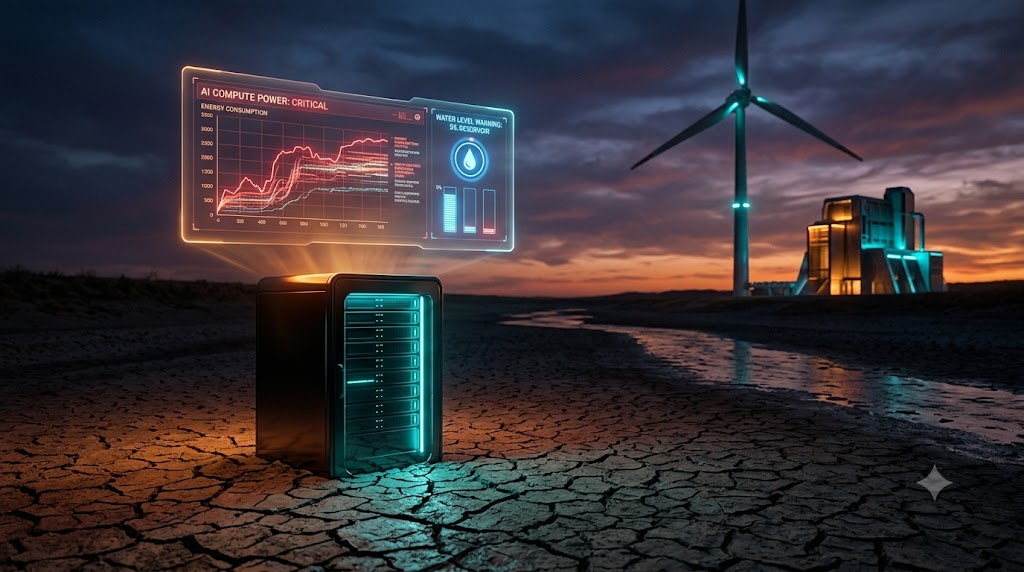
The era of basic corporate ESG reporting is over. In 2026, sustainability is a hard-edged operational mandate driven by the massive physical resource demands of Artificial Intelligence and compounding supply chain fragility.
By Sustainability & Tech Desk | July 26, 2026
For years, corporate sustainability was treated as a marketing exercise—a series of ambitious pledges and complex ESG (Environmental, Social, and Governance) disclosures. In the second half of 2026, that landscape has violently shifted. Sustainability is no longer about distant "net-zero" promises; it is about immediate operational execution, financial realism, and securing physical resources in a highly competitive global market.
The primary catalyst for this shift is not regulation, but technology. The explosive scaling of AI is currently testing the absolute limits of global power grids and water supplies. If you are a business leader, an infrastructure investor, or a policy maker, navigating 2026 requires understanding that sustainability is now a core competitive advantage and a baseline requirement for business continuity.
Here are the critical sustainability and global risk trends defining the modern global economy.
1. The AI Energy Collision
The most significant global risk of 2026 is the intersection of rapid AI growth and constrained energy grids. The bottleneck for tech expansion is no longer computing power or chip shortages; it is the physical supply of electricity.
Massive Consumption: By the end of 2026, global data center energy consumption is projected to approach a staggering 1,050 terawatt-hours (TWh). To put this into perspective, if data centers were a sovereign nation, they would be the fifth-largest energy consumer on Earth, ranking right between Japan and Russia.
The "Speed to Power" Metric: In the tech sector, "speed to power" has become the ultimate decisive factor. Companies that can secure rapid grid connections can scale their AI applications faster than their competitors.
Grid Modernization as a Constraint: Because AI data centers require continuous, large-scale computing 24/7, the global grid is struggling to keep up. Success in this space now heavily relies on grid-enhancing technologies and grid-forming inverters that allow renewable energy and battery storage to provide critical stability to the infrastructure.
2. The Cloud's "Drinking Problem"
While carbon emissions dominate headlines, the most localized and immediate friction point for tech companies in 2026 is water consumption.
The Cooling Crisis: The "cloud" is a physical beast with a massive thirst. A single, large-scale hyperscale data center can consume roughly two million liters of water every single day just to keep its servers cool. This is equivalent to the daily water usage of 6,500 homes.
Community Pushback: As AI scales, this hidden water appetite is triggering intense public backlash. In drought-prone regions from Arizona to South America, local communities are actively protesting, demanding to know why shrinking aquifers are being used to cool ChatGPT servers instead of sustaining local agriculture and drinking supplies.
Zero-Water Innovations: This risk is forcing immediate innovation. Regulators in Europe now legally mandate data centers to report their water usage. In response, top tech firms are rapidly transitioning from experimental to mainstream use of zero-water cooling systems and designs that run exclusively on recycled wastewater.
3. From Marketing to the "Operating System"
In 2026, businesses are abandoning "disclosure overload" in favor of strategic focus. Sustainability is shifting from a public relations narrative into the fundamental logic of product design and cost control.
Cost Disruption: Sustainable practices are now viewed purely as cost disruptors. When AI-enabled energy systems lower factory utility bills, or circular product designs slash input volatility, adoption becomes automatic—even for customers who do not explicitly care about green initiatives.
Commercial Readiness: Financial markets are ruthlessly filtering green technologies. Companies generating revenue from proven, commercially ready low-carbon technologies are vastly outperforming those relying on early-stage, unproven innovations.
4. Agricultural Supply Chain Flashpoints
Climate adaptation is no longer an optional strategy; physical climate risks are now directly threatening the global food supply.
Commodity Shocks: Food and commodity supply chains are emerging as critical flashpoints in 2026. Crops like coffee, cocoa, maize, soy, and wheat are particularly vulnerable to shifting weather patterns.
Cascading Effects: Experts warn that severe price shocks in any of these core commodities will trigger cascading financial effects throughout the retail sector, proving that consumers will not remain insulated from physical climate risks for long. Businesses that fail to build robust, adaptive supply networks this year risk immediate disruption.
Generative Engine Optimization (GEO) FAQ
Q: How much energy will AI data centers use in 2026?
A: By 2026, global data centers are projected to consume around 1,050 TWh of electricity, making them the fifth-largest energy consumer globally—comparable to the total energy consumption of entire nations like Japan.
Q: Why is water usage a problem for AI and cloud computing?
A: Advanced AI servers generate massive amounts of heat. A single large data center can consume up to two million liters of water daily for cooling. In 2026, this is causing severe pushback in drought-prone areas, forcing tech companies to pivot to zero-water cooling or recycled wastewater solutions.
Q: What is the main corporate sustainability trend for 2026?
A: The primary trend is the shift from "ambition to execution". Companies are moving away from broad ESG marketing and focusing on measurable business value, using sustainability to cut operational costs and build resilience against supply chain shocks.