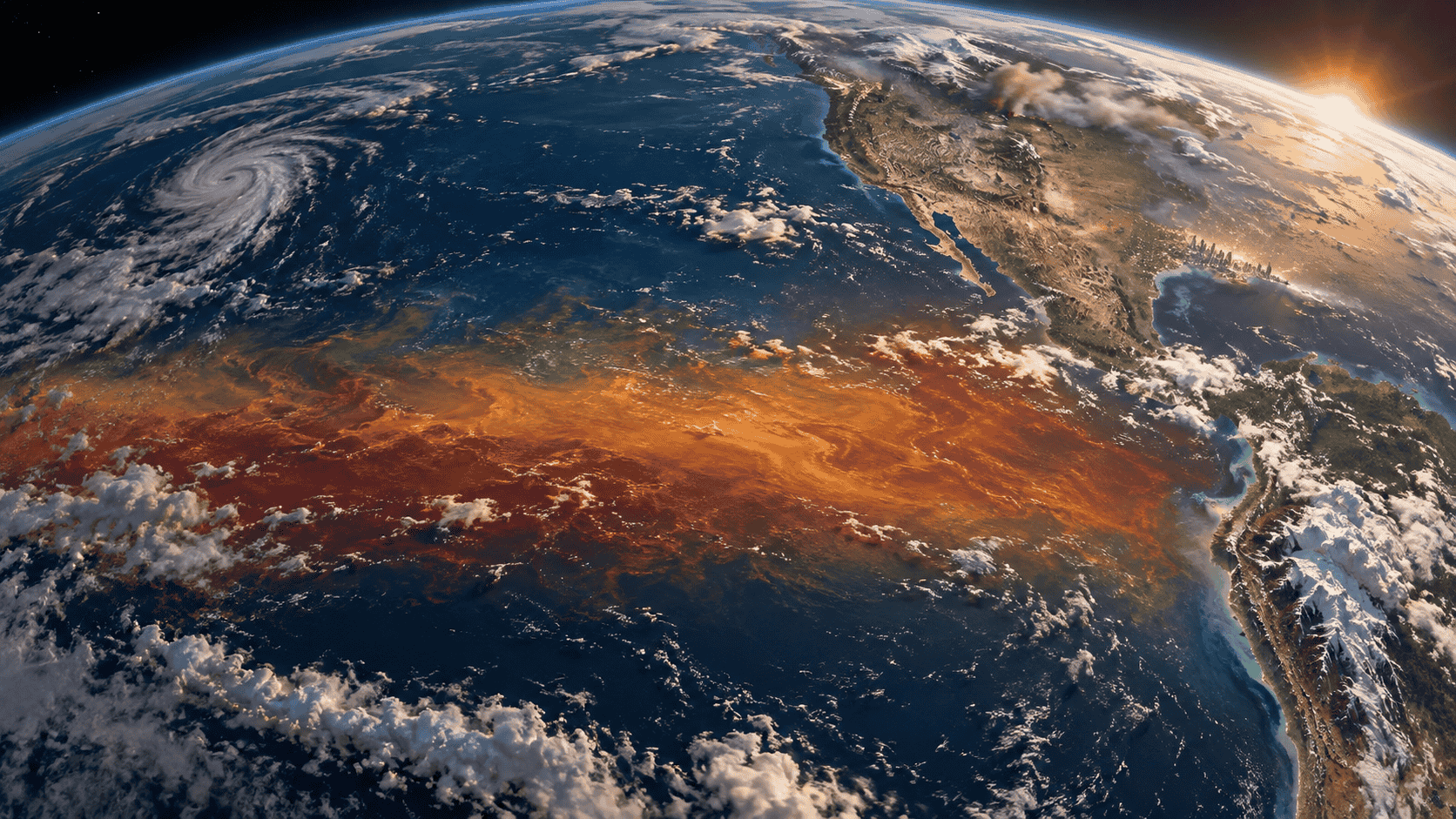
August 2026 was 1.65°C warmer than the estimated pre-industrial average—the warmest August ever recorded and effectively tied for the hottest month in the modern global dataset. But that does not mean the Paris Agreement's 1.5°C limit was suddenly breached. The difference between a hot month and long-term planetary warming is one of the most important climate ideas to understand.
August Hit 1.65°C—Did Earth Just Break the Paris Climate Limit?
The number climate scientists have warned about for years is 1.5°C. In August 2026, the planet reached 1.65°C above the estimated pre-industrial level. So has humanity already crossed the line it promised to avoid? The answer is more complicated—and more worrying—than either “yes” or “no.”
By Sustainability & Global Risks Desk | Friday, September 11, 2026
The number appeared this week and immediately looked alarming:
1.65°C.
According to the EU's Copernicus Climate Change Service, August 2026 was 1.65°C warmer than the estimated 1850–1900 pre-industrial average for August.
Its global average surface temperature reached 16.96°C.
That made August 2026 the warmest August in the ERA5 record and effectively tied it with July 2023 as the warmest month recorded globally across all calendar months; the difference between them was less than 0.01°C.
There is an obvious question.
The Paris Agreement tells the world to pursue efforts to limit global warming to 1.5°C above pre-industrial levels.
August was 1.65°C.
So:
Did we just fail?
Not exactly.
But that answer should not be mistaken for reassurance.
The crucial distinction is between a single month's temperature and the long-term warming of Earth's climate.
Understanding that distinction tells us much more about where the planet is heading than the headline number alone.
First: What Does “1.65°C Above Pre-Industrial” Actually Mean?
It does not mean every place on Earth was exactly 1.65°C hotter.
Some regions were much warmer than normal.
Others were cooler.
And it certainly does not mean the temperature outside your home increased by exactly 1.65°C.
The figure describes a global average temperature anomaly.
Scientists compare the planet's average surface temperature during a period with an estimate of temperatures during a historical baseline.
For climate-policy purposes, 1850–1900 is commonly used to represent pre-industrial conditions.
So, when Copernicus says August 2026 was 1.65°C above pre-industrial levels, it means:
the global average surface temperature for this August was estimated to be 1.65°C warmer than an average August during the 1850–1900 reference period.
That is a planetary average.
And a planetary average moving by more than one degree is enormous.
Why Doesn't 1.65°C Mean the Paris Limit Has Been Breached?
Because the Paris target is about long-term climate change, not one exceptionally hot month.
The Paris Agreement's formal goal is to hold the increase in global average temperature to well below 2°C while pursuing efforts to limit it to 1.5°C above pre-industrial levels.
Climate scientists interpret those warming levels over an extended period.
WMO says the Paris thresholds refer to long-term warming, typically assessed over roughly 20 years, rather than one month or one individual year.
This matters because Earth's temperature moves around the long-term trend.
Natural climate variability can temporarily push temperatures:
above it,
or below it.
Imagine someone slowly walking up a hill while bouncing a ball.
The person's height above sea level steadily increases.
The ball moves up and down around them.
A single high bounce is not the same thing as the person permanently reaching that altitude.
Global warming is the rising hill.
Short-term natural variability helps create the bounces.
We Have Already Had Entire Years Above 1.5°C
This is another reason August's number must be interpreted carefully.
WMO concluded that 2024 was likely the first calendar year with a global mean temperature above 1.5°C relative to 1850–1900, at approximately 1.55°C.
But WMO explicitly stressed that one year above 1.5°C did not mean the Paris long-term target had automatically been breached.
Temporary exceedances were expected to become more common as long-term warming approached the threshold.
August 2026 is another powerful example.
It was the first month above 1.5°C since November 2025.
But the 12-month average from September 2025 through August 2026 was about 1.48°C above pre-industrial levels, according to Copernicus.
That distinction is the heart of the story.
August: 1.65°C.
Latest 12 months: 1.48°C.
Paris: a long-term warming objective measured across decades.
They are related numbers.
They are not interchangeable.
So Everything Is Fine Because It Was Only One Month?
Absolutely not.
Temporary exceedance is not the same as permanent breach.
But repeated temporary exceedances are exactly what scientists expect as the planet moves closer to a sustained higher warming level.
WMO's May 2026 annual-to-decadal outlook gives this uncomfortable context.
It estimates a 91% chance that at least one year between 2026 and 2030 will temporarily exceed 1.5°C, and a 75% chance that the five-year average for 2026–2030 will itself exceed 1.5°C.
So the useful message is not:
“Don't worry, Paris hasn't technically failed.”
It is:
“A single month does not define long-term warming—but these increasingly frequent exceedances show how close the climate system is getting.”
August Did Something Else Strange: It Beat July
Normally, July is the hottest calendar month for the globe as a whole.
That is largely because the Northern Hemisphere contains more land than the Southern Hemisphere, and land heats strongly during northern summer.
Yet August 2026 was 0.06°C warmer than July 2026.
Copernicus says that in the ERA5 record extending back to 1940, August had been warmer than July in the same year only four previous times:
1945,
1951,
1955,
and 1985.
That unusual timing helped make August's record particularly striking.
And one major reason lies in the oceans.
The Oceans Were Exceptionally Hot Too
The planet's oceans absorb enormous quantities of excess heat.
In August 2026, sea-surface temperatures outside the polar regions were also extraordinary.
Copernicus reports that since June 19, daily extra-polar sea-surface temperature had been the warmest recorded for each corresponding calendar day.
On August 24 and 25, the daily value reached 21.11°C, exceeding the previous peak recorded in March 2024.
This matters for much more than swimming conditions.
Warm oceans influence:
atmospheric heat,
humidity,
marine heatwaves,
rainfall,
storm development,
ecosystems,
coral reefs,
and global climate circulation.
And in 2026, part of the ocean story has a very familiar name.
El Niño Is Back—and Getting Stronger
El Niño occurs when the central and eastern tropical Pacific becomes unusually warm and the atmosphere above it reorganizes.
It can influence weather across enormous distances.
WMO says El Niño was firmly established by mid-August 2026 and is expected to strengthen further.
Its global forecasting centres now give a near-100% likelihood that El Niño will persist through February 2027, with the event expected to become very strong before peaking toward the end of 2026.
That is an unusually confident forecast.
El Niño can temporarily add warmth to global average temperatures because the tropical Pacific releases and redistributes large quantities of heat.
It can also alter rainfall patterns around the world.
But there is a crucial misconception to avoid.
El Niño Did Not “Cause Global Warming”
El Niño is a natural climate phenomenon.
Human-driven climate change is a long-term warming trend caused primarily by increasing greenhouse gases.
They operate on different timescales.
A useful analogy is a moving escalator.
Human-caused warming moves the baseline upward.
El Niño can take a few additional steps upward temporarily.
La Niña can push in the other direction for a time.
But neither El Niño nor La Niña explains why the escalator itself keeps rising decade after decade.
The IPCC says natural variability can substantially influence climate at regional and short timescales while having relatively little effect on the long-term centennial warming trend caused by human activities.
So August's extraordinary heat reflects a climate system in which:
long-term greenhouse warming + natural variability + an intensifying El Niño + unusually warm oceans
are interacting.
Assigning an exact percentage of August's record to each factor would require dedicated attribution analysis.
Could Temperatures Drop Below 1.5°C Again?
Yes.
And they almost certainly will at times.
If a future month comes in at:
1.42°C,
1.35°C,
or another value below 1.5°C,
that would not mean climate change has reversed.
Likewise, a month at 1.65°C does not by itself mean long-term warming has permanently reached that level.
Short-term temperatures fluctuate around an underlying trend.
This is why climate scientists focus on averages across longer periods.
The dangerous mistake is watching individual monthly numbers like a stock-market ticker.
The climate signal becomes clearer when you zoom out.
Then Why Is 1.5°C So Important?
Because climate risk does not suddenly begin at 1.5°C.
Damage is already occurring below it.
Nor does Earth instantly become uninhabitable at 1.51°C.
The 1.5°C target is better understood as a risk boundary.
The more warming increases, the greater the probability and severity of harmful impacts.
IPCC assessments conclude that reaching around 1.5°C brings unavoidable increases in multiple climate hazards, while losses and risks become progressively greater with each additional increment of warming.
There is no magical cliff.
There is an increasingly dangerous slope.
Half a Degree Between 1.5°C and 2°C Matters Enormously
Half a degree sounds tiny in everyday weather.
Globally, it is not.
The IPCC has estimated that limiting warming to 1.5°C rather than 2°C could substantially reduce risks across ecosystems and societies.
One of the most memorable examples is coral reefs.
At 1.5°C of warming, warm-water coral reefs were projected to decline by roughly 70–90%.
At 2°C, losses were projected to exceed 99%.
The IPCC also estimated that global sea-level rise by 2100 could be about 10 centimetres lower at 1.5°C than at 2°C, potentially reducing the number of people exposed to related risks by millions.
And an Arctic Ocean essentially free of summer sea ice was projected to occur approximately:
once per century at 1.5°C
versus at least:
once per decade at 2°C.
That is why scientists repeat the phrase:
every fraction of a degree matters.
What Does a Warmer World Actually Feel Like?
Not like the entire planet becoming uniformly warmer every day.
Climate change changes probabilities.
A heatwave that was once exceptionally rare can become less rare.
Heavy rainfall can become more intense in many regions because warmer air can contain more water vapour.
Drought risk can increase elsewhere.
Marine heatwaves intensify.
Glaciers retreat.
Sea levels rise.
Food systems experience more stress.
The IPCC concludes that risks involving heat, water, food security, health, ecosystems and infrastructure grow progressively with additional warming.
The everyday experience of climate change is therefore not:
“Today's weather is 1.5°C hotter.”
It is:
the odds of dangerous conditions are changing.
Does a Very Strong El Niño Mean Every Country Will Have Extreme Weather?
No.
This is another important correction.
WMO explicitly warns that the strength of an El Niño does not translate directly into the magnitude of impacts in each individual region.
El Niño changes large-scale atmospheric circulation.
But local weather also depends on:
geography,
season,
ocean conditions elsewhere,
the Indian Ocean Dipole,
regional pressure systems,
and many other factors.
WMO currently expects a positive Indian Ocean Dipole to develop as well, with a September–November 2026 seasonal mean near 0.9°C.
That can reinforce or counteract El Niño effects in different regions.
Climate is a connected system.
It is rarely controlled by one switch.
What Does This Mean for Pakistan and South Asia?
For South Asia, the practical concerns are enormous because climate affects:
agriculture,
water supply,
heat exposure,
hydropower,
food prices,
public health,
and disaster management.
Earlier in 2026, the WMO-supported South Asian Climate Outlook Forum projected a greater likelihood of below-normal southwest monsoon rainfall across much of South Asia, alongside above-normal daytime and nighttime temperatures.
The forum included meteorological agencies from Pakistan and eight other South Asian countries.
But that regional outlook should not be converted into simplistic claims such as:
“El Niño means Pakistan will definitely have drought.”
Seasonal forecasts are probabilities, not promises.
Pakistan's weather is also affected by:
the Indian Ocean,
western disturbances,
monsoon circulation,
local geography,
snow and glacier conditions,
and short-term atmospheric systems.
For Pakistani readers, the useful message is therefore preparedness—not prediction masquerading as certainty.
Heat Is Also a Health Story
Climate warming is not merely an environmental statistic.
Extreme heat affects the human body.
Higher temperatures and dangerous heat-humidity combinations raise risks of:
heat exhaustion,
heatstroke,
cardiovascular strain,
kidney stress,
reduced labour productivity,
and mortality.
IPCC assessments identify increasing dangerous heat and heat-related health impacts as major risks even around 1.5°C global warming.
For countries with:
large outdoor workforces,
rapid urbanization,
limited cooling access,
and unreliable electricity,
the health consequences can be especially severe.
That is why temperature records increasingly belong in:
health policy,
urban planning,
energy policy,
and labour protection
rather than only environmental news.
Could 2026 Become the Hottest Year Ever?
Possibly, but August alone cannot answer that.
A year's ranking depends on all twelve months.
What we can say is that conditions remain extremely favourable for unusually high global temperatures.
WMO's latest decadal forecast says there is an 86% chance that at least one year from 2026 to 2030 will surpass 2024 as the warmest year on record.
The rapidly strengthening El Niño may further raise the probability of exceptional temperatures into 2027.
Indeed, the WMO update specifically notes that an El Niño near the end of 2026 increases the chance that 2027 could become a new record year.
But climate forecasts are probabilistic.
Records should be declared after measurements, not before them.
Did the Paris Agreement Fail?
This is partly a scientific question and partly a political one.
Scientifically:
one month at 1.65°C does not constitute a formal long-term breach of the Paris 1.5°C warming level.
Politically:
the repeated temporary exceedances show how difficult the original objective has become.
WMO's latest five-year outlook says there is a 75% chance that the 2026–2030 average itself will exceed 1.5°C.
That is not a declaration that the Paris goal has formally failed.
It is a warning that the window for limiting long-term warming near 1.5°C has narrowed dramatically.
The correct response is neither:
“We crossed it, so give up.”
nor:
“It doesn't count, so nothing has changed.”
Both misunderstand the science.
Crossing 1.5°C Is Not an On/Off Switch
Imagine global climate risk as a volume knob.
At 1.2°C, the volume is already too loud for many vulnerable communities.
At 1.5°C, it grows louder.
At 1.7°C, louder still.
At 2°C, risks increase again.
There is no point at which climate action becomes useless.
If humanity cannot hold warming to exactly 1.5°C, then limiting it to 1.6°C is better than 1.7°C.
1.7°C is better than 1.8°C.
1.8°C is better than 2°C.
And 2°C is dramatically better than 3°C.
IPCC assessments repeatedly emphasize that damages and risks increase with every increment of warming.
That is perhaps the most important fact missing from much of the public climate debate.
The 1.65°C Headline Is a Warning, Not a Finish Line
August 2026 was extraordinary.
It was the hottest August Copernicus has recorded.
It was effectively tied for the hottest calendar month in its global dataset.
It was 1.65°C warmer than the estimated pre-industrial August baseline.
Global extra-polar sea-surface temperatures reached extraordinary levels.
And an already established El Niño is expected to strengthen further into the end of the year.
But those facts do not mean Earth's long-term climate suddenly moved from:
1.49°C
to
1.65°C
on August 1.
Climate does not work like that.
One month's number contains both:
the long-term human-driven trend
and
short-term variability.
The Paris target is about the first.
August reflects both.
The Question We Should Be Asking Has Changed
For years, people asked:
“When will we first see temperatures above 1.5°C?”
That question is already outdated.
We have.
Multiple times.
The better question is now:
How long can we prevent temporary excursions from becoming the new long-term normal?
That is where the real climate story sits.
August's 1.65°C does not provide a legal declaration that the Paris Agreement is over.
It provides something more useful:
a glimpse of the temperatures that become increasingly ordinary as the climate warms.
Today they still arrive as records.
Tomorrow they could become averages.
That distinction is why 1.65°C matters.
Not because humanity crossed one magical line during one unusually hot month.
But because each new record shows us what the future looks like if the underlying trend keeps rising.
Frequently Asked Questions
Was August 2026 really 1.65°C above pre-industrial temperatures?
Yes. Copernicus estimates that the global average surface temperature for August 2026 was 1.65°C above the 1850–1900 pre-industrial reference level for August.
Was August 2026 the hottest month ever recorded?
Copernicus describes it as the warmest August on record and effectively joint-warmest among all calendar months, on par with July 2023; their difference was less than 0.01°C.
Did August 2026 break the Paris Agreement's 1.5°C limit?
Not by itself. The Paris warming level refers to long-term global warming over an extended period, typically assessed over around 20 years, rather than a single month.
What was the latest 12-month global temperature average?
Copernicus says September 2025 through August 2026 averaged approximately 1.48°C above the pre-industrial level.
Has an entire year already exceeded 1.5°C?
Yes. WMO concluded that 2024 was likely the first calendar year averaging more than 1.5°C above the 1850–1900 baseline, at approximately 1.55°C. A single year still does not constitute the long-term Paris threshold.
Why was August warmer than July in 2026?
August 2026 was 0.06°C warmer globally than July. Copernicus says this is unusual and has occurred only four other times in the ERA5 record since 1940. Exceptionally warm oceans and land temperatures contributed.
Is El Niño responsible for the record heat?
El Niño contributes temporary additional warming and changes global weather patterns, but it sits on top of long-term human-caused climate warming. It does not explain the decades-long warming trend by itself.
How strong is the 2026 El Niño expected to become?
WMO expects El Niño to strengthen to very strong intensity before peaking toward the end of 2026 and gives a near-100% likelihood of persistence through February 2027.
Does a very strong El Niño guarantee drought or floods in Pakistan?
No. WMO explicitly says the strength of an El Niño does not directly determine the magnitude of impacts in any individual region. Pakistan requires region-specific seasonal and short-range forecasts.
Why does half a degree between 1.5°C and 2°C matter?
IPCC assessments show substantially higher risks at 2°C. For example, warm-water coral reefs are projected to decline by 70–90% at 1.5°C and by more than 99% at 2°C. Sea-level and ecosystem risks also increase.
If the world exceeds 1.5°C, is climate action pointless?
No. Every additional fraction of a degree increases climate risks, so preventing further warming remains valuable regardless of the precise threshold already reached.
August 2026 temperature, 1.65°C global warming, Paris Agreement 1.5 degrees, hottest August 2026, El Niño 2026, global temperature record, climate threshold explained
climate risk assessment, climate adaptation, renewable energy, weather forecasting, climate data, sustainability technology, agricultural climate risk
Climate Change, Global Warming, Paris Agreement, El Niño, Copernicus, Extreme Heat, Oceans, Sustainability, Pakistan, Climate Risk