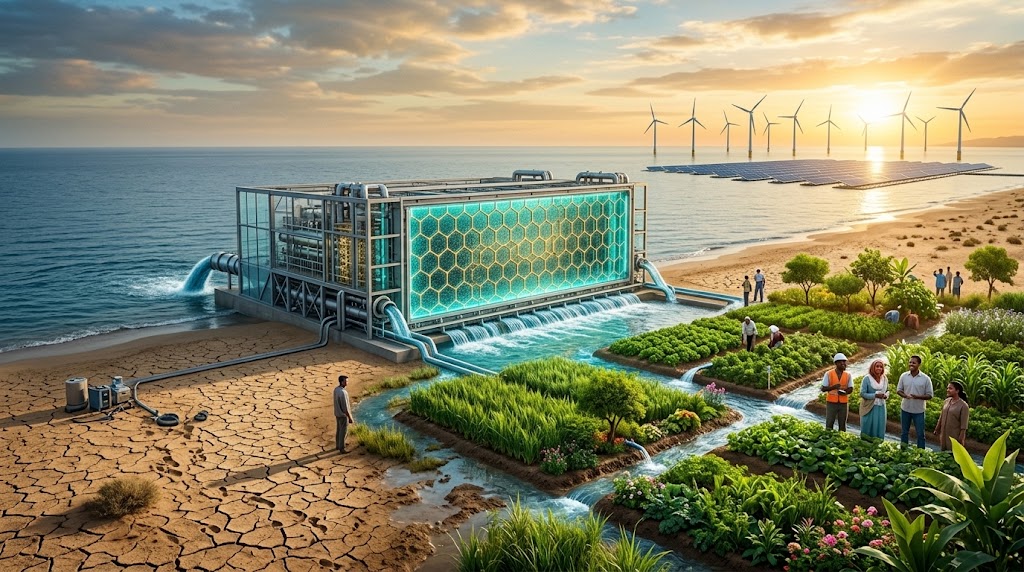
Graphene has been called a miracle desalination material for more than a decade. In 2026, researchers finally solved one of its biggest weaknesses: keeping nanoscale water channels stable instead of letting them swell apart. The result does not make seawater nearly free—but it brings graphene membranes significantly closer to practical water treatment.
The Graphene Water Breakthrough: Why 2026 Brought Desalination Closer to Reality
Graphene did not end the global water crisis this year. What happened may be more important scientifically: researchers found a way to keep graphene oxide's microscopic water channels stable for weeks while maintaining extraordinary water flow and salt rejection.
By Sustainability & Deep Tech Desk | Tuesday, September 8, 2026
For more than a decade, graphene has carried one of the most seductive promises in environmental technology.
Take carbon atoms.
Arrange them in sheets only atoms thick.
Create openings large enough for water molecules to move through but small enough to stop dissolved salts.
Then push seawater through.
Fresh water comes out.
Because the membrane is extraordinarily thin, the idea suggested something almost irresistible:
desalination with dramatically less resistance than conventional filters.
In laboratory simulations, graphene looked spectacular.
In headlines, it looked revolutionary.
But between a beautiful experiment and a desalination plant producing hundreds of millions of litres every day sits an extremely difficult engineering problem.
Real membranes must survive:
water,
pressure,
salt,
fouling,
temperature changes,
manufacturing defects,
and years of continuous operation.
Graphene repeatedly struggled with that transition.
Then, in July 2026, researchers reported a particularly important advance in Nature.
They created a graphene oxide membrane whose internal channels could be controlled with near-atomic precision and, crucially, kept stable while submerged in water.
The membrane maintained about 99% sodium chloride rejection after 30 days of continuous operation while sustaining a water permeance of 67.9 litres per square metre per hour per bar.
The researchers described the water transport as roughly one to two orders of magnitude higher than conventional membranes in the comparisons used in their paper.
That does not mean desalination has become free.
It does not mean giant graphene plants have replaced reverse osmosis.
And it certainly does not mean the global water crisis is over.
But it solves one of the field's hardest materials problems.
And that may be a much more significant milestone than another “miracle material” headline.
Why Water Can Pass Through Graphene So Quickly
Graphene is an extraordinarily thin carbon material.
A pristine graphene sheet consists of carbon atoms arranged in a hexagonal lattice.
Its extreme thinness is what originally made it attractive for filtration.
Water does not need to travel through a thick maze.
In principle, it crosses an extremely short barrier.
But modern experimental desalination research frequently uses graphene oxide, or GO, rather than a single perfect sheet of graphene.
Graphene oxide contains oxygen-containing chemical groups and can be assembled into stacks.
Between those stacked sheets exist incredibly narrow channels.
Water can move through them rapidly.
Ions such as sodium and chloride are surrounded by shells of water molecules.
If the channels are tuned properly, those hydrated ions become too large or energetically unfavorable to pass.
The membrane therefore behaves like an extraordinarily precise molecular sieve.
The concept has been understood for years.
The problem has been controlling those channels.
Graphene Oxide Has an Annoying Habit: It Swells
Put ordinary stacked graphene oxide into water and the sheets can absorb water and move farther apart.
That is disastrous for desalination.
Imagine building a gate designed to stop objects wider than five millimetres.
Then rain falls.
The gate expands to ten millimetres.
Suddenly objects you intended to block start passing through.
Graphene oxide membranes can suffer a similar problem at the atomic scale.
As the interlayer spacing changes, salt rejection deteriorates.
Previous reviews have identified swelling, delamination, inconsistent spacing, defects and large-area manufacturing as major barriers preventing widespread commercialization of graphene oxide desalination membranes.
The 2026 Nature work attacks this problem directly.
Researchers Built Tiny Molecular Pillars Between the Sheets
The team used dopamine molecules to create nanoscale supports inside the graphene oxide structure.
These eventually form polydopamine nanopillars.
The trick is not simply adding another chemical.
It is controlling exactly when the molecules assemble and when they chemically lock into place.
Researchers first used nanoconfined liquid water between graphene oxide layers to allow dopamine molecules to assemble into structures that set the desired channel height.
Then they lowered the temperature further.
The confined water froze.
The assembly process effectively stopped.
Chemical reactions continued, fixing the molecular pillars in place.
The result was a membrane whose internal spacing could be tuned across an extraordinarily narrow range—approximately 5.9 to 10.2 angstroms.
One angstrom is one ten-billionth of a metre.
At this scale, changing the gap by less than the diameter of an atom can determine which ions pass through.
The Membrane Stayed Stable Where Ordinary Graphene Oxide Did Not
This is probably the most important part.
The researchers immersed the composite membranes in water.
Their controlled interlayer structure remained stable for 30 days.
Pristine graphene oxide membranes used for comparison quickly lost structural stability because of swelling.
The team also subjected the composite membrane to high-speed water flushing.
It remained intact after an hour.
The untreated graphene oxide control was damaged far more rapidly.
This addresses one of the biggest objections that has followed graphene desalination research for years:
Fantastic transport properties are irrelevant if the structure changes as soon as the membrane gets wet.
Then Came the Salt Test
In filtration experiments, the membrane achieved sodium chloride rejection of approximately 99.4% over 16 days.
After 30 days, rejection remained around 99.0%.
Water permeance remained roughly:
67.9 L m⁻² h⁻¹ bar⁻¹.
Those are impressive materials-science results.
But there is a crucial detail.
The effective membrane area used for the filtration experiment was only 10.6 square centimetres.
The system operated at 5 bar pressure, and one key salt-rejection test used a 2,000 ppm sodium chloride solution.
Typical seawater contains far more dissolved salt than that.
The researchers also evaluated pretreated seawater from China's Bohai region for ion-sieving experiments, but they explicitly state that the water had been pretreated rather than fed directly as raw seawater.
That context is essential.
This is an advanced research device.
Not yet a replacement cartridge for the world's desalination plants.
This Is Why “The Water Crisis Has Ended” Is the Wrong Headline
Roughly half of the world's population experiences severe water scarcity during at least part of the year, according to UN-Water's summary of IPCC findings.
Another widely cited estimate says about four billion people experience severe scarcity during at least one month annually.
A better membrane cannot solve all of that.
Water scarcity is caused by much more than salt.
It includes:
drought,
groundwater depletion,
damaged infrastructure,
pollution,
population growth,
poor governance,
unequal access,
agricultural demand,
and climate change.
Agriculture alone accounts for roughly 72% of global freshwater withdrawals.
A coastal city may benefit greatly from cheaper desalination.
A farmer hundreds of kilometres inland still needs:
pipelines,
pumping,
storage,
irrigation,
and energy.
Technology changes the equation.
It does not erase geography.
Modern Reverse Osmosis Is Already Much Better Than Its Reputation
Another misconception needs correcting.
Conventional reverse-osmosis desalination does not normally use “silicon-based membranes.”
Commercial systems predominantly rely on thin-film composite polymer membranes, especially polyamide-based technologies.
Modern RO has improved enormously through decades of engineering.
The challenge is not that it “doesn't work.”
It works extremely well.
The challenge is reducing:
energy,
fouling,
membrane replacement,
chemical pretreatment,
brine management,
and operating cost.
A 2026 review of advanced saline-water membranes describes reverse osmosis and nanofiltration as among today's most effective desalination technologies while noting persistent permeability, fouling and pressure-related limitations.
Graphene has to compete with an industry that keeps improving.
That is a much higher bar than beating a laboratory control.
And No, Water Does Not Pass With “Zero Energy”
There is no physically free desalination.
Seawater contains dissolved salts.
Separating water from those salts requires energy because the process must overcome osmotic forces.
Even a theoretically perfect membrane cannot make that thermodynamic requirement disappear.
A more permeable membrane can reduce some pressure losses.
It can potentially allow:
smaller membrane areas,
lower operating pressures in some configurations,
less pumping,
or more water production from the same equipment.
But there is always an energy floor.
That is why claims that graphene makes desalination “nearly energy-free” should be treated skeptically.
The 2026 Nature study reports extraordinary permeance.
It does not demonstrate that a complete commercial seawater plant uses 90% less electricity.
Those are different measurements.
What About Lockheed Martin's Perforene?
The name Perforene has appeared in graphene desalination stories for more than a decade.
Lockheed Martin announced patents around its perforated graphene membrane technology back in 2013.
The concept uses an atomically thin perforated graphene layer supported by another material.
Lockheed argued that extreme thinness could potentially provide very high permeability compared with conventional membranes.
Today, Lockheed still describes Perforene as moving beyond laboratory development and seeking partnerships for real-world applications.
Its current page discusses possible uses in reverse osmosis, ultrafiltration, medical filtration and other separations.
What it does not show is a 2026 global network of giant Perforene seawater plants replacing conventional RO.
So Perforene belongs in the history of graphene desalination.
It should not be presented as the newly deployed system that solved water scarcity this year.
2026 Is Still a Very Important Year for Graphene Water Technology
The Nature paper is not the only advance.
Researchers have been attacking different parts of the practical engineering problem.
A July 2026 study reported graphene and graphene-oxide modified PVDF membranes that achieved roughly two times higher water flux in a membrane-distillation configuration compared with the relevant baseline.
An August study developed a graphene-oxide composite for solar-driven interfacial desalination that achieved a laboratory evaporation rate of 1.54 kilograms per square metre per hour under one-sun illumination and an outdoor water yield of approximately 4.09 litres per square metre per day.
Another 2026 study moved graphene oxide membrane distillation toward larger-area testing, using membranes around 375 cm² and reporting improved thermal performance and antifouling behavior.
None of these individually solves desalination.
Together they show the field moving from:
Can graphene filter water?
toward:
Can graphene survive, scale and operate economically?
That is a much more mature question.
Graphene Is Also Appearing in Water Harvesters That Don't Touch the Ocean
There is another fascinating branch of the story.
Instead of extracting salt from seawater, researchers are trying to extract water vapor from air.
In March 2026, a Nature Communications team reported an atmospheric-water-harvesting material made from:
pectin,
graphene oxide,
and glycerol.
The outer material absorbs moisture.
Graphene oxide layers create pathways that help captured water move through the structure.
Sunlight then helps release the collected water.
The system absorbed between 0.83 and 6.57 grams of water per gram of material across relative humidities from 30% to 90% and achieved a reported daily yield of up to 2.86 litres per kilogram of sorbent.
That's exciting.
But notice the humidity range:
30% to 90%.
Not 15%.
And again, this was advanced research—not millions of desert households already using graphene water generators.
Atmospheric Water Harvesting and Desalination Solve Different Problems
Desalination works best where you have:
seawater,
energy,
and infrastructure.
Atmospheric harvesting can potentially work where centralized water infrastructure is difficult but air still contains usable moisture.
One might someday support:
coastal megacities.
The other:
remote communities,
emergency response,
or decentralized drinking-water systems.
Neither replaces:
watershed protection,
groundwater management,
water recycling,
efficient irrigation,
or conventional treatment.
The future water system will almost certainly use several technologies simultaneously.
Why Scaling Graphene Is Still So Difficult
A laboratory membrane can be beautiful.
A commercial module has to be boring.
It must emerge from a factory:
uniformly,
cheaply,
repeatedly,
and by the square kilometre over its operational lifetime.
Graphene oxide membranes still face major scale-up issues.
Researchers must manufacture large sheets without:
pinholes,
cracks,
uneven thickness,
uncontrolled swelling,
or delamination.
A major review of large-area GO desalination membranes says these defects become substantially more difficult to control as membrane size grows.
Industrial fabrication would require continuous production, coating and drying systems capable of maintaining nanoscale uniformity over vastly larger areas.
A tiny imperfection in a research sample is inconvenient.
A similar defect repeated across thousands of square metres can destroy economics.
Fouling May Be Just as Important as Salt Rejection
Real seawater contains much more than sodium chloride.
There are:
microorganisms,
organic molecules,
oils,
minerals,
suspended particles,
and biological material.
These can accumulate on membranes.
The process is called fouling.
Fouling reduces water flow.
Plants then need:
cleaning chemicals,
higher pressure,
shutdowns,
or membrane replacement.
Some graphene-based materials have shown promising antifouling behavior, including earlier experiments with real Sydney Harbour seawater.
But laboratory fouling resistance must still survive years of industrial exposure before it can establish a major commercial advantage.
The Brine Problem Does Not Disappear Either
For every stream of fresh water produced from seawater, a more concentrated salty stream remains.
This is brine.
Desalination plants must manage it carefully.
Graphene does not make the salt disappear.
It separates salt from water.
The concentrated stream still has to be:
discharged,
processed,
diluted,
or potentially mined for useful minerals.
Better membranes can improve efficiency.
They do not eliminate mass balance.
This is another reason the phrase “unlimited free freshwater” oversimplifies the technology.
Where Graphene Could Have Its Biggest Early Impact
The first widespread graphene-water application may not be a gigantic municipal seawater plant.
It could appear in specialized situations where graphene's high permeability or selectivity is especially valuable.
Examples include:
industrial wastewater,
selective ion recovery,
lithium extraction,
high-value chemical separations,
brackish-water treatment,
and compact purification systems.
The July Nature paper demonstrated something especially interesting beyond ordinary desalination:
the membrane could distinguish between ions differing in hydrated size by less than 0.1 angstrom, including exceptional selectivity between rubidium and potassium under selected conditions.
That opens another commercial possibility.
Future water membranes may not simply remove unwanted material.
They may mine valuable ions from water.
Water Treatment Could Become Resource Recovery
Industrial wastewater contains potentially valuable materials.
Lithium.
Copper.
Rare metals.
Salts.
Nutrients.
Traditional treatment often considers them contaminants.
Highly selective membranes could change the economics.
Instead of:
clean water + waste,
a treatment plant might eventually produce:
clean water + recovered minerals.
This becomes particularly interesting as demand for lithium and other critical minerals rises alongside:
electric vehicles,
batteries,
renewable power,
and electronics.
Graphene's ability to control channels at near-atomic scale could therefore become valuable even before it transforms municipal desalination.
What Would a Real Graphene Desalination Breakthrough Look Like?
Not a laboratory membrane surviving 30 days.
That is the beginning.
A truly transformative result would need to demonstrate something closer to:
large membrane modules,
real seawater,
commercial flow rates,
years of durability,
resistance to fouling,
simple cleaning,
mass manufacturing,
competitive cost,
and significantly reduced energy use at the whole-plant level.
Then independent desalination operators would need to reproduce the result.
Then banks and infrastructure companies would need enough confidence to finance plants expected to operate for decades.
Only then can a research breakthrough become infrastructure.
Graphene has moved closer.
It hasn't crossed that finish line.
Could It Still Change the World?
Absolutely.
That is why accuracy actually makes this story more exciting.
For years, graphene desalination had an uncomfortable problem.
The theoretical physics was spectacular.
The practical membrane was unstable.
The 2026 polydopamine-pillared system demonstrates a clever way around one of those fundamental limitations.
It shows that researchers can:
control graphene oxide channels with extraordinary precision,
prevent severe swelling,
maintain high salt rejection,
and preserve high water transport for a meaningful continuous test period.
That is real progress.
Now comes the harder phase:
engineering.
Pakistan Has a Direct Interest in What Happens Next
For Pakistan, water technology is not an abstract sustainability topic.
The country faces pressure from:
population growth,
groundwater depletion,
agricultural demand,
changing river flows,
urbanization,
pollution,
and climate variability.
Graphene desalination would not solve the Indus basin.
It could eventually become relevant in:
Karachi,
Gwadar,
coastal industry,
brackish groundwater treatment,
and specialized industrial recycling.
But technology should complement—not replace—better management of existing freshwater.
A litre saved through efficient irrigation can sometimes cost dramatically less than producing a new litre from seawater.
The economically rational water system uses the cheapest appropriate solution first.
The Gulf Could Become the Natural Testing Ground
The Middle East is already one of the world's great desalination markets.
Countries including Saudi Arabia and the UAE have:
large coastal populations,
major desalination infrastructure,
capital,
cheap solar potential,
and strong incentives to reduce water-production energy use.
If graphene membranes eventually become commercially competitive, this region could be one of their natural early markets.
But existing reverse-osmosis infrastructure is already highly optimized.
New materials must prove not merely that they work—
but that replacing an established membrane produces enough savings to justify the risk.
Commercialization is an economic experiment as much as a scientific one.
The Graphene Miracle Is Becoming an Engineering Project
Graphene was discovered as an isolated two-dimensional material more than two decades ago.
Almost immediately, people imagined extraordinary applications:
electronics,
batteries,
composites,
sensors,
and water filtration.
Some predictions arrived far too early.
That happens with revolutionary materials.
The laboratory reveals what is physically possible.
Industry discovers what is economically practical.
In desalination, 2026 may be remembered as an important step between those two worlds.
Researchers have demonstrated a graphene oxide structure that can maintain near-atomic spacing while immersed in water.
It rejected roughly 99% of salt over a month-long test.
It moved water extraordinarily quickly.
Other researchers are simultaneously scaling graphene-assisted membranes, improving solar desalination and integrating graphene into atmospheric moisture harvesters.
None of them has ended water scarcity.
But perhaps that is the wrong standard.
A technology does not have to solve the entire global water crisis to matter.
It only has to make one important part of the problem:
cheaper,
cleaner,
more durable,
or more accessible.
Graphene is finally beginning to show how it might do that.
The miracle is not that the ocean suddenly became an unlimited source of free drinking water.
The miracle—if the technology survives the next stage—is that scientists are learning to control water and ions through channels measured almost atom by atom.
And for billions of people living in a world where freshwater is becoming more precious, that is a breakthrough worth watching very closely.
Frequently Asked Questions
Did graphene solve the global water crisis in 2026?
No. Water scarcity remains a major global problem. Graphene-based membranes made important laboratory and early engineering advances in 2026, but they are not yet replacing conventional desalination globally.
What was the major 2026 graphene desalination breakthrough?
A July 2026 Nature paper demonstrated polydopamine-pillared graphene oxide membranes with extremely precise and stable interlayer spacing. The membranes maintained roughly 99% NaCl rejection after 30 days while sustaining high water permeance.
How much salt did the membrane remove?
The study reported approximately 99.4% NaCl rejection during part of the extended test and around 99.0% after 30 days.
Was this tested in a full-size desalination plant?
No. The effective filtration membrane area was approximately 10.6 cm², so the result remains a research-scale demonstration rather than a city-scale deployment.
Was it tested with ordinary seawater?
Key salt-rejection experiments used a 2,000 ppm NaCl solution. The researchers also used pretreated Bohai seawater for ion-separation experiments and explicitly noted that it was not untreated raw seawater.
Does graphene reduce desalination energy by 90%?
There is no current commercial-scale evidence establishing a universal 90% reduction in whole-plant energy consumption. Graphene membranes can show much higher water permeance, but membrane permeance and total desalination-plant electricity consumption are not the same thing.
What is Lockheed Martin Perforene?
Perforene is Lockheed Martin's perforated graphene membrane technology, publicly discussed since at least 2013. Lockheed continues to describe it as a platform being developed with outside partners for various filtration applications, but it is not evidence that graphene desalination has already replaced commercial RO plants worldwide.
Are conventional reverse-osmosis membranes made from silicon?
Generally no. Modern commercial desalination commonly uses thin-film composite polymer membranes, particularly polyamide-based materials.
Why is graphene oxide useful for desalination?
Stacked graphene oxide sheets create extremely narrow channels through which water can move rapidly while hydrated ions can be rejected according to size, charge and confinement effects.
Why has graphene desalination taken so long?
Major obstacles include swelling in water, controlling channel spacing, membrane defects, fouling, mechanical stability, large-area production and cost-effective industrial manufacturing.
Can graphene pull water from air?
Graphene oxide is being incorporated into atmospheric-water-harvesting materials. A 2026 Nature Communications study demonstrated a pectin/graphene-oxide/glycerol material that harvested moisture across 30–90% relative humidity and produced up to 2.86 litres per kilogram of sorbent per day under its test conditions.
Does that system work at 15% humidity?
The cited 2026 Nature Communications study reported performance across 30–90% relative humidity, not 15%. Claims about 15% should not be attributed to that experiment.
Can graphene membranes remove pollutants other than salt?
Graphene-based and hybrid membranes are being researched for contaminants including heavy metals, oils, pharmaceuticals and other substances, but capabilities depend heavily on the specific membrane design. A desalination result should not automatically be interpreted as proof that the same membrane removes every contaminant.
When will graphene desalination become commercial?
There is no reliable universal date. Commercial adoption will require larger-area fabrication, long-duration operation, cost competitiveness, fouling resistance and successful testing under real industrial conditions.
Could graphene desalination help Pakistan?
Potentially, particularly in coastal and brackish-water applications. But desalination cannot replace water conservation, efficient irrigation, groundwater management, wastewater reuse and protection of existing freshwater resources.
Editorial Note: This article deliberately distinguishes laboratory and pilot-scale graphene research from commercial desalination. Claims that graphene has already made freshwater “nearly free,” reduced commercial desalination energy by 90%, ended global water scarcity or enabled widespread desert agriculture in 2026 are not supported by the current evidence. The strongest verified 2026 result is progress in membrane stability, precision ion sieving and water permeance-not global deployment.
graphene oxide membrane, water desalination technology, graphene water filter, low-energy desalination, water scarcity technology, advanced membrane filtration, atmospheric water harvesting
desalination systems, industrial water treatment, membrane filtration, seawater treatment, water purification technology, reverse osmosis membranes, sustainable water infrastructure
Graphene, Desalination, Water Scarcity, Graphene Oxide, Water Technology, Sustainability, Reverse Osmosis, Atmospheric Water Harvesting, Climate Technology