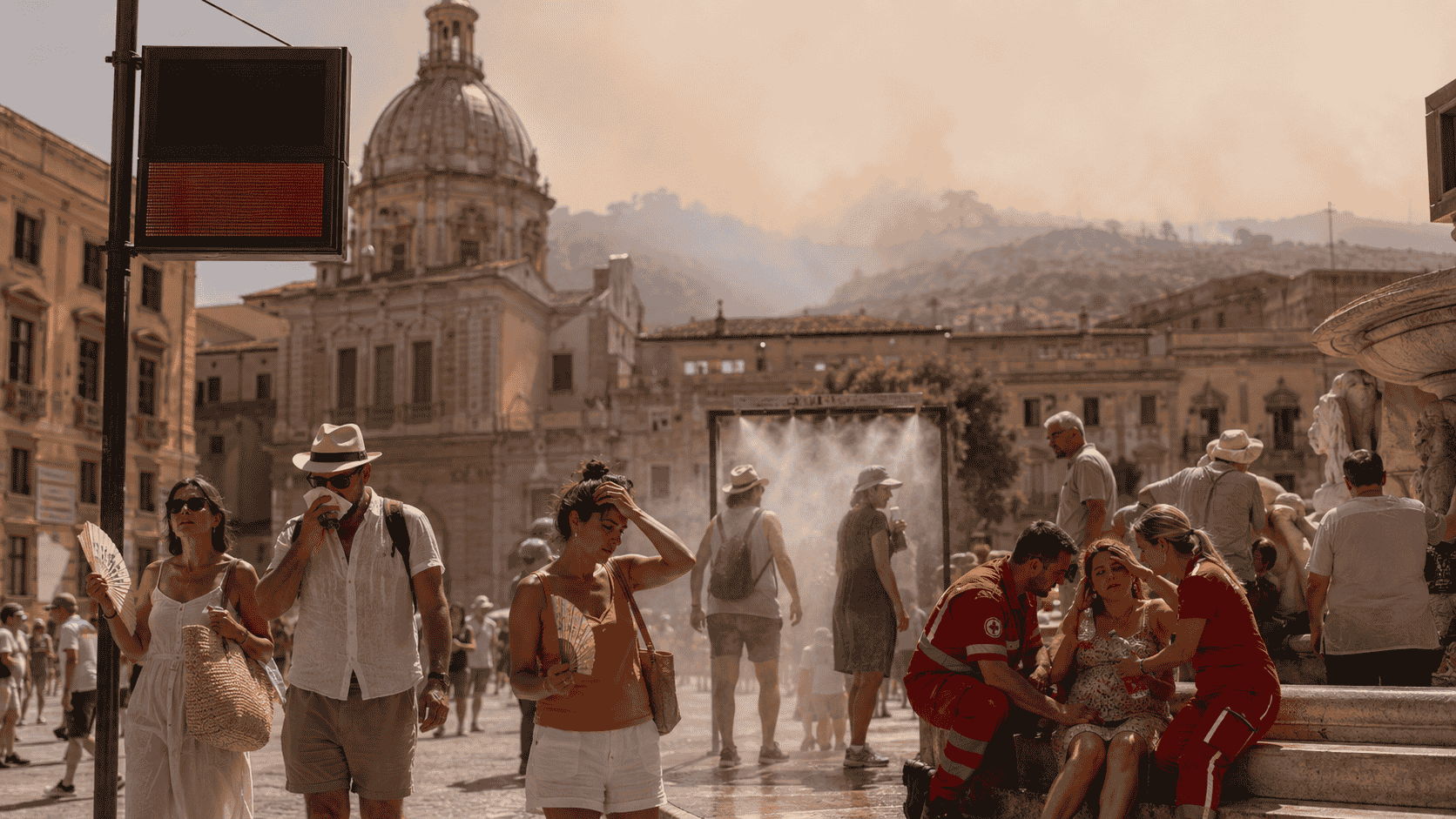
Every Major Italian City Put on Red Alert as Record Heat Grips Europe
Author: Javaid Ahmed Solangi
Publication date: August 7, 2026
Europe is facing a heat emergency, not an ordinary summer
Italy has placed all 27 of its major cities under the country’s highest heat warning as an intense heatwave pushes temperatures above 40°C across parts of Europe.
The red alerts cover cities from Trieste in the north to Palermo in the south, including Rome, Milan, Naples, Florence, Bologna and Venice. Italy’s highest alert level means the heat presents a risk not only to older people and those with medical conditions, but to the general population.
At the same time, Austria has recorded the highest temperature in its history, while dangerous heat, drought and wildfires are disrupting electricity generation, river transport, agriculture and public services across the continent.
This is no longer simply uncomfortable holiday weather.
It is a continent-wide test of whether European cities, hospitals, power stations and transport networks can continue functioning as extreme heat becomes more frequent.
Austria breaks its national temperature record
Austria recorded 41.2°C in Bad Deutsch-Altenburg, a town near the Slovak border, surpassing the country’s previous national record.
The record followed another exceptionally hot day in Vienna and surrounding regions, demonstrating how quickly temperature extremes are being broken during the current heatwave.
Neighbouring Slovakia also registered a national record of 41.4°C in Kamenica nad Hronom.
Slovakia’s previous heat records had already been broken more than once during the summer, while the country also experienced its hottest recorded night, offering residents little opportunity to recover after sunset.
Warm nights are especially dangerous because the human body relies on lower nighttime temperatures to recover from daytime heat exposure. When temperatures remain unusually high throughout the night, the risks of dehydration, heat exhaustion and cardiovascular stress increase.
What does Italy’s red alert mean?
Italy’s heat-warning system uses different levels to communicate the health risks associated with high temperatures.
A red alert is the highest category. It indicates prolonged extreme conditions that can affect healthy and active people—not only groups traditionally considered vulnerable.
Health authorities have advised people to:
Avoid direct sunlight during the hottest part of the day
Drink water regularly
Reduce strenuous outdoor activity
Wear light, loose clothing
Check on older relatives and neighbours
Never leave children or animals inside parked vehicles
Seek medical help when signs of heatstroke appear
Authorities in several cities have opened cooling spaces, installed misting equipment and adjusted public activities to reduce exposure during the hottest hours. Cooling mist fans and additional medical facilities have been deployed around major tourist locations in Rome, including the Colosseum.
Some museums and cultural sites have extended evening opening hours, allowing residents and visitors to avoid the most dangerous daytime temperatures.
Tourists are struggling in Rome and other historic cities
The heatwave has arrived during Europe’s busy summer tourism season.
In Rome, visitors have gathered around fountains, used umbrellas for shade and searched for air-conditioned spaces while walking between historic attractions.
The combination of exposed stone streets, crowded public areas and limited shade can make urban temperatures feel even higher. Historic European buildings were often designed to retain warmth and may lack modern cooling systems.
Outdoor workers, delivery riders, construction crews, agricultural labourers and street vendors face even greater risks because they cannot always avoid the afternoon heat.
Several suspected heat-related worker deaths have already been reported in Italy during the extreme conditions.
Europe’s energy system is also under pressure
The heatwave is creating a difficult energy problem.
Electricity demand rises as millions of homes, shops, hotels and offices increase their use of air conditioning. At the same time, drought and unusually warm rivers can reduce the amount of electricity produced by hydroelectric and nuclear power stations.
Nuclear facilities require large quantities of water for cooling. When river levels become too low—or water becomes too warm—operators may have to reduce production to comply with environmental and safety limits.
Hungary has switched off decorative lighting at prominent landmarks, including its parliament building, Buda Castle and the Chain Bridge, as authorities attempt to conserve electricity. Romania has also reduced public lighting and prepared emergency measures to protect power generation.
Low water levels in the Danube have affected cooling at nuclear facilities in Central Europe, while Moldova has warned that regional electricity shortages could increase the risk of outages.
The result is a dangerous feedback loop: extreme heat increases electricity demand while simultaneously weakening parts of the system responsible for supplying that electricity.
Germany’s rivers are becoming harder to navigate
Drought is also affecting major European waterways.
Falling water levels in Germany’s Rhine River are making it harder for cargo ships to carry full loads. When river levels become too low, vessels must reduce the amount of fuel, chemicals, coal and industrial materials they transport.
More ships may then be required to move the same volume of goods, increasing costs and creating delays.
The Rhine is one of Europe’s most important commercial waterways. Prolonged disruption can affect factories, fuel supplies and international trade far beyond the areas experiencing the lowest water levels.
Wildfire danger remains high
The extreme heat is drying vegetation and creating ideal conditions for wildfires.
Firefighters have been battling blazes across southern and eastern Europe, including parts of France, Albania, Greece, Croatia and Serbia.
In Albania, fires have threatened communities and forced evacuations. Greece has also faced wind-driven fires near populated and agricultural areas.
High temperatures do not automatically ignite a wildfire, but they remove moisture from vegetation. Once a fire starts—through lightning, human activity or damaged infrastructure—it can spread more quickly across dry ground.
Wind can then carry burning material ahead of the main fire, creating new outbreaks and making evacuation routes dangerous.
European wildfire damage during the current summer has already reached billions of euros, increasing pressure on governments to invest more heavily in prevention rather than relying almost entirely on emergency firefighting.
Farms are losing crops and livestock productivity
Agriculture is among the sectors most exposed to prolonged heat and drought.
Crops require more water as temperatures rise, but reservoirs, rivers and groundwater supplies are already under pressure. Heat can damage fruit, reduce grain yields and accelerate ripening before crops achieve their expected size or quality.
Italian farmers have reported stress on vineyards, field crops and livestock. Dairy cows produce less milk during extreme heat because they eat less and use more energy regulating their body temperature.
Britain is also heading toward what analysts expect to be its worst cereal harvest since comparable records began in 1984 following an exceptionally dry and hot growing period.
Lower harvests do not necessarily create immediate shortages, but they can increase production costs and add pressure to food prices—especially when several agricultural regions experience extreme weather at the same time.
Why is Europe becoming so hot?
The immediate weather pattern has been linked to a powerful area of high pressure drawing hot air from North Africa across the Mediterranean and into Europe.
Such systems have occurred before. The wider concern is that human-caused climate change is raising the temperature from which every heatwave begins.
Europe has warmed at approximately twice the global average since the 1980s, according to findings cited by the European Union’s Copernicus Climate Change Service. This makes severe heat events more likely to reach previously exceptional temperatures.
Climate change does not mean every summer will be hotter in every location.
It means that when conditions favour a heatwave, the event can become hotter, longer and more dangerous than it would have been in a cooler climate.
Heat is a silent public-health disaster
Wildfires and storms produce dramatic images of visible destruction.
Heat often kills quietly.
A person may become dehydrated, confused or exhausted without immediately recognising the seriousness of the situation. Heat can worsen heart, lung and kidney conditions and can interfere with medications.
The most vulnerable groups include:
Older adults living alone
Infants and young children
People with heart or respiratory conditions
Outdoor workers
People without air conditioning
Homeless populations
Tourists unfamiliar with local conditions
Residents of top-floor apartments
Urban neighbourhoods with limited trees and large areas of concrete can remain several degrees warmer than greener districts.
That inequality means the same heatwave may be inconvenient for someone with a cooled home but life-threatening for someone living in poorly ventilated housing.
Can European cities adapt?
The crisis is forcing governments to reconsider how European cities are designed.
Possible adaptations include planting more trees, creating shaded walking routes, installing reflective roofs, redesigning public squares, improving building ventilation and expanding access to cooling centres.
Hospitals, schools, nursing homes and public transport systems may also require dedicated heat-resilience standards.
Air conditioning can protect lives, but it also increases electricity demand. When powered by fossil fuels, widespread cooling can contribute to the emissions causing long-term warming.
The challenge is therefore to expand cooling while improving building efficiency and producing more electricity from low-carbon sources.
What happens next?
Forecasters expect dangerous conditions to continue in several regions, although temperatures and warnings will vary by country.
Residents and travellers should consult national weather services rather than relying on general social-media posts. Conditions in Rome may be very different from those in Paris, Vienna or the Alps.
The wider story, however, is unmistakable.
All 27 of Italy’s major cities are under the highest heat alert. Austria and Slovakia have broken national records. Rivers are shrinking, power stations are reducing output and wildfires are spreading across dry landscapes.
Europe’s 2026 heatwave is not only breaking thermometers.
It is revealing how quickly extreme heat can reach into every part of modern life—from the hospital ward and family farm to the electricity grid, cargo ship and crowded tourist street.
Europe Heatwave, Italy Red Alert, Austria Temperature Record, Extreme Weather, Climate Change, European Wildfires, Global Warming, World News