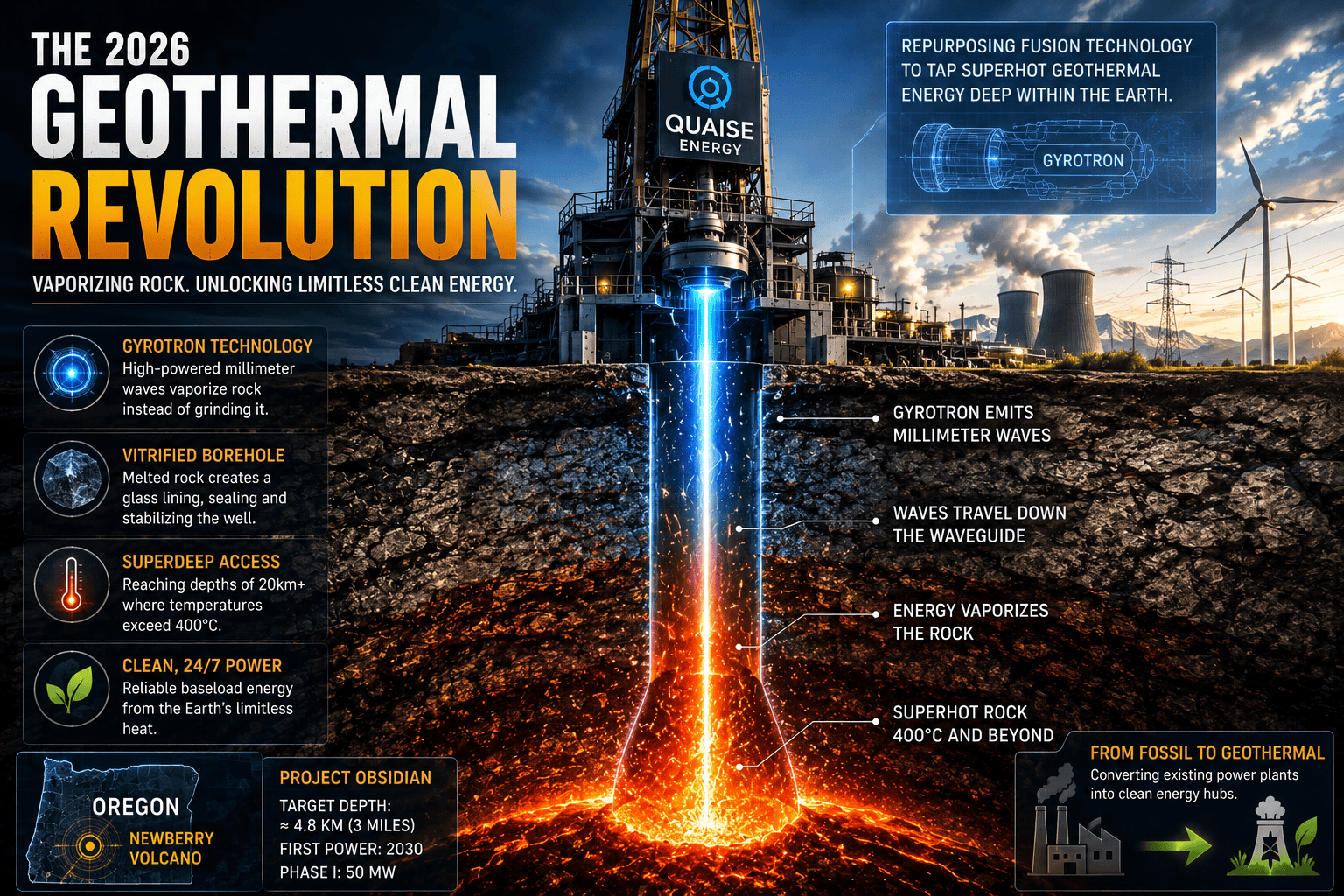
What if drilling five kilometres into hard rock no longer required a drill bit touching the rock? Quaise Energy is taking technology born in fusion research into the field, using high-power millimeter waves to vaporize granite and pursue a new generation of superhot geothermal power.
A machine originally associated with fusion experiments is being turned downward into the Earth. If it works at commercial scale, some of the world's hottest underground rock could become a new source of 24-hour electricity.
By Deep Tech & Energy Desk | Tuesday, August 18, 2026
Imagine standing beside an ordinary-looking drilling rig.
There is steel pipe, heavy machinery and the familiar industrial architecture inherited from more than a century of oil and gas exploration.
But deep inside the borehole, something unusual is happening.
There is no cutting head grinding against the hardest section of rock.
Instead, electromagnetic energy is travelling down the well and heating the rock until it melts and vaporizes.
That is the basic idea behind millimeter-wave drilling, one of the more radical technologies now being developed for the geothermal industry.
And in 2026, it is no longer confined to a laboratory.
Quaise Energy demonstrated more than 100 metres of millimeter-wave drilling through granite in Texas during 2025. By July 2026, the company said its system was approaching one kilometre of depth at the same Central Texas field site.
The next step is considerably more ambitious.
Quaise is developing Project Obsidian in Central Oregon, south of the Newberry caldera. The project is intended to become a commercial superhot geothermal power plant, with its first phase targeting 50 megawatts of continuous electricity and first grid power planned for 2030.
If the technology scales, it could change one of the oldest assumptions about geothermal energy:
That you can only build a major geothermal plant where nature conveniently puts accessible heat close to the surface.
The Real Problem With Geothermal Isn't the Heat
The Earth is not short of heat.
The problem is reaching it economically.
Conventional geothermal plants work extremely well in places where hot water, steam or sufficiently hot rock can be reached at manageable depths.
That is why countries and regions with favourable geology have traditionally dominated geothermal development.
Go deeper, however, and drilling becomes progressively more difficult.
Temperatures rise.
Rock becomes harder.
Pressure increases.
Equipment wears faster.
And every time a damaged mechanical component has to be retrieved from several kilometres underground, time and cost can rise dramatically.
MIT's Plasma Science and Fusion Center says traditional drilling cannot reliably or affordably reach many of the depths and temperatures associated with superhot geothermal resources. Its current research programme is therefore investigating millimeter-wave drilling under the representative pressure and temperature conditions needed for much deeper wells.
That is the problem Quaise is trying to solve.
Not by designing a harder drill bit.
But by eventually removing physical contact between the drilling tool and the deepest rock.
1. How Do You Drill Rock Without Touching It?
The key piece of equipment is called a gyrotron.
Despite some descriptions of the technology online, a gyrotron is not a laser.
It is a high-power vacuum electronic device capable of producing intense electromagnetic radiation at microwave and millimeter-wave frequencies.
Gyrotrons have been developed extensively for fusion research, where powerful electromagnetic waves are used to heat plasma.
Researchers at Oak Ridge National Laboratory describe Quaise's approach as repurposing gyrotron technology originally associated with fusion experiments for deep geothermal drilling.
Instead of directing that energy into a fusion plasma, Quaise sends it toward rock.
From Fusion Plasma to Granite
The idea traces back to work at MIT's Plasma Science and Fusion Center.
Researcher Paul Woskov investigated whether concentrated millimeter-wave energy could penetrate granite, basalt and other hard rock.
Laboratory experiments demonstrated that intense millimeter waves could fracture, melt and vaporize rock, while also producing vitrified surfaces along the borehole.
The engineering concept is surprisingly straightforward to visualize.
A gyrotron remains at the surface.
Millimeter-wave energy travels down a metallic waveguide.
The waves reach the rock face and rapidly heat it.
A gas flow removes the resulting particles and vaporized material back toward the surface.
There is no conventional drill bit spinning against the deepest rock.
That last point matters enormously.
Traditional drilling equipment has moving components underground.
Quaise's deep-rock concept keeps the gyrotron itself on the surface and delivers energy downward.
In theory, that removes one of the fundamental vulnerabilities of conventional ultra-deep drilling: putting complicated mechanical hardware into an environment where both heat and pressure are trying to destroy it.
2. Quaise Isn't Actually Throwing Away the Drill Bit
This is where the story often gets oversimplified.
The future drilling rig Quaise envisions does not replace conventional drilling everywhere.
There is no reason to.
Oil and gas companies have spent generations becoming extremely good at drilling through the relatively accessible formations near the Earth's surface.
Quaise therefore plans a hybrid system.
First, a conventional rotary drill handles the shallower section of the well.
When the bore reaches hard crystalline basement rock—where traditional drilling becomes increasingly costly—the system can switch to high-power millimeter waves.
That approach may ultimately be one of the technology's biggest commercial advantages.
Instead of replacing the entire drilling industry, it can potentially use much of what already exists:
drilling rigs,
pipes,
surface equipment,
oil-and-gas engineering expertise,
geologists,
field crews,
and established supply chains.
The innovation is concentrated where conventional equipment begins to struggle.
That makes this less a story about destroying an old industry and more a story about reusing its infrastructure for a different source of energy.
3. The Strange Glass Lining Created While Drilling
One of the most fascinating aspects of millimeter-wave drilling happens at the wall of the borehole.
When intense electromagnetic energy heats certain rock, part of the material melts.
That molten material can then cool into a hard, glass-like—or vitrified—surface.
This is not merely theoretical.
MIT's early experimental work reported vitrified borehole walls, and Quaise has discussed the possibility that this material could help stabilize deep sections of the well.
That could become extremely valuable.
Traditional wells often require steel casing and cement to maintain structural integrity.
At extreme geothermal temperatures, materials and well completions become much harder to engineer.
A naturally produced glass-like lining could potentially reduce some of those challenges.
But this part of the technology should not be exaggerated.
It has not yet been proven that future commercial superdeep wells can simply eliminate all conventional casing and cement.
MIT continues to study borehole stability, waveguides and rock behaviour under realistic superhot conditions, which shows that these engineering questions remain active areas of development.
That distinction matters.
The vitrified borehole may become a major advantage.
It is not yet a solved commercial system.
4. Why Go So Deep?
If geothermal electricity already exists, why take on the enormous challenge of drilling several kilometres farther?
Because temperature changes the economics.
Traditional geothermal systems generally rely on accessible regions where useful heat is relatively close to the surface.
Quaise is targeting a much hotter resource.
The company defines its superhot target broadly around 300°C to 500°C and ultimately wants its drilling technology to reach depths from roughly 3 kilometres to as much as 20 kilometres, depending on local geology.
The deeper target is not because 20 kilometres is always necessary.
It is because Earth heats differently from place to place.
Near volcanic systems, extremely hot rock can be much shallower.
In geologically cooler regions, you may need to drill dramatically deeper to reach the same temperatures.
That distinction is central to the business case.
If geothermal developers can economically reach hot enough rock in many more locations, geothermal stops being primarily a geographically fortunate resource.
It starts becoming an energy infrastructure technology.
5. Why Superhot Water Changes the Equation
At extreme temperatures and pressures, water behaves differently from the liquid flowing from a household tap.
Above its critical point, water enters a supercritical state in which the conventional distinction between liquid and gas disappears.
For geothermal developers, that matters because superhot fluids can transport far more usable energy through a well.
Quaise says superhot geothermal systems could deliver several times the energy of lower-temperature geothermal systems, increasing the amount of electricity that can potentially be produced from each well.
That is crucial because drilling wells is expensive.
If one well can produce substantially more power, the economics of the entire geothermal project can improve.
This is why Quaise is not merely trying to drill deeper for the sake of setting a depth record.
The real objective is power density.
6. The AI Data Center Problem Makes This More Interesting
There is another reason superhot geothermal is attracting attention in 2026:
The electricity market itself is changing.
AI data centers, semiconductor manufacturing, electrified industrial processes and expanding digital infrastructure are increasing demand for large quantities of reliable power.
Solar and wind are enormously important energy sources, but their output varies with weather and time of day.
That means a modern grid also needs dispatchable or consistently available generation, transmission capacity, storage and other forms of firm power.
Geothermal has a particularly attractive characteristic in that environment:
It can operate continuously.
Quaise describes its target as clean, reliable baseload generation that can eventually rival large conventional plants in power density.
For companies building AI data centers, cloud infrastructure, advanced manufacturing or large industrial sites, 24/7 clean electricity is becoming commercially valuable.
That potentially gives advanced geothermal a market far beyond traditional utility generation.
A future superhot geothermal plant could, in principle, become part of the power strategy for:
AI and cloud data centers;
semiconductor factories;
industrial parks;
hydrogen production;
critical manufacturing;
mining operations;
large cities; and
electricity grids trying to combine renewable generation with dependable firm power.
That is one reason geothermal investment has moved from a niche environmental story toward a much larger energy-security and infrastructure story.
7. Project Obsidian Is Where the Idea Meets Reality
The most important thing happening at Quaise in 2026 is not in a laboratory.
It is in Oregon.
Project Obsidian is being developed on the south side of the Newberry caldera in Central Oregon.
The location is deliberate.
The area's volcanic history gives it a high geothermal gradient, allowing Quaise to pursue superhot conditions without immediately attempting its ultimate 20-kilometre drilling goal.
Project Manager Paolo Rossi said in July 2026 that the project expects to drill roughly three miles—about 4.8 kilometres—to reach its target superhot conditions.
That makes Oregon a logical proving ground.
If you are developing radically new deep-drilling technology, it makes sense to first demonstrate the complete power system somewhere that the heat is relatively accessible.
What Quaise Plans to Build
The company's current Project Obsidian roadmap is staged:
Phase I: 50 MW
Phase II: expansion toward 250 MW
Phase III: potential development beyond 1 GW.
The company says the initial commercial plant is expected to deliver its first electricity to the grid in 2030.
That timeline is much more important than earlier speculative targets suggesting major commercial output in 2026 or 2028.
2026 is not the year superhot geothermal suddenly powers the grid at enormous scale.
It is the year the technology is making the transition from drilling demonstrations toward construction of a commercial project.
That is still a major milestone.
8. The Money Is Beginning to Follow the Technology
Deep-tech projects become considerably more interesting when institutional capital starts moving from experimental R&D toward infrastructure development.
On July 7, 2026, Quaise announced the first close of a $134 million Series B financing round.
The round was led by Prelude Ventures and included strategic investment from major Japanese energy companies JERA and Idemitsu.
Quaise said the financing brings total capital raised to approximately $230 million, with the new funds supporting Project Obsidian and continued commercialization of its millimeter-wave drilling technology.
There is an important signal buried in that announcement.
The funding is not merely intended to build a better laboratory prototype.
It is aimed at moving toward first commercial revenues and a utility-scale energy project.
That transition—from science funding to project finance—is where many promising energy technologies fail.
Power plants require an entirely different level of capital, permitting, engineering, insurance, grid interconnection and commercial contracts than laboratory experiments do.
For Quaise, proving that a gyrotron can vaporize granite was only the beginning.
The much harder challenge is proving that the resulting electricity can compete economically with other forms of generation.
9. The 2025 Drilling Record Was Only the Beginning
The development curve has moved rapidly.
Before 2025, Quaise says millimeter-wave drilling had largely been demonstrated at laboratory scale.
Then came field testing.
In July 2025, the company reported successfully drilling more than 100 metres through granite using its millimeter-wave system in Central Texas. Later public demonstrations described a hole reaching about 118 metres.
By July 2026, Quaise reported that drilling at the Texas site was approaching one kilometre.
That is still dramatically short of a five-, ten- or twenty-kilometre commercial well.
But it represents an important increase from the centimetre-scale experiments where the technology began.
The scale-up problem now becomes progressively harder.
Engineers must maintain energy transmission over longer distances.
They must reliably remove vaporized rock.
They must control borehole geometry.
They must manage waveguide performance.
They must understand how the bore behaves under huge temperature and pressure.
And eventually they must prove that all of this costs less than alternative ways of reaching the same energy resource.
MIT is still building new experimental infrastructure to investigate many of those questions.
10. Could Old Fossil-Fuel Plants Become Geothermal Plants?
This is perhaps the most commercially attractive part of Quaise's long-term vision.
A fossil-fuel power plant is much more than a boiler.
It has turbines.
Generators.
Transmission connections.
Cooling infrastructure.
Buildings.
Industrial permits.
Skilled workers.
And, most importantly, a place on the electrical grid.
Quaise has long proposed developing geothermal resources near existing fossil-fired power stations so some of this infrastructure could eventually be reused.
Conceptually, the underground heat replaces the heat previously produced by burning fuel.
That does not mean every coal or gas power station can simply be converted overnight.
Reservoir engineering, turbine conditions, well design and plant configuration would all matter.
But the economic logic is powerful.
Building a completely new electricity project often requires enormous investment not only in generation but also in transmission and grid connections.
If a future geothermal project can reuse portions of existing power infrastructure, part of that cost could potentially be avoided.
It could also create a transition path for workers whose expertise already lies in drilling, turbines and large thermal power plants.
11. The Biggest Challenges Are Still Underground
For all the excitement around drilling, getting into superhot rock solves only half the problem.
You still have to extract the heat.
That means creating pathways through the underground rock so water can travel through the hot formation, absorb energy and return to the surface.
At superhot temperatures, even that process is not fully understood.
Quaise researchers have acknowledged major research gaps around rock mechanics, reservoir stimulation, permeability, high-temperature tools and long-term well integrity.
That is why it is premature to call superhot geothermal a solved technology.
The drilling system might work while the reservoir fails economically.
The reservoir might perform while well materials deteriorate.
The plant may work technically but cost too much.
Or a new generation of engineering could solve all three.
Project Obsidian is important precisely because the industry needs real field data rather than another computer simulation.
12. Is 20-Kilometre Geothermal Drilling Really Possible?
That is Quaise's ultimate ambition.
The company describes a future drilling envelope of approximately 3 to 20 kilometres, targeting rock between roughly 300°C and 500°C.
MIT's own current research discusses potential millimeter-wave boreholes extending to around 15 kilometres, while emphasizing that significant experimental work remains necessary.
So the correct answer in 2026 is:
Possible in principle, but not yet demonstrated.
Quaise has not drilled a 20-kilometre geothermal well.
It has not yet drilled five kilometres using millimeter waves.
The significance of 2026 is that the gap between small laboratory experiments and those extraordinary targets is finally beginning to close.
A technology that once bored centimetres through laboratory rock has now moved into real field drilling.
The next question is whether that progression can continue by another order of magnitude—and then another.
Why This Technology Matters Even If Quaise Doesn't Reach 20 km
It is tempting to judge millimeter-wave drilling only by its most spectacular promise.
Can it drill twelve miles into the Earth?
That may be the wrong test.
Even if the technology initially proves economic only at five or six kilometres, it could still expand the geography available for geothermal development.
Even if vitrified boreholes do not completely replace traditional casing, they might reduce casing requirements.
Even if old fossil plants cannot be converted directly, geothermal could still benefit from their transmission connections, workforce and industrial sites.
And even if superhot geothermal does not become the dominant global energy source, it could become a valuable source of firm, high-density, zero-fuel electricity.
That alone would matter greatly in a world increasingly hungry for reliable power.
The Bigger Energy Story of 2026
For years, the clean-energy conversation has largely revolved around how quickly the world can build more solar panels, wind turbines and batteries.
Those technologies remain central to the energy transition.
But another question is becoming harder to ignore:
Where will enormous quantities of reliable 24-hour electricity come from as AI, electrification and industrial demand continue growing?
Possible answers include nuclear power, advanced batteries, long-duration storage, expanded transmission, hydropower, natural gas with carbon management—and next-generation geothermal.
Quaise is betting that the Earth itself can become part of that answer.
Its technology takes something developed for one of humanity's most futuristic ambitions—fusion energy—and applies it to one of our oldest sources of energy: heat beneath the ground.
A gyrotron sits at the surface.
Millimeter waves travel kilometres downward.
Granite turns to vapor and ash.
And somewhere beneath it all lies rock hot enough to run a power station.
It sounds like science fiction.
In 2026, at least part of it is already happening in a Texas borehole.
The real test now begins in Oregon.
Frequently Asked Questions
What is millimeter-wave drilling?
Millimeter-wave drilling uses high-power electromagnetic radiation to heat, melt and vaporize rock instead of relying entirely on a mechanical cutting tool. The technology originated from research at MIT's Plasma Science and Fusion Center.
Does Quaise Energy use lasers to drill rock?
No. Quaise uses gyrotron-generated millimeter waves, which are high-frequency electromagnetic waves related to microwaves. Calling the technology a “gyrotron laser” is technically inaccurate.
How deep has Quaise drilled?
Quaise demonstrated more than 100 metres of millimeter-wave drilling through granite in Texas in 2025. In July 2026, the company reported that the system was approaching one kilometre of depth at its Central Texas test site.
Can Quaise drill 20 kilometres underground today?
No. Twenty kilometres is a long-term target rather than a demonstrated capability. Quaise's stated technology vision covers roughly 3–20 km, while its current field drilling is still scaling toward kilometre-class depths.
What is Project Obsidian?
Project Obsidian is Quaise Energy's planned commercial superhot geothermal project in Central Oregon, south of the Newberry caldera. The company plans to drill roughly three miles to access rock in the 300–500°C range.
How much electricity will Project Obsidian generate?
Quaise currently lists 50 MW for Phase I, expansion toward 250 MW in Phase II and longer-term potential beyond one gigawatt.
When will Project Obsidian begin generating electricity?
Quaise says Project Obsidian is targeting first electricity to the grid in 2030. As with any project under development, that remains a forward-looking schedule rather than guaranteed completion date.
What is superhot geothermal energy?
Superhot geothermal targets extremely hot underground rock, generally in the several-hundred-degree Celsius range. Quaise is targeting approximately 300–500°C, where higher-temperature fluids could greatly increase the energy produced per well.
Does millimeter-wave drilling create a glass borehole?
Experiments have demonstrated vitrified—or glass-like—borehole walls when millimeter waves melt rock. Researchers believe this could help stabilize deep wells, but replacing conventional casing entirely has not yet been commercially demonstrated.
Why could geothermal power be valuable for AI data centers?
Geothermal can provide continuous electricity rather than depending on sunlight or wind conditions. If next-generation geothermal can be deployed more widely, that type of firm power could be attractive to grids and large electricity users such as AI data centers and industrial facilities.
How much funding has Quaise Energy raised?
Quaise announced a $134 million first close of its Series B on July 7, 2026, bringing total capital raised to approximately $230 million. The financing is intended to support Project Obsidian and continued development of its millimeter-wave technology.
Editorial Note: Millimeter-wave drilling and superhot geothermal remain emerging technologies. Commercial depth, drilling cost, long-term reservoir performance, borehole integrity and power-plant economics still require field validation. Development targets cited in this article represent company plans rather than guaranteed outcomes.
millimeter-wave drilling 2026, superhot geothermal energy, gyrotron drilling technology, Quaise Energy Project Obsidian, Newberry Oregon geothermal, deep geothermal drilling, 20 km geothermal drilling, geothermal baseload power
geothermal energy investment, clean energy infrastructure, data center electricity, baseload power, grid reliability, renewable energy finance, industrial energy, geothermal drilling technology, power plant investment, energy infrastructure, 24/7 clean power
Quaise Energy, Geothermal Energy, Clean Energy, Millimeter Wave Drilling, Gyrotron, Project Obsidian, Energy Technology, Data Centers, Grid Reliability, Renewable Energy