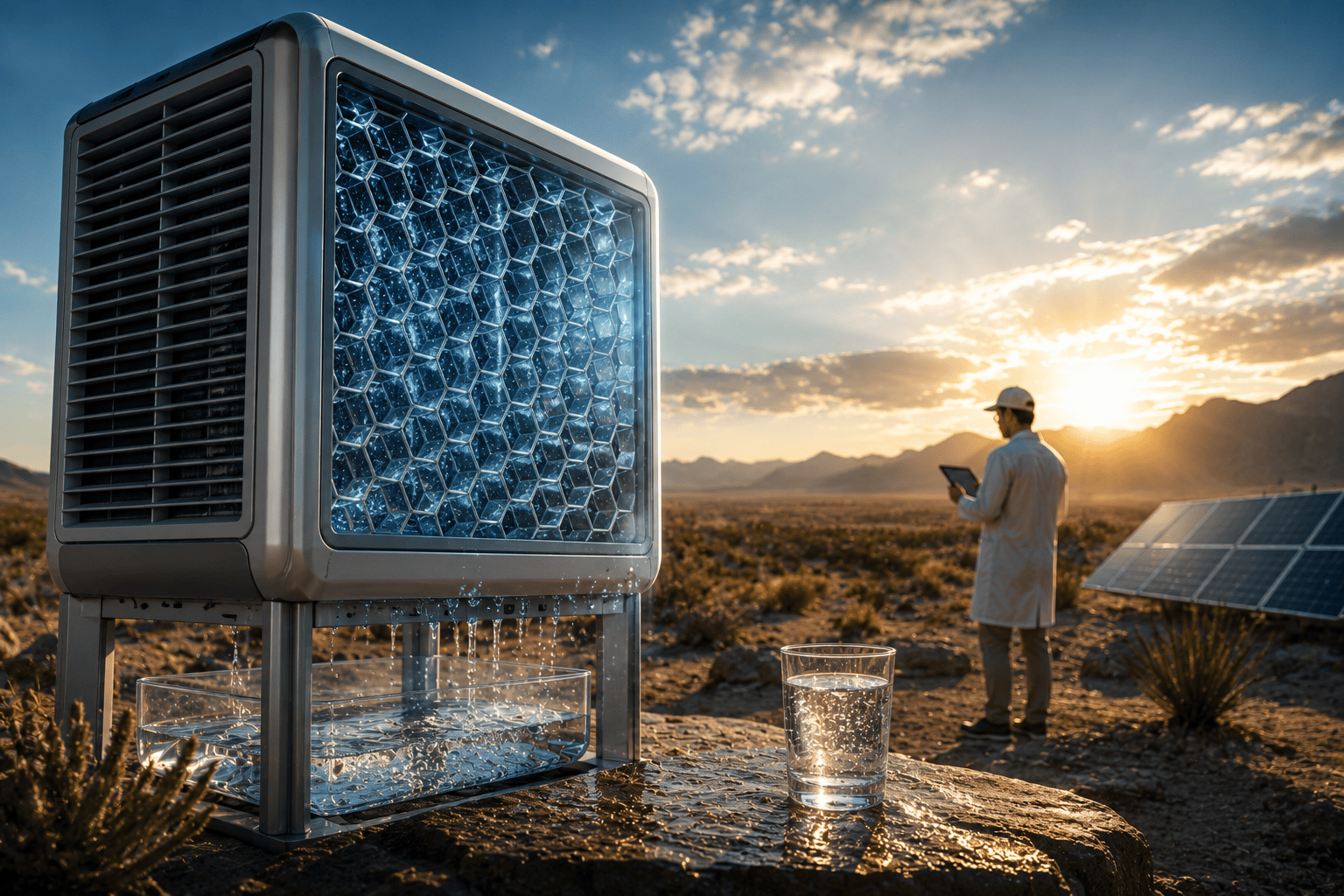
Scientists have known for years that microscopic crystalline structures can trap water from remarkably dry air. In 2026, Nobel recognition, AI-driven materials discovery and the arrival of commercial-scale machines are turning that extraordinary idea into an emerging water industry.
There is water floating above every desert. The difficult part has always been catching enough of it without spending more energy than the water is worth. A Nobel-winning class of materials may finally be changing that equation.
By Deep Tech & Sustainability Desk | Saturday, August 22, 2026
Stand in the middle of a desert and the air feels empty.
Dry.
Hot.
Almost hostile to the idea of water.
But it is not actually empty.
Even extremely dry air contains water molecules.
They are simply spread too thinly for most conventional water-from-air machines to collect efficiently.
That difference has frustrated engineers for decades.
A standard dehumidifier works beautifully in a humid basement because there is plenty of moisture available. Try the same basic approach in a dry inland climate and the machine may consume large amounts of electricity while producing disappointingly little water.
Now imagine a material engineered at the molecular scale specifically to hunt for those scattered water molecules.
A crystalline sponge containing billions of microscopic cavities.
Air passes through it.
Water molecules enter those cavities and become temporarily trapped.
Later, heat—potentially supplied partly or entirely by sunlight—is used to release the captured moisture as concentrated vapour, which can then be condensed into liquid water.
That is the promise of metal-organic frameworks, better known as MOFs.
And 2026 has become an unusually important year for them.
The scientists whose work established MOFs as a new form of molecular architecture received the 2025 Nobel Prize in Chemistry. The Nobel committee specifically highlighted water harvesting from desert air among the technology's potential applications.
At the same time, artificial intelligence is accelerating the search for better water-harvesting MOFs.
And after years of laboratory demonstrations, companies are beginning to move the technology into commercial-scale machines.
This does not mean humanity has suddenly solved water scarcity.
It means something more realistic—and perhaps more important.
The atmosphere is beginning to look like a usable water resource rather than merely a scientific curiosity.
The Water Crisis Is Already Here
Before getting lost in the chemistry, it is worth understanding why this technology matters.
According to the latest WHO and UNICEF figures, around 2.1 billion people still lack safely managed drinking water.
That is roughly one person in four.
More than 100 million people still obtain drinking water directly from untreated surface sources such as rivers and lakes.
Climate change makes the problem harder.
Drought can reduce reservoirs.
Groundwater can be pumped faster than it recharges.
Coastal aquifers can suffer saltwater intrusion.
Population growth increases demand.
Agriculture competes with cities.
And extending pipelines to isolated settlements can be enormously expensive.
Traditional water infrastructure therefore faces a geographic problem.
Water has to come from somewhere.
A river.
A reservoir.
An aquifer.
A desalination plant.
Then it has to be transported.
Atmospheric water harvesting proposes a radically different model.
Instead of transporting water toward the user, capture the water already moving through the air around them.
The atmosphere becomes, in effect, a constantly circulating reservoir.
The question is whether we can access it economically.
1. What Exactly Is a Metal-Organic Framework?
MOFs do not look dramatic.
There are no giant turbines.
No enormous dams.
No glowing reactors.
At a human scale, they can simply appear as powders or granules.
The remarkable architecture exists far below what the eye can see.
A metal-organic framework consists of metal ions or clusters connected by organic molecular linkers.
Those components assemble into repeating crystalline structures filled with microscopic cavities.
Think of a building constructed almost entirely from rooms and corridors.
Now shrink that building to the molecular scale.
The result can have an enormous internal surface area relative to its physical size.
The Nobel committee describes MOFs as molecular constructions containing large spaces through which gases and other chemicals can move. By changing the components, researchers can tune the cavities to capture particular molecules.
That tunability is what makes them so interesting.
A chemist can alter:
pore size,
surface chemistry,
water affinity,
stability,
adsorption behaviour,
and the temperature at which captured molecules are released.
In other words, scientists do not merely find a porous material.
They can design the pore.
For atmospheric water harvesting, that means trying to create a structure that loves water molecules just enough.
Too weakly, and it will not capture enough water from dry air.
Too strongly, and enormous amounts of energy may be needed to release the water again.
The useful material sits somewhere between those extremes.
2. Why Ordinary Water-from-Air Machines Struggle in the Desert
Atmospheric water generators already exist.
Many rely on cooling humid air below its dew point, much like condensation forming on a cold bottle.
In humid climates, this can work well.
But physics becomes less friendly as humidity falls.
Dry air contains less water.
So the machine must process more air and often expend more energy cooling it to extract the same volume of liquid.
Nature Water notes that conventional direct-cooling approaches become particularly energy-intensive and inefficient in the low relative humidity typical of desert environments. MOFs are attractive precisely because their adsorption properties can allow water capture under those dry conditions.
Instead of trying to chill enormous volumes of desert air until water condenses, a MOF system can first concentrate the moisture.
The MOF captures individual molecules.
Once enough water accumulates in the material, the system releases it into a much smaller volume of air.
That concentrated vapour is easier to turn into liquid.
Conceptually, the MOF performs the difficult part first.
It gathers the scattered molecules together.
3. Why the 2025 Nobel Prize Matters
In October 2025, Susumu Kitagawa, Richard Robson and Omar M. Yaghi received the Nobel Prize in Chemistry “for the development of metal-organic frameworks.”
The award was not specifically for atmospheric water harvesting.
MOFs have applications across carbon capture, gas storage, catalysis, chemical separation and other fields.
But the Nobel committee explicitly identified harvesting water from desert air as an example of what these molecular structures can enable.
The recognition matters commercially as well as scientifically.
Advanced materials often spend years trapped in a strange middle ground.
The science works.
Academic papers accumulate.
Prototypes appear.
But manufacturers, investors and customers remain uncertain whether the technology is ready to leave the laboratory.
A Nobel Prize does not magically solve manufacturing.
It does, however, change awareness.
Suddenly an obscure materials-science field becomes internationally recognizable.
Investors notice.
Engineers outside the discipline notice.
Governments notice.
Potential customers notice.
And companies selling MOF technology no longer need to begin every conversation by explaining why the material matters.
The scientific credibility has been established at the highest level.
The challenge now is engineering.
4. AI Is Searching a Chemical Universe Humans Could Never Test Manually
This is where the 2026 story becomes especially interesting.
There is not one MOF.
There are enormous numbers of possible structures.
Change the metal.
Change the organic linker.
Change the geometry.
Change functional groups.
Change pore size.
Change synthesis conditions.
Each alteration can produce different properties.
The chemical design space becomes vast very quickly.
No laboratory can physically synthesize and test every possibility.
This is exactly the kind of problem machine learning is good at.
A 2026 study on atmospheric water harvesting developed an AI-based screening system to predict MOF performance across several properties simultaneously, including water uptake, selectivity and stability.
The researchers screened potential structures, identified top candidates and released a tool called AquaMOF for rapidly estimating whether new MOFs may be promising for atmospheric water harvesting.
Another 2026 review concluded that machine learning is becoming increasingly important for predicting MOF structures, properties, design and synthesis.
This does not mean a scientist types:
“Give me the perfect desert-water MOF.”
and AI instantly invents a commercial material.
Reality is much less magical.
Machine learning can narrow the search.
It can predict.
Rank.
Screen.
Identify patterns.
Suggest promising candidates.
Then chemists still have to make the material.
Characterize it.
Cycle it repeatedly.
Test whether it survives water exposure.
Determine whether it can be manufactured cheaply.
Integrate it into a device.
And prove that device in the field.
AI does not replace the laboratory.
It helps scientists decide which experiments are worth running.
When the possible design space is enormous, that can save extraordinary amounts of time.
5. The Hardest Material Is Not Necessarily the One That Holds the Most Water
This is another place where technology headlines become misleading.
You might assume the best MOF is simply whichever one absorbs the greatest quantity of water.
Not necessarily.
A commercial atmospheric water harvester needs several things at once.
It needs strong water uptake at the humidity where the machine will operate.
It needs to release that water without excessive energy.
It needs to survive thousands of adsorption and desorption cycles.
It needs to resist chemical degradation.
It needs to be manufacturable.
Its ingredients cannot be impossibly expensive.
It must work inside a device rather than only inside a laboratory instrument.
And the overall machine still needs acceptable economics.
This is why multi-objective AI screening matters.
The 2026 AquaMOF research evaluates not just water uptake but selectivity and stability as well.
A spectacular laboratory material that falls apart after repeated exposure to water is not a good commercial water technology.
A slightly less impressive MOF that can be manufactured cheaply and cycled for years may ultimately be far more valuable.
6. Sunlight Could Help Solve the Release Problem
Capturing water is only half the cycle.
The material must give it back.
Traditionally, sorbent-based water-harvesting systems often require heating to release captured moisture.
That regeneration step can dominate energy consumption.
Researchers are therefore experimenting with photothermal materials and MOF composites that use sunlight more effectively.
A Nature Communications study published in January 2026 demonstrated a MOF-based composite designed to reduce the temperature needed for water release. At device level, the researchers reported desorption below 60°C compared with temperatures above 90°C typical of many MOF systems, while field tests showed substantial improvements in solar-to-water generation.
Another 2026 study integrated MOF-303 into bio-inspired photothermal microfibres designed for rapid atmospheric water uptake and release under low humidity.
Researchers have also demonstrated passive systems combining night-time radiative cooling with daytime solar heating, achieving water capture and release without conventional electrical refrigeration.
This is where the phrase solar atmospheric water harvesting becomes genuinely exciting.
In the ideal system:
cooler night air helps adsorption,
the sorbent captures moisture,
morning sunlight heats the material,
water is released,
vapour condenses,
and the cycle repeats.
No municipal pipeline.
Potentially little or no grid electricity for the sorption cycle.
But again, laboratory demonstrations and commercially deployable systems are not the same thing.
The science is moving quickly.
The economics still need proving.
7. 2026 Is the Year Commercialization Started Looking Real
For years, MOF water harvesting lived mainly in research papers, university laboratories and demonstration devices.
That line is finally beginning to blur.
In late July 2026, UK company Ahbstra unveiled its ARK atmospheric water harvester, which it describes as the first commercially available large-scale MOF-based system.
According to the company, the ARK can produce up to 500 litres of water per day and is being positioned for hot, dry regions where conventional condensation systems struggle.
The first purchased installations are expected in early 2027, initially including customers in Spain's water-stressed Balearic Islands.
The machine is not a tiny passive box.
It reportedly costs about £150,000, uses around 10 kW in a typical southern Mediterranean installation and is aimed initially at applications such as off-grid properties and water systems that might otherwise depend on stressed wells.
That is a crucial reality check.
MOF water harvesting is entering commercialization.
It is not yet a cheap household appliance for everyone.
8. Other Companies Are Targeting Much Larger Water Volumes
Ahbstra is not alone.
Atoco, founded around technologies emerging from the work of Nobel laureate Omar Yaghi, has been developing atmospheric water harvesting systems aimed at industrial-scale use.
In early 2026, the company discussed plans for a 20-foot containerized system.
Reported targets for the system range from roughly 2,000 to 4,000 litres per day in grid-connected configurations, with off-grid versions targeting lower output. Agriculture and controlled-environment farming are among the proposed applications.
Another commercial platform, AirJoule, states in regulatory filings that its water-harvesting technology uses a proprietary MOF sorbent combined with a pressure-swing process to extract distilled water from air.
These approaches are not identical.
And that is important.
There may be no single winning architecture for atmospheric water harvesting.
Some systems will be passive.
Some solar-assisted.
Some electrically regenerated.
Some hybrid.
Some built for homes.
Others for farms, hotels, factories, military operations or isolated communities.
The industry is still discovering where atmospheric water makes the most economic sense.
9. The First Big Market May Not Be the Average Household
A futuristic image of a little box beside every home producing unlimited drinking water is irresistible.
The real commercial rollout will probably be more targeted.
Atmospheric water becomes especially valuable where conventional alternatives are expensive, unreliable or geographically difficult.
Imagine a remote resort on a dry island.
A mining operation far from municipal infrastructure.
A greenhouse in an arid region.
A military installation.
A disaster-response camp.
A construction site.
A rural clinic.
An isolated community where water currently arrives by truck.
In those situations, the economic comparison is not:
atmospheric water versus cheap municipal tap water.
It might be:
atmospheric water versus trucking thousands of litres across 100 kilometres.
That changes everything.
A litre of water that looks expensive compared with a city pipeline can suddenly look attractive compared with tanker deliveries, bottled-water logistics or drilling an unreliable well.
This is how disruptive infrastructure technologies often enter the market.
Not everywhere at once.
At the places where the old system hurts most.
10. Agriculture Could Become One of the Most Important Applications
Agriculture consumes enormous quantities of water.
That means atmospheric water harvesting is unlikely to irrigate vast commodity-crop fields anytime soon.
The volumes required are simply enormous.
But specialized agriculture tells a different story.
Greenhouses.
Seed production.
High-value horticulture.
Nurseries.
Controlled-environment farming.
Hydroponics.
Remote livestock operations.
These applications can place much higher economic value on each litre of reliable water.
Atoco has specifically discussed controlled-environment agriculture as a commercial target for its containerized systems.
There is an additional attraction.
A greenhouse releases water vapour.
Plants transpire.
In a sufficiently controlled environment, future water systems could potentially capture and recycle part of that atmospheric moisture.
The result would not be “water from nothing.”
It would be smarter management of a local water cycle.
That is an important distinction.
11. Atmospheric Water Is Not Automatically Drinking Water
This deserves far more attention than futuristic articles usually give it.
Pulling water molecules from the atmosphere does not automatically produce a glass that should be handed to a child.
The entire system matters.
Air may contain:
dust,
microorganisms,
volatile chemicals,
particulates,
and other contaminants.
The device itself may introduce contamination if poorly maintained.
Stored water can also develop microbial problems.
Depending on system design and intended use, harvested water may therefore require filtration, disinfection, mineral balancing, sanitary storage and regular water-quality testing.
Some technologies produce very pure distilled water, which creates a different problem: extremely low mineral content may need adjustment for taste or specific potable-water standards.
So the correct technological goal is not merely:
capture water.
It is:
reliably produce safe water at the point of use.
That involves materials science, mechanical engineering, filtration, sensors, sanitation and regulatory compliance.
The MOF is only one part of the machine.
12. Atmospheric Water Will Not Replace Desalination
Another dramatic claim worth resisting is that MOFs make desalination obsolete.
They do not.
Desalination has an enormous advantage:
the ocean contains a lot of water.
A giant coastal city may require hundreds of millions of litres every day.
Large desalination plants can operate at a scale that atmospheric water harvesting is nowhere close to matching.
Atmospheric systems have a different advantage.
They can be decentralized.
No coastline is required.
Potentially no long pipeline.
No giant reservoir.
Install generation close to consumption.
That makes the technologies complementary.
A future water system might combine:
reservoirs,
groundwater,
water recycling,
desalination,
rainwater harvesting,
leak reduction,
and atmospheric water generation.
The goal is not finding one magical source.
It is building resilient portfolios.
13. The Air Is a Reservoir—But It Is Not Infinite at Every Scale
The phrase “the atmosphere is an unlimited source of water” sounds attractive.
Physics demands more care.
Earth's atmosphere contains an enormous quantity of water overall because the hydrological cycle continuously replenishes it.
But the amount available at a particular place and time depends on temperature, humidity, weather and airflow.
A single machine extracting modest quantities is unlikely to matter environmentally.
Large-scale atmospheric extraction concentrated in one location raises more complicated questions about local moisture flows and overall energy use.
That research will become increasingly important if AWH moves from specialized devices to serious infrastructure.
Every water technology has environmental constraints.
Desalination has energy demand and brine.
Groundwater extraction can deplete aquifers.
Dams alter ecosystems.
Atmospheric harvesting will need its own careful lifecycle analysis.
There is no free water.
There are only different ways of accessing the hydrological cycle.
14. The Most Important Cost May Be Energy per Litre
Water technology ultimately becomes an economics problem.
A machine can be scientifically brilliant and commercially useless if each litre costs too much to produce.
This is why energy efficiency matters so much.
How much electricity—or solar thermal energy—is required to collect and release the moisture?
How much air must be moved?
How frequently can the material cycle?
How long does the MOF last?
What does replacement material cost?
How much maintenance is required?
What purification is necessary?
What is the cost per litre over the machine's lifetime?
These questions matter more to an actual customer than the elegance of the crystal structure.
A 2026 prototype study of a hybrid MOF-assisted refrigeration system illustrates the challenge. Researchers demonstrated that MOFs can improve water recovery in hybrid devices, but energy consumption remains highly dependent on operating conditions and system design.
Commercial success will therefore require more than new MOFs.
It needs better engineering around them.
15. AI Could Eventually Optimize the Whole Machine, Not Just the Material
The relationship between artificial intelligence and atmospheric water harvesting may eventually extend far beyond molecular discovery.
Imagine a commercial machine operating in a desert.
Humidity changes every hour.
Temperature changes.
Electricity prices may change.
Solar output changes.
Water demand changes.
The machine does not necessarily want to adsorb and regenerate at exactly the same schedule every day.
An intelligent controller could decide:
when to expose the sorbent,
when to regenerate it,
whether to use solar heat,
when to run fans,
when to store water,
how to respond to weather forecasts,
and when maintenance is required.
A system could learn the local climate.
In humid hours, harvest aggressively.
During expensive electricity periods, reduce active processes.
During strong sun, regenerate.
Before expected demand, fill storage.
At that point AI is not merely helping invent the MOF.
It is helping operate an adaptive local water plant.
That may ultimately be as important as AI-based material discovery itself.
16. Why Water Technology Could Become a Huge Investment Category
Water is easy to underestimate because consumers in well-served cities turn a tap and expect it to work.
Behind that simple action is enormous infrastructure:
pumping,
treatment,
pipelines,
storage,
electricity,
chemicals,
monitoring,
maintenance,
and capital expenditure.
Much of that infrastructure is ageing.
Climate stress adds uncertainty.
Industry requires increasingly reliable water.
Semiconductor plants need ultra-pure water.
Data centres require cooling strategies.
Agriculture remains highly exposed to scarcity.
Hotels and real-estate developments in dry regions need secure supply.
That creates commercial demand across:
industrial water treatment,
desalination,
water recycling,
filtration,
leak detection,
atmospheric water generation,
smart metering,
and water-quality monitoring.
MOFs therefore sit inside a much larger investment story.
The technology is not merely about giving someone a futuristic bottle of desert water.
It is about whether distributed water production can become another layer of infrastructure.
17. The 2026 Breakthrough Is Not One Magic Material
Perhaps the most important lesson is that there is no single breakthrough to point at.
Instead, several technologies are converging.
MOFs are improving.
Composite sorbents are lowering regeneration temperatures.
Photothermal materials are making better use of sunlight.
AI is accelerating material screening.
Manufacturing methods are improving.
Sensors are becoming cheaper.
Control systems are smarter.
Commercial machines are getting larger.
And investors are finally willing to fund deployment.
This is often how deep technology becomes real.
Not with one cinematic Eureka moment.
With hundreds of smaller improvements finally crossing an economic threshold together.
18. What 2026 Actually Represents
It would be easy to write:
“The global water crisis has been solved.”
It has not.
Two billion people do not suddenly receive safe water because a MOF exists.
Water scarcity is shaped by poverty, governance, infrastructure, agriculture, inequality, conflict and climate.
A brilliant adsorbent cannot solve those problems by itself.
The more meaningful statement is this:
2026 is beginning to look like the year MOF atmospheric water harvesting moved from celebrated science toward an emerging commercial industry.
The Nobel Prize brought international recognition.
New research is showing better solar regeneration.
Machine learning is helping screen enormous numbers of materials.
And commercial developers are beginning to sell or prepare machines capable of producing hundreds or potentially thousands of litres per day.
Those are genuine milestones.
Drinking the Desert Air
The poetry of atmospheric water harvesting is difficult to ignore.
A crystal sits in dry air.
Nothing visible happens.
Inside microscopic pores, individual water molecules begin gathering.
One joins another.
Then another.
The material fills.
Sunlight arrives.
The water is released.
Vapour becomes liquid.
A substance that seemed absent from the landscape appears in a container.
There is something almost impossible about it.
But the underlying science is straightforward.
The desert was never completely without water.
We simply lacked an efficient way to collect molecules that were too widely scattered to see.
Metal-organic frameworks give scientists the ability to engineer tiny spaces that are unusually good at finding them.
AI is helping search for better versions.
Solar engineering is helping release the water with less energy.
And industry is attempting to turn the entire cycle into machines that can survive outside the laboratory.
The future may not be a world where every home owns a magical box producing unlimited water.
It may be more practical than that.
A greenhouse that no longer depends entirely on tanker deliveries.
A remote resort that reduces groundwater extraction.
A village with an additional emergency water source.
A disaster zone where local water production can arrive in a container.
An industrial site that generates part of its process water from the atmosphere.
A dry island that adds another source to its water portfolio.
That is how infrastructure revolutions usually happen.
Not by replacing everything overnight.
By making previously impossible places a little less dependent on where water happens to be.
In 2026, one of chemistry's strangest crystals is beginning to do exactly that.
Frequently Asked Questions
What is a metal-organic framework?
A metal-organic framework, or MOF, is a crystalline material built from metal ions or clusters connected by organic molecules. The structures contain microscopic pores that can be chemically tuned to capture selected molecules, including water vapour. The developers of MOFs received the 2025 Nobel Prize in Chemistry.
Who won the 2025 Nobel Prize for MOFs?
The 2025 Nobel Prize in Chemistry was awarded to Susumu Kitagawa, Richard Robson and Omar M. Yaghi for the development of metal-organic frameworks.
Can MOFs really collect water from desert air?
Yes. MOFs have demonstrated the ability to adsorb water at low humidity, which is one reason they are attractive for atmospheric water harvesting in arid and semi-arid environments.
How does a MOF atmospheric water harvester work?
The MOF adsorbs water molecules from air into its microscopic pores. The material is then heated or otherwise regenerated, releasing concentrated water vapour that is condensed and collected.
Can sunlight release water from MOFs?
Solar-assisted systems are being actively developed. Several 2026 studies demonstrated MOF composites and photothermal structures that use solar energy to drive water release at lower temperatures or without conventional electrical refrigeration.
Is MOF water harvesting commercially available in 2026?
Commercialization is beginning. Ahbstra unveiled a large-scale MOF atmospheric water harvester in July 2026, with first purchased installations expected in early 2027. Other companies including Atoco and AirJoule are developing commercial systems.
How much water can commercial MOF systems produce?
Current announced systems vary substantially. Ahbstra says its ARK can produce up to about 500 litres per day, while Atoco has discussed larger containerized systems targeting thousands of litres per day in certain configurations. These are manufacturer targets and real-world production will depend on climate and operating conditions.
Can I buy a household MOF water generator today?
Small consumer-scale MOF systems are not yet a mature mass-market category comparable with conventional household appliances. Current commercial efforts are focused heavily on larger off-grid, agricultural, industrial and infrastructure applications.
Does atmospheric water harvesting work at 5% humidity?
MOFs are being researched specifically for low-humidity operation, but usable water output depends strongly on the material, temperature, device architecture and climate. A blanket claim that every MOF system operates efficiently at 5% relative humidity would be misleading.
How is AI helping develop MOFs?
Machine learning can predict properties across huge libraries of potential MOF structures and rank promising candidates before researchers synthesize them. A 2026 project called AquaMOF uses machine learning to predict water uptake, selectivity and stability for atmospheric water harvesting.
Does AI automatically invent new MOFs?
No. AI can accelerate screening, prediction and design, but candidate materials still require chemical synthesis, characterization, stability testing and device-level validation.
Is water harvested from air automatically safe to drink?
Not necessarily. A complete potable-water system must control contamination through appropriate filtration, disinfection, hygienic storage and water-quality testing. The requirements depend on the device and local drinking-water regulations.
Can MOF atmospheric water harvesting replace desalination?
Not at the scale required for large coastal cities today. Desalination remains capable of producing vastly larger volumes. Atmospheric water harvesting is more likely to complement existing supplies, particularly in remote, arid or decentralized applications.
Is atmospheric water unlimited?
The atmosphere is continuously replenished by Earth's hydrological cycle, but available moisture at a specific location varies with temperature, humidity and weather. Large-scale extraction would still need environmental and energy assessment.
What industries could use atmospheric water harvesting?
Potential markets include off-grid properties, agriculture, greenhouses, hotels, remote infrastructure, disaster response, military operations, industrial facilities and communities where wells, pipelines or water deliveries are unreliable or costly.
Why is 2026 important for MOF water harvesting?
The field has reached an unusual convergence: MOFs received the 2025 Nobel Prize in Chemistry, new AI tools are accelerating material discovery, solar-driven systems are improving, and commercial-scale machines are beginning to enter the market.
Editorial Note: Atmospheric water harvesting remains an emerging water-supply technology. Actual yield, energy use, water quality, cost and reliability vary substantially by climate, machine architecture and operating conditions. Manufacturer production figures should be treated as stated performance targets unless independently validated under comparable field conditions.
metal-organic frameworks, atmospheric water harvesting, water from air technology, MOF atmospheric water generator, AI materials discovery, solar water harvesting, desert water technology, atmospheric water generator 2026
industrial water treatment, atmospheric water generators, water filtration systems, solar water technology, desalination alternatives, agricultural water systems, off-grid water solutions, commercial water purification, climate technology investment, water infrastructure
MOF, Water Harvesting, Atmospheric Water, Water Scarcity, Climate Technology, AI Materials Science, Clean Water, Sustainability, Solar Energy, Deep Tech