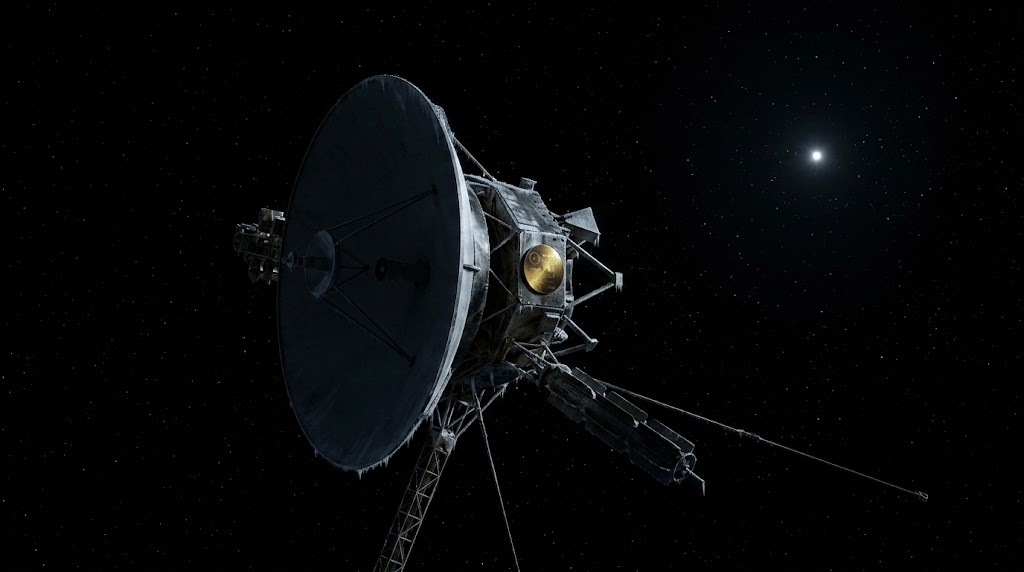
One Light-Day From Home: NASA's Extraordinary Fight to Keep Voyager 1 Alive
Nearly half a century after leaving Earth, Voyager 1 has one problem no engineer can permanently repair: every year, it has a little less electricity than the year before. NASA is now performing some of the most delicate power management in spacecraft history to keep humanity's most distant machine talking.
By Space & Deep Tech Desk | Sunday, August 30, 2026
There is no repair crew coming for Voyager 1.
No astronaut can reach it.
No robotic servicing spacecraft can rendezvous with it.
There is no spare battery waiting somewhere beyond Pluto.
Voyager 1 is now roughly 25.6 billion kilometres from Earth, moving through interstellar space at around 61,000 kilometres per hour. A radio command sent from Earth currently needs almost 23 hours and 46 minutes just to reach it.
Soon, even that astonishing delay will become longer.
NASA calculates that on November 18, 2026, Voyager 1 will cross a milestone no human-made object has ever reached before:
one light-day from Earth.
At that distance, light—or a radio signal travelling at light speed—requires a full 24 hours to cross the gap in one direction.
Send a command on Monday.
Voyager receives it on Tuesday.
If the spacecraft responds immediately, Earth may not hear the answer until Wednesday.
And yet NASA is still operating it.
That may be one of the most extraordinary engineering facts of the modern space age.
Voyager 1 was launched on September 5, 1977.
Its original planetary mission was measured in years.
In 2027, it will turn 50.
The challenge now is not travelling farther.
Voyager has already done that.
The challenge is keeping enough of the spacecraft alive to continue returning science.
And in 2026, that challenge became urgent.
A Spacecraft Slowly Running Out of Electricity
Voyager 1 does not carry solar panels.
At its current distance, sunlight is far too weak for the spacecraft's original mission architecture to rely on solar power.
Instead, Voyager carries three radioisotope thermoelectric generators, or RTGs.
Inside them is plutonium-238.
As the isotope naturally decays, it produces heat.
Thermocouples convert part of that heat into electricity.
There are no spinning generators and no conventional rechargeable batteries powering the mission indefinitely.
It is an elegant system—and one of the major reasons Voyager has survived this long.
But the process cannot continue at the same power level forever.
As the plutonium decays and the generators age, the amount of usable electrical power declines.
NASA says each Voyager currently loses roughly 4 watts of electrical power every year.
Four watts sounds trivial.
In a house, it is.
On a spacecraft that has already spent decades eliminating almost every unnecessary electrical load, four watts can determine whether an entire scientific instrument survives another year.
NASA Has Been Turning Voyager Off Piece by Piece
The Voyagers originally carried ten scientific instruments.
Many were designed for the planetary encounters with Jupiter, Saturn, Uranus and Neptune and became unnecessary after those encounters ended.
Others continued operating during the probes' journey toward interstellar space.
As the available electrical power declined, engineers gradually shut equipment down.
Heaters went first where spacecraft temperatures allowed it.
Then more instruments.
Then more subsystems.
Every shutdown creates another little reserve of electrical power.
But eventually there is very little left to sacrifice.
Voyager 1 reached that point again this year.
February 27 Was the Warning
During a routine planned roll maneuver on February 27, 2026, Voyager 1 experienced an unexpected decline in its available power.
That worried engineers because the spacecraft has an automatic undervoltage-protection system.
If electrical voltage drops too far, Voyager can begin shutting components down automatically to protect itself.
That sounds useful.
At a distance approaching one light-day, it can also create an enormous recovery problem.
If the spacecraft autonomously enters a fault state, engineers must first understand what happened, devise recovery commands, transmit them across more than 25 billion kilometres and wait nearly another day for confirmation.
NASA's Voyager team decided it was safer to reduce the electrical load deliberately before the spacecraft was forced to make that decision itself.
Something had to be sacrificed.
On April 17, a 49-Year-Old Instrument Went Silent
NASA chose Voyager 1's Low-Energy Charged Particles experiment, known as LECP.
The instrument had operated almost continuously since Voyager launched in 1977.
For nearly five decades, LECP measured ions, electrons and cosmic rays.
It helped scientists study the heliosphere and, after Voyager 1 crossed the heliopause in 2012, the particle environment of interstellar space.
On April 17, 2026, JPL sent the shutdown command.
The command itself took about 23 hours to reach Voyager.
Then the programmed shutdown sequence required approximately three hours and 15 minutes aboard the spacecraft.
Only after that could telemetry make the enormous journey back toward Earth.
That means even switching off one instrument becomes a multi-day conversation.
NASA Didn't Quite Turn All of LECP Off
There is a wonderful engineering detail hidden inside the shutdown.
LECP contains a small motor that rotates part of the detector so it can scan particles arriving from different directions.
NASA left that motor running.
Why keep part of a supposedly retired instrument alive?
Because it consumes only around 0.5 watts.
Leaving it operating increases the possibility that engineers might someday turn LECP back on if they manage to free enough power elsewhere.
At Voyager's age, half a watt can preserve an option.
That is how tight the power budget has become.
Voyager 1 Is Now Down to Two Operating Science Instruments
After the LECP shutdown, Voyager 1 retained two active scientific instruments.
The Magnetometer measures magnetic fields.
The Plasma Wave Subsystem listens to plasma-wave activity in interstellar space.
These measurements are scientifically unusual because no other operating spacecraft is remotely as far into interstellar space as Voyager 1.
That makes every additional month valuable.
Voyager is no longer performing glamorous planetary flybys.
There are no new close-up photographs of Jupiter.
But it is collecting information from a region no other functioning spacecraft has directly explored.
Turning Off Instruments Isn't Enough Anymore
The LECP shutdown bought engineers time.
NASA estimates it gave Voyager 1 approximately one additional year of power margin.
But shutting down another science instrument every time power declines eventually destroys the reason to operate the spacecraft.
So JPL engineers developed a more ambitious idea.
They gave it a slightly alarming nickname:
the Big Bang.
Despite the name, nothing explodes.
The operation is essentially an extraordinarily careful power-system reconfiguration.
Instead of shutting down one science instrument, engineers identified a group of existing powered devices that could be switched off while lower-power alternatives were activated.
The important part is that the changes need to happen in a coordinated way while keeping the spacecraft thermally and electrically stable.
NASA describes the strategy as simultaneously turning off selected powered devices and substituting lower-power alternatives while ensuring Voyager remains warm enough to operate.
On an ordinary computer, that might sound routine.
On a spacecraft built in the 1970s, almost 26 billion kilometres away, with razor-thin electrical margins and nearly two days of round-trip communication delay, it is anything but routine.
NASA Practiced on Voyager 2 First
There is a beautiful piece of engineering discipline in NASA's approach.
Voyager 1 was not the first spacecraft to receive the Big Bang configuration.
Engineers tested it on Voyager 2.
Voyager 2 is closer to Earth and had slightly more power available, making it the safer spacecraft on which to attempt the procedure first.
Power and thermal testing took place during May and June.
The configuration was then successfully completed in July.
On August 4, NASA publicly confirmed that the strategy had worked.
The power savings mean Voyager 2 can keep its three remaining science instruments operating for at least an additional year before another shutdown becomes necessary, according to NASA.
After 49 years in flight, engineers effectively found another year hidden inside the spacecraft's electrical system.
Voyager 1 Is Next—but Don't Declare Victory Yet
This is where several reports about Voyager 1 have moved slightly ahead of NASA's official confirmation.
NASA's August 4 update said engineers planned to perform the same power-saving swap on Voyager 1 and complete the work in the coming months.
A subsequent Scientific American report on August 7 said the Voyager 1 team had already begun stepping through the process and that an initial power test had gone extremely well. Engineers expected to work through the remaining sequence over the following weeks.
As of August 30, however, NASA's public Voyager updates do not yet contain an official announcement saying the complete Voyager 1 Big Bang operation has finished successfully.
That distinction matters.
The accurate headline today is not:
NASA Successfully Executes Big Bang on Voyager 1.
It is:
NASA Is Preparing Voyager 1 for the Big Bang Power-Saving Strategy That Already Worked on Voyager 2.
The drama does not need exaggeration.
The real operation is extraordinary enough.
The Strange Thermal Problem of a Dying Spacecraft
It is tempting to imagine Voyager simply freezing because deep space is cold.
The actual engineering problem is subtler.
Voyager's electronics generate heat.
Its RTGs generate heat.
Various powered systems behave indirectly like heaters simply because they consume electricity.
As engineers switch those systems off, the spacecraft loses not just their function but also their waste heat.
Temperatures can fall.
Some Voyager components have continued operating at temperatures far below what engineers expected when the spacecraft was built.
But there is one especially important constraint:
the spacecraft's hydrazine propulsion system must not become so cold that its fuel lines freeze.
That is why NASA cannot simply shut off everything that appears unnecessary.
Electrical conservation and thermal survival are interconnected.
Every watt has two jobs:
power something,
and heat something.
Why Not Install a Bigger Battery?
Because Voyager cannot be upgraded physically.
That obvious fact produces an unusual style of engineering.
Modern spacecraft design often solves reliability problems through redundancy.
Voyager once had far more options too.
After nearly 50 years, many of those choices have already been used.
The engineering team is now working with hardware that physically left Earth during the presidency of Jimmy Carter.
The processors are primitive by modern standards.
Memory is tiny.
Communications are extraordinarily slow.
There is no remote hardware replacement.
All NASA can change is how the existing machine behaves.
This turns mission extension into an exercise in understanding every remaining electrical load, every thermal interaction and every dormant capability better than anyone expected would still matter half a century after launch.
A One-Day Command Delay Changes Everything
On Earth, a system administrator can make a configuration change and watch what happens almost instantly.
Voyager engineers cannot.
NASA's recent mission data show Voyager 1's one-way radio travel time already approaching 23 hours and 46 minutes.
On November 18, that becomes exactly 24 hours.
Suppose an engineer sends a command at noon Monday.
Voyager receives it around noon Tuesday.
The spacecraft executes it.
Telemetry begins travelling back.
Earth receives the response around Wednesday.
If the result is unexpected, the next corrective command starts another cycle.
A troubleshooting exchange that takes minutes on Earth can consume most of a week.
That forces engineers to think several moves ahead.
November 18: Humanity Becomes One Light-Day Away
NASA has calculated the milestone with remarkable precision.
Voyager 1 is expected to reach a distance of one light-day from Earth on Wednesday, November 18, 2026, at 2:16:07 a.m. Pacific Standard Time.
One light-day is approximately:
25.902 billion kilometres
or
16.095 billion miles.
Voyager will have needed approximately:
49 years, two months and 11 days
to travel that far from Earth.
Light does it in one day.
The contrast is humbling.
Voyager is one of the fastest objects humanity has ever launched toward interstellar space.
Against the speed of light, it is barely moving.
Voyager Is in Interstellar Space—but It Hasn't Technically Left the Solar System
There is another useful distinction.
Voyager 1 crossed the heliopause in August 2012.
That means it left the enormous bubble dominated by the solar wind and entered interstellar space.
It became the first human-made object to do so.
But saying Voyager has completely “left the Solar System” is more complicated.
The Sun's gravitational domain extends far beyond the heliopause into the distant Oort Cloud.
Voyager will need centuries just to approach that region and tens of thousands of years to cross it completely.
So Voyager is genuinely travelling through interstellar space while still remaining, in a broader gravitational sense, within the outer reaches of the Solar System.
Could the Big Bang Bring LECP Back?
Possibly.
And this may be one of the most delightful outcomes if the Voyager 1 power reconfiguration works as hoped.
When NASA shut down LECP in April, engineers deliberately preserved its tiny rotating motor.
NASA said that if the Big Bang strategy releases sufficient power, there is a chance the LECP experiment could eventually be activated again.
There is no guarantee.
But consider what that would mean.
Engineers shut down an instrument that began operating in 1977 because the spacecraft was running out of electricity.
Then, using nothing but commands transmitted across almost 26 billion kilometres, they reorganize a 49-year-old electrical system sufficiently well to potentially switch the experiment back on.
That would be less like repairing an antique computer and more like finding a forgotten room inside it.
Will Voyager 1 Survive Into the 2030s?
Possibly—but no current NASA statement guarantees it.
This is another place where the original story should remain cautious.
The Voyagers lose approximately four watts every year.
That decline continues regardless of clever engineering.
The Big Bang does not restore the RTGs.
It does not create new energy.
It simply uses the remaining energy more efficiently.
NASA says the successful Voyager 2 implementation should protect its current science operations for at least another year. Voyager 1's April LECP shutdown similarly created approximately a year of breathing room.
Future conservation measures may extend operations further.
Eventually, however, there will not be enough electrical power to keep meaningful science and essential spacecraft systems running simultaneously.
The mission is finite.
NASA simply refuses to waste any of the time remaining.
The Greatest Achievement May Be That Voyager Still Answers
Voyager 1's famous accomplishments came decades ago.
Jupiter.
Saturn.
The first detailed views of worlds humans had barely seen.
The discovery of new moons.
The family portrait of the Solar System.
The Pale Blue Dot.
Then came another historic achievement in 2012:
interstellar space.
But there is something almost equally extraordinary about Voyager in 2026.
It still answers the phone.
A command leaves Earth.
Twenty-three hours pass.
Somewhere beyond the heliosphere, electronics designed in the 1970s receive it.
Software interprets it.
Relays switch.
Instruments change state.
The spacecraft points a 3.7-meter antenna toward a star that, from its perspective, is simply the Sun.
A radio transmitter sends a whisper home.
Another day passes.
An antenna on Earth listens.
And Voyager is still there.
One Light-Day From Home
When Voyager 1 reaches one light-day from Earth this November, there will be no dramatic picture from the spacecraft.
Its cameras were switched off decades ago.
There will be no engine burn.
No flyby.
No landing.
Just distance.
A human-made machine will exist so far away that today's command reaches it tomorrow.
That machine was never designed to operate for 50 years.
Its original builders could not have known the computers we would use to communicate with it today.
They could not have imagined a world of smartphones, generative AI or reusable rockets.
Yet their spacecraft is still conducting science.
And JPL engineers are still finding ways to stretch a few watts further.
NASA's “Big Bang” does not make Voyager young again.
It cannot stop plutonium decay.
It cannot shorten the communications delay.
It cannot prevent the mission from eventually ending.
What it can do is something far more modest:
buy time.
Another measurement.
Another month.
Perhaps another year.
Maybe one more scientific instrument brought back to life.
At almost 26 billion kilometres from home, time is now Voyager 1's most precious remaining resource.
And NASA is fighting for every watt of it.
Frequently Asked Questions
Where is Voyager 1 now?
Voyager 1 is roughly 25.6 billion kilometres from Earth and remains the most distant human-made object. Its current one-way communication delay is close to 24 hours.
When will Voyager 1 be one light-day from Earth?
NASA calculates that Voyager 1 will reach exactly one light-day from Earth on November 18, 2026, at 2:16:07 a.m. PST.
What is the Voyager “Big Bang”?
“Big Bang” is NASA engineers' nickname for a coordinated power-saving configuration that switches off selected powered devices and substitutes lower-power alternatives while keeping the spacecraft warm enough to operate.
Has NASA completed the Big Bang on Voyager 1?
As of August 30, 2026, NASA has officially confirmed successful completion on Voyager 2, but has not yet published an official confirmation that the complete Voyager 1 operation is finished. A subsequent report indicated Voyager 1 had passed an initial power test successfully and engineers were progressing through the procedure.
Why did NASA shut off Voyager 1's LECP instrument?
Voyager 1's power supply is decreasing by around four watts per year. After an unexpected power decline in February 2026 reduced its margin further, NASA shut down the Low-Energy Charged Particles experiment on April 17 to conserve electricity.
How many science instruments are still running on Voyager 1?
Two remain in active science operation: the Plasma Wave Subsystem and Magnetometer.
How is Voyager 1 powered?
Voyager 1 carries three RTGs that convert heat from the radioactive decay of plutonium-238 into electrical power.
Why does Voyager lose power every year?
The plutonium-238 fuel naturally decays, while conversion efficiency also changes over time. NASA says the available electrical power declines by roughly four watts annually.
Could NASA turn the LECP instrument back on?
Possibly. NASA left LECP's low-power rotating motor operating, and the agency has said a successful Big Bang power-saving configuration could potentially create enough margin to reactivate the instrument. It is not guaranteed.
Is Voyager 1 outside the Solar System?
Voyager 1 entered interstellar space in 2012 after crossing the heliopause. However, the Sun's gravitational influence extends much farther through the Oort Cloud, so saying the spacecraft has completely left the Solar System depends on the definition being used.
Will Voyager 1 still work in 2030?
It is possible, but NASA does not guarantee it. The available electrical power continues declining every year, and engineers will eventually have to shut down additional systems. Current conservation measures are intended to extend meaningful science for as long as technically possible.
Editorial Note: The Voyager mission is changing in real time as engineers perform power-conservation work. As of August 30, 2026, NASA has officially confirmed the successful “Big Bang” power-saving configuration on Voyager 2. Voyager 1 is undergoing the corresponding process, but NASA has not yet issued a public notice confirming complete implementation. This article should be updated when that confirmation arrives.
Voyager 1 2026 update, Voyager 1 Big Bang, NASA Voyager 1, Voyager 1 power shortage, one light-day from Earth, Voyager LECP shutdown, interstellar spacecraft, Voyager RTG, Voyager mission 2026