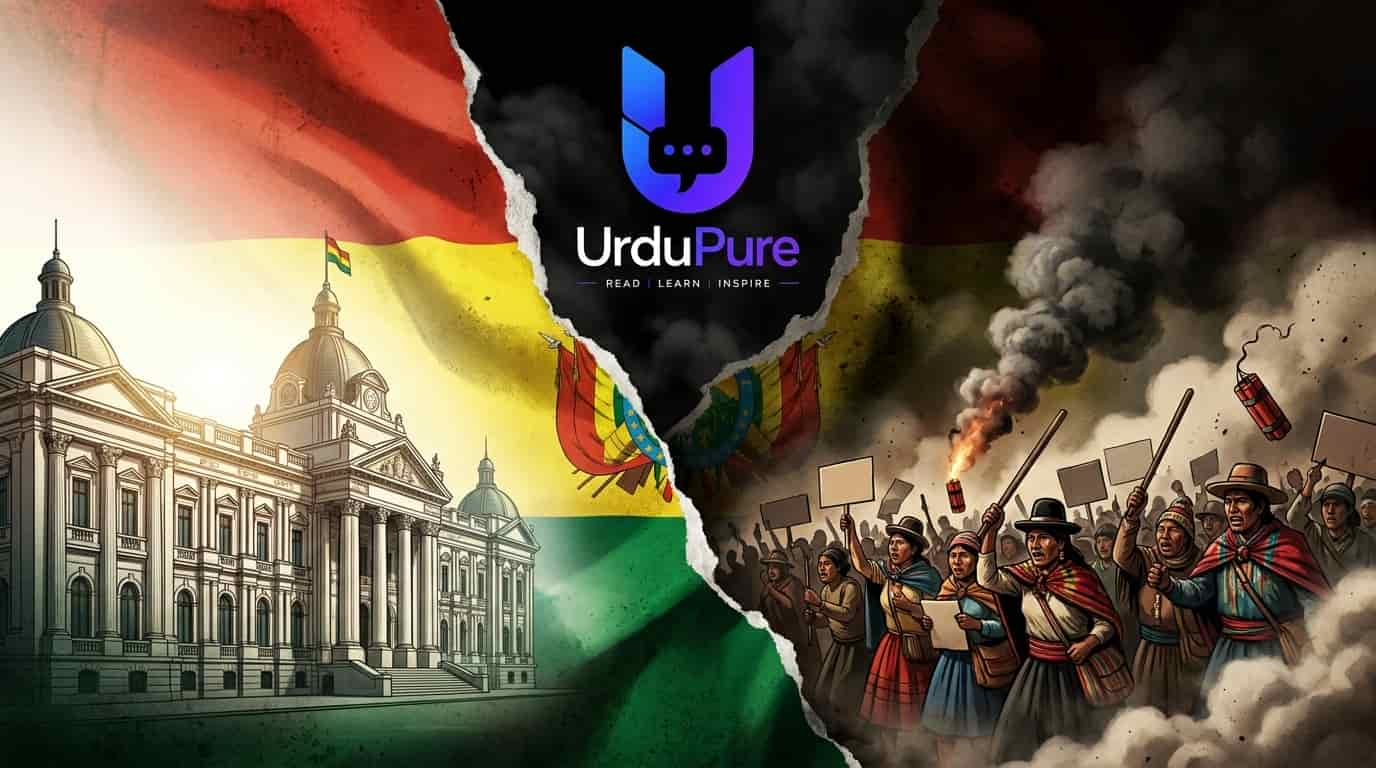
Bolivia Is Breaking: How a Reform President Became the Enemy of His Own Country
Bolivia's capital has a cruel name for what it's going through right now. La Paz — the peace — is anything but. Tear gas drifts through its narrow streets. Miners lob dynamite at riot police. Seven people are dead. Hundreds of vehicles are stranded on highways strangled by blockades. And at the center of it all sits a president who, just six months ago, was celebrated with fireworks as the man who would finally save Bolivia.
That man is Rodrigo Paz. And right now, he is the most embattled leader in the Western Hemisphere.
This is not simply a story about food prices or fuel subsidies — though those are very real and very painful. This is a story about broken promises, a state that was already bankrupt before its new president took the oath, a fugitive former leader playing puppeteer from a coca-growing stronghold, and a United States government that has decided, loudly and clearly, that Bolivia is its business.
Timeline
How Bolivia got here: a sequence of miscalculations
October 2025
Rodrigo Paz wins Bolivia's presidential election with 54% of the vote, ending 20 years of MAS (Movement for Socialism) dominance. His platform: "capitalism for all" — lower taxes, fiscal discipline, economic decentralization, and continued social spending. He inherits 20%+ annual inflation, a near-empty central bank, and chronic fuel shortages.
December 18, 2025
Paz signs Supreme Decree 5503, eliminating fuel subsidies that had been in place for roughly two decades. The move is paired with a 20% minimum wage increase. Gasoline prices rise 86%. Diesel rises over 160%. Transport costs in several regions nearly double overnight. Bolivia's largest trade union, the COB, organizes a major strike — but the government deftly splits the coalition by offering bus drivers duty-free auto part imports. The strike fizzles. Paz survives. But he looks beatable.
April 8, 2026
Congress passes Law 1720, a land reform measure framed as expanding rural credit access. Small farmers can reclassify their holdings as medium-sized properties, making them eligible for bank loans. The government calls it financial inclusion. Farmers call it a path to eviction and land seizure by corporations. On the same day the law passes, approximately 300 people begin marching from Pando in Bolivia's north toward La Paz — a journey of over 1,000 km.
May 1, 2026
The COB declares an indefinite general strike. Demands include a further 20% minimum wage increase, higher teacher pay, and a fully state-funded education system. Miners add their own list: greater access to explosives, fuel, and implementation of mining regulations. The protest coalition mushrooms.
May 4–13, 2026
The 300-person march arrives in La Paz. Protesters stage a sit-in outside the vice president's office. By May 12, police report 67 active road blockades nationwide. Three people die after emergency vehicles are blocked from reaching medical facilities. On May 13, Paz capitulates and repeals Law 1720 — but the protests do not stop.
May 20–27, 2026
Paz reshuffles his cabinet, then announces that his salary and those of his ministers will be halved. Neither move changes anything on the streets. A convoy of 2,000 police and military in 150 vehicles attempts to clear the highway linking La Paz to Oruro. It is attacked and forced to retreat. Both chambers of Bolivia's Congress vote within 48 hours to repeal a 2020 law restricting emergency declarations. Paz signs new powers into law on May 27 — granting himself legal authority to deploy the army. He has not yet used it.
Late May – June 2026
The defense minister resigns. Seven people are dead. 120 arrested. La Paz is functionally under siege. The demand on the streets has collapsed into one word: resignation.
"There's a huge break between what Paz promised and what he's done in practice — a white upper-middle-class cabinet, no genuine dialogue, no empathy for what people are going through day-to-day." — Kathryn Ledebur, Andean Information Network
Strategic assessment
Who is fighting whom — and what they actually want
One of the most important things to understand about the Bolivia crisis is that this is not a single uprising. It is a coalition of grievances that happened to find themselves on the same street at the same time.
Protest coalition
Farmers and indigenous groups — fear land dispossession under Law 1720
COB / trade unions — demand higher wages and education reform
Miners — want access to explosives, fuel, and mining rights
Teachers — separate salary negotiations
General public — food, fuel, medicine shortages; inflation above 20%
Government position
Inherited a "bankrupt state" from MAS — central bank depleted
Fuel subsidies cost $10 million/day; removal was fiscally necessary
Repealed Law 1720; reached separate deals with farmers and miners
New emergency powers allow military deployment — unused so far
Security forces remain loyal; Washington backing is explicit
Motives and shadow players
The Morales factor: fugitive, firebrand, or false flag?
No analysis of the Bolivia crisis is complete without confronting the specter of Evo Morales. The former president — who ruled from 2006 to 2019, nationalized energy resources, built alliances with Venezuela, Cuba, Russia, and China, and became the most significant left-wing leader in modern Bolivian history — is currently a fugitive. He is hiding in the Chapare region, a coca-growing stronghold where his support remains deep, while facing trial for human trafficking, specifically allegations that he impregnated a 15-year-old girl during his presidency.
Despite all of this, Morales has not gone quiet. He has publicly endorsed the protests, writing that the uprising will not be quelled until the people's demands are met. The Paz government has seized on this, blaming Morales for organizing the unrest as a destabilization campaign against a democratically elected government.
The truth, as analysts told NPR, is probably more complicated. Morales almost certainly lacks the organizational capacity to orchestrate this scale of unrest from hiding. But he does have the ideological gravity to give the movement narrative coherence — to frame a chaotic coalition of competing demands as a unified resistance against neoliberal betrayal. In that sense, he doesn't need to organize the protests. He just needs to show up rhetorically, and the movement shapes itself around him.
The Paz government's decision to make Morales the villain of this story carries its own risks. It has galvanized his domestic supporters and earned him sympathy from ideologically aligned governments abroad. In a country as polarized as Bolivia, calling the protests a coup attempt — which is essentially what Washington has done — risks delegitimizing a real and widespread popular grievance.
Geopolitical dimension
Washington's Monroe Doctrine moment
The United States is not a passive observer here. Secretary of State Marco Rubio has said explicitly that Washington will not allow what he described as criminals and drug traffickers to overthrow a democratically elected government within its hemisphere. One unnamed US official described the protests as an attempted coup financed by an "unholy alliance between organized crime and politics."
The word "hemisphere" matters. Since the publication of Washington's national security strategy document last year and what observers have called a reinvocation of the Monroe Doctrine, the United States has been far more willing to intervene — diplomatically and otherwise — in the internal politics of Latin American countries. The arrest and detention of Venezuela's former President Nicolás Maduro is the starkest illustration of this posture.
For Paz, US backing is a lifeline. It signals to the Bolivian military, to regional governments, and to institutional investors that his government has powerful friends who will not allow it to be toppled. Paz has also aligned Bolivia with the Shield of the Americas, a US-led military alliance with a stated mission of fighting cartels — a move that further cements his geopolitical positioning.
But Washington's support is also a liability. In a country where 20 years of left-wing government cultivated deep suspicion of US motives, Paz being seen as Washington's man in La Paz does not help him win hearts on the streets. Every Rubio tweet defending him may consolidate his international position while eroding his domestic legitimacy.
Strategic verdict
Paz faces two paths, both painful. Deploy the military — and risk looking like every authoritarian predecessor who used force against his own people, potentially triggering a larger backlash. Or continue negotiating — with a protest coalition whose stated goal is now simply his removal from office. The protests are costing Bolivia an estimated $50 million per day. The security forces are loyal for now. But loyalty is a function of payroll and legitimacy, and both are under pressure. The rock and the hard place are exactly where Paz is standing.
The outlook
Will Paz survive — and what does survival even mean?
Most Latin America analysts lean toward Paz remaining in office, at least in the short term. His security forces have not mutinied — a critical difference from 2019, when police in three cities defected to the opposition during the final crisis of the Morales era. Washington's support creates a strong deterrent against any military figure contemplating intervention. And despite the street pressure, there is no clear alternative leader who could credibly take power and be internationally recognized.
But surviving is not the same as governing. Paz's own political vehicle, the Christian Democratic Party, fractured almost immediately after entering parliament. He has no reliable legislative majority. His vice president is feuding with him. In the March–April regional elections, candidates he backed won only two of nine gubernatorial races — a stinging rebuke for a man who had just won the presidency with 54% of the vote. He has made separate peace deals with farmers and miners, but cannot make inroads with the broader coalition that is still calling for his head.
What emerges from this crisis — even if Paz does survive it — is a president profoundly weakened for the rest of his term. A man who promised Bolivia a new beginning and delivered, in the eyes of much of the population, nothing more than a different flavor of the same austerity that left-wing governments had also eventually been punished for.
Bolivia has been here before. The country has a long and violent tradition of popular movements toppling presidents who overstep or under-deliver. Paz knows this history. The question now is whether he has enough runway — diplomatic, financial, and political — to outlast the anger on the streets. And whether, by the time this is over, there is anything left of the Bolivia he promised to save.
Bolivia crisis 2026, Rodrigo Paz protests, Bolivia economic collapse, Latin America political instability, Bolivia coup risk 2026, Evo Morales fugitive, Bolivia fuel subsidies, COB general strike Bolivia





Discussion
Comments
Approved comments are published after moderation to keep discussion useful and spam-free.
No comments yet. Start the discussion below.