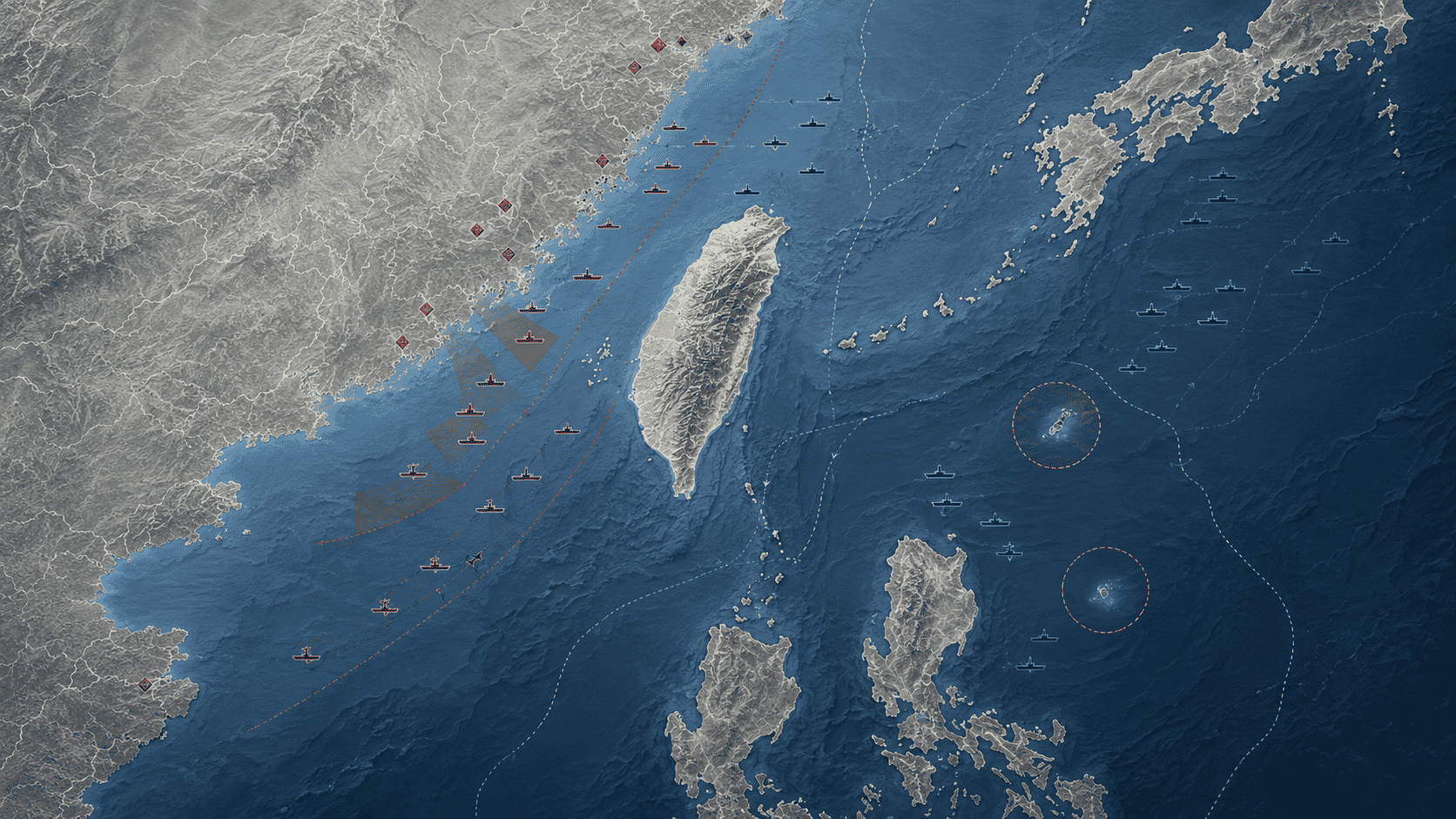
China vs Taiwan 2026: The Full Military, Diplomatic and Economic Picture — Everything That's Changed in the Last 90 Days
The Week That Changed the Calculus: July 6, 2026
On July 6, 2026, a People's Liberation Army Navy submarine — its location narrowed by Chinese Maritime Safety Administration notices to either the Bohai Sea or the South China Sea — launched a ballistic missile that travelled thousands of kilometres before landing between Tuvalu and the Gilbert Islands of Kiribati in the South Pacific.
PRC state media reported on July 6 that an unspecified ballistic missile nuclear submarine (SSBN) conducted a test of a submarine-launched ballistic missile (SLBM). PRC state-owned tabloid Global Times speculated that the missile tested was a JL-3, a missile the PRC first unveiled during a September 2025 military parade that has a reported range of 10,000 kilometres.
This is the first time China has publicly announced an SLBM test since 1982. That 44-year gap is not an accident — China's doctrine of nuclear opacity has historically meant concealing rather than demonstrating nuclear capability developments.
The deliberate public announcement of this test is a signal, not an operational requirement.
The question is: to whom, and what is the message?
The PRC last tested a ballistic missile in the Pacific in 2024, which landed near French Polynesia, and has not publicly announced a test of an SLBM since 1982.
The shift from covert to public announcement — in a week when China-Russia Joint Sea-2026 naval drills are simultaneously running — is the most significant single data point in the Taiwan Strait's security environment in the current period.
On the same day, the PRC and Russia began annual combined naval exercises off Qingdao.
The PRC's Ministry of National Defense announced that the PRC and Russia would hold the "Joint Sea-2026" naval exercise from July 6 to July 13 in the waters and airspace near the PRC port city of Qingdao.
The drill is part of the annual cooperation plan between the two militaries.
Simultaneous nuclear capability demonstration and Russia-China naval integration exercises in the same week are not coincidence.
They are the strategic communication of a great power that wants specific audiences — Washington, Tokyo, Taipei — to update their risk calculations simultaneously.
The Official Assessment: No Invasion in 2027 — But That's Not the Whole Story
The US Office of the Director of National Intelligence (ODNI) released its 2026 Annual Threat Assessment report on March 18 and assessed that the PRC likely will not invade Taiwan in 2027, but would continue coercive action around Taiwan and the Indo-Pacific.
This assessment — the most authoritative single judgment produced by the US intelligence community on the Taiwan question — is important, reassuring, and frequently misread.
What it says: no invasion in 2027.
What it does not say: that the trajectory of Chinese military development, coercive activity, and political preparation is compatible with long-term peace.
The ODNI assessment is a one-year window, not a strategic verdict.
It reflects current intelligence about Xi Jinping's intentions and the PLA's current capability gaps — not a projection of what 2029 or 2031 looks like as China's military modernisation continues and Taiwan's defence investments are complicated by political dysfunction.
The coercive activity that the ODNI projects continuing is itself historically significant.
In 2025, China violated Taiwanese airspace more than 3,700 times.
The Chinese Coast Guard has maintained continuous presence in waters east of Taiwan, conducting "special maritime law enforcement operations" to assert Beijing's territorial claims.
A Taiwan that is being coerced 3,700 times per year without an invasion is still a Taiwan under siege — and the political, economic, and military effects of sustained coercion compound over time regardless of whether an invasion ever happens.
The Military Balance: What Each Side Actually Has
China's Growing Naval Capability
PLAN carrier Fujian was commissioned with the Southern Theater Command (STC) in November 2025 but was stationed at the Northern Theater Command (NTC) Fleet headquarters.
PLAN carrier Shandong has been undergoing maintenance since January.
The PLA previously was unable to maintain two carriers on station year-round, but may be able to do so with three carriers.
This could allow the PLAN to conduct more frequent carrier deployments, with one carrier undergoing maintenance, one in reserve at port, and a third at sea.
The three-carrier capability — Liaoning, Shandong, and Fujian — represents a fundamental change in China's power projection capacity.
A navy that can maintain one carrier continuously at sea has a qualitatively different operational profile from one that cannot.
The specific positioning of Fujian in the Southern Theater Command — the command responsible for Taiwan contingency operations — is the most operationally significant carrier deployment decision in the PLAN's history.
The PLAN may rely on its Type 055 guided missile destroyers to conduct air defense missions during a conflict with the United States.
The PLAN's carriers would likely operate beyond the first island chain during a blockade or invasion of Taiwan to intercept US intervention efforts.
An air defense role would prevent at least some portion of the PLAN's 10 Type 055s from escorting PLAN aircraft carriers while they conduct missions in the Western Pacific, significantly limiting the combat power of a PLAN carrier strike group.
This analysis reveals a genuine Chinese military constraint: the Type 055 destroyers cannot simultaneously provide air defence for the mainland and escort carrier groups in the Western Pacific.
The United States can exploit this dilemma with air assets — forcing the PLAN to choose between defensive and offensive postures.
It is a meaningful vulnerability in an otherwise formidable force package.
The PLA Purge: Xi Cleans House
PLA Daily released details of the PLA ideological training camp that ran from April 8 to June 12, including ideological studies, anti-corruption rhetoric, and military exercises.
PLA Daily stated that Xi personally decided to launch the exercise and delivered a speech at the opening ceremony, stressing that leading officers must take the lead in building an atmosphere "where people speak the truth, offer advice candidly and fight against wrongdoings."
ISW-CDOT has previously reported on the broader military purge campaign, which notably saw the removal of CMC members Zhang Youxia and Liu Zhenli in January 2026.
The removal of two Central Military Commission members in January 2026 — the most senior military leadership body in China's command structure — represents the most significant military leadership disruption in Xi's tenure.
The simultaneous launch of an "ideological training" campaign that Xi personally opened suggests the purge is not complete.
Xi is removing officers he believes were corrupt, disloyal, or insufficiently committed to operational readiness — a process that simultaneously strengthens his political control and weakens the PLA's operational cohesion during a period of transition.
The military purge creates a specific uncertainty for Taiwan contingency planning: a PLA whose senior officer corps has been recently disrupted may behave differently from a stable military institution.
Whether that disruption makes China more or less likely to act aggressively in the near term is genuinely contested among analysts.
Taiwan's Drone Defence Bill: The Internal Crisis Nobody Is Talking About
The ruling Democratic Progressive Party (DPP) is seeking to fund a $210 billion NTD (approximately $6.5 billion) special budget bill for domestic drone procurements from August 2026 to 2031.
The opposition-controlled Legislative Yuan voted together to prevent the bill from being sent to committee review on June 26.
The KMT and TPP have since announced their own versions of the bill, and all versions will be submitted for committee review at the July 3 plenary session.
Taiwan's opposition parties have significantly delayed the 2026 General Budget, which could have deleterious effects on Taiwan's defence readiness.
Passing Taiwan's general budget without significant cuts to defence is critical for demonstrating Taiwan's willingness to provide for its own defence.
This is the domestic Taiwan story that receives the least coverage relative to its strategic importance.
The United States has consistently communicated — from the Biden administration through the current Trump administration — that US willingness to support Taiwan depends partly on Taiwan's willingness to support itself.
A Taiwanese parliament that blocks its own $6.5 billion drone defence procurement sends a specific signal to Washington about Taipei's commitment that undermines the political foundation of US deterrence credibility.
The drone budget obstruction is not merely a domestic political dispute.
Taiwan's military conducted training exercises with first-person view (FPV) drones and Altius-600M anti-armor drones for the first time on June 3.
Taiwan must develop industrial know-how and flexible drone production capacity in addition to expertise in drone operation to be effective on the modern battlefield.
Taiwan will likely struggle to achieve this without significant investments in its domestic drone industry.
Ukraine's experience — where domestically produced drone capability has been one of the most significant asymmetric advantages in resisting a much larger adversary — is Taiwan's most directly applicable military lesson.
The parliament's obstruction of the drone procurement bill is obstructing the specific lesson that Ukraine has paid in blood to teach the world.
The Japan Dimension: The Variable Beijing Fears Most
The most consequential development in the Taiwan Strait security environment in the past 12 months is not Chinese military capability improvement — that trajectory is documented and expected.
It is Japan.
ODNI emphasized that the PRC "probably is concerned that Prime Minister Takaichi's statements regarding a Taiwan military contingency" represent a fundamental change in Japan's strategic posture.
Japan is continuing to insulate itself from PRC coercion efforts, partially through cooperation with the United States.
Japanese Prime Minister Sanae Takaichi — whose defence reforms and coalition-building activities were covered in detail in UrduPure's Japan-China geopolitics analysis — stated in parliament in November 2025 that a Chinese attack on Taiwan could constitute a "survival-threatening situation" for Japan, implying Tokyo might invoke its 2015 collective self-defence law to come to Taiwan's aid.
China's response has been both furious and revealing.
The PRC has imposed economic measures including bans on dual-use exports to Japanese military entities, bans on Japanese imports, travel advisories against Japan, and the detention of multiple Japanese citizens on smuggling charges.
The PRC placed 20 entities on a control list and 20 others on a dual-use watch list, stating it enacted the sanctions as a measure against Japanese "militarism."
The Joint Sea-2026 drills may contribute to PRC capabilities for an amphibious invasion of Taiwan and improve interoperability with the Russian military, which may play a peripheral role in deterring or diluting Japan's involvement in defending Taiwan.
That sentence is analytically crucial.
The China-Russia naval exercises are not simply a bilateral military event.
They are specifically designed — according to the ISW/AEI assessment — to send a deterrent signal to Japan:
If Japan intervenes in a Taiwan contingency, it faces not just China but a Russia-China axis that can threaten Japan from multiple directions simultaneously.
The exercises are geopolitical communication as much as military training.
Japan has not been deterred.
Japan has agreed to sell Mogami-class frigates to Australia, discussed a similar sale to New Zealand, and strengthened its military diplomacy and exchanges with South Korea since April 2026.
Continued cooperation between Japan and other militaries such as India and the Philippines will strengthen regional players' abilities to combat PRC coercion in the Indo-Pacific.
The Philippines Front: The Active Flashpoint
While Taiwan is the strategic focus, the South China Sea's contested waters around Scarborough Shoal and Second Thomas Shoal are where Chinese coercion is most actively applied in 2026.
The PRC sanctioned Philippine Defense Secretary Gilberto Teodoro on June 11 for "damaging PRC-Philippine relations."
The PRC is working to present a small group of anti-PRC Philippine officials as the cause for recent tensions, downplaying PRC aggression in the South China Sea.
The Philippine task force on the South China Sea reported on June 17 that the PRC removed a floating platform from the Scarborough Shoal.
Philippine officials first became aware of the structure in May.
The PRC could then begin construction and militarization efforts of the shoal, posing a significant security concern for the Philippines and the United States.
The Scarborough Shoal situation is the most immediate risk of a US-China military incident in the region.
The Philippines has a mutual defence treaty with the United States.
Chinese Coast Guard vessels that ram or disable Philippine vessels are technically triggering a treaty relationship that obligates a US response.
Every month that passes without a formal US military response to Chinese harassment of Philippine vessels either:
Encourages China to escalate further
Erodes the credibility of the mutual defence treaty
Neither outcome is desirable for US policy.
The ODNI report noted PRC efforts to strengthen its presence in the South China Sea, "particularly at the Philippine-claimed Scarborough Reef and Second Thomas Shoal, through persistent military and coast guard patrols and diplomatic and legal actions."
It noted PRC efforts to establish a nature reserve at Scarborough Shoal, a line of effort assessed as a coercive action likely intended to increase the PRC's legal cover for aggressive actions against Philippine vessels.
The Intelligence Dimension: China in Cuba
The Taiwan Strait story has a global footprint that extends far beyond the Western Pacific.
CSIS on June 18 reported on modifications to a likely signals intelligence (SIGINT) site near Bejucal, Cuba.
These modifications may allow the PRC to capture signals intelligence from the United States.
CSIS assessed that the site had "very likely" begun operation.
The report detailed modifications to an antenna field at the Bejucal site showcasing "completed" antenna rings from May 2026 satellite imagery.
A Chinese intelligence collection facility 90 miles from the Florida coast — in a location specifically positioned to intercept US military and government communications — represents a Cold War-era provocation dressed in 21st-century technology.
The strategic logic is identical to the Soviet deployment of nuclear missiles to Cuba in 1962:
The value is not purely operational but demonstrative, signalling that China has the reach and the relationships to establish strategic positions in America's backyard.
The Trump-Xi Summit: Much Discussed, Little Resolved
Trump and Xi discussed global flash points at their summit but did not reach major agreements on Iran or Taiwan.
That single sentence — repeated across three consecutive AEI/ISW weekly updates — is the most significant diplomatic non-event of 2026.
The two most powerful leaders on earth met, discussed the most consequential strategic questions on the planet, and resolved nothing specific about either the Iran conflict's energy impact or the Taiwan Strait's escalation trajectory.
The absence of agreement is not simply diplomatic failure.
It reflects the structural reality that the United States and China have fundamental interests in the Taiwan question that are not reconcilable through summit diplomacy.
The US position — that Taiwan's political status should be determined peacefully, without coercion — is incompatible with China's position that Taiwan is an internal Chinese matter to be resolved on China's timeline by China's means.
No summit changes that underlying incompatibility.
What summits can do is:
Slow the pace of escalation
Create communication channels that reduce miscalculation risk
Establish guardrails that keep competition below the threshold of armed conflict
The 2026 Trump-Xi summit appears to have done the last of these — established that direct military conflict is not imminent — without doing either of the first two.
The escalation trajectory continues.
The communication channels remain limited.
The guardrails are present but untested.
Cross-Strait Politics: China's Electoral Influence Campaign
Cheng's 2026 meeting with Xi — the first such meeting since 2016 — illustrated the PRC's desire to present cross-strait engagement positively to the Taiwanese public.
The PRC is likely to continue such engagement efforts with amenable Taiwanese politicians prior to the November local elections and 2028 Presidential elections.
Taiwan's political cycle creates specific windows for Chinese influence operations.
The November 2026 local elections and the 2028 Presidential election are the near-term targets of a Chinese political influence effort that operates through:
Economic inducements
Cultural ties
Media relationships
Direct electoral interference
The techniques are fungible.
The targets vary by geopolitical priority.
Taiwan's democracy is more robust than Armenia's and its population more uniformly aware of Chinese influence efforts.
But the KMT-TPP coalition that blocked the drone defence budget is the domestic political expression of a cross-strait preference that China actively cultivates — and its consequences for Taiwan's defence readiness are real regardless of the motivation behind it.
The Economic Dimension: Semiconductors and the Chokehold
The Taiwan Strait situation cannot be understood purely in military terms.
Taiwan produces approximately 92% of the world's most advanced semiconductors — the chips that power every AI system, every advanced military platform, and every smartphone on earth.
The Taiwan Semiconductor Manufacturing Company (TSMC) is a strategic asset whose value to the global technology supply chain exceeds the GDP of most nations.
The US Department of Defense expanded its list of PRC entities the DoD believes to be affiliated with the PRC military, the "1260H list," to include 65 new entities, including tech companies such as Alibaba and Tencent.
Companies on the list are not explicitly sanctioned, but the DoD will be prohibited from contracting with them effective June 30, 2026.
DoD contractors will also be prohibited from sourcing from listed companies effective June 30, 2027.
The semiconductor dimension creates an economic logic for Chinese action that is separate from — and potentially more urgent than — the political reunification ideology.
China's ambition to develop its own advanced semiconductor capability has been substantially impeded by US export controls on chip-making equipment.
A China that controls Taiwan controls TSMC.
A China that controls TSMC controls the most consequential industrial asset in the technology economy.
The economic prize has never been larger.
The strategic motivation has never been clearer.
Three Scenarios: What Happens Next
Scenario 1: Sustained Coercion Without Invasion
Most Probable — 2026–2028
The ODNI assessment that China will not invade in 2027 is the most authoritative available judgment.
The scenario that the evidence supports is sustained, intensifying coercion:
More frequent incursions
More aggressive maritime law enforcement
More economic pressure on Japan and the Philippines
More sophisticated influence operations in Taiwan's political system
All of this remains short of the military threshold that triggers a US military response.
This scenario is strategically rational for China.
It degrades Taiwan's international relationships, erodes the credibility of US deterrence through repeated testing of response thresholds, and advances Chinese interests without the catastrophic military and economic risk of invasion.
The JL-3 SLBM test and the China-Russia naval exercises are elements of this coercive strategy — signals designed to raise the perceived cost of US military intervention without actually triggering it.
Scenario 2: Blockade Rather Than Invasion
Moderate Probability — 2027–2030
Military analysts at the RAND Corporation, CSIS, and the Australian Strategic Policy Institute have consistently assessed that a naval blockade — cutting Taiwan's maritime supply lines without landing troops — is China's most militarily viable coercive option below full invasion.
A blockade exploits Chinese naval and anti-ship missile capabilities, creates economic pressure without the catastrophic human cost of an amphibious assault, and presents the United States with a less clear-cut casus belli than direct invasion.
The Fujian carrier's positioning in the Southern Theater Command and the PLAN's expanding capacity to maintain continuous carrier deployments are the specific military developments most consistent with a blockade capability development trajectory.
Scenario 3: Invasion
Lower Probability — But Not Zero
The ODNI assessment rules out invasion in 2027.
It does not rule it out in 2030 or 2035.
Xi Jinping has stated repeatedly that Taiwan reunification is the central historical mission of his leadership.
The PLA's modernisation timeline — as articulated in official Chinese documents — targets completion of the capabilities required for a Taiwan contingency by 2027, with the window for action extending into the early 2030s.
The conditions that make invasion most likely — and therefore most important to monitor — are:
A major US military commitment elsewhere that reduces Pacific deterrence capacity
A Taiwanese political crisis that provides a pretext
A Chinese domestic political crisis that Xi seeks to deflect through nationalist action
A PLA leadership assessment that the window of military advantage over a Japan-supported US response is closing as Japanese rearmament proceeds
None of these conditions is currently present in acute form.
All of them are latent possibilities in a 10-year horizon.
What to Watch in the Next 90 Days
Taiwan's drone budget: Whether the KMT-TPP opposition versions of the $6.5 billion drone bill pass committee review is the single most immediate indicator of Taiwan's defence self-commitment.
Joint Sea-2026 conclusions: The scope and nature of exercises concluded in the next week will provide the most current read on China-Russia military interoperability development.
Scarborough Shoal: Whether China begins construction activity following the removal of the floating platform is the most immediate trigger for a US-Philippines treaty consultation.
PLA purge continuation: Whether additional senior CMC members are removed following the April-June ideological training camp indicates whether Xi's military consolidation is complete or continuing.
TSMC Arizona construction: The pace and completion of TSMC's Arizona facilities reduces the US's strategic stake in Taiwan's physical sovereignty over its semiconductor industry — a factor that subtly affects deterrence calculations.
Sources
AEI/ISW China & Taiwan Update July 10, 2026
AEI/ISW China & Taiwan Update July 2, 2026
AEI/ISW China & Taiwan Update June 26, 2026
AEI/ISW China & Taiwan Update June 18, 2026
AEI/ISW China & Taiwan Update June 12, 2026
AEI/ISW China & Taiwan Update March 27, 2026
ODNI 2026 Annual Threat Assessment, March 18, 2026
CSIS Bejucal Cuba SIGINT Report, June 18, 2026
China Taiwan 2026, Taiwan Strait crisis July 2026, China SLBM test July 2026, Joint Sea 2026 China Russia, ODNI Taiwan invasion assessment, Taiwan drone budget KMT, Japan Taiwan Takaichi China, Scarborough Shoal 2026, PLA military purge Xi Jinping, China Taiwan war probability






Discussion
Comments
Approved comments are published after moderation to keep discussion useful and spam-free.
No comments yet. Start the discussion below.