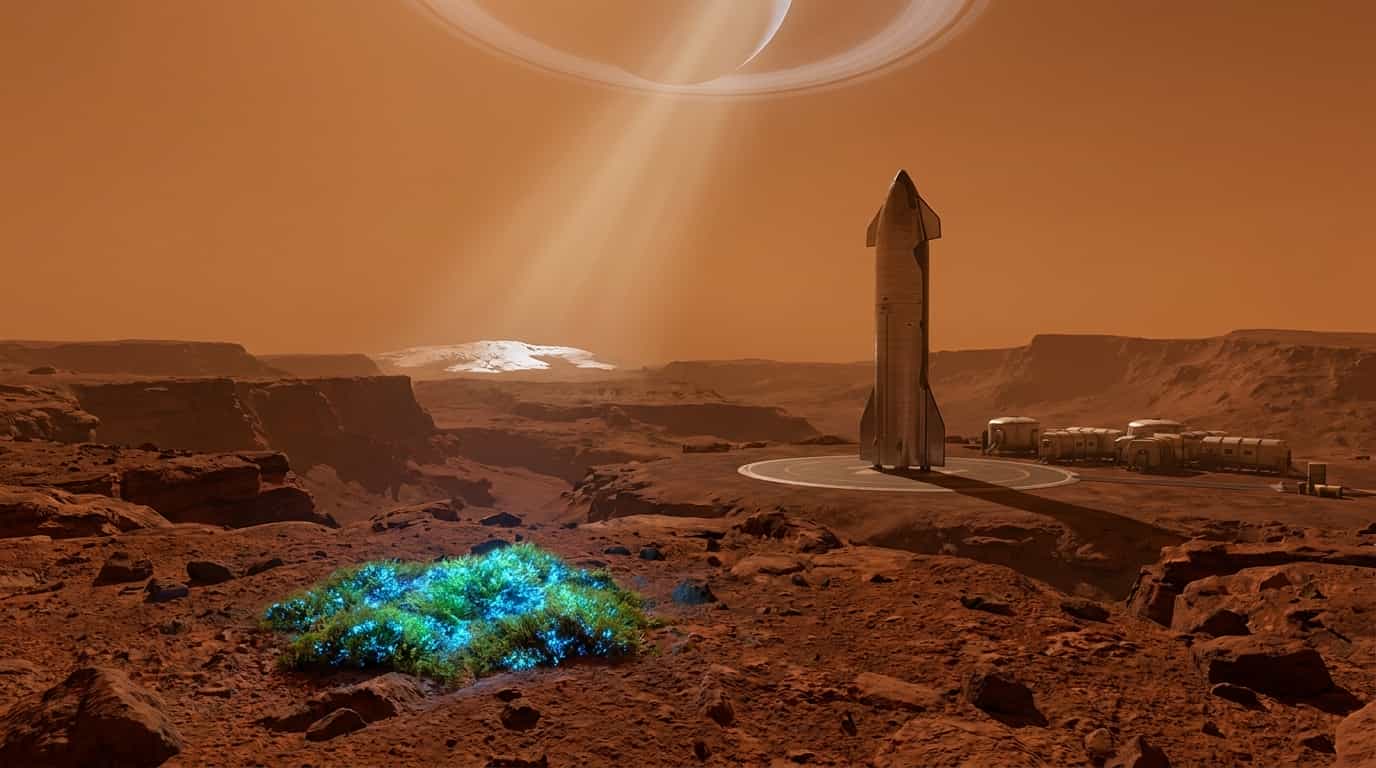
Terraforming Mars may be more realistic than scientists once thought
Dramatic reductions in launch costs and bio-engineering advances are turning the Red Planet's sci-fi dream into a highly debated scientific research topic.
By Eric Berger | July 19, 2026
For decades, the concept of terraforming Mars—physically transforming the planet's surface environment into something resembling Earth—has been firmly relegated to the realm of science fiction. It was an ambitious thought experiment, fun for novelists and tabletop gamers, but widely dismissed by the astrophysics community as practically impossible within any reasonable timeframe.
However, the conversation is beginning to shift. A recent surge in scientific workshops and engineering analyses suggests that the underlying math of reshaping the Red Planet might be changing. Driven by the imminent promise of massive payload capacities from SpaceX's Starship and quiet advances in bio-engineering, the idea of a "Green Mars" is slowly transitioning from a fantasy into a legitimate, albeit fiercely debated, scientific research topic.
But before anyone packs their bags for a Martian paradise, researchers warn that the gap between "scientifically plausible" and "actually achievable" remains staggeringly wide.
1. Background & Context: The New Space Economics
The fundamental barrier to any Mars terraforming operation has always been mass. To change a planet, you have to move millions of tons of material, equipment, and volatiles. Historically, stretching our current technology to send a single ton to Mars has been an immense challenge.
This is where the Starship calculus comes in. Elon Musk has claimed that SpaceX has a 50:50 chance of sending its first uncrewed Starships toward Mars in 2026, with crewed landings potentially following as early as 2029 or 2031. While many aerospace experts view this timeline as a fantasy—Musk has also floated the idea of building a Mars city in about 5 to 7 years—the vehicle concept fundamentally changes the math.
If Starship succeeds in dropping launch costs by orders of magnitude, it theoretically enables the delivery of the massive infrastructure required to initiate early-stage planetary warming. The economic feasibility of orbital mirrors, massive solar sails, or localized bio-reactor deployments suddenly enters the realm of long-term strategic planning, prompting events like the recent Green Mars Workshop, which brought together scientists and engineers to discuss exactly what terraforming would necessitate.
2. Technical Challenges: The Physics of a Frozen Desert
Even with unlimited rockets, Mars is brutally hostile. It is a deathly cold, frozen desert that has been devoid of a biosphere for three billion years. The planet has zero vegetation, and regular dust storms whip across a surface exposed to ionizing solar and cosmic radiation.
To make the surface even partially hospitable, engineers must overcome three massive technical hurdles:
Atmospheric Pressure: The Martian atmosphere is currently about 1% the pressure of Earth's at sea level. For water to exist as a liquid and for humans to survive without full pressure suits, this must be drastically increased. Estimates suggest there is sufficient CO2 ice trapped in the Martian regolith and the south polar cap to form a 30 to 60 kilopascals (kPa) atmosphere if it can be released through planetary warming.
The Volatile Deficit: Even if all the ice is melted, Mars's lower gravity requires 2.6 times Earth's column airmass to reach an optimal 100 kPa surface pressure. Nitrogen, essential as a buffer gas and for growing plants, is particularly scarce. Supplying additional volatiles might require external sources, such as redirecting massive ammonia-rich asteroids.
The Magnetic Shielding: Mars lacks a global magnetic field, allowing the solar wind to directly interact with the atmosphere and slowly strip it away. While the current loss rate is relatively slow (equivalent to approximately 1 millibar per billion years), a long-term terraforming project would likely require an artificial magnetosphere positioned at the L1 Lagrange point to block the solar wind entirely.
3. Expert Commentary: The Realism Check
Despite the newfound enthusiasm in certain engineering circles, veteran planetary scientists remain deeply skeptical of the endeavor.
Chris McKay, a senior NASA Ames astrogeophysicist who has spent over 40 years studying the possibility of human life beyond Earth, is blunt about the prospects of permanent colonization. “I don't see any prospect for there to be permanent settlements,” McKay stated. “Why would anybody want to live there?”.
Furthermore, researchers point out that establishing a permanent colony implies lifetime commitments and generations growing up in an environment where a single infrastructure failure means instant death. The hypothetical options currently being researched to make Mars habitable, if they work at all, will take many decades, if not centuries, to execute.
"It's far enough into the future that, once you get beyond, say, 30 years, you can't tell the difference between that and infinity into the future," noted planetary scientist Bruce Jakosky, emphasizing the distinction between scientific realism and science fiction.
4. Scenario Analysis: How It Actually Starts
If a terraforming effort does move forward in the 21st century, it won't look like an overnight transformation. Instead, it will be a slow, localized process.
Phase 1: Localized Warming (The First Century): Rather than trying to heat the entire planet, initial efforts will likely focus on localized warming experiments. Concepts like utilizing open-source particle screening tools to design Mars-warming aerosols or deploying solar sails to direct sunlight onto the poles are currently being researched. The goal is to sublimate enough CO2 to trigger a runaway greenhouse effect.
Phase 2: Bio-Engineering the Regolith (The Tipping Point): Once atmospheric pressure rises and temperatures marginally stabilize, bio-engineering takes over. Genetically modified extremophile microbes, lichens, and engineered cyanobacteria would be seeded to slowly process the toxic regolith and begin converting CO2 into trace amounts of oxygen.
Phase 3: The Long Wait: This is not a project for impatient venture capitalists. Even under the most aggressive, technologically flawless scenarios, raising oxygen levels to breathable limits would take millennia. For the foreseeable future, future colonists will be living in pressurized domes, wearing oxygen masks whenever they venture outside.
5. Risks & Trade-offs: The Ethical Dilemma
Beyond the physics and the economics, there is a profound ethical debate. Does humanity have the right to foster a world-scale biosphere on a planet that is not our own?
If Mars harbors its own dormant or microbial life deep underground, terraforming the surface would almost certainly eradicate it. Planetary protection protocols currently strictly govern how we interact with Mars to prevent biological contamination. Initiating a terraforming project requires abandoning those protocols entirely, trading the scientific preservation of an alien world for the expansion of Earth's biological footprint.
6. Future Outlook: The Bottom Line
There is no doubt that humans will eventually reach Mars. Crewed spacecraft are highly likely to land on the Red Planet within a couple of decades, where astronauts will explore the surface and return home.
The Bottom Line:
Thanks to plummeting launch costs and advances in synthetic biology, terraforming Mars is no longer a purely fictional concept—it is a definable engineering problem. But having the tools to theoretically solve a problem does not mean humanity has the multi-generational attention span, capital, or ethical consensus required to actually do it. We may eventually turn the Red Planet green, but it won't happen in our lifetime.



Discussion
Comments
Approved comments are published after moderation to keep discussion useful and spam-free.
No comments yet. Start the discussion below.