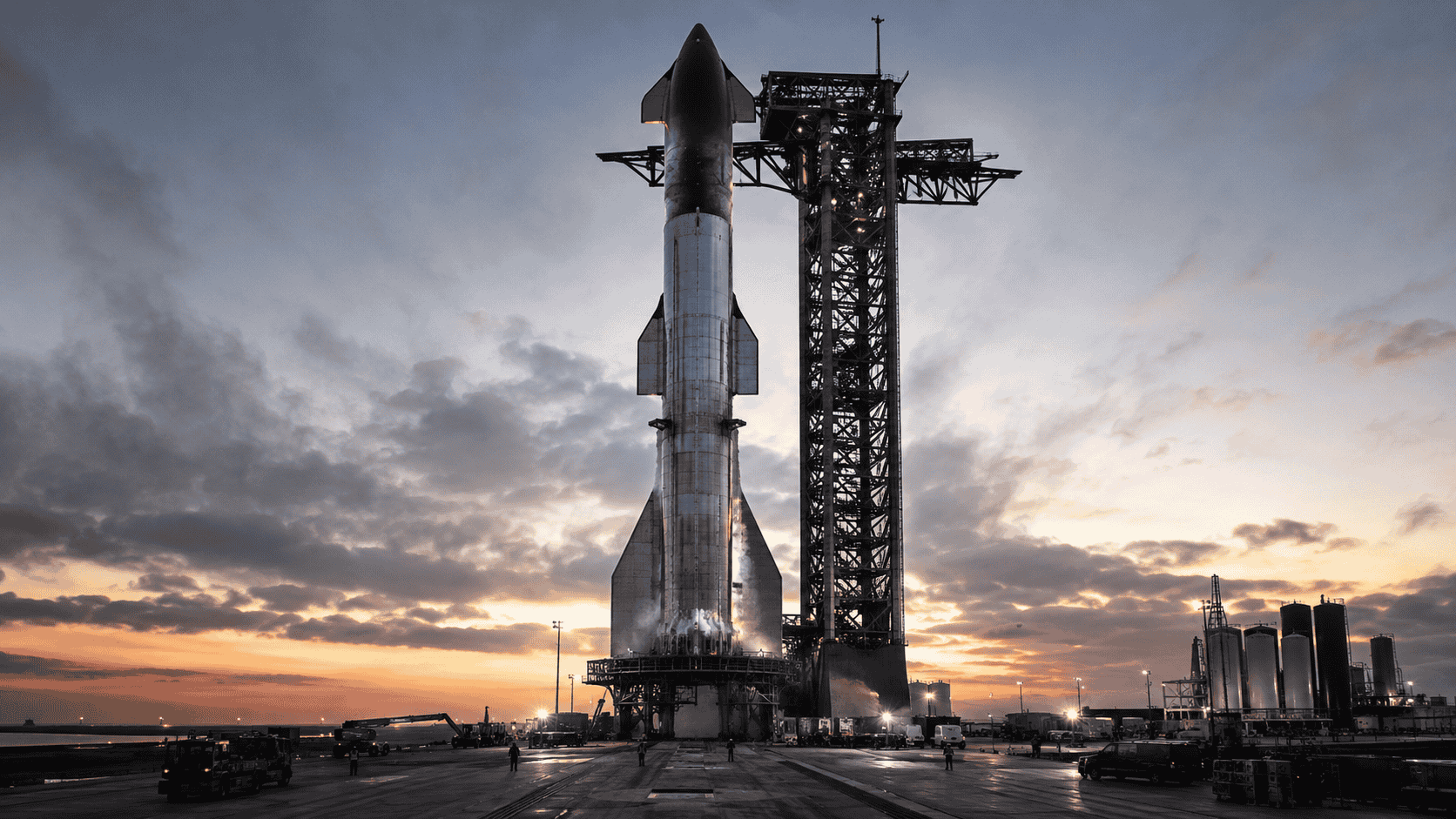
Updated July 1, 2026: SpaceX has tested Ship 40 ahead of the planned Flight 13 campaign, but no firm launch date has been announced. The next Starship flight remains dependent on vehicle readiness, FAA clearance and weather.
SpaceX’s next Starship launch is not just another rocket test from South Texas. It is part of a larger question now sitting over the entire program: can Starship move from spectacular demonstrations to a repeatable launch system?
That is the difference between a test vehicle and a transportation network.
Starship has already become one of the most watched rockets in the world because of its size, ambition and failures in public view. But the next phase is less about one dramatic launch and more about cadence, reliability, refueling, infrastructure and NASA’s Moon plans. SpaceX is trying to prove that Starship can become a system that launches often, carries more, returns more hardware and eventually supports missions beyond low Earth orbit.
Recent reporting shows why the pressure is rising. SpaceX has been preparing its next-generation Starship hardware, while also planning major fuel infrastructure around Starbase in Texas. Reuters reported that SpaceX plans to build an eight-mile natural gas pipeline called “Starpipe” to supply its Texas launch facilities, part of the company’s effort to support a much higher Starship flight rate.
A rocket test can be exciting. A launch system is something else. The next Starship flight matters because SpaceX is trying to prove the second.
Starship is entering its harder phase
Early rocket tests are allowed to be messy. Engineers expect failures, explosions, heat-shield damage, engine problems and unexpected behavior. That is part of how SpaceX develops hardware.
But Starship is no longer a small prototype program watched only by rocket fans. It is tied to NASA’s Artemis lunar program, SpaceX’s plans for larger Starlink deployment, and Elon Musk’s long-term Mars ambitions. NASA says Artemis is designed to send astronauts on increasingly difficult missions to explore more of the Moon and build toward future crewed missions to Mars.
That makes Starship’s next launches more important than the early test flights. SpaceX does not only need a rocket that can fly. It needs a vehicle that can fly often enough, safely enough and predictably enough to support missions with real customers and national space goals attached.
The technical challenge is large. Starship must prove the vehicle, the booster, the heat shield, the engines, the launch pad, the recovery system and eventually orbital refueling. Any one of those pieces can slow the entire program.
Flight 13 is about progress, not spectacle
Space.com reported that SpaceX conducted a static fire test of Ship 40, a next-generation Starship prototype, using a single Raptor 3 engine for about 15 seconds at the Starbase Massey test site in Texas. The report described the test as a milestone ahead of the upcoming Flight 13 demonstration.
That detail may sound small compared with a full launch, but static-fire testing is part of the real story. A Starship launch begins long before the countdown appears online. Engines have to be tested. Tanks have to be checked. Ground systems have to work. The vehicle has to survive loading, pressurization and repeated handling before it ever leaves the pad.
SpaceX has not announced a firm launch date for Flight 13. Space.com reported that the company is expected to attempt the mission before the end of summer 2026, but Starship test timing can change quickly because of vehicle readiness, regulatory approval and weather.
That is the lens through which Flight 13 should be judged. Not by whether everything looks perfect, but by whether it moves Starship closer to repeatable orbital operations.
Flight 12 showed progress, but also unfinished work
Flight 12 gave SpaceX valuable data, but it did not remove the big questions.
Reuters reported that SpaceX launched its upgraded Starship V3 rocket on May 22, 2026, in the twelfth Starship test flight and the first flight of the V3 iteration. The mission achieved several objectives, including stage separation, payload deployment and a controlled splashdown of the upper stage in the Indian Ocean.
But the test was not flawless. The Super Heavy booster did not complete its planned return objective, and the FAA later ordered SpaceX to investigate the booster mishap. Reuters reported that there were no public injuries or public property damage, but the FAA said it would oversee the investigation and approve corrective actions before return to flight.
That is why the next launch matters. SpaceX has already shown that Starship can produce impressive test results. Now it has to show that problems are being narrowed, systems are becoming more dependable and the launch campaign is moving toward repeatability.
The real bottleneck may be fuel
One reason the next Starship launch matters is that SpaceX is already thinking beyond single-flight tests.
Reuters reported that Starship uses about 630,000 gallons of liquid methane per launch. At present, that fuel is delivered by hundreds of tanker trucks, a process that takes hours and does not fit easily with SpaceX’s long-term launch ambitions. The planned Starpipe project would help feed Starbase with natural gas that could be processed into rocket fuel.
That says a lot about where the program is heading.
A company does not build major fuel infrastructure simply for occasional test flights. Pipelines, liquefaction facilities and local energy supply become important only when launch cadence becomes central to the business. Reuters reported that the Starpipe plan signals SpaceX’s attempt to lay the groundwork for faster and more frequent launches.
For readers, this is the key point: Starship’s future is not only about rocket engineering. It is also about industrial logistics.
The vehicle may be the visible part. The hidden system underneath includes fuel, permits, launch pads, manufacturing, recovery operations, ground equipment and regulatory approval.
Starbase is becoming part of the machine
Starship is inseparable from Starbase.
The South Texas site is not just a launch location. It is becoming a manufacturing, testing, fueling and launch ecosystem. Reuters reported that SpaceX has explored broader gas infrastructure plans in Texas, including more than 100 oil and gas leases signed with property owners since 2023, and that engineering plans show SpaceX wants a liquefaction facility at Starbase.
This fits SpaceX’s usual strategy: control more of the supply chain, move quickly and reduce dependence on outside bottlenecks where possible.
That approach helped SpaceX scale Falcon 9 launches. The question is whether it can work for Starship, which is much larger, more complex and more demanding. If Starbase becomes a high-cadence launch factory, Starship changes the economics of space. If it remains a test site with occasional flights, the promise stays further away.
NASA is watching for a reason
NASA’s Artemis program gives Starship much of its near-term importance.
NASA is working with commercial providers to develop human landing systems that can safely carry Artemis astronauts from lunar orbit to the Moon’s surface and back. NASA’s Artemis page identifies SpaceX’s Starship Human Landing System as part of that lunar lander effort.
The timeline also matters. NASA now lists Artemis III, scheduled for 2027, as a low Earth orbit demonstration mission to test one or both commercial landers from SpaceX and Blue Origin. NASA continues to target early 2028 for the first Artemis lunar landing under Artemis IV.
That puts Starship under a different kind of pressure. It is not just a SpaceX project. It is tied to America’s return-to-the-Moon architecture.
For Starship to support lunar missions, SpaceX must prove more than launch and splashdown. It must prove the systems needed for deep-space operations, including docking and eventually propellant transfer. Space.com reported that in-space refueling remains untested and is required for missions beyond low Earth orbit.
That may be the hardest piece.
Refueling is the mission behind the mission
Starship’s size is impressive, but its most important future capability may be refueling.
A Starship lunar mission is not expected to work like a traditional single-launch mission. The broader concept depends on launching propellant into orbit, transferring it, and sending the lunar Starship onward after it has been fueled. That means SpaceX has to turn Starship into a transportation system with tankers, depots, docking operations and repeat launches.
This is why one next launch matters less as a standalone event and more as a step toward a chain.
A successful Starship test flight can validate engines, heat shield behavior, guidance, staging or splashdown. But the program will only become truly operational when those tests combine into a system that can launch repeatedly, transfer fuel and support mission architecture beyond Earth orbit.
That is also why schedule pressure will remain intense. If refueling takes longer than expected, NASA’s Moon plans can feel the delay.
The booster question still matters
SpaceX has already made rocket reuse routine with Falcon 9. Starship is supposed to push that idea further.
The goal is full reusability: both the Super Heavy booster and the Starship upper stage returning for reuse. This is far more difficult than recovering Falcon 9’s first stage. The upper stage must survive higher-energy flight, reentry heating and controlled return conditions that SpaceX is still learning to manage.
Flight 12 showed progress with new hardware, but the Super Heavy booster issue remains important. Reuters reported that the FAA ordered a mishap investigation after the booster crashed into the Gulf following the May 22 test flight.
The booster is not just a technical curiosity. It is central to cost and cadence. If SpaceX cannot recover and reuse the major parts of Starship at high frequency, the system becomes less revolutionary and more expensive to operate.
That is why each test flight is judged on details that casual viewers may miss: engine relights, tile behavior, control authority, splashdown accuracy, pad performance and data quality.
The next launch is also a regulatory story
SpaceX can want thousands of launches. Regulators still have to approve what is safe.
Reuters reported that FAA Administrator Bryan Bedford said SpaceX has discussed a five-year vision of reaching 10,000 launches annually, but that the FAA would need to see much more reliability before approving such an expansion. The same report noted that SpaceX conducted 170 launches in 2025, deploying about 2,500 satellites.
Those numbers show the size of the gap between where spaceflight is and where SpaceX wants it to go.
Even if the 10,000-launch target sounds distant, it reveals the company’s mindset. SpaceX is not designing Starship around occasional prestige missions. It is aiming for industrial-scale space access.
That ambition will run through safety reviews, airspace management, environmental concerns, local infrastructure, launch reliability and public tolerance for disruptions around launch sites.
The next Starship launch will be watched not only by fans, but also by regulators and customers who need to know whether the vehicle is becoming more dependable.
What success would look like
A successful next Starship launch does not need to be flawless to matter.
For SpaceX, useful success could mean clean engine performance, good staging, stable upper-stage flight, improved heat-shield behavior, controlled descent, better data on reentry and fewer ground-system issues. It could also mean proving that the new hardware is easier to prepare, test and fly again.
For NASA, success is measured differently. The agency needs confidence that Starship is moving toward the capabilities required for Artemis, including docking, propellant transfer and lunar-lander operations.
For the public, the launch will likely be judged by the most visible moment: whether it flies, whether something explodes, whether it lands or splashes down as planned. But the engineering verdict will be more detailed. SpaceX may learn a lot even from a mission that looks imperfect on video.
That has always been the company’s development style. Fly, gather data, fix, repeat.
The challenge now is that repetition itself must become faster and more reliable.
Why this one matters
The next Starship launch matters because the program is moving from promise to proof.
SpaceX has shown that it can build and fly enormous vehicles. Now it has to show that the system can mature. The company needs cleaner flights, better recovery, stronger ground operations and a path toward refueling. It also needs the infrastructure to support more launches without turning every mission into a one-off campaign.
Reuters’ Starpipe report is important for exactly that reason. A fuel pipeline is not as visually dramatic as a rocket launch, but it may say more about the future of Starship than another viral liftoff clip. SpaceX is preparing for a world in which Starship launches often enough that trucking fuel to the pad is no longer practical.
That is the real story.
Starship’s next flight will be watched as a rocket test. But its importance is larger. It is a test of whether SpaceX can build the industrial base for a new kind of spaceflight.
The flame and smoke will last only minutes. The question behind them will last much longer: can Starship become reliable enough to carry the future SpaceX keeps promising?
Frequently asked questions
When is the next SpaceX Starship launch?
SpaceX has not announced a firm launch date for Flight 13. Space.com reported that the mission is expected before the end of summer 2026, but timing can change because Starship tests depend on vehicle readiness, FAA clearance and weather.
What was Starship Flight 12?
Flight 12 was the twelfth Starship test flight and the first launch of the upgraded Starship V3 system. Reuters reported that the May 22, 2026 test achieved several objectives, including stage separation, payload deployment and upper-stage splashdown, though the Super Heavy booster did not complete its planned return objective.
Why does Starship need so much fuel?
Reuters reported that Starship uses about 630,000 gallons of liquid methane per launch. SpaceX’s planned Starpipe natural gas pipeline is intended to support higher launch cadence by improving fuel supply to Starbase.
Why is Starship important to NASA?
NASA is working with commercial providers on human landing systems for Artemis missions, and SpaceX’s Starship Human Landing System is part of that effort. NASA says Artemis is designed to support lunar exploration and build toward future crewed missions to Mars.
What is the hardest Starship milestone still ahead?
One of the hardest milestones is in-space refueling. Starship missions beyond low Earth orbit will depend on the ability to launch, dock and transfer propellant in space, a capability that remains central to NASA’s future Moon architecture.





Discussion
Comments
Approved comments are published after moderation to keep discussion useful and spam-free.
No comments yet. Start the discussion below.