Updated July 2, 2026: New reporting on JWST observations of XLSSC 122 confirms that the galaxy cluster is now considered the most distant known cluster to show strong gravitational lensing.
Webb has revealed strong gravitational lensing in the distant galaxy cluster XLSSC 122, giving astronomers a sharper test of how quickly massive structures formed in the early universe.
The James Webb Space Telescope has given astronomers another reason to look carefully at the early universe.
This time, the story is not about a single distant galaxy or a record-breaking black hole. It is about a galaxy cluster called XLSSC 122, a massive structure seen as it looked roughly 3.4 billion years after the Big Bang. That is early enough to matter. At that stage, the universe was still young, and structures as large and concentrated as galaxy clusters were expected to be in the process of assembling, not already looking so developed.
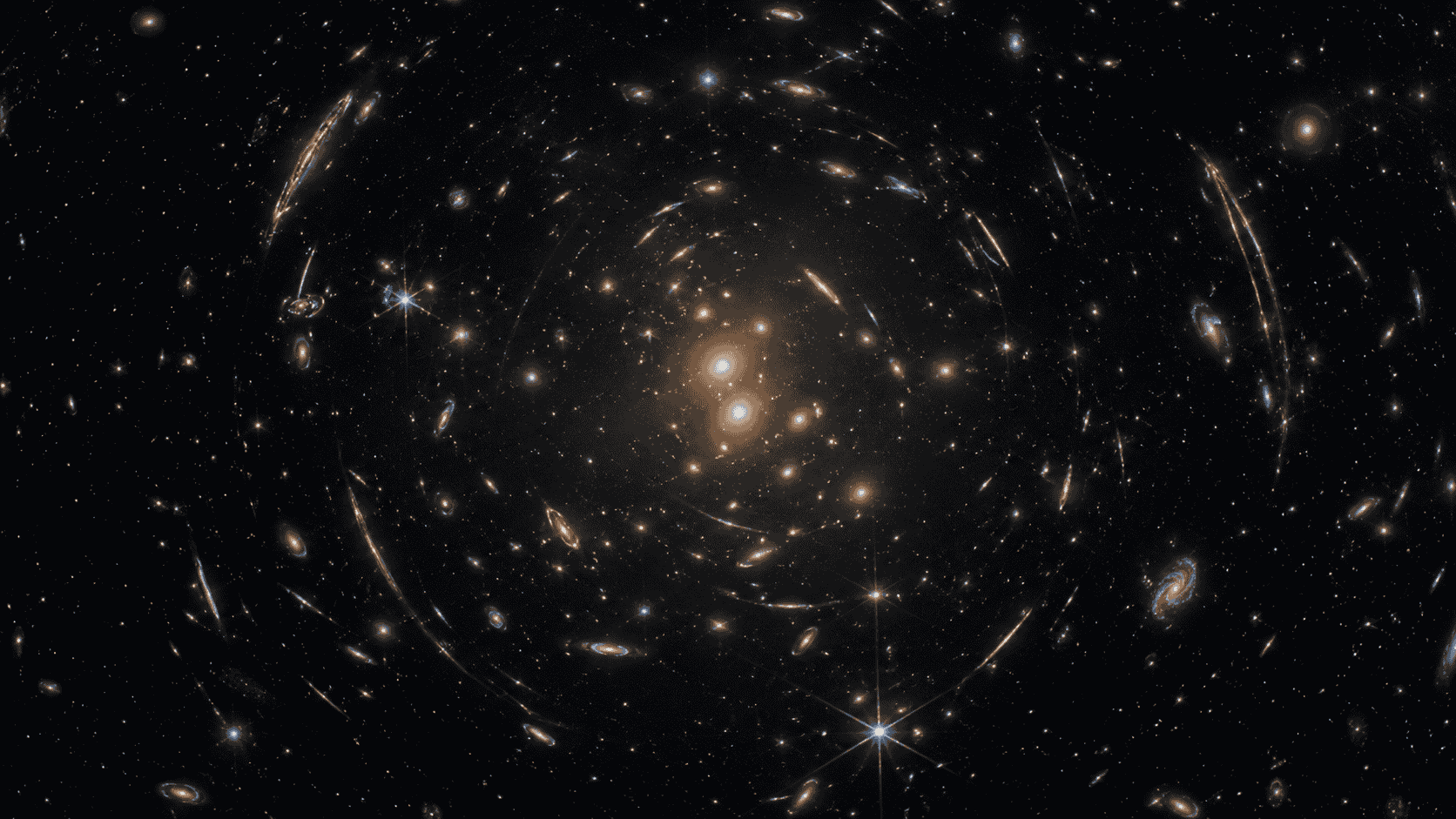
New Webb observations show giant arcs around XLSSC 122. Those arcs are not decorations. They are the signature of strong gravitational lensing, where the mass of a foreground object bends and magnifies light from galaxies behind it.
That makes XLSSC 122 important for two reasons. First, it is now reported as the most distant known galaxy cluster to show strong lensing. Second, the lensing gives astronomers a way to measure how mass is packed inside the cluster, including the dark matter that cannot be seen directly.
The result is not a dramatic “everything we know is wrong” moment. Science rarely works that way. But it is a serious clue that large structures in the early universe may have formed, concentrated and matured faster than some models expected.
What Webb saw in XLSSC 122
XLSSC 122 was not discovered by Webb. Astronomers already knew about the cluster before JWST studied it in detail. What Webb changed was the view.
With its infrared instruments, JWST was able to see the cluster more sharply than earlier telescopes. The new images revealed arcs created by strong gravitational lensing. In simple terms, the cluster is so massive that it bends the light of galaxies behind it, stretching that light into curved shapes.
This is one of the most useful tricks in modern astronomy. A massive galaxy cluster can act like a natural telescope, magnifying objects that would otherwise be too faint or too distant to study. At the same time, the shape of the lensing arcs tells astronomers how mass is distributed inside the cluster doing the bending.
In the case of XLSSC 122, that mass distribution is the key story.
A research team led by Kyle Finner of Caltech measured an unusually concentrated core in the cluster. The arXiv version of the paper reports a concentration value of 6.3 plus or minus 0.5 for the inner 100 kiloparsecs and estimates the mass inside that region at 6.5 plus or minus 0.7 times 10^13 solar masses.
That is technical language, but the meaning is simple enough: for a cluster seen so early in cosmic history, the center of XLSSC 122 appears surprisingly dense.
Why the timing matters
The universe is about 13.8 billion years old. XLSSC 122 is seen at a redshift of about 1.98, which places it around 3.4 billion years after the Big Bang. That is not the very first generation of galaxies, but it is still early for a massive, highly concentrated galaxy cluster.
Galaxies can form early. Smaller structures can merge and grow. But galaxy clusters are the giants of the cosmic web. They require dark matter, gas and galaxies to gather across enormous scales.
That is why XLSSC 122 stands out. It is not only massive. It is massive in a way that produces strong lensing, which means enough mass has already collected in the right configuration to bend and magnify background light.
The Webb finding therefore gives astronomers a useful problem. Did massive structures form more efficiently than expected? Is XLSSC 122 unusual? Are current simulations missing details about early cluster growth? Or are researchers seeing a rare object that became concentrated because of its own merger history?
Those are better questions than “does this break cosmology?” The answer to that is no. The more interesting answer is that Webb is making the early universe measurable in ways that were not possible before.
What gravitational lensing tells us
Gravitational lensing is powerful because it lets astronomers study both the background object and the foreground mass.
When a galaxy cluster sits between Earth and a more distant galaxy, the cluster’s gravity bends the path of the distant galaxy’s light. Depending on the alignment, that light can appear as arcs, rings or repeated images.
For XLSSC 122, the arcs are important because they allow researchers to map the cluster’s mass. That includes ordinary matter, such as stars and gas, but also dark matter, which does not emit light. Dark matter reveals itself through gravity, and lensing is one of the cleanest ways to trace that gravitational influence.
That makes XLSSC 122 more than a pretty Webb image. It is a dark matter laboratory from a much earlier era of the universe.
A related weak-lensing study of the same cluster also found evidence that XLSSC 122 is dynamically active. In plain English, the cluster may still be growing through merger activity. That matters because a merger can affect how mass appears to be distributed, and it may help explain why the cluster looks so concentrated.
The careful interpretation is not that one cluster has rewritten physics. The careful interpretation is that XLSSC 122 is now a valuable test case.
The latest Webb update adds another clue
The story has also become stronger because XLSSC 122 is not only showing lensing.
A newer JWST analysis reported evidence of intracluster light in XLSSC 122. Intracluster light is faint, diffuse starlight spread between galaxies inside a cluster. It often comes from stars that have been stripped away during galaxy interactions and mergers.
That matters because intracluster light is a sign of cluster evolution. If a cluster already has a measurable diffuse stellar component at this redshift, it suggests that some of the processes that build mature clusters were already underway.
In other words, Webb is not only seeing a massive object. It is seeing hints of a system with structure, history and internal activity.
That is why XLSSC 122 is such a useful target. Strong lensing shows mass. Weak lensing helps map the broader cluster. Intracluster light gives clues about how galaxies inside the cluster have interacted. Put together, those observations make the cluster a much richer scientific case.
Webb keeps finding a busy early universe
XLSSC 122 fits into a wider pattern.
Since JWST began science operations, astronomers have repeatedly found that the early universe looks more active and more organized than many expected. Webb has identified surprisingly bright early galaxies, early black holes, compact star-forming systems and galaxy structures that push researchers to refine their models.
Recent Webb-related work has not stopped with XLSSC 122. Space.com recently reported that JWST identified a system of at least six galaxies merging about 12 billion years ago, roughly 1.8 billion years after the Big Bang. That system, known as TGSSJ1530+1049, may eventually form one of the largest galaxies in the universe and appears linked to the growth of a young supermassive black hole.
A 2026 review of early-universe research with JWST and ALMA also describes how the two observatories are transforming the study of high-redshift galaxies by revealing gas, dust, stars, structure, black holes and star formation in far greater detail.
The pattern is becoming clear. Webb is not giving astronomers a quiet young universe. It is showing a universe where structure, stars, black holes and galaxies were already developing quickly.
Does this challenge the Big Bang?
No. It challenges parts of early structure-formation models, not the Big Bang itself.
The Big Bang model describes the expansion and early evolution of the universe. Discoveries of early galaxies, black holes and clusters do not automatically disprove that framework. What they can do is pressure the models that explain how matter gathered, cooled, formed stars and assembled into larger structures.
That distinction matters because science headlines often exaggerate Webb discoveries. Words like “impossible,” “breaks physics” and “scientists can’t explain” attract clicks, but they can make serious research sound more chaotic than it is.
A better framing is this: JWST is finding objects that formed earlier, grew faster or became more organized than expected. Astronomers now have to work out whether that means the models need minor adjustments, better simulations, more complete observations or, in some cases, deeper changes.
That is how science advances. Not by collapsing every time a surprising object appears, but by turning surprise into better measurement.
Why Webb is built for this kind of discovery
Webb is powerful because it sees infrared light with extraordinary sensitivity.
Very distant objects are seen as they were billions of years ago because their light has taken so long to reach us. As the universe expands, that light is stretched into infrared wavelengths. Webb was designed to detect that ancient, stretched light better than previous space telescopes.
That is why JWST can reveal faint early galaxies, study distant clusters and detect structures that Hubble could not examine in the same way. NASA describes Webb as a telescope built to study every phase in the history of the universe, from the first luminous glows after the Big Bang to the formation of stars, planets and galaxies.
In XLSSC 122, Webb’s value is not only distance. It is detail. The telescope sees the arcs, the structure and the faint clues needed to turn a distant cluster into a test of cosmic history.
What scientists need next
One cluster is not enough to rewrite the cosmic timeline.
The next step is to find more examples. Are early strong-lensing clusters rare, or are they part of a larger population? Do they all show high concentrations? Are they often connected to mergers? Can simulations reproduce them? Are observational biases making the most dramatic clusters easier to find?
The XLSSC 122 research points in that direction. Scientists need a larger sample of high-redshift lensing clusters, studied with the same care across Webb, X-ray, radio and millimeter observations.
That is when the field can move from surprise to statistics.
If more clusters like XLSSC 122 appear, the pressure on early-universe models will grow. If the cluster remains rare, it may become an unusual case that teaches astronomers about special pathways of cluster formation.
Either outcome is useful.
Why this discovery matters for ordinary readers
For non-scientists, the appeal of Webb discoveries is simple: they make the scale of the universe feel real.
XLSSC 122 is not nearby in any ordinary sense. Webb is looking across most of cosmic history and finding a structure already massive enough to bend light from galaxies behind it. That means the universe was building enormous systems earlier than many people might imagine.
The discovery also shows how modern astronomy works. Scientists are not only taking pictures of space. They are reading light as evidence: bent light, stretched light, infrared light, faint arcs and diffuse starlight between galaxies.
From those clues, they reconstruct events that happened billions of years before Earth existed.
That is what makes Webb so important. It does not simply show the early universe. It makes the early universe measurable.
XLSSC 122 is not the end of cosmology. It is a sharper question.
Webb has shown that this distant galaxy cluster produces strong gravitational lensing and appears to have an unusually concentrated core for its age. Related work suggests the cluster may also be dynamically active, with evidence of merger activity and early intracluster light.
Together, those findings point toward a young universe where massive structures may have assembled quickly, or at least in ways current models need to describe more carefully.
The next few years will decide how important this finding becomes. More Webb observations will show whether XLSSC 122 is a rare cosmic exception or part of a broader pattern.
Either way, Webb has done what it was built to do.
It has turned a distant smudge of cosmic history into a test of how the universe learned to build itself.
Frequently asked questions
What did the James Webb Space Telescope discover in 2026?
Webb observations of the galaxy cluster XLSSC 122 revealed strong gravitational lensing arcs. The cluster is now reported as the most distant known galaxy cluster to show strong lensing.
What is XLSSC 122?
XLSSC 122 is a distant galaxy cluster at a redshift of about 1.98. We see it as it looked roughly 3.4 billion years after the Big Bang.
Why is gravitational lensing important?
Gravitational lensing happens when a massive object bends and magnifies light from objects behind it. Astronomers use lensing to study distant galaxies and map mass, including dark matter, inside galaxy clusters.
Does this discovery disprove the Big Bang?
No. The discovery does not disprove the Big Bang. It may challenge details of how quickly massive galaxy clusters and large-scale structures formed in the early universe.
Why is Webb important for early-universe science?
Webb is an infrared telescope designed to study distant, ancient light. Because the universe’s expansion stretches early light into infrared wavelengths, JWST can see objects from deep cosmic history in greater detail than earlier telescopes.
Reference Note
This article was verified using Space.com’s June 29, 2026 report on XLSSC 122, Phys.org/IPAC coverage of the JWST images, the arXiv strong-lensing paper, related weak-lensing research, NASA’s Webb mission overview, and recent JWST/ALMA early-universe studies.
James Webb Space Telescope, JWST discovery 2026, XLSSC 122, early universe, galaxy cluster, gravitational lensing, strong lensing, dark matter, cosmic noon, Webb telescope discovery, early universe models, Big Bang, galaxy formation, JWST dark matter, distant galaxy cluster
James Webb Telescope, JWST, XLSSC 122, Early Universe, Galaxy Cluster, Gravitational Lensing, Dark Matter, Space News, Astronomy, Big Bang, NASA, Cosmic Noon





Discussion
Comments
Approved comments are published after moderation to keep discussion useful and spam-free.
No comments yet. Start the discussion below.