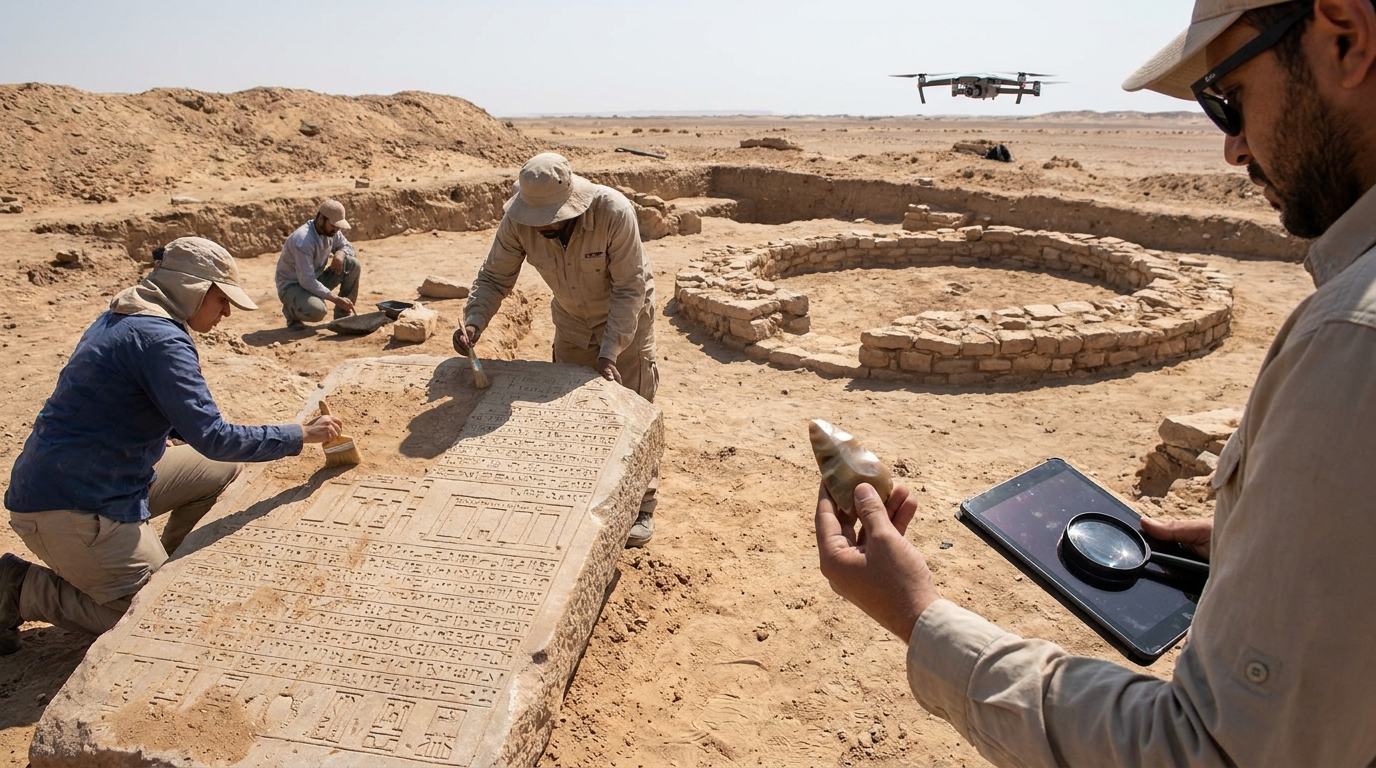
How Ancient Civilisations Were Far More Advanced Than We Were Taught
Modern archaeology keeps finding evidence of sophistication we didn't expect. Here's what the latest research reveals about the true capabilities of ancient peoples — and why it matters that we get this right.
The Myth of Linear Progress
The standard model of human civilisational development is linear: hunter-gatherers gave way to settled farmers, who developed tools, writing, mathematics, and eventually the complex societies we inhabit today. Progress, in this model, is a one-way ratchet — each era more sophisticated than the last.
This model is increasingly challenged by archaeological discoveries that reveal capabilities, knowledge systems, and social complexities in ancient peoples that don't fit the expected timeline. The evidence doesn't suggest mystical or extraterrestrial explanations — the favourite territory of pseudo-archaeology — but something more interesting: that human beings have always been cognitively capable of remarkable sophistication, and that the circumstances, materials, and social structures available to them shaped what that sophistication looked like in ways we are only beginning to understand.
Here are the most significant recent discoveries that challenge the conventional narrative of ancient "primitiveness."
1. Göbekli Tepe: Monumental Architecture 6,000 Years Before Stonehenge
Discovered in southern Turkey in the 1990s and still being excavated today, Göbekli Tepe is the most disruptive archaeological site of the modern era. Its T-shaped limestone pillars — some weighing up to 20 tonnes, covered in intricate relief carvings of animals and abstract symbols — were erected approximately 11,500 years ago, making the complex roughly 6,000 years older than Stonehenge and predating the invention of writing, pottery, and settled agriculture.
This is the problem for conventional narratives: the scale and complexity of Göbekli Tepe requires an organisational sophistication that was supposed to come after the development of agriculture and permanent settlements. Instead, the evidence suggests it was built by hunter-gatherers — people without cities, without writing, and without the agricultural surpluses that were supposed to be prerequisites for large-scale organised construction.
Recent excavations published in 2024–2025 have revealed that the site is even larger than initially assessed, with new enclosures still being uncovered and evidence of sophisticated astronomical alignments in the positioning of the pillars. The site appears to have been deliberately buried approximately 10,000 years ago — itself a logistically remarkable undertaking that required the movement of hundreds of thousands of cubic metres of soil.
What it means: The capacity for monumental, symbolically sophisticated construction does not require agriculture or cities as prerequisites. This forces a fundamental rethink of what "civilisation" requires and when humans first achieved it.
2. The Antikythera Mechanism: An Ancient Computer
Recovered from a shipwreck off the Greek island of Antikythera in 1901, the Antikythera Mechanism is a bronze mechanical device from approximately 100 BCE that calculated the movements of the Sun and Moon, predicted eclipses on an 18-year Saros cycle, tracked the four-year cycle of the Panhellenic Games (including the Olympics), and modelled the varying orbital speeds of the Moon using differential gearing — a mechanical principle not rediscovered in Europe until the 16th century CE.
The mechanism contains at least 37 interlocking bronze gears, some with teeth less than a millimetre in size. X-ray imaging and CT scanning conducted over the past two decades have revealed inscriptions on its interior panels that served as an operating manual. A 2021 paper in Nature reconstructed the complete front panel mechanism; subsequent work through 2025 has extended this to the rear panel and identified previously unknown gear trains.
The Antikythera Mechanism is not a curiosity or an anomaly — it is evidence that the mechanical and mathematical knowledge required to produce it was present in the ancient world, and that the absence of comparable surviving artefacts reflects the fragility of bronze objects over two millennia, not the absence of ancient technical capability.
What it means: Precision mechanical engineering was achieved in the ancient world at a level not seen again until the Renaissance. The gap is explained by the fragility of evidence, not by the absence of ancient sophistication.
3. Indus Valley Civilisation: Urban Planning That Rivalled Rome
The Indus Valley Civilisation, which flourished from approximately 3300 to 1300 BCE across what is now Pakistan and northwest India, built cities with a level of urban planning sophistication that was not matched in Europe until the Roman Empire — nearly two thousand years later.
The city of Mohenjo-daro (in modern Pakistan) covered approximately 250 hectares and housed an estimated 40,000 people at its peak. It featured a grid street system with standardised brick sizes used across all construction, a sophisticated sewage and drainage system that connected individual houses to covered street drains (Rome's famous sewers came nearly 2,000 years later), public buildings including a "Great Bath" that may have served ritual purposes, and what appears to have been a remarkably egalitarian social structure — archaeological evidence for extreme wealth concentration or large-scale warfare is largely absent.
Recent excavations using ground-penetrating radar and LiDAR technology, published in 2024–2025, have revealed the extent of Indus Valley sites to be significantly larger than previously assessed. Rakhigarhi, in India, now appears to have been the civilisation's largest city — larger than Mohenjo-daro — and new survey data suggests several previously unknown large settlements.
What it means: The Indus Valley civilisation achieved urban infrastructure sophistication comparable to Rome nearly two millennia before Rome — yet it receives a fraction of the historical and educational attention.
4. Ancient Polynesian Navigation: Ocean Crossing Without Instruments
Polynesian navigators settled islands across the Pacific Ocean — from Hawaii to Easter Island to New Zealand — in an expansion that covered approximately one third of the Earth's surface between roughly 1000 BCE and 1200 CE. They did so in double-hulled voyaging canoes, without magnetic compasses, sextants, or charts, navigating by stars, wave patterns, bird behaviour, cloud formations, and the colour and temperature of water.
The precision required for these voyages — finding islands that are tiny specks in the world's largest ocean after journeys of thousands of kilometres — was for a long time dismissed by Western scholars as accidental drift. A 2023 computational study published in PNAS modelled thousands of simulated voyages using the available navigational knowledge and vessel characteristics and demonstrated conclusively that the Polynesian expansion was systematic and intentional — the result of a navigational knowledge system of extraordinary sophistication.
The traditional navigational knowledge, nearly lost after European colonisation, is being actively recovered and taught. The Polynesian Voyaging Society's voyages aboard the reconstructed Hōkūle'a — which has circumnavigated the globe using traditional navigation — demonstrate that this knowledge system works precisely as the ancient navigators required it to.
What it means: Navigational sophistication sufficient for intentional transoceanic voyaging existed in pre-literate Pacific cultures millennia before equivalent European capabilities — achieved through systematic environmental observation rather than instrumental technology.
5. Ancient Roman Concrete: More Durable Than Ours
Roman concrete — opus caementicium — has baffled engineers for centuries. Structures built 2,000 years ago in seawater, including the harbours at Caesarea Maritima and Pozzuoli Bay, are not merely intact but in many cases stronger than when they were built. Modern Portland cement, by contrast, begins to degrade after 50–100 years, particularly in marine environments.
A 2023 study in PLOS ONE and follow-up research published in 2024–2025 definitively identified the mechanism: Roman volcanic ash (pozzolana) mixed with seawater and lime creates a chemical reaction that produces aluminous tobermorite crystals within the concrete matrix over time. The longer the concrete is exposed to seawater, the stronger it becomes — the exact opposite of modern concrete's behaviour. This process was understood empirically by Roman engineers even without knowledge of the underlying chemistry.
Research groups are now working to develop modern concrete formulations based on the Roman recipe that could dramatically extend the lifespan of marine infrastructure while reducing the enormous carbon footprint of Portland cement production.
What it means: Roman engineers solved a materials science problem — long-term durability in marine environments — that modern engineering only re-identified as a problem in the 20th century and still hasn't fully matched. Two thousand years of "progress" produced concrete that lasts less long.
6. The Nazca Lines: Hydraulic Engineering, Not Just Art
The Nazca Lines of Peru — enormous geoglyphs covering approximately 450 square kilometres of desert plateau, depicting animals, plants, and geometric shapes visible in their entirety only from the air — have attracted speculation about their purpose since their Western discovery in the early 20th century. The most recent and most rigorously evidenced interpretation, developed through extensive archaeological and hydrological research published in 2022–2025, suggests they functioned as a sophisticated hydraulic system.
The lines appear to map and mark underground water channels (puquios — spiral holes drilled into the earth to access groundwater) and to have functioned as a ritual landscape connected to water management ceremonies in an extremely arid environment. Analysis of the geoglyphs' alignment with water sources, underground channels, and seasonal water movement patterns shows systematic correspondence that is too consistent to be coincidental.
What it means: The Nazca Lines were likely a functional water management system as well as a ritual landscape — evidence of sophisticated hydraulic engineering and environmental understanding in a culture without written records, not merely decorative or ceremonial art.
What Unites These Discoveries
The thread connecting all of these findings is not that ancient people had technologies or knowledge they "shouldn't" have had — a framing that implicitly imposes our own developmental timeline on radically different contexts. It is something both more interesting and more humanising: ancient people were fully cognitively modern humans who applied extraordinary intelligence, careful observation, and sophisticated social organisation to the specific challenges and materials of their environment.
The bias toward seeing ancient peoples as primitive is partly the inheritance of colonialism — a worldview that needed to believe in a hierarchy of civilisational development to justify its own project. Correcting this is not merely an academic exercise. It changes how we understand human potential, how we approach indigenous knowledge systems, and how we think about what "advanced" actually means.
ancient civilisations advanced technology, Göbekli Tepe significance, Antikythera mechanism explained, Indus Valley civilisation facts, Roman concrete durability, Polynesian navigation science, Nazca lines water theory, archaeological discoveries 2025 2026, ancient advanced technology evidence






Discussion
Comments
Approved comments are published after moderation to keep discussion useful and spam-free.
No comments yet. Start the discussion below.