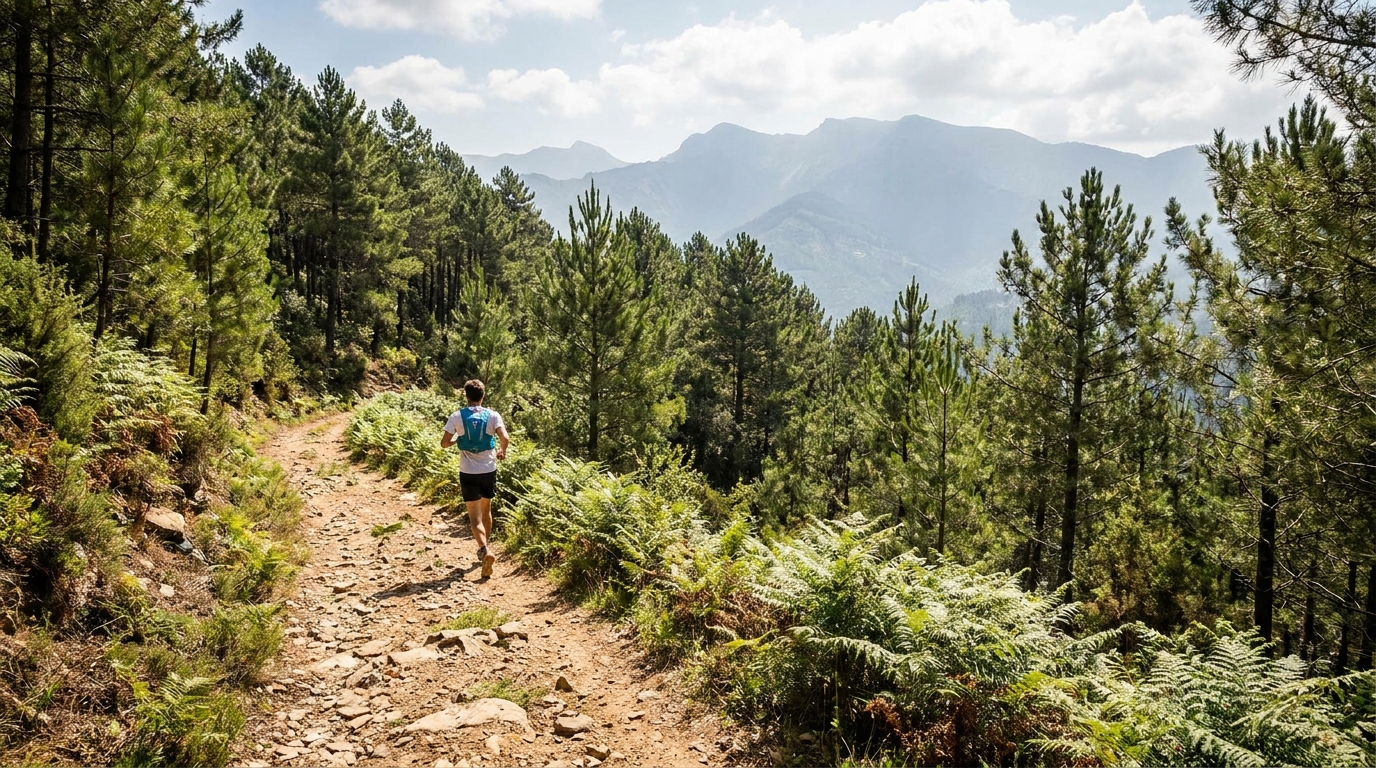
How to Start Trail Running in 2026: The Complete Beginner's Guide
Trail running combines the best of hiking and road running — but it comes with its own rules, risks, and rewards. Here's how to start right, stay injury-free, and fall genuinely in love with running off-road.
Why Trail Running Is Having Its Biggest Moment Yet
Trail running participation has grown by approximately 35% in the US and UK since 2020, making it one of the fastest-growing outdoor sports in either country. The reasons are straightforward: it offers everything road running does — cardiovascular fitness, mental health benefits, a community of fellow participants — alongside something road running rarely provides: genuine immersion in natural environments, constantly changing terrain that demands attention rather than allowing the mind to drift, and views that make the effort feel worth it in ways that staring at a pavement ahead does not.
Trail running is also, for most people, more forgiving than road running on the body. The varied terrain means no two footstrikes land identically, distributing load across different muscles and reducing the repetitive stress injuries (shin splints, IT band syndrome, plantar fasciitis) that plague road runners. Softer surfaces — earth, grass, packed dirt — absorb impact more effectively than tarmac. And the slower pace that technical terrain demands naturally reduces overexertion for beginners who have no choice but to run within their aerobic capacity.
This guide takes you from complete trail running beginner to your first trail race or long trail run — with everything in between.
Trail Running vs Road Running: The Key Differences
Pace
The most important mental adjustment for road runners transitioning to trails: your pace will be slower. Significantly slower. Technical terrain, elevation changes, and surface variability make the same effort level produce a much lower speed than on roads. A runner who covers road miles in 8 minutes per mile might find themselves running 12–16 minutes per mile on technical mountain trails. This is normal and universal — professional trail runners experience the same ratio. Judging trail performance by road pace expectations is a recipe for frustration and overexertion.
The appropriate metric for trail running is effort — rated by perceived exertion or heart rate — not pace. Running by feel, at an effort where conversation is possible, is the most appropriate approach for beginners on trails regardless of the pace that produces.
Navigation
Road running rarely requires navigation. Trail running frequently does. Even well-marked trails can be ambiguous at junctions, partially obscured by vegetation, or difficult to follow in poor visibility. Learning to read trail markers (typically coloured blazes on trees, cairns in open terrain, or signposts at junctions), to use offline mapping apps (Gaia GPS, AllTrails), and to carry a physical map as backup for unfamiliar terrain are skills trail runners develop progressively.
Elevation and Technical Terrain
Hills, roots, rocks, mud, stream crossings, and loose scree are the environment of trail running rather than exceptions to it. Learning to descend efficiently — a skill that takes practice and is more technically demanding than ascending — is one of the most important trail-specific developments for any runner. Beginners who can comfortably run uphill often discover that technical descending is the more challenging skill.
Self-Sufficiency
Road running rarely requires carrying much beyond a phone and some cash. Trail running — particularly in remote areas — requires carrying water, food, navigation tools, and emergency equipment appropriate to the distance and terrain. The principle of self-sufficiency becomes more important as trail distances increase and civilisation recedes.
Gear: What You Actually Need to Start
Trail Running Shoes: The Non-Negotiable First Purchase
Road running shoes are not appropriate for technical trail running. Their smooth, cushioned soles provide no grip on wet rock, loose dirt, or rooty surfaces, and their lower durability construction degrades rapidly when exposed to the abrasion of trail surfaces. Trail running shoes feature lugged rubber outsoles for grip, rock plates (in some models) to protect feet from sharp stones underfoot, and reinforced toe boxes to absorb impact from roots and rocks.
The appropriate level of cushioning and lug aggressiveness depends on terrain type:
Groomed dirt trails and fire roads (most beginner terrain): Light lug, well-cushioned trail shoes. The Hoka Speedgoat 6 and Brooks Cascadia 17 are the most universally recommended options for this category.
Rooty, rocky technical trails: More aggressive lug pattern, rock plate, stiffer ride. Salomon Speedcross 6, Inov-8 Trailroc G 280.
Muddy terrain (UK-specific, very common): Deep, aggressive lugs designed to clear mud. Inov-8 Mudclaw series, Salomon Speedcross 6.
Best all-rounder for beginners in 2026:
Hoka Speedgoat 6 — £140 / $155: The most widely recommended beginner-to-intermediate trail shoe globally. Exceptional cushioning for long distances, reliable grip on most surfaces, comfortable for runners transitioning from road shoes.
Brooks Cascadia 17 — £130 / $140: The benchmark alternative — slightly firmer ride, excellent durability, outstanding value over its lifespan.
Hydration
For runs under 60 minutes on trails with no risk of being delayed, no hydration system is typically necessary. For runs of 60–90 minutes, a simple handheld water bottle (Nathan SpeedDraw Plus — £30 / $35 — holds 18oz and has a small storage pocket for gels and a phone) is the simplest option. For runs over 90 minutes or in hot conditions, a hydration vest or pack becomes appropriate.
Best hydration vest for beginners: Salomon Active Skin 8 — £110 / $130
8-litre capacity, front soft flask pockets included (no hydration bladder to wrestle with), stable and non-bouncing design, widely considered the best value hydration vest for non-technical running. The standard recommendation for runners moving into longer trail distances.
The Rest: What to Actually Carry
A minimal but complete kit for a beginner trail runner on a 1–3 hour run in reasonable conditions:
Trail shoes (as above)
Moisture-wicking running top and shorts (avoid cotton)
Lightweight windproof jacket or gilet (conditions change rapidly in mountain terrain)
Water (500ml–1 litre depending on duration and heat)
One gel or snack for runs over 75 minutes
Fully charged smartphone with AllTrails trail downloaded offline
Small first aid items — blister plasters, pain relief
Finding Trails: Where to Begin
The Best Platforms for Trail Discovery
AllTrails: The most comprehensive trail database in the US and UK. Filter by difficulty, length, elevation gain, and surface type. Reviews from other users are typically honest and include current condition updates. The free tier covers basic trail information; the Pro tier (£25 / $30 annually) adds offline maps and route planning tools.
Komoot: Particularly strong in the UK and Europe, with excellent route planning tools and a community of hikers and runners who contribute current condition reports. The sport-specific routing (separate algorithms for trail running vs hiking vs cycling) produces more appropriate routes than AllTrails for running.
Strava segments and local running clubs: Local trail running communities on Strava often have curated local route collections. Joining a local trail running club — most UK parkrun locations have associated trail groups; in the US, local running shops often organise weekly trail runs — is the fastest way to get local knowledge and a supportive introduction to the terrain.
What to Look for in a Beginner Trail
Clearly marked routes: Waymarked trails (National Trails in the UK; well-marked National Forest trails in the US) reduce navigation anxiety for beginners
Manageable elevation gain: Under 100 feet per mile for beginners; 150–250 feet per mile for intermediate runners
Loop or out-and-back format: Point-to-point trails require either a shuttle car or the willingness to double the distance — loops and out-and-backs are logistically simpler for beginners
Mobile coverage along most of the route: Until navigation confidence is established, mobile coverage provides a safety net
A 10-Week Beginner Trail Running Programme
This programme assumes you can already run 20–30 minutes continuously on roads. If you can't, complete a couch-to-5K programme first — the trail-specific training adds complexity that is better introduced after base running fitness is established.
Weeks 1–3: Introduction (3 sessions per week)
All runs on the easiest available trail — groomed paths, flat or gently rolling terrain, well-marked. Walk any steep sections rather than running them. Focus on adapting to variable footing rather than pace or distance. Session duration: 30–45 minutes.
Key skill to develop: looking ahead rather than at your feet. Trail runners scan 3–5 metres ahead to plan footing, rather than watching directly beneath each step. This takes practice to become automatic but dramatically reduces stumbles and falls.
Weeks 4–6: Building on Trails (3 sessions per week)
Introduce one session per week with more significant elevation — aim for trails with 200–400 feet of climbing per session. Begin running gentle uphills rather than walking all ascents. Continue walking steep sections. Extend session duration to 45–60 minutes on the longest day. Introduce one flat road or easy trail run per week to maintain cardio base.
Key skill to develop: descending with confidence. Controlled, quick-footed descending — leaning very slightly forward, arms out for balance, landing on the midfoot rather than braking with the heel — is the most trail-specific technical skill. Practice on gentle slopes before attempting steep technical descents.
Weeks 7–9: Trail Specific (3–4 sessions per week)
Introduce your first genuine elevation session: a run with 500–800 feet of climbing, run continuously including the uphills (at whatever pace is necessary — very slow is fine). This session builds the specific fitness for trail running that flat running cannot develop. Extend the long run to 75–90 minutes on appropriate trail terrain.
Introduce the practice of running by effort rather than pace. Leave GPS pace displays covered and run by feel — easy enough to breathe through the nose on climbs, recovering on descents.
Week 10: Your First Trail Goal
Target a specific trail run of 60–90 minutes on terrain you've partially explored. An organised trail 5K or 10K event is an excellent goal — the atmosphere of other trail runners, the marked course, and the aid stations make the experience significantly more supportive than a solo first long effort. Parkrun trail events (in the UK) and various trail series (XTERRA Trail Run Series in the US; Run the Wild, Rat Race series in the UK) offer organised trail events at all distances for all abilities.
Injury Prevention: The Rules Trail Runners Actually Follow
Increase weekly distance by no more than 10% per week: The most universal and most frequently violated rule in running. Tendons and ligaments adapt more slowly than cardiovascular fitness — overloading them is the primary cause of overuse injuries.
Strength train: Single-leg exercises (single-leg squats, Bulgarian split squats, single-leg deadlifts) build the hip and glute strength that stabilises the knee and ankle on uneven terrain. Two sessions of 20–30 minutes per week reduces trail running injury risk significantly.
Respect technical terrain: Running faster than your technical skill allows on rooty or rocky terrain is the primary cause of acute trail running injuries (falls, ankle sprains). Running slower than feels necessary on technical ground is always the right decision until technique is established.
Never run to failure in remote terrain: Always maintain enough energy and attention to return safely. The second half of any trail run should never be completed on fumes — the fall rate increases dramatically when tired on technical ground.
The Trail Running Community: Finding Your People
Trail running has one of the most welcoming communities in sport. The shared experience of suffering on hills, navigating in the rain, and discovering spectacular places through their own effort creates a genuine bond among trail runners that road racing — more competitive, more urban, more anonymous — often lacks. Local trail running groups, organised events, and the universal practice of waiting for slower runners at junctions (no trail runner gets left behind) make it an unusually accessible community for newcomers.
The UK's Trail Running Association and the US's American Trail Running Association both maintain event databases and club directories. Joining a club is the single fastest way to accelerate trail running development — the knowledge transfer from experienced local runners about the best terrain, the current conditions, and the appropriate gear for specific environments is irreplaceable.
trail running beginners 2026, how to start trail running, trail running tips, best trail running shoes 2026, Hoka Speedgoat review, trail running vs road running, beginner trail running programme, trail running gear guide, trail running hydration vest, learn trail running UK US





Discussion
Comments
Approved comments are published after moderation to keep discussion useful and spam-free.
No comments yet. Start the discussion below.