NATO in 2026: Is the Alliance Strong Enough to Deter Russia?
NATO has expanded, increased spending, and hardened its eastern flank. But after years of war in Ukraine, is the alliance genuinely capable of deterring Russian aggression against its members? An honest assessment.
The Alliance That Changed Forever in 2022
Russia's full-scale invasion of Ukraine in February 2022 transformed NATO in ways that years of alliance management had failed to achieve. Countries that had spent decades below the 2% GDP defence spending target scrambled to meet it. Finland and Sweden — nations that had maintained neutrality or non-alignment for decades — joined the alliance. Eastern European member states that had been warning about Russian intentions for years found themselves suddenly credible rather than alarmist. And NATO's relevance, questioned by some Western analysts in the years before 2022, was reasserted with brutal clarity.
Four years later, the alliance is stronger in several measurable respects than it was before the invasion. It is also more exposed — geographically extended, internally divided on some questions of strategy and Ukraine policy, and confronting a Russian military that has learned from its early failures and adapted. Whether NATO's current posture is adequate for the deterrence task it faces is a genuinely contested question among security analysts, and this guide attempts to assess it honestly.
NATO's Current State: What's Changed Since 2022
Membership Expansion
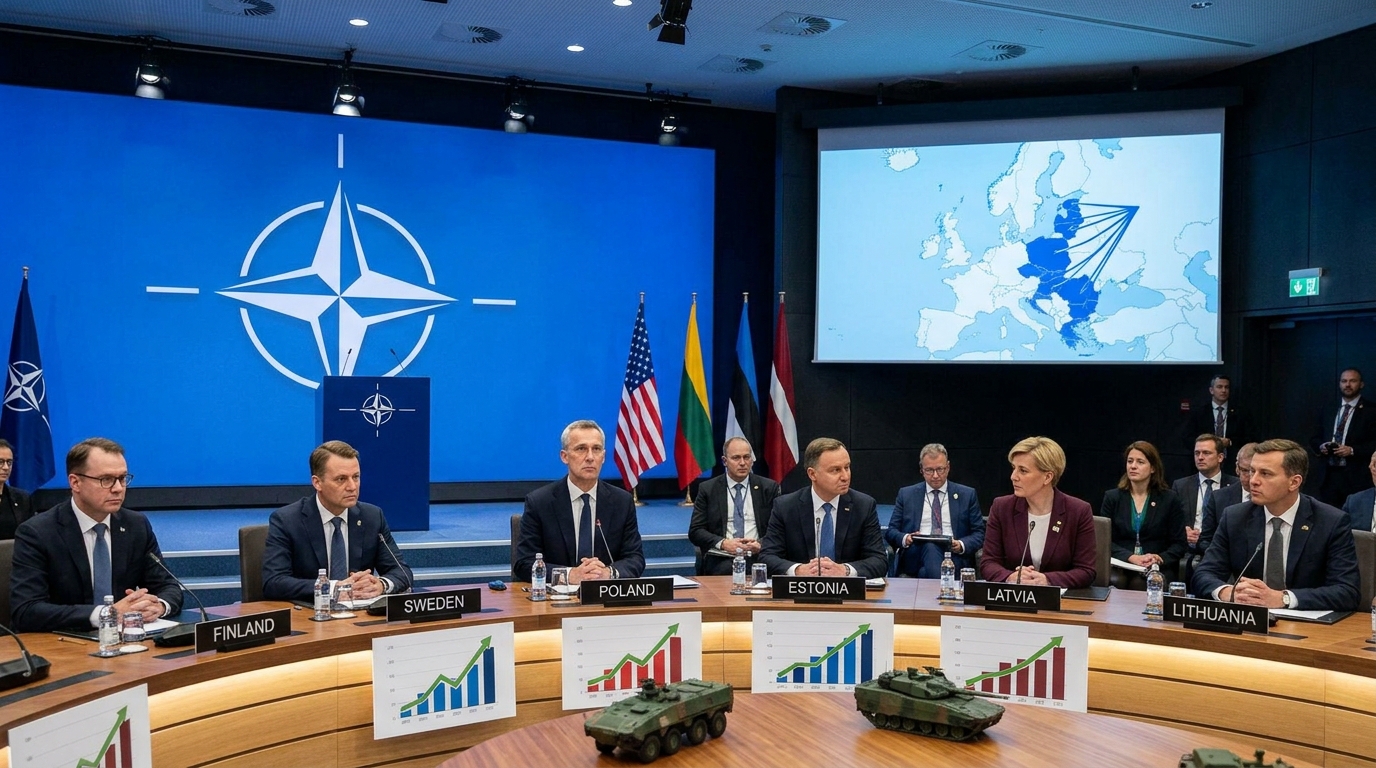
The most structurally significant change to NATO since 2022 is its enlargement. Finland joined in April 2023 and Sweden in March 2024 — bringing the alliance to 32 members and, in the case of Finland, adding 1,340 kilometres of NATO-Russian border. This expansion dramatically changes the strategic geography of northern Europe. Finland's military — one of the most capable in Europe per capita, built around a credible territorial defence doctrine — materially strengthens NATO's northern flank.
The enlargement also validates what Putin claimed to be trying to prevent. Russian demands that NATO commit to no further eastward expansion were rejected before the invasion; the invasion produced precisely the expansion it was ostensibly designed to deter.
Defence Spending
The 2% of GDP defence spending target — long treated as aspirational by many members — has been met or exceeded by 23 of NATO's 32 members as of 2026. This compares to just 9 members meeting the target in 2021. The increase in real defence expenditure across the alliance is substantial: Germany, which spent just 1.3% of GDP on defence in 2021, has crossed 2% and is committed to 3% by 2028. Poland is spending over 4% of GDP — the highest in the alliance proportionally. The UK and France continue to anchor the alliance's military capability at the upper tier.
The caveat is that spending figures take years to translate into capability. Money allocated today produces trained soldiers, procured equipment, and built infrastructure over a 5–10 year horizon. The alliance is more heavily funded than it was in 2021; it is not yet as capable as that funding will eventually produce.
Eastern Flank Reinforcement
Following the 2022 invasion, NATO significantly increased its forward presence on the eastern flank. The Enhanced Forward Presence battlegroups in the Baltic states and Poland were upgraded from battalion-level to brigade-level forces. US forces in Europe were increased by approximately 20,000 troops. Air policing missions were expanded. And NATO's Very High Readiness Joint Task Force — the alliance's rapid reaction capability — was expanded from 40,000 to over 300,000 troops.
Whether this posture constitutes credible deterrence or a "trip wire" that would require massive reinforcement in any actual conflict remains a subject of significant debate among military analysts.
Russia's Military in 2026: Weakened But Not Broken
Russia's military has paid an extraordinary price for the Ukraine war. Equipment losses — tanks, armoured vehicles, aircraft, helicopters — have been severe, with Western intelligence estimates suggesting Russia has lost more tanks than it possessed in 2022. Personnel casualties (killed and seriously wounded) are estimated by various intelligence agencies at between 350,000 and 500,000 — a staggering human and institutional cost.
But Russia's military has also adapted. The initial catastrophic failures of the 2022 campaign — poor logistics, inadequate command and control, overestimated capabilities — have been partially addressed through painful institutional learning. Russian drone warfare capability has expanded significantly. Domestic weapons production has been increased dramatically through the conversion of much of the civilian manufacturing sector to defence production. And Russian forces, however degraded, continue to hold and in some areas advance in eastern Ukraine.
The critical assessment for NATO deterrence: Russia's conventional military capability against a well-prepared NATO adversary in the next 2–3 years is significantly below its pre-2022 level. The ability to generate the combined arms forces required for a major offensive against a NATO member is degraded. But this window will not last indefinitely — Russian defence production is running at wartime rates, and the question of when Russian forces will have regenerated sufficient capability to threaten NATO's eastern members is a matter of genuine debate among analysts, with estimates ranging from 5 to 15 years.
The Deterrence Question: Is NATO's Posture Adequate?
The Case That Deterrence Is Working
Article 5 — the collective defence clause — has never been invoked. No NATO member has been attacked. Russia, despite its rhetoric, has consistently calibrated its actions to avoid direct military confrontation with the alliance. The reinforced eastern flank, the political unity demonstrated through the Ukraine support process, and the demonstrated willingness of European members to significantly increase defence spending all send credible signals that NATO aggression would be met with collective response.
The Baltic states and Poland — the members most exposed to Russian pressure — have invested heavily in their own territorial defence capabilities alongside the forward presence of allied forces. Estonia and Latvia, in particular, have developed territorial defence doctrines explicitly modelled on Finland's approach and designed to make any occupation strategically costly even if initial defence failed.
The Case for Concern
The most significant concern among military analysts is the gap between NATO's political commitment and its near-term warfighting capability for a major conventional conflict on the eastern flank. The forward presence — even at upgraded brigade-level — is too small to defeat a major Russian offensive without significant reinforcement. Reinforcement timelines, tested in exercises, routinely exceed the timelines of realistic threat scenarios. European logistics infrastructure — roads, bridges, rail — is not adequately prepared for rapid large-scale military movement in many cases.
Ammunition production is a specific concern. The Ukraine war has consumed ammunition at rates that exposed the inadequacy of Western production capacity. NATO members have been replenishing their own stocks while also supplying Ukraine — a dual demand that most members' defence industries were not structured to meet. Production increases are underway but the gap will not be fully closed for several years.
Internal alliance cohesion has also shown stress fractures. Disagreements about the level of support to Ukraine, questions about burden-sharing, and political developments in some member states (Hungary most prominently) have demonstrated that Article 5 unity — while ultimately maintained — is not unconditional in every circumstance.
The Nuclear Dimension
Any honest assessment of NATO-Russia deterrence must acknowledge the nuclear dimension — the factor that makes this confrontation fundamentally different from any conventional military competition. Russia possesses the world's largest nuclear arsenal, and Russian doctrine explicitly contemplates the use of tactical nuclear weapons to "de-escalate" a conventional conflict it is losing — a doctrine that differs meaningfully from Western deterrence doctrine.
NATO's nuclear sharing arrangement — US B61 nuclear gravity bombs hosted at bases in Belgium, Germany, Italy, the Netherlands, and Turkey — provides a nuclear deterrent capability within the alliance structure. The question of whether this arrangement, and the broader nuclear deterrence framework, adequately addresses Russia's tactical nuclear posture is one of the most contested in current NATO strategic thinking.
The Verdict: Adequate but Not Comfortable
The most defensible assessment of NATO's deterrence posture in 2026 is that it is adequate for the near-term threat environment — a Russian military significantly degraded by the Ukraine war — but not comfortably so, and not reliably so over a longer time horizon without continued investment and reform.
The alliance has demonstrated political will (the Ukraine support effort, the spending increases, the Finland and Sweden accessions) that was not clearly present before 2022. The military capability to match that political will is being built but is not yet fully in place. The window of Russian conventional military weakness is real but finite. And the internal political cohesion of the alliance — particularly as national elections in multiple member states produce governments with varying degrees of commitment to collective defence — remains the most uncertain variable of all.
Deterrence is ultimately a perception game: whether Moscow believes NATO will respond collectively and decisively to an attack on a member. On that question, the actions of the past four years — the Ukraine support, the enlargement, the spending increases — have sent clearer signals than anything in the preceding decade. Whether those signals are clear enough, and will remain clear enough, is the central question of European security for the rest of this decade.
NATO 2026 strength assessment, NATO Russia deterrence, NATO defence spending 2026, Russia military capability 2026, NATO eastern flank, Finland NATO membership, Article 5 collective defence, NATO Ukraine Russia war, European security 2026, NATO military readiness



Discussion
Comments
Approved comments are published after moderation to keep discussion useful and spam-free.
No comments yet. Start the discussion below.