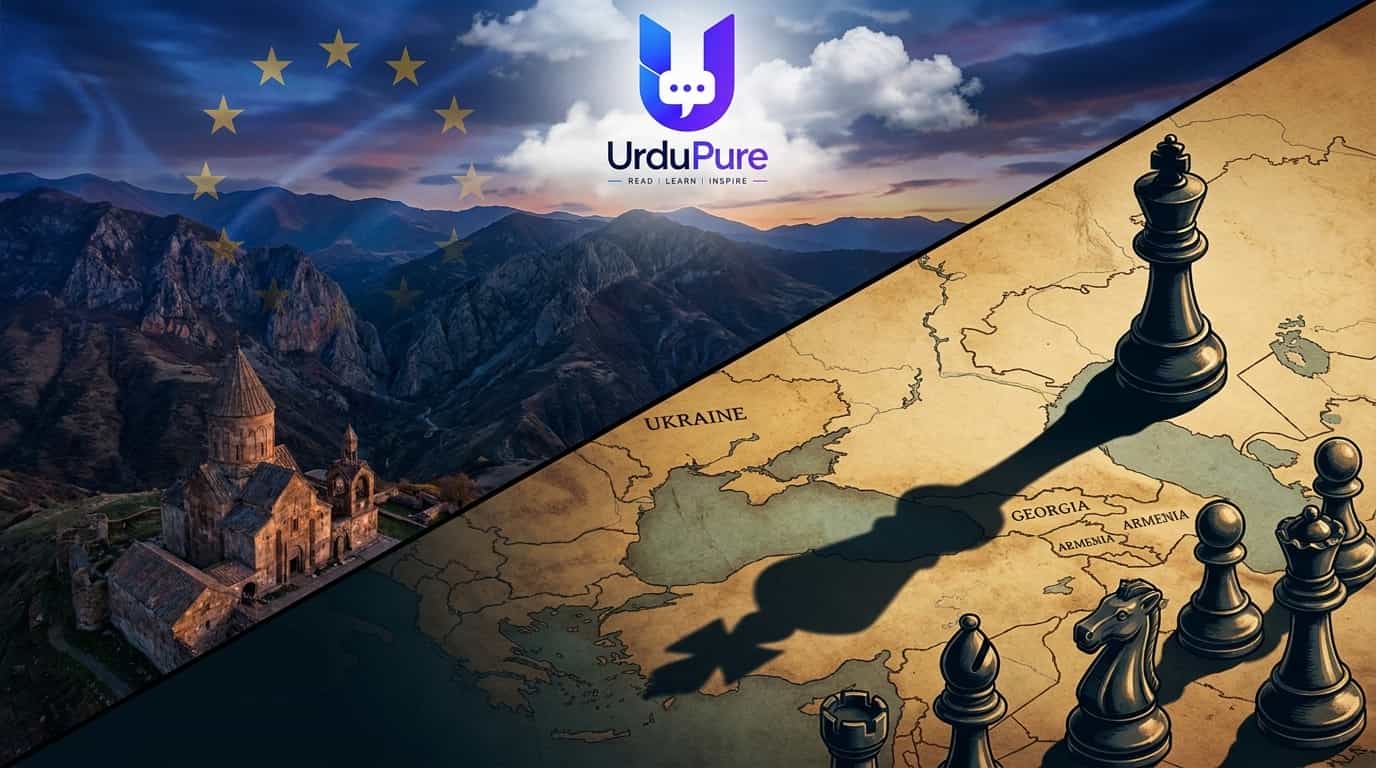
Who Could Russia Invade Next? The Frightening Case for Armenia and Georgia in 2026
Two Days Ago, Russia Launched Its Biggest Attack on Kyiv in Months — and Nobody Was Impressed
On the night of May 23–24, 2026, Russia fired 690 separate weapons at Ukraine — 90 missiles of various types and 600 strike drones, including one Oreshnik intermediate-range ballistic missile, a hypersonic nuclear-capable weapon travelling at Mach 10 that Ukraine has no system to intercept. Four people died. Schools burned. A shopping mall collapsed in flames. The Kremlin called it a demonstration of Russian power.
Then the Kremlin's own supporters reacted.
"What's the point of firing a blank slug without a warhead and calling it Oreshnik?" asked Russian milblogger 13th on Telegram. "Why hasn't any of Ukraine's leadership been killed? Why is Zelensky still alive?" Another milblogger — Shadow of Russ — was blunter: "Oreshnik is supposed to work as a news hook to frighten, to convince, to pressure. But it doesn't work." A third called it "a humiliating circus, a clown dance on the bones of Russians."
EU foreign policy chief Kaja Kallas called the Oreshnik strike "a political scare-tactic and reckless nuclear-brinkmanship." The US deputy ambassador to the UN called it "another dangerous and inexplicable escalation." Ukraine's President Zelensky, watching his capital burn, called on allies to raise pressure.
Here is what all of this tells you, clearly and without diplomatic softening: Vladimir Putin fired his most sophisticated missile at a capital city, killed four civilians, and impressed absolutely nobody on either side. That is not the behaviour of a man who believes he is winning. That is the behaviour of a man running out of options — and desperately searching for a way to prove he still matters.
The question the world's intelligence services are now asking — and that the people of the South Caucasus are asking with considerably more personal urgency — is this: what does a desperate Putin do next?
The Stalemate Putin Cannot Admit
The battlefield reality in Ukraine in May 2026 bears no resemblance to the narrative Vladimir Putin presents to the Russian public. The Institute for the Study of War, one of the most rigorous conflict analysis organisations operating in this space, recently announced that it will no longer project a timeline for when Russia could capture all of Donetsk Oblast — because "it is no longer clear that Russia can capture Donetsk at all."
The ISW's May 24 assessment is unambiguous: Russian nationalist milbloggers dismissed the Oreshnik strike as mostly symbolic and noted that the strikes came amidst Russian failures on the battlefield.
Russia is bleeding soldiers faster than it can recruit them. Its forward progress on the ground is measured in metres per week, purchased at staggering human cost. The April 11 Easter truce — ostensibly a humanitarian pause — was violated 469 times by Russia in 32 hours, according to Ukrainian military monitoring. Even moments that should demonstrate Russian goodwill become evidence of its bad faith.
Inside the Kremlin, something more alarming than military failure is occurring. Putin's advisers, according to multiple insider leak reports, are feeding him battlefield projections that bear no relationship to documented reality — because admitting failure to Putin has become career-ending, or worse. The resulting information bubble means Russia's leadership is simultaneously losing a war it cannot acknowledge losing, and searching for a "show of force" that its strained military cannot actually provide.
"Russia's exaggerated territorial ambitions and aggressive territorial demands run completely counter to battlefield reality." — Institute for the Study of War, May 2026
This is Putin's trap. And trapped leaders with nuclear weapons and deluded advisers do not quietly accept stalemate. They look for somewhere else to win.
The Doctrine of Historical Lands — and Where It Points
To understand which countries face the most acute risk, you need to understand how Vladimir Putin justifies aggression — because his own words provide the clearest map of his intentions.
"Wherever a Russian soldier sets foot is ours," Putin said earlier this year. Based on the boundaries of the Czarist Empire at its greatest extent on the eve of World War I, potential targets of future Russian aggression could include Finland, Poland, Estonia, Latvia, Lithuania, Belarus, Moldova, Armenia, Georgia, and Azerbaijan.
This is not a secret doctrine. The same framing — historical Russian lands wrongly separated from the motherland by Soviet dissolution — that Putin used to justify the invasion of Ukraine in 2022 has already been explicitly extended to Armenia. Russian Foreign Ministry spokeswoman Maria Zakharova alleged that Yerevan had been drawn into an "anti-Russian orbit" by the European Union — the same framing of Euro-Atlantic encroachment into the historical Russian sphere of influence that the Kremlin used to justify its war on Ukraine.
State propagandist Vladimir Solovyov on Russian national television in January 2026 explicitly argued for Russia to expand its "special military operation" to Armenia. Not as a fringe view — as prime-time content on Russia's most-watched political programme.
The vocabulary is identical. The script is identical. The only thing different is the target country.
Armenia: The Nation That Refused to Play Along
Armenia was supposed to be a reliable Russian client state. It hosted Russian military bases. It belonged to Russia's Collective Security Treaty Organisation. Its economy was deeply intertwined with Russian corporate interests. The Armenian Apostolic Church — one of the most powerful social institutions in the country — maintained deep historical connections to Moscow.
Then, in September 2023, Azerbaijan invaded the Armenian-majority enclave of Nagorno-Karabakh while Russian "peacekeepers" stationed there did precisely nothing. The enclave was overrun in 24 hours. Its entire Armenian population — over 100,000 people — was expelled. Its government was dissolved. And Russia, which had promised to protect it, watched from a safe distance.
Prime Minister Nikol Pashinyan drew the only rational conclusion: Russia's security guarantees are not worth the paper they're printed on. Armenia began its Western pivot in earnest. In 2025, Armenia passed legislation mandating pursuit of EU membership. In early May 2026, European leaders — including Ukrainian President Zelensky — attended the first-ever EU-Armenia summit in Yerevan. A direct, public statement of realignment that Moscow could not misread.
Putin's response was both revealing and ominous. "We all see what's happening with Ukraine now," he said in remarks from recent weeks. "But where did it all start? With Ukraine's attempt to join the EU." He then suggested Armenia should hold a referendum on EU membership — using the exact framework through which Ukraine's own Western orientation was constructed as a Russian national security threat justifying invasion.
The June 7 Election: The Pivot Point Nobody Is Watching Closely Enough
On June 7, 2026 — twelve days from now — Armenia holds parliamentary elections. These are not ordinary elections. The elections could prove decisive not only for Armenia, but also for the wider South Caucasus region and Europe. The outcome will affect regional stability, Russia's ability to project influence in the post-Soviet space, and the EU's strategic architecture.
Russia is not waiting for the outcome. It is trying to engineer it.
A leaked Kremlin intelligence document — published by Swedish investigative outlet Blankspot and verified as originating from a hacked Russian intelligence source — is titled "Programme for Work in the Anti-Pashinyan Direction for 2026." It lays out specific objectives: frame the June 7 election as a personal referendum against Pashinyan, block improvements in his political image, and prevent his government from consolidating its pro-Western standing before the vote.
The disinformation watchdog NewsGuard attributes Armenia's pre-election operation to Russian information warfare groups Storm-1516 and the Foundation to Battle Injustice — both of which were active in previous interference campaigns in the United States, Germany, France, and Moldova. The campaign has pushed false narratives across multiple platforms, aiming to erode trust in Armenia's democratic institutions and create instability that could help pro-Russia actors regain influence.
More specifically: the International Republican Institute's Pre-Election Assessment Mission found serious concerns about cash entering Armenia through airports or land routes from Georgia, allegedly from Russia, and possible bribery of Armenian citizens residing in Russia to travel to Armenia to participate in the elections. Physical cash. Airport couriers. Voter bribery on a coordinated scale.
The electoral Trojan horse has a name and a political vehicle. The Strong Armenia party, led by Russian-Armenian business tycoon Samvel Karapetyan, is set to feature as the main contender and the centre of gravity within the opposition. Karapetyan made his fortune in Russia. His party's emergence this electoral cycle — rather than any previous election — is not coincidental.
Why Direct Invasion of Armenia Is Unlikely — But Not the Only Danger
The National Interest's analysis provides important counterweight to invasion scenarios: a Russian invasion of Armenia at this stage is highly improbable. Russian forces are tied down in Ukraine. Moreover, Russia and Armenia do not share a border — in order to reach Armenia, Russian forces would need to pass through Georgia, Azerbaijan, Turkey, or Iran, each posing its own military or political problem. What is more likely — and in fact already underway — is an intensified hybrid campaign to bring down Prime Minister Pashinyan and reinstall a Kremlin-aligned government in Yerevan.
This is the distinction the West consistently fails to make until it is too late. Russia does not need tanks on Armenian streets if it can install a compliant government through electoral manipulation. A Kremlin-aligned Armenia is strategically equivalent to an invaded Armenia — it simply costs fewer soldiers and generates fewer headlines. The hybrid war option is not the soft option. It may be the more effective option.
If, however, Russia's influence campaign fails — if Pashinyan wins convincingly on June 7, if EU election observers confirm the result, if Armenia's Western trajectory is confirmed democratically — then Putin faces a harder choice. And his track record suggests that a democratic rebuke of Russian influence, documented clearly for all to see, creates precisely the kind of existential narrative threat that he has historically responded to with force.
Georgia: The Country Russia Practically Already Owns
If Armenia represents Putin's frustration, Georgia represents his template for what success looks like without invasion.
Georgia's ruling party, Georgian Dream — established by Bidzina Ivanishvili, a Georgian oligarch who made his fortune in Russia — has spent the past several years systematically dismantling the country's democratic institutions. It refused to join Western sanctions against Russia after the 2022 invasion. It won a 2024 parliamentary election that international observers condemned for widespread fraud. It has jailed opposition figures, forced dissidents into exile, and passed legislation modelled directly on Russian laws designed to suppress civil society.
This week, Georgian Dream created a "Russophobic monitoring council" — a state body that will officially identify and sanction what it calls "anti-Russian discrimination and hate speech." In a country where pro-European protesters demonstrate in the capital every night, a government has created official machinery to suppress criticism of Russia.
For Moscow, this makes Georgia simultaneously a success story and a potential stage set. Russia invaded Georgia in 2008, occupying parts of its territory, displacing 192,000 people, and recognising two breakaway regions as independent states. The template already exists. Russian troops are already stationed in South Ossetia, less than a two-hour drive from the Georgian capital of Tbilisi. Georgian Dream's leadership would not resist Russian entry — they might welcome it.
The scenario that geopolitical analysts find most plausible for Georgia is not a full-scale invasion but a "stabilisation" operation — Russian troops entering ostensibly to address a crisis that Georgian Dream has either manufactured or allowed to develop, with the pro-Russian government providing the political cover that transforms an invasion into an invitation. Russia could annex South Ossetia and Abkhazia formally in the process, adding territory to its ledger without a single NATO nation being obligated to respond.
And if Russia establishes freedom of military movement in Georgia, the road to Armenia shortens from diplomatically and logistically impossible to merely difficult.
What the West Keeps Getting Wrong
The Western analytical failure in this situation is the same one that preceded the 2022 invasion of Ukraine. When Zelensky himself insisted in January 2022 that Russian threats were rhetoric, the US and UK were publishing invasion timelines. The truth was more complex than either: the threats were real, the timing was uncertain, the trigger was contingent on conditions that resolved themselves into invasion only when they did.
Even weeks before the Ukraine invasion, President Zelensky insisted that Russia's threats to invade were mere rhetoric. Until they were not. The same vocabulary is now being aimed at Armenia, and Putin has taken it on himself to deliver it.
The appropriate response to this situation is not to predict imminent invasion with certainty — that would be analytically dishonest. The appropriate response is to take the pattern seriously, to understand that hybrid war and electoral manipulation are forms of aggression that deserve the same collective response as military action, and to recognise that the June 7 Armenian elections are not a domestic political event in a small country but a geopolitical inflection point with consequences for the entire regional order.
As the EU's other partnerships in the South Caucasus grow more complicated — with Azerbaijan continuing along an authoritarian path, and Georgia undergoing renewed democratic backsliding — Armenia has emerged as an increasingly important strategic partner for Europe. That importance is exactly what makes the Kremlin's campaign to undermine it so aggressive, and exactly what makes June 7 so consequential.
What Happens on June 8 — The Morning After
Three scenarios emerge from June 7:
Scenario 1: Pashinyan Wins Clearly
If Armenia's Civil Contract party wins convincingly and international observers validate the result, Armenia's EU trajectory continues. Russia faces its influence operation's failure in public. The question then becomes whether Putin seeks a face-saving response — whether that response takes hybrid, economic, or ultimately military form. The pressure on Armenia does not end; it escalates.
Scenario 2: A Contested Result
If the Strong Armenia party performs unexpectedly well and the result is contested — with allegations of fraud flowing in both directions — Armenia enters a period of political instability that Russia's interference apparatus is specifically designed to exploit. A contested Armenian election in June 2026 becomes Russia's version of what it manufactured in Georgia in 2024: a pretext for delegitimising a pro-Western government without needing to fire a shot.
Scenario 3: Russian-Backed Forces Win
If Kremlin-aligned forces gain sufficient parliamentary seats to form or block a government, Armenia's EU trajectory is reversed. Russian military bases remain. The Western pivot stops. And Russia demonstrates, with significant geopolitical impact, that electoral manipulation works as a tool of territorial restoration even when invasion is unavailable.
Vladimir Putin is not operating from strength. He is operating from a position of military stalemate, domestic information management, and the specific desperation of a leader who has staked his legacy on a war he cannot win on the terms he defined. Desperate leaders in this position do not quietly accept the status quo. They look for something they can win — something that allows them to tell the Russian public, and the Russian military bloggers mocking his "humiliating circus," that Russia is still a force that demands respect.
Georgia has already been captured without being invaded. Armenia is being contested with every instrument short of tanks. The June 7 elections are the next decisive moment. And the world's attention is, as usual, elsewhere.
That is exactly how Putin prefers it.
Russia next invasion 2026, who could Russia invade, Armenia Russia threat May 2026, Georgia Russia 2026, Oreshnik missile Kyiv, Armenia elections June 7, Putin Armenia warning, Georgian Dream authoritarian, South Caucasus Russia, Putin desperate Ukraine stalemate
References & Sources — "Who Could Russia Invade Next? The Frightening Case for Armenia and Georgia in 2026"
All references verified as of May 26, 2026. Live sources retrieved within 72 hours of publication. Sources are listed by category for editorial transparency and reader verification.
🔴 Breaking News — Live Sources (Published within 72 hours)
Institute for the Study of War (ISW) — Russian Offensive Campaign Assessment, May 24, 2026 — Russia's Oreshnik strike on Kyiv; milblogger reaction to battlefield failures
https://www.kyivpost.com/post/76773TIME Magazine — Zelensky Calls For 'Consequences' After Russia Fires Oreshnik Missile, May 24–25, 2026 — 690 weapons fired, four killed, EU and US diplomatic reaction
https://time.com/article/2026/05/24/kyiv-Oreshnik-missile-strikes-zelenskyLIGA.net (Ukrainian News) — Russia Launches Oreshnik in Kyiv Region on May 24, 2026 — Technical strike details, Ukrainian Air Force confirmation
https://news.liga.net/en/war/news/zelensky-announces-the-use-of-oreshnik-in-bila-tserkvaThe Guardian — Armenia Election: At a Crossroads Between East and West, May 25, 2026 — Armenia's electoral landscape, EU support for Pashinyan
https://www.theguardian.com/world/2026/may/25/armenia-election-crossroads-between-east-westThe Soufan Center — Europe's Intensifying Interest in Armenia Signals Shifting Regional Dynamics, May 21, 2026 — Strategic importance of Armenia for EU, Russian interference in elections
https://thesoufancenter.org/intelbrief-2026-may-21/Lansing Institute — From Georgia to Armenia: Russia's Use of Economic Warfare to Preserve Regional Influence, May 25, 2026
https://lansinginstitute.org/2026/05/25/from-georgia-to-armenia-russias-use-of-economic-warfare-to-preserve-regional-influence/FINCHANNEL — A Nation at the Crossroads: Russia Races to Reclaim Armenia Before It Slips Into the West's Orbit, May 2026 — Blankspot leaked document, Karapetyan's Strong Armenia party
https://finchannel.com/a-nation-at-the-crossroadsLe Monde (English) — Kyiv Attacks the Complex Logistics Network Behind Russia's War Machine, May 25, 2026
https://www.lemonde.fr/en/international/article/2026/05/25/kyiv-attacks-the-complex-logistics-network
🟠 Armenia — Election & Russian Interference (Published 2025–2026)
International Republican Institute (IRI) — Statement of Findings and Recommendations: Pre-Election Assessment Mission to Armenia's 2026 Parliamentary Elections — Cash smuggling through Georgia airports, cyber threats, voter bribery schemes
https://www.iri.org/resources/iri-pre-election-assessment-armenia-2026/Foundation for Defense of Democracies (FDD) — Russia Escalates Early Election Interference in Armenia as Yerevan Deepens Its Pivot Toward the West, November 2025 — Storm-1516, Foundation to Battle Injustice named as active operators
https://www.fdd.org/analysis/2025/11/19/russia-escalates-election-interference-armenia/CSS ETH Zurich — Parliamentary Elections in Armenia: A Potential Watershed Moment, May 2026 — Geopolitical stakes of June 7 elections
https://css.ethz.ch/en/center/CSS-news/2026/05/parliamentary-elections-in-armeniaGerman Marshall Fund — A Risk Assessment for Armenia's 2026 Parliamentary Elections, February 2026 — Samvel Karapetyan and Strong Armenia party analysis
https://www.gmfus.org/news/risk-assessment-armenias-2026-parliamentary-electionsHeinrich Böll Stiftung — Armenia Before the Election: What Kind of Democracy Will Prevail? April 2026
https://www.boell.de/en/2026/04/29/armenia-election-what-kind-democracy-will-prevailDGAP (German Council on Foreign Relations) — Armenia Before the Election, 2026
https://dgap.org/en/research/publications/armenia-before-electionChatham House — Armenia's Pivotal Election: What's at Stake? May 2026
https://www.chathamhouse.org/events/all/standard-event/armenias-pivotal-election-what-stake-0The National Interest — Listen to What Vladimir Putin Is Saying About Armenia, May 2026 — Counter-argument: why direct invasion is improbable but hybrid war is underway
https://nationalinterest.org/blog/silk-road-rivalries/listen-to-what-vladimir-putin-is-saying-about-armeniaThe Moscow Times — Russia Wants Armenia Back in the Fold. It May Be Too Late, May 20, 2026
https://www.themoscowtimes.com/2026/05/20/russia-wants-armenia-back-in-the-foldCarnegie Endowment for International Peace — Armenia-Russia: Drifting Apart, January 2026
https://carnegieendowment.org/russia-eurasia/politika/2026/01/armenia-russia-drifting-apartEuractiv — Putin Says Armenia EU Membership Referendum Would Be Logical, 2026
https://www.euractiv.com/news/putin-says-armenia-eu-membership-referendum-would-be-logical/Politico Europe — Armenia Adopts Law to Launch EU Accession Process
https://www.politico.eu/article/armenia-adopts-law-launch-european-union-accession-process/DW — Armenia Balances on the Tightrope Between Russia and the EU
https://www.dw.com/en/armenia-balances-on-the-tightrope-between-russia-and-the-eu/a-77055231The Hill — Armenia's Strategic Shift Toward the West, May 2026
https://thehill.com/opinion/international/5841162-armenia-west-strategic-shift/Euronews — Russia Increasing Military Presence in Armenia, July 2025
https://www.euronews.com/2025/07/08/russia-increasing-military-presence-in-armeniaYahoo News / AP — Why Armenia May Be the Next Target for Russian Aggression — Historical background on Armenia-Russia relations
https://news.yahoo.com/why-armenia-may-next-target-173013231.html
🟡 Georgia — Democratic Backsliding & Russian Influence (2025–2026)
CSIS — Russia's Hybrid Aggression Against Georgia: Use of Local and External Tools
https://www.csis.org/analysis/russias-hybrid-aggression-against-georgiaNew York Times Magazine — Georgia, Russia, Autocracy and Dictatorship, August 2025
https://www.nytimes.com/2025/08/20/magazine/georgia-russia-autocracy-dictatorship.htmlCarnegie Endowment — Georgia Repressions: Consequences, December 2025
https://carnegieendowment.org/russia-eurasia/politika/2025/12/georgia-repressions-consequencesGerman Marshall Fund — Georgian Dream: Digging Its Own Grave
https://www.gmfus.org/news/georgian-dream-digging-its-own-graveReuters — Five Minutes to Autocracy: How Georgia U-Turned on Its Western Path, November 2025
https://www.reuters.com/world/five-minutes-autocracy-how-georgia-u-turned-its-western-path-2025-11-18/Lowy Institute — Georgian Dream: Now Nothing But a Nightmare
https://www.lowyinstitute.org/the-interpreter/georgian-dream-now-nothing-nightmareX / Twitter — Mikiashvili_M on Georgia domestic situation
https://x.com/Mikiashvili_M/status/2058844113970057380
🔵 Russia-Ukraine War — Battlefield & Weapons (2025–2026)
Understanding War (ISW) — Ukraine's Intermediate-Range Strike Campaign and New Mechanized Attacks Herald a New Phase of the War
https://understandingwar.org/research/russia-ukraine/ukraines-intermediate-range-strike-campaignX / ChrisO_wiki — Russian milblogger reactions to Oreshnik (Tweet 1)
https://x.com/ChrisO_wiki/status/2058527373314740308X / ChrisO_wiki — Russian milblogger reactions to Oreshnik (Tweet 2)
https://x.com/ChrisO_wiki/status/2058534327596519490X / TheStudyofWar — ISW assessment on Donetsk progress
https://x.com/TheStudyofWar/status/2054894416356147431Al Jazeera — Ukraine Calls on Allies to Raise Pressure as Russia Fires Oreshnik Missile, January 2026
https://www.aljazeera.com/news/2026/1/9/ukraine-oreshnikUK Ministry of Defence / Global Security — Russo-Ukraine War Day 1416 — Oreshnik Strike on Lviv, January 2026
https://www.globalsecurity.org/military/world/war/russo-ukraine-2026-01-09.htmAOL / AP — Russia's Nuclear-Capable Oreshnik Missile System Has Entered Active Service
https://www.aol.com/articles/russia-nuclear-capable-oreshnik-missileWikipedia — 2026 Russo-Ukrainian Truce — Easter ceasefire, 469 Russian violations documented
https://en.wikipedia.org/wiki/2026_Russo-Ukrainian_truceWikipedia — Timeline of the Russo-Ukrainian War (January 2026–present)
https://en.wikipedia.org/wiki/Timeline_Russo-Ukrainian_war_2026
🟢 Russia's Imperial Doctrine & Broader Threat Assessment
Atlantic Council — Putin's Next Move: Five Russian Attack Scenarios Europe Must Prepare For, March 2026 — Baltic states threat analysis, hybrid war doctrine
https://www.atlanticcouncil.org/in-depth-research-reports/report/putins-next-moveAtlantic Council — Reclaiming Russia's 'Historical Lands': How Far Do Putin's Imperial Ambitions Extend? December 2025
https://www.atlanticcouncil.org/blogs/ukrainealert/reclaiming-russias-historical-landsCrisis Group — Nagorno-Karabakh Conflict: Visual Explainer — 2023 fall of Nagorno-Karabakh
https://www.crisisgroup.org/visual-explainers/nagorno-karabakh-conflict-visual-explainerGeopolitical Futures — The Strange Fear of Russia — Strategic analysis of Russian deterrence and bluff
https://geopoliticalfutures.com/the-strange-fear-of-russia/
🟣 Human Rights & War Crimes Documentation
BBC News — Ukraine war documentation
https://www.bbc.com/news/articles/cz7g5xnvl2eoOHCHR — UN Commission Concludes Deportation and Forcible Transfer of Ukrainian Children, March 2026 — 20,000 Ukrainian children abducted
https://www.ohchr.org/en/press-releases/2026/03/Human Rights Watch — Russia's Systematic Torture of Ukrainian POWs, December 2025
https://www.hrw.org/news/2025/12/11/russias-systematic-torture-of-ukrainian-powsAmnesty International — Russia's Aggression in Ukraine — Ongoing documentation
https://www.amnesty.org/en/projects/russias-aggression-in-ukraine/Council on Foreign Relations — Can Russia Be Held Accountable for War Crimes in Ukraine?
https://www.cfr.org/articles/can-russia-be-held-accountable-war-crimes-ukraine
📚 Academic & Think Tank Background
Naval Postgraduate School — Perspectives on Ukraine and the Russian Invasion
https://nps.edu/web/ecco/w/perspectives-on-ukraine-and-the-russian-invasionTaylor & Francis / Tandfonline — Academic analysis of Russian military operations, 2025
https://www.tandfonline.com/doi/full/10.1080/10758216.2025.2467057Carnegie Endowment — My Country Right or Wrong: Russian Public Opinion on Ukraine, September 2022
https://carnegieendowment.org/research/2022/09/russian-public-opinion-ukraineJournal of Democracy — Why Russians Are Souring on Putin's War
https://www.journalofdemocracy.org/online-exclusive/why-russians-are-souring-on-putins-war/Atlantic Council Ukraine Alert — How Strong Is Russian Public Support for the Invasion of Ukraine?
https://www.atlanticcouncil.org/blogs/ukrainealert/russian-public-support-invasion-ukraine
All URLs were active at time of publication. For any broken links, search the article title in quotation marks in Google to find the cached or archived version. The Internet Archive (web.archive.org) maintains snapshots of all major news sources referenced above.





Discussion
Comments
Approved comments are published after moderation to keep discussion useful and spam-free.
No comments yet. Start the discussion below.