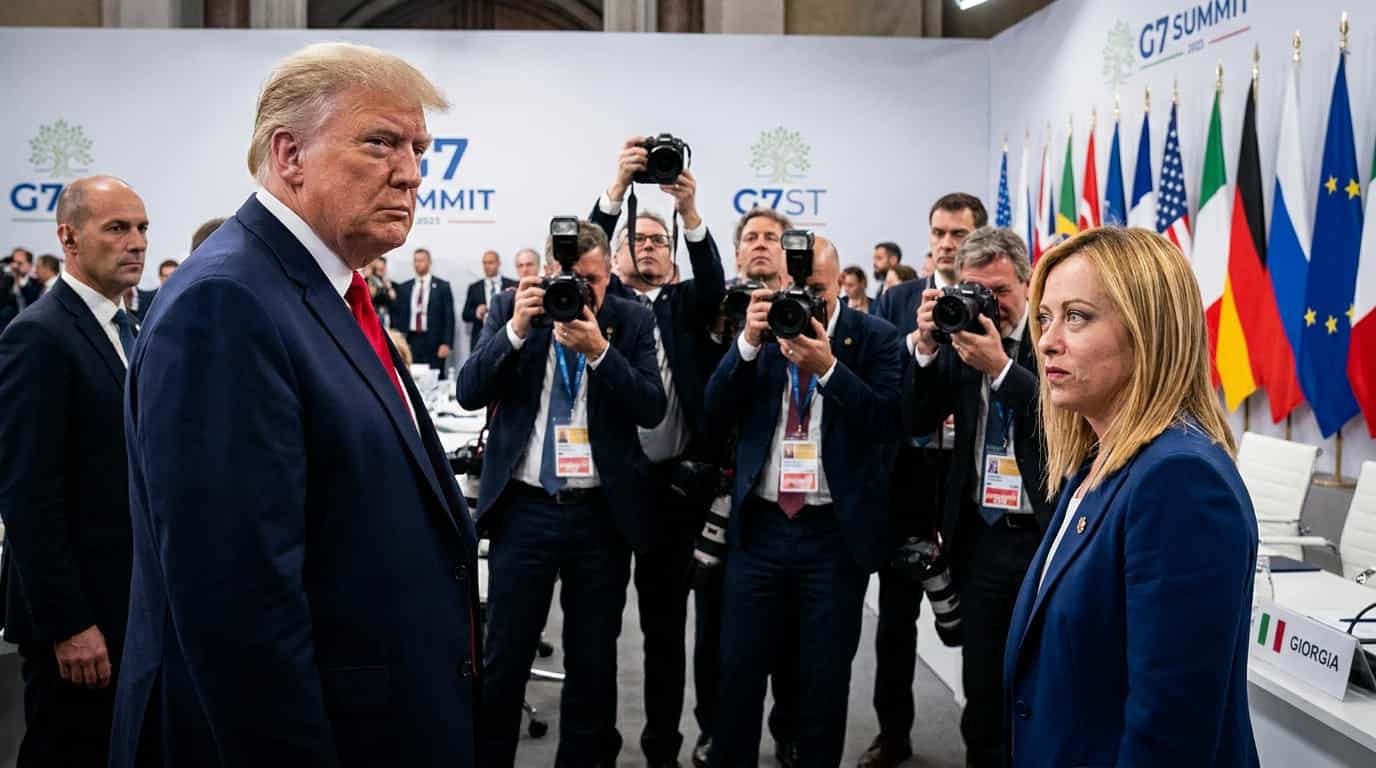
A disputed photo claim at the G7 summit has turned into a public clash between Donald Trump and Giorgia Meloni—revealing deeper tensions between Washington, Rome and Europe.
A photo can be harmless. A photo claim can become explosive. That is exactly what happened after the G7 summit in France, where Donald Trump said Giorgia Meloni had begged him for a picture. Meloni did not laugh it off. She fired back. Within hours, a personal remark had become a diplomatic quarrel, a social media storm and a new test of U.S.–Italy relations. The image itself was no longer the story. The story was power. Who needed whom? Who was trying to look stronger? And why did a simple photo claim suddenly sound like a warning about the future of transatlantic politics?
The dispute began when Trump told an Italian broadcaster that Meloni had wanted a photo with him at the G7 summit. According to Reuters, Trump claimed the Italian prime minister had “begged” for the picture, while Meloni responded that the story was completely made up.
The row did not end there.
Trump later repeated the claim on Truth Social, while Meloni answered on Instagram by criticizing what she described as unprovoked attacks and telling Trump to focus on his own popularity rather than hers. Reuters reported that the disagreement also touched on Italy’s refusal to allow U.S. use of Italian bases during the U.S.-Israel war with Iran, a position Meloni defended as consistent with national sovereignty and existing agreements.
For readers, the question is simple:
Was this just another Trump insult?
Or was it a sign of something larger?
The real story is not the photo.
It is the collapse of a political friendship that once looked useful to both leaders.
Meloni had often been described as one of Trump’s closest ideological allies in Europe. Reuters noted that their relationship had previously been seen as warm, with Meloni attending Trump’s 2025 inauguration and trying to maintain a privileged channel with Washington. But the latest dispute shows that personal chemistry can disappear quickly when national interests collide.
This is why the story is going viral.
It has celebrity-level drama.
But it carries real diplomatic consequences.
What Did Trump Claim?
Trump claimed that Meloni wanted a photo with him during the G7 summit and suggested she was trying to repair relations with Washington. Reuters reported that he framed the alleged photo request as proof that Meloni wanted to improve her political standing by being seen with him.
That claim immediately carried political weight.
In Trump’s framing, the photo was not simply a photo.
It was a symbol of dependence.
It suggested Meloni needed him more than he needed her.
For a sitting prime minister, especially one who built her image around strength, sovereignty and national pride, that was not a small insult.
How Did Meloni Respond?
Meloni rejected Trump’s version of events.
According to Reuters, she said the story was fabricated and expressed astonishment at his remarks. In her later response, she accused Trump of making senseless and unprovoked attacks and pushed back against his suggestion that her popularity depended on his approval.
Her message was clear:
Italy does not beg.
And she does not need Trump to validate her leadership.
That response mattered domestically because it allowed Meloni to position herself not as a junior ally of Washington, but as a national leader defending Italy’s dignity.
Why Did This Become Such a Big Story?
Because it combined four ingredients that make a political story go viral:
A powerful personality clash
A short, memorable claim
A public denial
A deeper diplomatic background
The phrase “begged for a photo” is exactly the kind of line that spreads quickly online.
It is simple. It is humiliating. It is easy to debate.
But the deeper reason it matters is that Trump and Meloni are not political strangers. They are both right-wing leaders who once appeared ideologically aligned. A fight between opponents is expected. A fight between former allies feels more dramatic.
The Iran Factor Behind the Photo Row
The dispute did not happen in a vacuum.
Reuters reported that tensions between Trump and Meloni had worsened over Italy’s refusal to permit the U.S. to use Italian military bases during the U.S.-Israel war with Iran. Meloni defended that decision as a matter of national sovereignty and existing agreements.
That detail changes the entire meaning of the photo dispute.
Trump’s complaint was not only about a picture.
It was also about loyalty.
From Washington’s point of view, Italy’s refusal to provide military support may have looked like hesitation from an ally.
From Rome’s point of view, saying no may have looked like a responsible decision to avoid deeper involvement in a regional war.
That is why the photo became a proxy battle for a much bigger issue:
Should European allies automatically support U.S. military decisions?
Why Italy Took the Remarks Personally
Italy is not a minor player in European diplomacy. It is a G7 country. It is a NATO member. It hosts important U.S. and NATO military infrastructure.
Its prime minister represents a major European economy. So when Trump framed Meloni as someone who allegedly begged for a photo, Italian officials saw more than a personal insult. They saw a slight against Italy’s status.
Reuters reported that Foreign Minister Antonio Tajani canceled a planned U.S. visit after the controversy, showing that the dispute had moved beyond social media rhetoric.
That is the key difference between a viral argument and a diplomatic problem.
A viral argument trends. A diplomatic problem changes schedules.
Trump’s Political Style Meets European Diplomacy
Trump has always used personal dominance as a political tool.
He turns relationships into public tests.
Who praised him?
Who resisted him?
Who needed him?
Who was loyal?
This style works well for rally speeches and social media.
It works less smoothly in diplomacy.
European leaders often prefer careful language, controlled messaging and private negotiation. A public claim that another leader begged for a photo creates pressure on that leader to respond—especially when domestic audiences are watching.
Meloni could not simply ignore the claim.
If she stayed silent, critics might say Trump had humiliated her.
If she responded too aggressively, she risked worsening relations with Washington.
She chose confrontation.
Why Meloni’s Response Could Help Her at Home
The dispute may damage relations with Trump, but it could help Meloni domestically.
Reuters reported that her government’s popularity had rebounded to around 35%, while Trump’s approval rating remained at 36%. Meloni used her response to emphasize national interest and Italian pride rather than personal loyalty to Trump.
For a leader often accused by critics of being too close to Trump, pushing back publicly offers political value.
It tells Italian voters:
I may share some ideological ground with Trump, but I do not take orders from him.
That is a powerful message in European politics.
What This Means for U.S.–Italy Relations
The U.S.–Italy relationship is much larger than Trump and Meloni.
It includes:
NATO cooperation
Military bases
Trade
Intelligence sharing
Energy policy
European security
Ukraine policy
Middle East diplomacy
One public dispute will not destroy that relationship. But repeated public clashes can weaken trust.
Diplomacy relies on predictability. When allies fear that private disagreements may become public insults, they become more cautious.
That caution can affect future cooperation.
Why Europe Is Watching Closely
Other European leaders are watching this row carefully because it sends a message about how Trump handles allies.
If Meloni—once considered one of Trump’s friendlier European partners—can become the target of public criticism, then other leaders may assume they are not safe either.
That matters for NATO, Ukraine, Iran policy, trade disputes and future G7 coordination.
The dispute also complicates the idea that ideological similarity guarantees diplomatic alignment.
Meloni and Trump may share some political instincts.
But Italy and the United States do not always share the same strategic calculations.
Myth vs Fact
Myth: This is only about a photo.
Fact: The photo claim became viral, but the dispute reflects deeper tensions over Iran, military cooperation and the balance between U.S. leadership and European sovereignty.
Myth: Meloni and Trump are political enemies.
Fact: They were previously seen as ideological allies, which is why this public clash became especially striking.
Myth: Italy has no leverage.
Fact: Italy is a G7 and NATO member with strategic importance in Europe and the Mediterranean.
Myth: The dispute will automatically break U.S.–Italy relations.
Fact: The institutional relationship is strong, but personal distrust can still complicate diplomacy.
The most revealing part of this dispute is not whether a photo was requested.
It is how quickly a photo became a test of power.
Trump used the claim to suggest Meloni needed him.
Meloni used her response to show Italy does not.
That is why the story matters.
It exposes the fragile psychology of modern diplomacy, where one sentence on television can trigger a foreign policy headache.
The G7 was supposed to show unity.
Instead, it showed how quickly unity can crack.
Sometimes diplomacy does not collapse over treaties.
Sometimes it starts cracking over a photograph.
12. FAQ
What did Trump say about Giorgia Meloni?
Trump claimed Meloni had “begged” him for a photo at the G7 summit in France. Meloni rejected the claim and said the story was fabricated.
Did Giorgia Meloni deny Trump’s claim?
Yes. Meloni strongly denied the claim and criticized Trump’s remarks as unprovoked and senseless.
Where did the dispute happen?
The dispute relates to the recent G7 summit in Évian-les-Bains, France, where Trump and Meloni were both present. AP published images of the two leaders at a G7 working lunch in Evian-les-Bains on June 16, 2026.
Why did the photo claim become political?
The claim implied that Meloni needed Trump’s support or public association to boost her popularity, which she rejected as insulting to both herself and Italy.
Did the dispute affect diplomacy?
Yes. Reuters reported that Italy’s foreign minister canceled a planned U.S. visit after the controversy escalated.
What role did Iran play in the dispute?
The row came amid tension over Italy’s refusal to allow U.S. use of Italian bases during the U.S.-Israel war with Iran, a decision Meloni defended on sovereignty grounds.
Are Trump and Meloni still allies?
They remain leaders of allied countries, but their personal and political relationship appears strained compared with earlier warmth.
Why does this matter for Europe?
The dispute shows that even ideologically similar European leaders may clash with Trump when national interests differ from U.S. demands.
13. Internal Links
G7 Summit 2026 Explained
Donald Trump Foreign Policy: What Has Changed?
Giorgia Meloni Political Profile
U.S.–Italy Relations Explained
Why Europe Is Worried About Trump’s Diplomacy
Iran War and Global Alliances
NATO and the Mediterranean Explained
How Political Photo-Ops Shape Diplomacy
Trump and European Leaders: A History of Clashes
What Is the G7 and Why Does It Matter?
14. External Sources
Recommended authority sources:
Reuters
Associated Press
Italian government statements
White House statements
G7 official communications
NATO background documents
Italian foreign ministry updates
Trump Meloni G7 photo claim, Trump Meloni, Giorgia Meloni, G7 summit, G7 photo claim, Trump Italy row, Meloni Trump dispute, Trump Meloni photo, Italy US relations, G7 France 2026, Trump foreign policy, Meloni Instagram response, Antonio Tajani, Italy diplomacy, U.S. Italy tensions, Trump Truth Social, European allies, NATO politics, Iran war, Italy airbases, diplomatic row, Trump allies, Meloni popularity
What did Trump say about Giorgia Meloni at G7?
Trump Meloni G7 photo claim explained
Did Meloni ask Trump for a photo?
Giorgia Meloni response to Trump photo claim
Why are Trump and Meloni arguing?
Trump Italy diplomatic row latest
Trump Meloni G7 summit dispute
Italy foreign minister cancels U.S. trip
Trump claims Meloni begged for photo
Giorgia Meloni says Trump invented story
G7 summit France Trump Meloni controversy
U.S. Italy relations after G7
Why Trump attacked Meloni
Meloni Trump relationship explained
Trump Truth Social Meloni comments
Italy response to Trump comments
Trump and Meloni political fallout
G7 photo controversy explained
Meloni popularity Trump claim
Trump Europe allies dispute



Discussion
Comments
Approved comments are published after moderation to keep discussion useful and spam-free.
No comments yet. Start the discussion below.