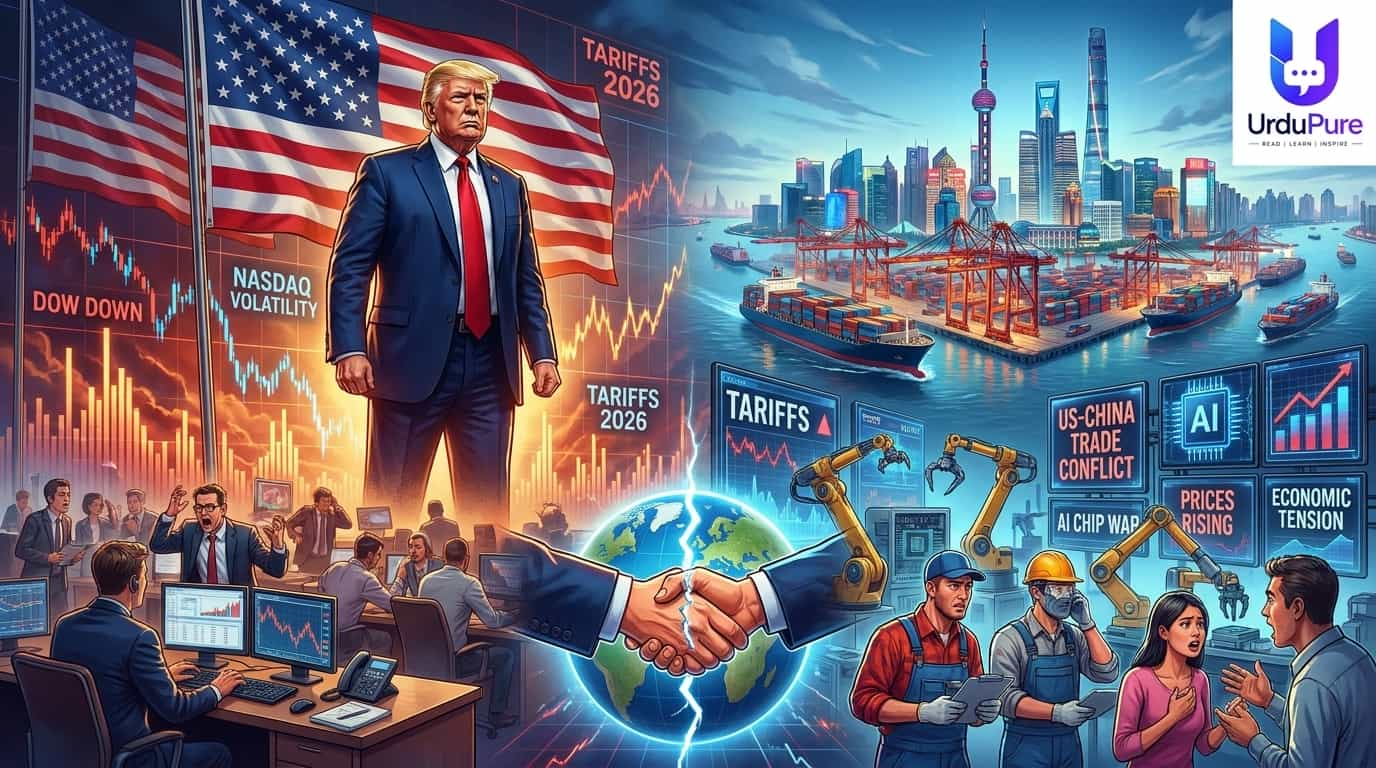
Trump and China 2026: Trade War, Tariffs, Tensions, and What It Means for You
A comprehensive look at Trump's China policy in 2026 — the latest tariffs, trade war escalation, diplomatic tensions, economic impact on American consumers, and what the US-China standoff means for the global economy.
Trump and China in 2026: Everything You Need to Know About the World's Most Consequential Rivalry
There is no bilateral relationship on the planet more consequential — or more complicated — than the one between the United States and China. In 2026, under the second Trump administration, that relationship has entered one of its most turbulent and uncertain phases in decades, with sweeping tariffs, escalating rhetorical confrontation, and a fundamental disagreement about the rules and leadership of the global order playing out in ways that affect every American family, every American business, and the economic stability of the entire world.
Whether you are a business owner trying to navigate supply chain uncertainty, an investor watching markets gyrate on every trade headline, or simply a citizen trying to understand the forces shaping the economy you live in, this guide breaks down the Trump-China relationship in 2026 with clarity, depth, and context.
The Background: How Did We Get Here?
Decades of Economic Integration
To understand the current US-China confrontation, it helps to understand what preceded it. For roughly four decades — from the normalization of diplomatic relations under Nixon in the 1970s through China's accession to the World Trade Organization in 2001 and the subsequent explosion of trade — the United States and China pursued a policy of deep economic integration.
The theory was that economic interdependence would gradually draw China into the rules-based international order, promote political liberalization, and create mutual prosperity. American consumers benefited from cheap manufactured goods. American corporations benefited from enormous Chinese factory capacity and, increasingly, the Chinese consumer market. China benefited from access to American technology, investment, and export markets that powered its extraordinary economic rise.
That theory has been largely abandoned by policymakers across the American political spectrum. The consensus that drove engagement has given way to a new consensus that China represents a strategic competitor whose economic practices — from intellectual property theft to state subsidies to forced technology transfer — have come at unacceptable cost to American workers and national security.
Trump's First Term: Tariffs as a Weapon
Donald Trump's first administration (2017–2021) was the first to translate this competitive framing into aggressive policy action. Beginning in 2018, the Trump administration imposed sweeping tariffs on hundreds of billions of dollars of Chinese goods — initially targeting steel, aluminum, and specific sectors, then broadening dramatically.
China retaliated with its own tariffs on American exports — agricultural products, in particular, hitting American farmers hard. A Phase One trade deal signed in January 2020 paused the escalation and committed China to purchase significant volumes of American goods, but most of the underlying structural disputes remained unresolved.
The Biden administration largely maintained the Trump-era tariffs while adding its own targeted measures — particularly around semiconductor technology — signaling a bipartisan consensus on the need for a tougher China policy.
Trump's Second Term China Policy: 2025–2026
Tariffs Escalate to Historic Levels
The return of Donald Trump to the presidency in January 2025 brought a dramatic escalation of trade confrontation with China. True to his campaign rhetoric, Trump moved quickly to impose broad, sweeping new tariffs on Chinese imports — going significantly further than his first term.
By early 2025, the Trump administration had imposed tariffs on Chinese goods reaching levels — in some cases exceeding 100–145% on specific product categories — that effectively constitute a near-embargo on meaningful trade in those goods. China responded with its own round of retaliatory tariffs on American exports, counter-restrictions on rare earth mineral exports critical to American manufacturing, and a range of regulatory measures targeting American companies operating in China.
The result has been what many economists are calling the most significant disruption to US-China trade since the normalization of relations in the 1970s.
The Executive Orders and Legal Framework
The Trump administration has pursued its China trade agenda through a combination of legal authorities:
Section 301 of the Trade Act of 1974 allows the President to impose tariffs in response to unfair trade practices — the primary legal vehicle for the original Trump tariffs.
International Emergency Economic Powers Act (IEEPA) has been invoked to justify additional measures, giving the administration broad authority to regulate international commerce in response to declared national emergencies.
Export Control Regulations have been significantly tightened, restricting the sale of advanced semiconductors, semiconductor manufacturing equipment, and related technologies to Chinese companies and entities. The Entity List maintained by the Commerce Department — which restricts exports to specific Chinese companies deemed to pose national security risks — has been dramatically expanded.
The Economic Impact: What Americans Are Actually Feeling
Consumer Prices and Inflation
The most immediate and tangible effect of the US-China trade war on ordinary Americans is through consumer prices. China remains one of the most significant sources of manufactured goods sold in the United States — from electronics and appliances to clothing, footwear, furniture, toys, and thousands of other products.
When tariffs are imposed on these goods, importers face a choice: absorb the cost (reducing their margins), pass it on to consumers (raising prices), or shift sourcing to other countries (a process that takes time and money). In practice, the answer has been a combination of all three — but consumers have borne a meaningful share of the burden.
Economists across the political spectrum have documented that the existing tariffs have contributed to higher prices for American consumers, functioning in effect as a consumption tax that falls disproportionately on lower- and middle-income households who spend a higher share of their income on manufactured goods.
Impact on American Businesses
The trade war has produced sharply divergent outcomes for different sectors of the American economy:
American manufacturers who compete with Chinese imports — steel, aluminum, certain industrial products — have benefited from tariff protection, at least in the short term.
American companies with complex supply chains involving Chinese components or manufacturing — consumer electronics, automotive, retail — have faced significant cost pressures and supply chain disruption, forcing expensive and time-consuming relocations of production to other countries.
American exporters — particularly agricultural producers and technology companies — have been hit hard by Chinese retaliatory tariffs and regulatory measures, losing market access and revenue.
American consumers — as noted — have faced higher prices across a wide range of goods.
Stock Market Volatility
Financial markets have been acutely sensitive to every development in the US-China trade relationship. Announcements of new tariffs, retaliatory measures, or diplomatic breakdowns have triggered sharp selloffs, while hints of negotiation or de-escalation have produced equally sharp rallies.
The unpredictability of trade policy — the possibility that any day could bring a new executive order or tweet that reshapes the trade landscape — has created a risk premium that businesses factor into investment decisions, contributing to uncertainty that can suppress capital expenditure and hiring.
China's Response: Strategies and Vulnerabilities
Retaliation: Tariffs and Beyond
China has not accepted American trade pressure passively. Its retaliatory toolkit extends well beyond simply matching US tariffs on Chinese goods:
Rare Earth Export Controls: China controls a dominant share of global rare earth mineral processing — materials essential for semiconductors, electric vehicle batteries, defense systems, and countless other advanced technologies. Restricting or threatening to restrict rare earth exports is one of Beijing's most powerful leverage points.
Regulatory Pressure on US Companies: American companies operating in China — from technology firms to consumer brands to financial institutions — have faced increased regulatory scrutiny, inspections, and operational difficulties that serve as a form of economic retaliation below the threshold of formal tariffs.
Agricultural Purchase Diversion: China has redirected agricultural purchases that would have gone to American farmers to alternative suppliers — Brazilian soybeans instead of American ones, for example — reducing the market leverage that US farm exports previously provided.
Currency Management: Concerns about deliberate currency depreciation — allowing the yuan to weaken against the dollar — periodically surface as a potential Chinese tool for offsetting the competitiveness impact of American tariffs.
China's Own Economic Pressures
It is important to note that China is not in a position of strength in this confrontation. The Chinese economy in 2025–2026 faces significant domestic challenges: a prolonged property sector crisis, deflationary pressures, elevated youth unemployment, and slowing consumer spending have created economic headwinds that complicate Beijing's ability to sustain a prolonged trade war.
China's export-dependent manufacturers are also genuinely harmed by lost American market access. The Chinese government is balancing the political imperative to appear strong in the face of American pressure against the economic reality that escalation carries real costs at home.
The Technology Dimension: The Real Strategic Battleground
Semiconductors: The Defining Contest
If tariffs on consumer goods represent the most visible dimension of the US-China confrontation, the struggle over advanced semiconductor technology represents the most strategically significant.
The United States and its allies — particularly the Netherlands and Japan, home to the world's leading semiconductor equipment manufacturers — have constructed an increasingly tight web of export controls designed to prevent China from acquiring the advanced chips and chip-making equipment needed to develop competitive AI systems, advanced weapons, and modern telecommunications infrastructure.
NVIDIA, as discussed elsewhere, is directly affected by these controls — it cannot sell its most powerful AI GPUs to Chinese customers. ASML, the Dutch company that makes the extreme ultraviolet (EUV) lithography machines required for the most advanced chip manufacturing, has been pressured to stop exporting to China.
China has responded with an enormous state-directed push to develop domestic semiconductor capabilities — investing hundreds of billions of yuan in chip design, manufacturing equipment, and materials. While China has made progress at less advanced nodes, it remains significantly behind the global frontier in the most advanced chip manufacturing — and the export controls are specifically designed to keep it that way.
AI as a National Security Priority
The connection between semiconductor technology and artificial intelligence has made AI capabilities a central concern of US national security policy toward China. American officials worry that Chinese leadership in AI — whether in military applications, surveillance technology, or economic productivity — would represent a strategic threat of the first order.
This concern drives the export control regime, the massive American public investment in semiconductor manufacturing through the CHIPS and Science Act, and a broader effort to build allied coalitions around technology standards and supply chains that exclude Chinese companies.
Diplomatic Relations: Where Do Things Stand?
High-Level Contact: Minimal but Maintained
Despite the intensity of trade and technology confrontation, the US and China have maintained minimal high-level diplomatic contact — a thin lifeline designed to prevent economic rivalry from tipping into military conflict or complete diplomatic breakdown.
Both sides have an interest in maintaining some degree of communication, even as their public postures are adversarial. The risk of miscalculation — a military incident in the South China Sea or around Taiwan escalating in ways neither side intends — makes back-channel and direct diplomatic contact valuable, even in the absence of substantive progress on trade or other disputes.
Taiwan: The Flashpoint
The Taiwan issue remains the single most dangerous potential trigger for US-China confrontation. The United States maintains a policy of strategic ambiguity about whether it would militarily defend Taiwan from Chinese invasion, while supporting Taiwan's defense capabilities and maintaining unofficial relations. China views Taiwan as a breakaway province that must ultimately be reunified with the mainland — by force if necessary.
Any significant escalation in cross-strait tensions — Chinese military exercises, a naval blockade, or outright invasion — would trigger a US response that could transform economic competition into outright conflict. This risk hangs over all US-China relations as a background condition of extraordinary gravity.
The Global Impact: Allies, Supply Chains, and World Trade
Forcing a Choice on US Allies
One of the most significant effects of the US-China confrontation has been the pressure it places on American allies to choose sides. Countries like South Korea, Japan, Germany, and others have deep economic ties to both the United States and China — they want access to American security guarantees and the American market, while also relying heavily on the Chinese economy.
American pressure to restrict technology exports to China, exclude Chinese telecom equipment (like Huawei's 5G systems), and diversify supply chains away from Chinese manufacturers has created genuine tension with allies who face their own economic costs from decoupling.
Supply Chain Restructuring
One of the most visible structural effects of the trade war has been the acceleration of supply chain restructuring — the movement of manufacturing out of China to alternative locations. Countries like Vietnam, Mexico, India, Thailand, and Indonesia have been major beneficiaries of this trend, attracting factories and investment as companies seek to reduce their dependence on Chinese manufacturing.
This process — sometimes called "China plus one" or "friend-shoring" — is fundamentally reshaping global trade patterns in ways that will play out for decades.
What a Trade Deal Would Require — And Why It's Difficult
Any comprehensive resolution of US-China trade tensions would require both sides to make concessions that are politically painful:
The United States would need to reduce or eliminate tariffs that have become a political symbol of toughness on China — a difficult move for any American politician to make without being able to demonstrate substantial concessions in return.
China would need to make credible commitments on intellectual property protection, state subsidies to Chinese companies, market access for American firms, and technology transfer practices — commitments that Beijing has historically resisted as interference in its economic model and domestic governance.
The structural nature of the conflict — rooted in fundamentally different economic systems and competing visions of the international order — makes comprehensive resolution unlikely in the near term. Managed competition, with guardrails to prevent escalation, is the more realistic near-term goal.
What This Means for American Consumers and Businesses in 2026
For ordinary American consumers, the practical implications of the US-China trade war in 2026 include:
Higher prices on a wide range of manufactured goods, from electronics to clothing
Potential supply disruptions on products that remain heavily China-dependent
A gradual (and incomplete) shift toward goods produced elsewhere, often at higher cost
For American businesses, the environment requires:
Ongoing supply chain diversification away from single-country dependence
Careful navigation of export control compliance requirements
Scenario planning for further escalation or unexpected de-escalation
Frequently Asked Questions About Trump's China Policy
Q: What tariffs has Trump imposed on China in his second term?
A: The Trump administration has imposed tariffs on a wide range of Chinese goods, with rates in many categories exceeding previous levels — in some cases reaching 100% or more on specific product categories.
Q: How is China retaliating against US tariffs?
A: China has responded with its own tariffs on American goods, restrictions on rare earth exports, increased regulatory pressure on US companies in China, and redirection of agricultural purchases to other suppliers.
Q: Will there be a new US-China trade deal?
A: While both sides have incentives to reduce tensions, a comprehensive deal faces major structural obstacles. Managed competition — rather than full resolution — is the more likely near-term outcome.
Q: How does the US-China trade war affect everyday Americans?
A: Higher consumer prices on manufactured goods, supply chain disruptions, and agricultural market losses for American farmers are among the most direct impacts.
Q: What is the most important US-China dispute beyond trade?
A: The contest over advanced semiconductor technology and AI capabilities is increasingly seen as the most strategically significant dimension of US-China competition.
For the latest developments in US-China trade relations, follow reporting from Reuters, the Wall Street Journal, and the Financial Times. Trump China 2026, Trump China trade war, US China tariffs 2026, Trump tariffs China, US China trade deal, Trump China policy, China trade war impact, US China relations 2026, Trump trade war update, China tariffs consumers




Discussion
Comments
Approved comments are published after moderation to keep discussion useful and spam-free.
No comments yet. Start the discussion below.