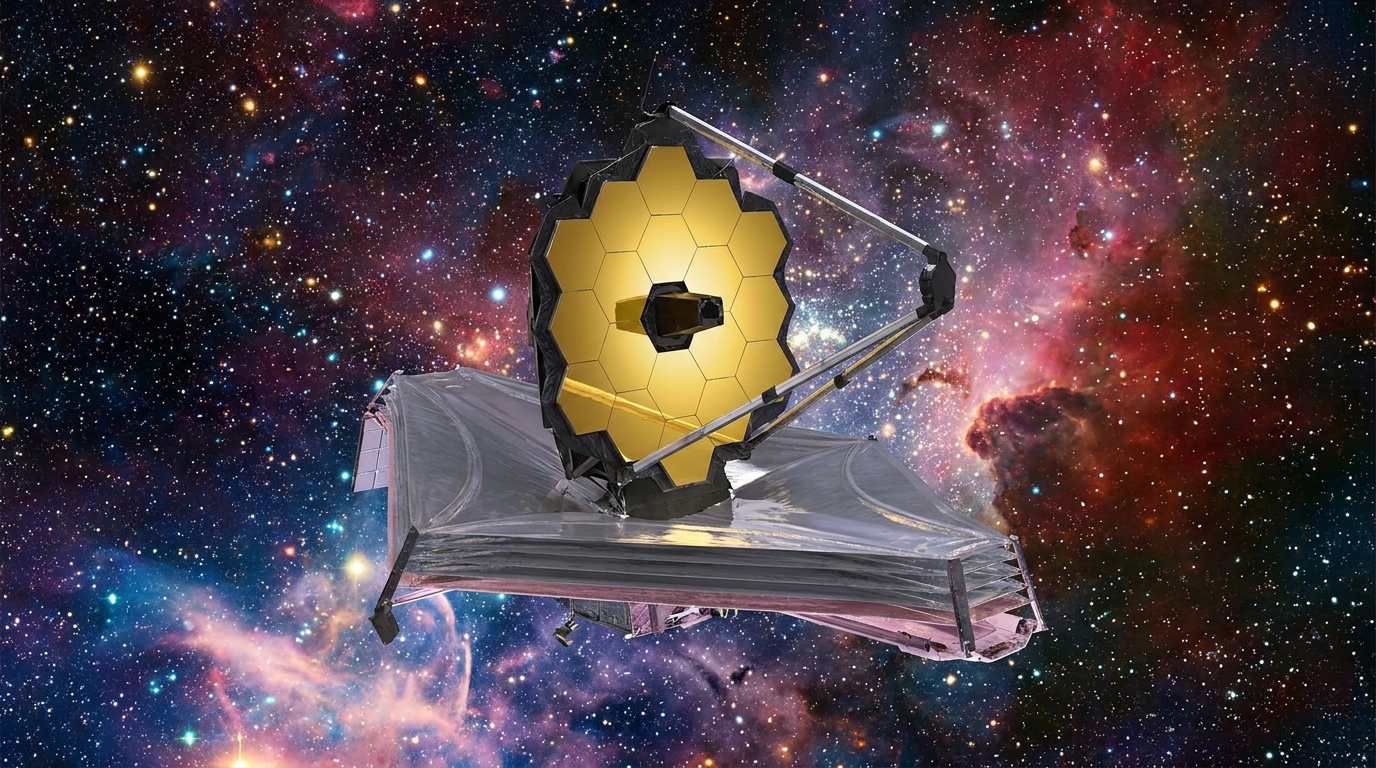
The James Webb Telescope's Most Mind-Blowing Discoveries of 2025–2026
Webb has been rewriting everything we thought we knew about the early universe. Here are the biggest revelations so far — explained in plain English, with what they actually mean for our understanding of existence.
The Telescope That Changed Everything
When the James Webb Space Telescope released its first full-colour images in July 2022, NASA administrator Bill Nelson called them "a new window into the history of our universe." That description, which might have sounded like institutional hyperbole at the time, has proved to be an understatement.
In less than four years of operation, Webb has not merely confirmed existing theories — it has challenged fundamental assumptions about galaxy formation, the early universe, the potential for life elsewhere in the cosmos, and the very structure of the cosmos itself. Several of its discoveries have produced what astrophysicists cautiously but genuinely describe as a crisis in cosmological theory: the universe Webb is showing us does not entirely match the universe our best models predicted.
Here are the most significant discoveries from 2025–2026 — explained without jargon, with their genuine scientific implications made clear.
1. Galaxies That Shouldn't Exist — The "Universe Breaker" Problem Deepens
One of Webb's most destabilising findings, first noted in 2022 and confirmed and extended through extensive follow-up observations in 2025, is the discovery of massive, fully formed galaxies in the very early universe — so early, and so large, that they shouldn't exist according to standard cosmological models.
The Lambda-CDM model (Lambda Cold Dark Matter) — the standard model of cosmology — predicts how long it takes for galaxies to form and grow through the gravitational accumulation of matter. According to this model, the very early universe should contain only small, irregular proto-galaxies in the process of formation. Instead, Webb has found galaxies as massive as the Milky Way — or larger — existing just 500–700 million years after the Big Bang, when the universe was less than 5% of its current age.
A 2025 paper published in Nature Astronomy, analysing 87 such "early massive galaxies" detected by Webb, concluded that their existence is statistically incompatible with current cosmological models at a significance level that cannot be dismissed as observational error. Something in our understanding of either galaxy formation, the nature of dark matter, or the early universe's conditions requires revision.
What this means in plain English: The universe got big much faster than our best theories say it should have. Either galaxies can form faster than we thought, or something about our model of what the early universe was like is wrong. Either answer requires rewriting cosmology textbooks.
2. The Hubble Tension Gets Worse — and Webb Makes It Harder to Ignore
For several years before Webb launched, cosmologists had been troubled by the "Hubble tension" — a discrepancy between two independent measurements of the Hubble constant, the number that describes how fast the universe is expanding. Measurements based on the cosmic microwave background (the afterglow of the Big Bang) give a different value from measurements based on observable astronomical objects like Cepheid variable stars and Type Ia supernovae.
The hope was that Webb's superior resolution would resolve the tension by revealing systematic errors in the Cepheid-based measurements. Instead, Webb's 2025 analysis confirmed the Cepheid measurements with greater precision — and the tension remains. The two methods disagree by approximately 8–9%, a discrepancy that is now statistically robust enough that measurement error alone cannot explain it.
The implication is significant: either our understanding of the early universe (and hence the CMB-based measurement) is wrong, or our understanding of how the universe has evolved since then (and hence the distance-ladder measurement) is wrong. Possibly both. Some cosmologists have suggested this might be the first observational evidence that requires new physics — something beyond the Standard Model of particle physics.
What this means in plain English: We have two different ways of measuring how fast the universe is expanding and they give different answers. Webb has confirmed the discrepancy is real. Something in fundamental physics may need to change to explain it.
3. Potential Biosignatures on K2-18b — The Most Significant Exoplanet Finding Yet
In 2023, Webb detected dimethyl sulphide (DMS) in the atmosphere of K2-18b, a planet 120 light years away — a chemical that on Earth is produced exclusively by marine phytoplankton. The finding was presented cautiously: a tentative detection that required confirmation. In 2025, follow-up observations using Webb's NIRISS and NIRSpec instruments provided stronger spectroscopic evidence for DMS and for another potential biosignature compound, dimethyl disulphide (DMDS).
K2-18b is a "Hycean" world — a class of exoplanet theorised to have hydrogen-rich atmospheres and potentially liquid water oceans beneath them. It orbits in its star's habitable zone. Its size (approximately 2.6 times Earth's radius) and mass suggest it may be an ocean world without a solid surface like Earth's.
The scientific community remains appropriately cautious: these are possible biosignatures, not confirmed life detections. Abiotic (non-biological) processes that could produce DMS at detectable concentrations in a Hycean atmosphere are not fully ruled out. Additional observations are planned for 2026. But the significance of this finding cannot be understated: if confirmed, it would be the first observational evidence of life beyond Earth.
What this means in plain English: Webb has detected chemicals in an alien planet's atmosphere that on Earth are only made by living organisms. It is not confirmed as life — but it is the most serious candidate for extraterrestrial life ever detected.
4. The First Stars — Population III — May Have Been Detected
The very first stars in the universe — known as Population III stars — have never been directly observed. Formed from the pristine hydrogen and helium of the Big Bang (before any heavier elements existed), they were theorised to be extremely massive, extremely bright, and extremely short-lived. Their existence is a cornerstone of our understanding of cosmic chemical evolution — they forged the first heavy elements and seeded the universe with the building blocks of planets and life.
In late 2024 and confirmed in 2025, Webb observations of a gravitationally lensed galaxy cluster (used as a natural telescope to magnify objects behind it) detected spectral signatures consistent with Population III stars in a galaxy observed just 900 million years after the Big Bang. The finding is not yet definitively confirmed — the signal could potentially be explained by an unusual population of very massive conventional stars — but it is the most compelling Population III candidate ever identified.
What this means in plain English: We may have seen, for the first time, the very first generation of stars that ever existed in the universe — stars that formed from the raw materials of the Big Bang itself, before any planets or heavy elements existed anywhere.
5. Detailed Atmospheric Chemistry of Exoplanets — A New Era of Planetary Science
Beyond the K2-18b biosignature findings, Webb has transformed exoplanet atmospheric science more broadly. Its spectroscopic instruments can now routinely detect the molecular fingerprints of exoplanet atmospheres in ways that were entirely impossible with previous telescopes. In 2025 alone, Webb characterised the atmospheres of over 40 exoplanets — detecting carbon dioxide, methane, water vapour, sulphur dioxide, and in several cases carbon monoxide.
The TRAPPIST-1 system — seven Earth-sized planets orbiting a nearby red dwarf star, three of them in the habitable zone — has been a particular focus. Webb's 2025 observations of TRAPPIST-1c suggested it likely lacks a substantial atmosphere, making it less promising for life than some models suggested. Observations of TRAPPIST-1e and TRAPPIST-1f are ongoing and are among the most anticipated scientific results of 2026.
What this means in plain English: Webb can now "taste" the air of distant planets. This capability, which didn't exist five years ago, is the foundation of humanity's ability to eventually determine whether other planets harbour life.
6. The Cosmic Web — Filaments of the Universe's Large-Scale Structure Directly Imaged
The large-scale structure of the universe — the "cosmic web" of filaments, sheets, and voids along which galaxies are distributed — has been inferred from galaxy surveys for decades. In 2025, Webb produced the first direct images of cosmic web filaments in the very early universe, observed as they existed just 800 million years after the Big Bang.
The filaments, made of hydrogen gas, are far more clearly defined and structurally organised in the early universe than models predicted — another suggestion that large-scale structure formed faster than current theory accounts for. The images are also among the most visually spectacular Webb has produced: gossamer threads of gas spanning tens of millions of light years, glowing at the edge of infrared visibility, with galaxies clustered along their intersections like dew on a spider's web.
7. Supermassive Black Holes Were Everywhere in the Early Universe
Webb has revealed that supermassive black holes — black holes millions to billions of times the mass of the Sun — were astonishingly common in the early universe. Multiple surveys in 2025 found that the density of active supermassive black holes (quasars and AGN — active galactic nuclei) in the early universe is orders of magnitude higher than models predicted. This compounds the mystery of the "early massive galaxy" problem: not only did galaxies form faster than expected, but the supermassive black holes at their centres also grew to enormous sizes faster than any current mechanism adequately explains.
What this means in plain English: The early universe was full of monster black holes growing at rates that our current physics cannot fully account for. This is not a minor discrepancy — it suggests either a new mechanism for black hole growth or a fundamental revision to our understanding of the conditions immediately after the Big Bang.
What Webb Is Looking at Next
The 2026 observing programme includes several of the most scientifically consequential targets in Webb's mission:
TRAPPIST-1e and 1f atmosphere observations — the definitive test of whether the most promising known habitable-zone planets have Earth-like atmospheres
Follow-up K2-18b observations — additional spectroscopic time to confirm or refute the DMS/DMDS biosignature detections
Deep field surveys of the very early universe — extending the census of early massive galaxies to determine how widespread the Lambda-CDM problem is
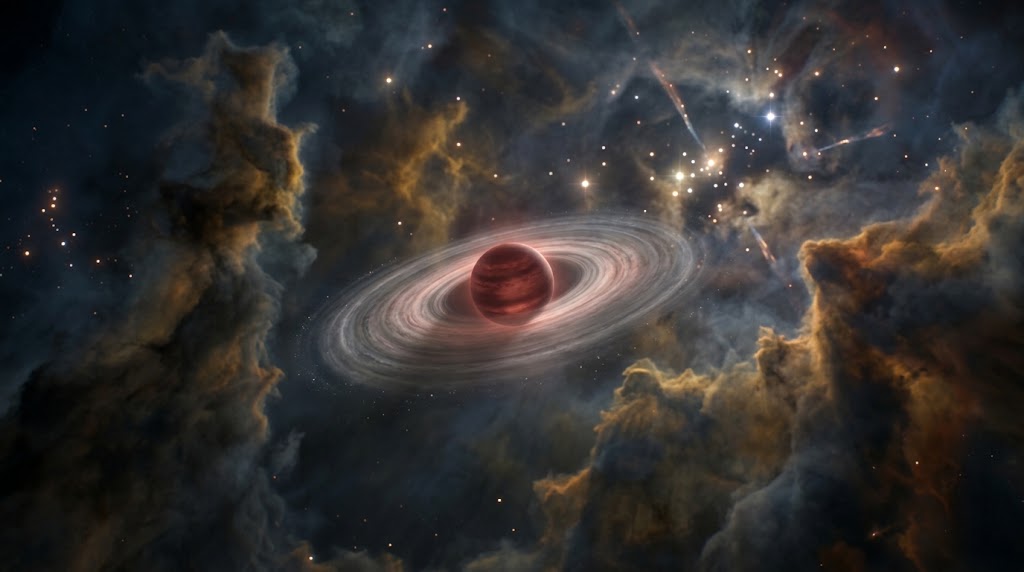
Protoplanetary disk observations — mapping the chemistry of planet-forming disks around young stars to understand how Earth-like planets acquire water and organics
The coming 12 months of Webb results may be the most significant in the telescope's history. If the K2-18b biosignatures are confirmed, or if the TRAPPIST-1 habitable zone planets show Earth-like atmospheres, the implications for our understanding of life in the universe will be profound and permanent.
James Webb telescope discoveries 2025 2026, Webb telescope findings, exoplanet life detection, early universe galaxies, Hubble tension explained, K2-18b biosignatures, TRAPPIST-1 atmosphere Webb, Population III stars, space discoveries 2026, Webb space telescope results


Discussion
Comments
Approved comments are published after moderation to keep discussion useful and spam-free.
No comments yet. Start the discussion below.