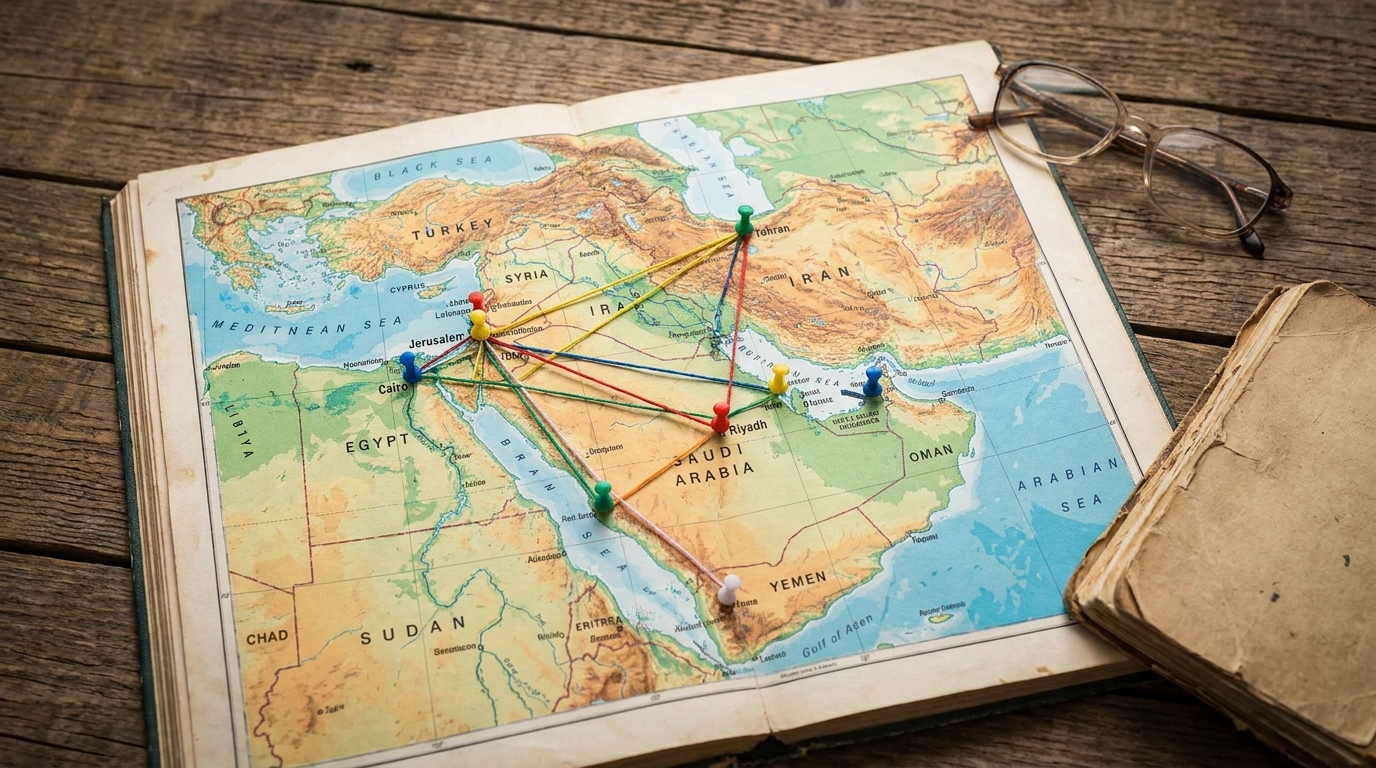
The Middle East in 2026: A Plain-English Guide to What's Happening and Why It Matters
For many readers, Middle East politics feels impossibly complex. This guide explains the key players, their interests, and what the current dynamics mean — without the jargon, without the partisanship.
Why the Middle East Is Impossible to Ignore
The Middle East accounts for approximately 30% of global oil production and a significant share of natural gas. It sits at the intersection of three continents. Its internal conflicts have produced refugee crises that have reshaped European politics. Its geopolitical alignments determine energy prices globally. And the unresolved Israeli-Palestinian conflict remains one of the most internationally contested issues on earth — generating more UN Security Council resolutions than any other single dispute in history.
Understanding the Middle East in 2026 requires understanding that there is no single "Middle East story." There are overlapping, interacting conflicts and competitions: the Israeli-Palestinian conflict, the Iran-Israel confrontation, the Saudi-Iran rivalry, the Syrian fragmentation, the Iraqi balancing act, and the role of external powers — the US, Russia, China, and Turkey — in all of the above. This guide attempts to explain each clearly, and then show how they connect.
The Israeli-Palestinian Conflict: Where Things Stand
The October 7, 2023 Hamas attacks on Israel — which killed approximately 1,200 Israelis and resulted in approximately 250 hostages being taken to Gaza — and Israel's subsequent military campaign in Gaza have produced the most acute phase of the Israeli-Palestinian conflict in decades and have reshuffled regional dynamics in ways still being processed in 2026.
Gaza: The Current Situation
Israeli military operations in Gaza following October 7 have killed over 45,000 Palestinians according to Gaza's health ministry (these figures are contested by Israel but broadly consistent with independent assessments). The physical infrastructure of Gaza has been devastated — the UN estimates over 70% of buildings damaged or destroyed. A humanitarian situation characterised by the UN and multiple independent agencies as catastrophic has produced international condemnation alongside international paralysis, with the US Security Council veto preventing binding resolutions.
Ceasefire negotiations, mediated by Qatar, Egypt, and the US, have produced temporary pauses in fighting but not a durable end to the conflict as of early 2026. Hamas's political leadership, significantly degraded but not destroyed, continues to operate from outside Gaza. The question of what Gaza looks like politically and who governs it post-conflict remains unresolved and is the central subject of ongoing negotiations.
The West Bank
While international attention has focused on Gaza, the situation in the West Bank has deteriorated significantly. Palestinian civilian deaths at the hands of Israeli settlers and military forces have reached levels not seen since the Second Intifada. Settlement expansion — declared illegal under international law by the International Court of Justice in a 2024 advisory opinion — has continued. Palestinian Authority control is weakened. And the prospect of a negotiated two-state solution has receded further from practical possibility than at any point in the past three decades.
The Two-State Solution: Is It Still Possible?
The international consensus position — that a negotiated two-state solution is the only viable long-term resolution — is increasingly difficult to reconcile with facts on the ground. Israeli settlement expansion in the West Bank means approximately 700,000 Israeli settlers now live in territory that would need to form part of a Palestinian state under any realistic two-state framework. The political coalitions in Israel that would need to support territorial withdrawal currently do not exist. And Palestinian political fragmentation — the split between Fatah (which controls the Palestinian Authority) and Hamas (which controlled Gaza until October 7) — has made a unified negotiating partner an abstract rather than a reality.
The honest assessment: a two-state solution remains the stated policy of most international actors and the stated preference of most polling data of Palestinians and of Israeli moderates. It does not currently have a visible political pathway.
Iran: The Regional Power Everyone Watches
Iran's foreign policy in the Middle East is best understood through the concept of "strategic depth" — the Iranian doctrine of projecting power through proxy and partner relationships across the region rather than through direct military action, creating deterrence through distributed capability and raising the cost of any direct attack on Iranian territory.
The "Axis of Resistance"
Iran maintains relationships of varying depth with Hezbollah in Lebanon (the most capable and most directly supported), Hamas in Gaza (significantly degraded since October 2023), the Houthis in Yemen (who launched sustained maritime and missile attacks in the Red Sea through 2024–2025), and various militia groups in Iraq and Syria. These groups share an anti-Israel, anti-US orientation and receive varying degrees of Iranian financial, material, and intelligence support.
The axis has been severely tested since October 7. Hezbollah engaged in sustained exchange of fire with Israel through 2024, suffered significant leadership losses including the killing of secretary-general Hassan Nasrallah in September 2024, and agreed to a ceasefire that required withdrawal from southern Lebanon. Hamas's military capabilities in Gaza have been substantially degraded. The axis is diminished but not dissolved.
Iran's Nuclear Programme
Iran's nuclear programme remains the most consequential strategic issue in the Middle East beyond the Israeli-Palestinian conflict. Iran has enriched uranium to 60% purity — close to the 90% threshold for weapons-grade material — and its breakout time (the time needed to produce enough fissile material for a nuclear weapon if it chose to) is estimated by the IAEA and US intelligence agencies at weeks rather than months as of 2026.
Iran does not yet have a demonstrated nuclear weapon and has not made the political decision to cross that threshold — a decision that would carry enormous international consequences. But the combination of enrichment capability, ballistic missile programme, and diminished conventional deterrence (following the degradation of its proxy network) creates pressure toward nuclear threshold status.
Direct Iran-Israel Confrontation
The exchange of direct strikes between Iran and Israel in April and October 2024 — unprecedented in the history of the conflict — established a new and dangerous dynamic. Both countries demonstrated a willingness to strike each other directly rather than exclusively through proxies, while both also exercised restraint in scale that reflected neither's desire for full-scale war. The question of whether this restraint holds, particularly in the context of Iran's advancing nuclear programme, is the most volatile element of the regional situation.
Saudi Arabia: The Pivotal Player
Saudi Arabia's strategic positioning in 2026 is more complex and more autonomous than at any previous point. The Abraham Accords process (which normalised relations between Israel and UAE, Bahrain, Sudan, and Morocco) had been heading toward a potential Saudi-Israel normalisation agreement — arguably the most significant potential diplomatic development in the region in a generation — before being suspended by October 7.
Saudi Crown Prince Mohammed bin Salman (MBS) has transformed the kingdom's foreign policy from near-total dependence on the US security relationship to a more genuinely multi-directional approach. The China-brokered Saudi-Iranian normalisation agreement of March 2023 was a deliberate signal to Washington that Riyadh has options. Saudi oil production decisions — made through OPEC+ — continue to have global economic consequences well beyond the region.
Saudi Arabia's position on the Palestinian issue has hardened since October 7. Any resumption of normalisation discussions with Israel now requires a credible path toward Palestinian statehood as a condition — a position that reflects both genuine Saudi public opinion and the political impossibility of being seen to normalise with Israel during an ongoing conflict in Gaza.
Syria and Iraq: Fragmentation and External Influence
Syria After Assad
The fall of Bashar al-Assad's government in December 2024 — following a rapid rebel offensive led by Hayat Tahrir al-Sham (HTS) and allied factions — ended over 50 years of Assad family rule and produced a new political reality still being established in 2026. Syria's new governing authority, led by HTS's Ahmed al-Sharaa (formerly known as Abu Mohammad al-Jolani), has moderated its public rhetoric and sought international engagement — a pragmatic adaptation to the realities of governing a shattered state requiring reconstruction assistance.
Syria in 2026 remains deeply fragmented: HTS-led governance in the northwest, Kurdish-led Syrian Democratic Forces in the northeast, Turkish-controlled zones in northern border areas, and residual instability across the country. The reconstruction challenge — estimated in the hundreds of billions of dollars — is beyond any realistic near-term international commitment.
Iraq
Iraq's government continues to navigate between its security relationship with the US (which maintains approximately 2,500 troops there) and its deep economic and political ties to Iran. The Popular Mobilisation Forces — Iranian-aligned militia groups that are formally part of the Iraqi security structure — attacked US positions in Iraq and Syria repeatedly in 2023–2024, producing US retaliatory strikes that strained the bilateral relationship. Negotiations over the future of the US military presence continue.
How the Region Affects the Global Economy
The most direct channel through which Middle East instability affects the global economy is energy. The Houthi attacks on Red Sea shipping through 2024–2025 — targeting vessels with perceived links to Israel or its supporters — forced significant rerouting of global container shipping around the Cape of Good Hope, adding 10–14 days and significant cost to shipping routes between Asia and Europe. This contributed to elevated global freight rates and modest inflationary pressure in importing economies.
Oil prices in 2026 are shaped by the complex interaction of OPEC+ production decisions (Saudi Arabia and Russia coordinating output cuts), US shale production (which has become the effective global swing producer), and the risk premium embedded in Middle East instability. A direct conflict involving Iranian oil infrastructure or a Strait of Hormuz closure scenario — through which approximately 20% of global oil supply passes — would produce immediate and severe global economic disruption.
What to Watch in the Rest of 2026
Gaza ceasefire negotiations: Whether a durable ceasefire and hostage release deal can be reached, and what post-conflict governance arrangement emerges
Iran nuclear programme: Whether Iran crosses the weapons-grade enrichment threshold and how the US and Israel respond
Saudi-Israel normalisation: Whether diplomatic progress resumes and on what conditions regarding Palestinian statehood
Syrian reconstruction: Which international actors fund Syria's reconstruction and what political influence they extract in return
US Middle East policy: How the current US administration's posture affects Israeli decision-making, Iran policy, and the Gulf relationships
Middle East 2026 explained, Israel Palestine conflict 2026, Iran nuclear programme 2026, Saudi Arabia foreign policy, Middle East geopolitics plain English, Houthi Red Sea attacks, Syria after Assad, Iran Israel conflict, Middle East oil economy, Hamas Gaza 2026



Discussion
Comments
Approved comments are published after moderation to keep discussion useful and spam-free.
No comments yet. Start the discussion below.