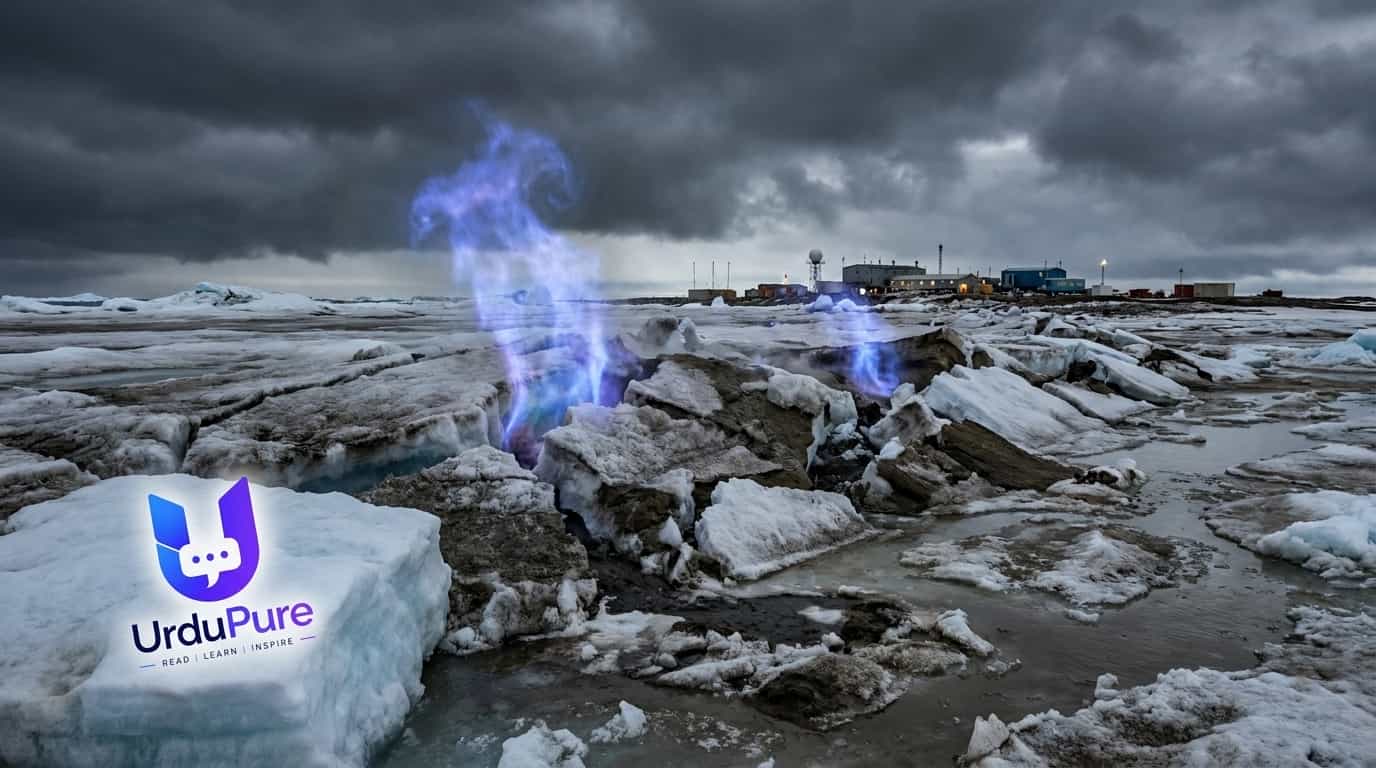
The Permafrost Time Bomb: The Climate Crisis Hiding Beneath the Arctic That Could Dwarf Everything Else
Scientists are alarmed. Beneath the Arctic tundra, billions of tonnes of frozen carbon are thawing faster than any climate model predicted — and the feedback loop it triggers could make every other climate intervention we've made irrelevant. Here's what's happening, why it matters, and what the latest 2026 data actually shows.
The Sleeping Giant Nobody Is Talking About Enough
In every conversation about climate change — the solar panels, the electric vehicles, the carbon taxes, the net-zero pledges — there is a factor so large and so potentially decisive that its relative absence from mainstream climate discussion borders on the surreal. It sits beneath approximately 25% of the Northern Hemisphere's land surface. It contains roughly twice as much carbon as is currently in the Earth's entire atmosphere. And it is thawing.
Permafrost — permanently frozen ground that in some regions has remained frozen for tens of thousands of years — is one of the planet's most important carbon stores and one of its most sensitive climate tipping points. As global temperatures rise, this frozen ground thaws. As it thaws, the organic matter locked inside it decomposes. As it decomposes, it releases carbon dioxide and methane into the atmosphere. And as those greenhouse gases accumulate, global temperatures rise further — causing more permafrost to thaw.
This is not a distant threat. It is not a worst-case scenario. It is happening right now, faster than the models that underpin most global climate agreements predicted, and 2026's data is the most alarming yet recorded.
What Permafrost Is — and Why Its Carbon Content Is So Enormous
Permafrost is ground — soil, sediment, rock — that remains at or below 0°C (32°F) continuously for at least two years. In practice, most permafrost has been frozen for thousands of years: Siberian permafrost contains material frozen since the Pleistocene epoch, some of it over 700,000 years old. The permafrost zone spans vast regions of Russia, Canada, Alaska, Greenland, and parts of the Tibetan Plateau — a total area of approximately 23 million square kilometres.
The reason its carbon content is so staggering requires understanding how it accumulated. For millennia, Arctic and sub-Arctic regions were rich ecosystems — tundra, grasslands, and boreal forests where plants grew, died, and failed to fully decompose in the cold. Instead of completing the carbon cycle (where dead organic matter is broken down and its carbon returns to the atmosphere), this material accumulated in frozen layers, year after year, century after century. It is, in essence, a planetary-scale compost heap that has been stored in a vast natural freezer.
Current estimates suggest that permafrost contains approximately 1.5 trillion tonnes of organic carbon — about 1,500 gigatonnes. For comparison, all human activities since the Industrial Revolution have released approximately 700 gigatonnes of CO₂ into the atmosphere. The carbon frozen in permafrost is more than double the total cumulative human industrial emissions in history.
"Permafrost carbon represents an amount of stored climate risk that dwarfs anything else in our climate system. If even a fraction of it is released rapidly, the consequences cascade beyond anything current models fully capture." — Professor Merritt Turetsky, University of Colorado Institute of Arctic and Alpine Research
How Fast Is It Thawing in 2026? The Latest Data
The short answer: faster than predicted, in ways that are structurally surprising to climate scientists, and with documented acceleration that 2025–2026 data has made impossible to minimise.
The Temperature Context
The Arctic is warming approximately four times faster than the global average — a phenomenon known as Arctic amplification, driven by feedback loops including sea ice loss (which reduces reflectivity, causing more solar absorption) and changes in atmospheric circulation patterns. In 2025, Arctic land temperatures averaged 2.7°C above the 1991–2020 baseline — the highest annual anomaly recorded. In the first quarter of 2026, the anomaly has exceeded 3°C in Siberian and Alaskan monitoring stations.
What the Ground Measurements Show
The Global Terrestrial Network for Permafrost (GTN-P), which monitors ground temperatures at hundreds of sites across the permafrost zone, published its most comprehensive update in early 2026. Key findings:
Ground temperatures at 20-metre depth — which had remained stable for decades before 2010 — have now increased by 0.3–0.5°C at most monitored Siberian and Alaskan sites, and by over 1°C at some high-latitude Canadian sites
The "active layer" — the surface permafrost that thaws and refreezes seasonally — has deepened by an average of 17% across monitored sites compared to 2000 measurements
Abrupt thaw events — sudden, dramatic collapses of permafrost that create lakes and sinkholes called thermokarst — have increased in frequency by approximately 60% since 2015 across monitoring zones
Methane emissions from newly thawed wetlands have increased by measurable amounts in 2024–2025 that exceed the projections of most climate models by 15–25%
The Abrupt Thaw Problem
For years, climate models treated permafrost thaw as a gradual, predictable process — a slow, steady deepening of the active layer that would release carbon at a pace that existing models could incorporate. The most alarming finding of recent research is that a significant proportion of permafrost thaw is not gradual — it is abrupt.
Thermokarst formation — where ice-rich permafrost collapses suddenly, forming lakes, bogs, and sinkholes across previously stable ground — releases carbon at rates 1.5 to 10 times faster than gradual thaw processes. NASA's Arctic-Boreal Vulnerability Experiment (ABoVE) has documented thermokarst expansion across Alaska and Canada that was not predicted by any major climate model used in the most recent IPCC reports.
This matters enormously because the IPCC's climate projections — which form the basis of virtually every national climate policy and international agreement — were calculated using models that did not fully incorporate abrupt thaw dynamics. The real-world carbon release trajectory from permafrost may be significantly worse than the trajectories that underpin current policy.
The Methane Feedback Loop — Explained Simply
Carbon dioxide is the greenhouse gas that gets the most attention in climate discussions. But the permafrost story is significantly complicated — and significantly worsened — by methane.
Why Methane Is the More Dangerous Permafrost Emission
When permafrost thaws under waterlogged conditions — the case for much of the tundra and boreal wetland zones — the decomposing organic matter is processed by anaerobic bacteria (bacteria that function without oxygen). These bacteria produce methane (CH₄) rather than carbon dioxide as their primary byproduct.
Methane is a dramatically more potent greenhouse gas than CO₂. Over a 20-year period, methane traps approximately 80 times more heat per tonne than carbon dioxide. Over 100 years, this factor is still approximately 28–36 times. This means that methane released from waterlogged permafrost thaw has a near-term warming impact that is categorically different from the gradual CO₂ accumulation that climate discussions more commonly address.
The Feedback Loop Step by Step
Human emissions raise global temperatures — this is the established, primary warming driver
Arctic temperatures rise 4x faster than the global average — Arctic amplification accelerates the regional warming
Permafrost thaws, releasing CO₂ and methane — both in gradual and abrupt thaw processes
These emissions add to atmospheric greenhouse gas concentrations — above and beyond human emissions, independently
Global temperatures rise further — causing more permafrost to thaw
The loop repeats, self-reinforcing — this is what climate scientists mean by a "feedback loop"
The critical concern is that once this feedback loop reaches sufficient momentum, it may continue even if human emissions are reduced to zero. The permafrost-carbon feedback becomes an autonomous climate driver — a self-sustaining warming process that operates independently of human industrial activity.
The Methane Clathrate Complication
Permafrost on land is only part of the methane story. Beneath the shallow Arctic Ocean — particularly the East Siberian Arctic Shelf, where the water is less than 50 metres deep — lies an even larger reservoir of methane in the form of clathrates (methane molecules trapped in ice-like crystalline structures in the seafloor sediment). These submarine permafrost deposits are being destabilised by warming Arctic Ocean temperatures. The scientific consensus on the timeline and scale of submarine methane release is less settled than for terrestrial permafrost, but the potential quantities dwarf even the terrestrial permafrost carbon store.
Which Countries and Regions Are Most at Risk?
The consequences of accelerating permafrost thaw are not evenly distributed. While the emissions have global atmospheric effects, certain countries and regions face immediate physical and economic consequences — and others face the climate impacts of the additional warming the permafrost feedback loop will drive.
Russia: The Nation With the Most at Stake Physically
Approximately 65% of Russia's territory sits on permafrost. The physical consequences of thaw are already economically significant: buildings, pipelines, roads, and industrial infrastructure across Siberia and the Russian Far East are built on permafrost — and are designed for it to remain frozen. As the ground destabilises, buildings tilt, foundations crack, pipelines rupture, and infrastructure built at enormous cost becomes unusable.
Russia's energy infrastructure is particularly exposed. The major Siberian oil and gas pipelines, along with the drilling infrastructure that extracts Russia's primary export commodity, are experiencing documented stability problems as permafrost thaw progresses. The economic cost to Russia is already estimated at tens of billions of dollars annually — a figure that will accelerate dramatically.
Canada and Alaska: The North American Permafrost Zone
Indigenous communities across Canada's Northwest Territories, Nunavut, and the Yukon are experiencing permafrost thaw as an immediate, daily reality — not a future projection. Traditional ice roads that provided the only vehicle access to remote northern communities are lasting shorter seasons each year. Permafrost-supported homes and community infrastructure are showing structural damage. Food security is affected as traditional hunting and fishing grounds are altered by thaw-related landscape changes.
Alaska's northern communities — Utqiaġvik (Barrow), Bethel, and dozens of smaller villages — are among the world's most direct climate change frontlines. Some villages face complete relocation as coastal erosion accelerates (itself partly driven by permafrost thaw reducing the stability of Arctic coastlines) and infrastructure becomes untenable.
The Caribbean and Dominican Republic: The Indirect but Severe Risk
The Caribbean sits thousands of kilometres from the Arctic permafrost zone — but the connection between permafrost thaw and Caribbean climate risk is direct and significant.
The additional warming that permafrost feedbacks will drive — above and beyond the warming from human emissions alone — translates directly into:
More intense and more frequent Atlantic hurricanes: Hurricane intensity is directly tied to sea surface temperatures. A Caribbean that is 0.5–1°C warmer than climate models projected — because of permafrost feedback emissions — faces a materially different hurricane risk profile. For the Dominican Republic, which has experienced catastrophic hurricane impacts historically, this is a direct existential concern.
Accelerated sea level rise: Permafrost thaw contributes to sea level rise through multiple mechanisms — direct meltwater contribution and the thermal expansion of oceans as additional heat is trapped. Caribbean islands and coastal communities, including Santo Domingo's low-lying coastal areas, face amplified flooding risk.
Coral reef collapse: The Caribbean's coral reefs — the foundation of its marine ecosystems and its tourism economy — are highly sensitive to temperature increases. Additional warming from permafrost feedbacks could accelerate bleaching events and push reef systems past recovery thresholds.
Agricultural disruption: The Dominican Republic's agricultural sector — coffee, cacao, bananas, and sugarcane — faces changing precipitation patterns, more extreme drought and flood cycles, and temperature increases that affect crop viability, all amplified by the additional warming permafrost feedbacks will drive.
The Dominican Republic, like all Caribbean nations, bears almost zero responsibility for the permafrost emissions — they are a consequence of warming driven overwhelmingly by industrial nations — but will experience some of the most acute physical consequences.
Low-Lying Nations and Small Island Developing States
Beyond the Caribbean, nations including Bangladesh, the Maldives, Tuvalu, Kiribati, and parts of Vietnam's Mekong Delta face existential sea level rise risks that are directly amplified by permafrost feedback emissions. The climate justice dimension — nations with negligible historical emissions facing the consequences of feedbacks triggered by high-emitting nations' historical output — is one of the most morally significant aspects of the permafrost story.
What Can Still Be Done?
The permafrost story is alarming. It is not — based on current scientific understanding — hopeless. But the window for meaningful action is shorter than most policy discussions acknowledge.
The Fundamental Intervention: Rapid Global Emissions Reduction
Every fraction of a degree of global warming prevented reduces the permafrost thaw trajectory. Climate models that incorporate permafrost feedbacks consistently show that the difference between a 1.5°C warming scenario and a 2.5°C warming scenario is enormous in terms of permafrost carbon release — not linear but exponential, because higher warming crosses more thaw thresholds and activates more abrupt thaw processes.
This makes aggressive emissions reduction more urgent, not less, in light of permafrost data — because the permafrost feedback adds to whatever warming human emissions drive, and limiting the human emissions baseline limits the feedback's scale.
Rewetting Drained Peatlands
A significant proportion of former wetland permafrost in Russia, Scandinavia, and Canada has been drained for agriculture and development — dramatically accelerating decomposition and carbon release. Rewetting these drained peatlands, which refreezes the organic material and halts decomposition, has been identified as one of the highest-leverage, most cost-effective climate interventions available.
The Global Peatlands Initiative estimates that rewetting and restoring the world's drained peatlands could prevent 0.4 gigatonnes of CO₂-equivalent emissions annually — comparable to removing 85 million cars from the road. The cost per tonne of CO₂ avoided is competitive with most other mitigation approaches.
Reflective Interventions and Arctic Cooling Research
A small but growing body of research is examining highly controversial approaches to cooling the Arctic specifically — from marine cloud brightening (increasing the reflectivity of low clouds over the Arctic Ocean to reduce solar absorption) to, more controversially, stratospheric aerosol injection. These approaches are contentious, poorly understood in their side effects, and carry risks of unilateral deployment by individual nations. The scientific community is deeply divided about whether they should be pursued at the research level.
Less controversially, restoring Arctic vegetation cover — specifically grassland "mammal parks" that reflect more sunlight and insulate permafrost through snow trapping — is being actively researched in Siberia. The Pleistocene Park project, which is reintroducing large grazing mammals to Siberian tundra to restore the grassland ecosystem that prevailed during the last ice age, has produced measurable permafrost temperature reductions at its research site.
Carbon Removal Technologies
Direct air capture of CO₂ and enhanced weathering (spreading crushed silicate rocks to absorb CO₂ from rainwater) are both being scaled in 2026, with significant investment from governments and technology companies. Their relevance to permafrost is indirect but important: if atmospheric CO₂ concentrations can be reduced, Arctic warming slows, and permafrost thaw rates decrease.
The challenge: current carbon removal technology operates at a scale of millions of tonnes per year. The permafrost feedback could release hundreds of millions to billions of tonnes per year at its projected trajectory. Technology is necessary but not sufficient without accompanying emissions reduction.
Monitoring and Early Warning
Perhaps the most immediately actionable intervention is dramatically improved permafrost monitoring. Current monitoring networks are sparse relative to the geographic area they need to cover. Satellite-based methane monitoring — systems like MethaneSAT, launched in 2024, and the expanding ESA methane monitoring constellation — are providing the first genuinely comprehensive real-time data on permafrost methane emissions. This data is essential for understanding whether tipping points are being approached and for providing the scientific basis for policy response.
The Urgency Gap
The permafrost time bomb sits at the intersection of three uncomfortable realities: it is real and documented; it is underrepresented in the climate models that drive policy; and the window for the most impactful interventions — dramatic global emissions reduction — is narrowing with each year of delayed action.
For US and UK policymakers, the permafrost data strengthens the case for the most aggressive possible emissions reduction timelines and for the kind of international climate finance that enables vulnerable nations — including Caribbean countries like the Dominican Republic — to adapt to the amplified impacts the feedback loop will drive.
For Caribbean and developing-world governments, the permafrost story is an argument for the loss and damage mechanisms that international climate negotiations have been slowly establishing — compensation from high-historical-emitter nations for the consequences of emissions and feedbacks they did not cause.
For individuals, the permafrost data is not a reason for despair. It is a reason for urgency — and for demanding that the institutions capable of acting at the scale required actually do so. The sleeping giant is waking. The question is whether we act before it fully rises.
permafrost thaw 2026, climate crisis tipping point, Arctic methane release, climate change news 2026, permafrost carbon feedback loop, Arctic warming 2026, thermokarst formation, methane clathrates, Caribbean climate risk, Dominican Republic climate change impact, IPCC permafrost, climate tipping points explained





Discussion
Comments
Approved comments are published after moderation to keep discussion useful and spam-free.
No comments yet. Start the discussion below.