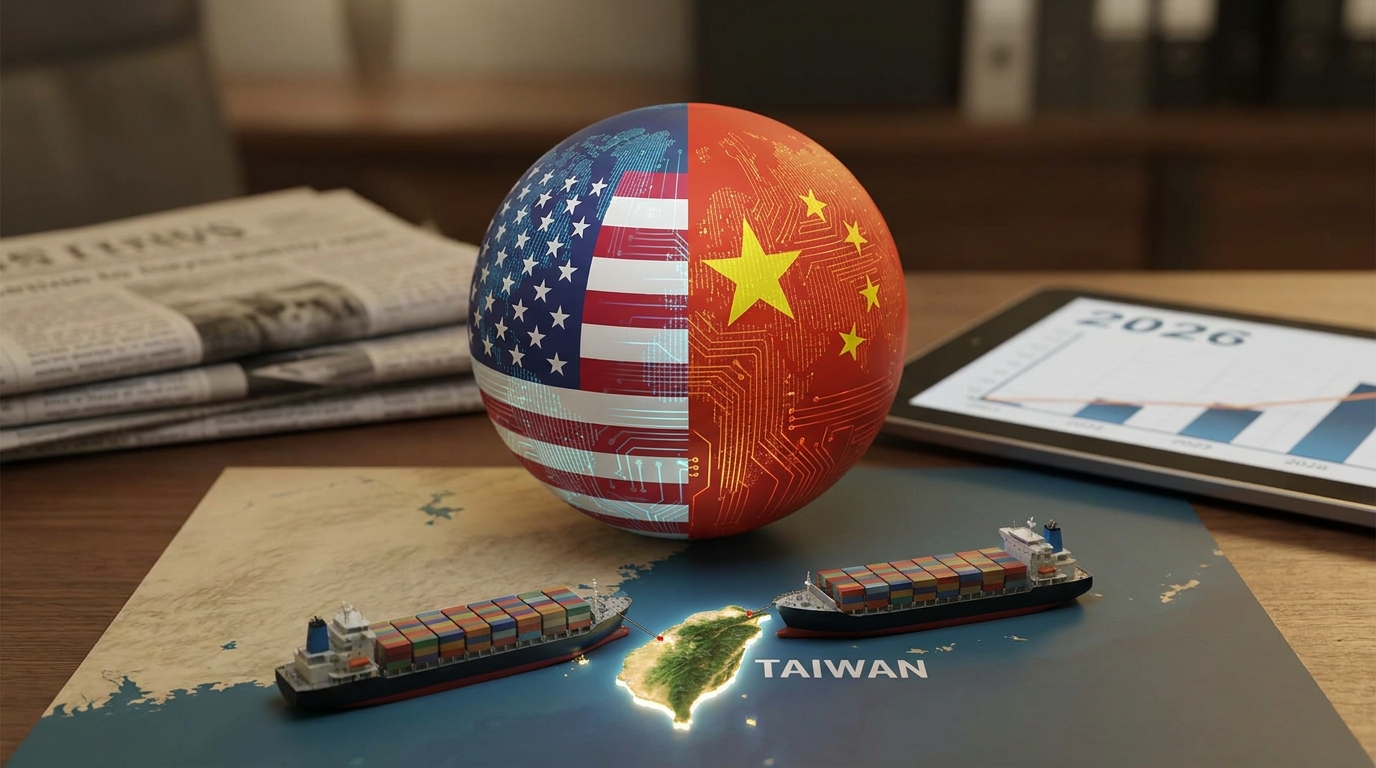
The US-China Rivalry in 2026: What's Really at Stake for the Rest of the World
Trade wars, tech embargoes, Taiwan tensions, and competing visions for global order — here's a clear-eyed, plain-English breakdown of where the world's most consequential rivalry stands in 2026 and what it means for everyone else.
Why This Rivalry Defines the 21st Century
The relationship between the United States and China is the most consequential bilateral relationship in the world. It shapes global trade flows, determines which technologies dominate markets, influences the foreign policies of dozens of nations caught between the two powers, and underpins the security architecture of the Indo-Pacific region — home to roughly half the world's population and a disproportionate share of its economic output.
Understanding this rivalry doesn't require choosing sides. It requires understanding what each country wants, where their interests genuinely conflict, where cooperation remains possible, and what the realistic range of outcomes looks like. This guide provides exactly that — a factual, balanced analysis of the US-China relationship in 2026 for readers who want to understand it rather than simply root for one side.
What Each Side Wants: The Core Interests
What the United States Wants
American foreign policy toward China in 2026 is driven by several overlapping concerns, some strategic and some economic:
Maintaining technological leadership: The US views Chinese advancement in semiconductors, artificial intelligence, quantum computing, and biotechnology as a direct threat to long-term economic competitiveness and military advantage. The semiconductor export controls introduced in 2022 and significantly tightened in 2023–2025 reflect this concern — restricting China's access to advanced chips and the equipment to make them.
Preserving the rules-based international order: The post-WWII international architecture — the UN system, WTO, international courts — was designed primarily by the US and reflects American values and interests. China's growing willingness to challenge or circumvent these institutions is perceived in Washington as an existential challenge to American global influence.
Taiwan: The US maintains strategic ambiguity on Taiwan — neither explicitly committing to military defence nor explicitly abandoning it. This position has been increasingly tested as China's military capabilities and assertiveness have grown.
Economic rebalancing: Successive administrations — both Democrat and Republican — have concluded that the terms of economic engagement with China that prevailed from the 1990s to 2010s were strategically disadvantageous. Tariffs, investment restrictions, and supply chain diversification initiatives reflect an attempt to reduce American economic exposure to Chinese decisions.
What China Wants
National rejuvenation: The Chinese Communist Party's central organising narrative is the restoration of China to what it considers its natural place as a leading world power — reversing the "century of humiliation" from the Opium Wars through WWII. This is not merely rhetorical: it underpins Xi Jinping's domestic legitimacy and drives foreign policy ambition.
Taiwan reunification: China considers Taiwan a breakaway province and its eventual reunification — peacefully if possible, by force if necessary — a core national interest. Xi Jinping has stated explicitly that this issue cannot be left to future generations.
Technological self-sufficiency: US export controls have dramatically accelerated China's investment in domestic semiconductor capability, AI development, and technology independence. The goal of tech self-sufficiency has become both a strategic necessity and a national prestige project.
A multipolar world order: China seeks a world order in which it has a seat equal to the US at the table of global governance — or, more ambitiously, one in which US-dominated institutions are supplemented or replaced by ones less reflective of Western values.
The Technology Cold War: The Most Important Battleground
The competition for technological supremacy is arguably more consequential than any military competition between the two powers — because technology leadership determines both economic and military advantage for decades forward.
Semiconductors: The Chokepoint
The most advanced semiconductors — the chips that power AI systems, next-generation weapons, and advanced communications — are manufactured almost exclusively by TSMC in Taiwan and Samsung in South Korea, using equipment predominantly supplied by ASML (Netherlands), Applied Materials, and Lam Research (US). American export controls restrict both the chips themselves and the manufacturing equipment from reaching Chinese customers for advanced applications.
China's response has been a massive state-funded investment in domestic semiconductor capability. SMIC, China's largest chipmaker, has made progress — successfully producing 7nm chips using equipment creative workarounds — but remains 2–4 technology generations behind TSMC's leading edge. The consensus among industry analysts in 2026 is that China can produce chips sufficient for most consumer applications domestically but remains dependent on imported equipment for the most advanced nodes required for cutting-edge AI and military applications.
Artificial Intelligence: A Genuine Race
In AI development, the gap between US and Chinese capabilities is narrower than in semiconductors and has closed significantly. Chinese AI companies — Baidu, Alibaba, ByteDance (parent of TikTok), and newer entrants — have developed large language models and AI systems that are competitive with leading American equivalents in many benchmarks. The Chinese government's access to vast datasets and its willingness to mandate data sharing from domestic companies gives it certain AI development advantages.
The critical constraint remains compute — access to the most advanced GPU clusters needed for the largest AI training runs. Export controls targeting Nvidia's most advanced chips have slowed but not stopped Chinese AI development, with Chinese researchers increasingly optimising for efficiency rather than raw scale.
Electric Vehicles and Clean Energy: China's Lead
In the transition to clean energy technologies — solar panels, wind turbines, batteries, and electric vehicles — China has achieved global leadership, not parity. China produces approximately 70–80% of the world's solar panels, 60% of wind turbines, and dominates battery manufacturing. Its EVs, led by BYD, offer comparable or superior technology to Western competitors at significantly lower prices.
Western governments have responded with tariffs — the EU imposed 27–48% additional tariffs on Chinese EVs in 2024, and US tariffs on Chinese EVs remain prohibitive — but the competitive challenge to Western automotive industries from Chinese manufacturers is real, significant, and not resolved by tariffs alone.
Taiwan: The Highest-Stakes Issue
Taiwan is the issue most likely to produce direct military conflict between the US and China — and therefore the issue with the most catastrophic potential consequences for the global economy and security architecture.
Taiwan is home to TSMC, which manufactures over 90% of the world's most advanced semiconductors. A military conflict over Taiwan — whether a Chinese blockade, missile strikes, or an amphibious invasion — would devastate global technology supply chains in ways that make the COVID-era chip shortage look trivial. The economic modelling of a Taiwan conflict by the RAND Corporation and others consistently produces global GDP impact figures in the trillions of dollars.
China's military has developed specific capabilities — hypersonic missiles, anti-ship weapons, cyber capabilities — designed to deter or degrade US military intervention in a Taiwan scenario. The People's Liberation Army Navy has grown to be the world's largest by vessel count. And Xi Jinping has publicly linked Taiwan reunification to China's national rejuvenation timeline.
The dominant view among security analysts in 2026 remains that an amphibious invasion of Taiwan in the near term carries unacceptably high risks for China — both military (Taiwan's defences have been significantly strengthened) and economic (sanctions would devastate China's export-dependent economy). A coercive campaign short of invasion — blockade, grey-zone pressure, cyber operations — is considered more likely as a near-term pressure tactic. But the structural dynamic — China's growing capability and stated intent versus US commitment to strategic ambiguity — means this remains the most dangerous flashpoint in global geopolitics.
What It Means for the Rest of the World
The Global South: Forced to Choose?
Most countries in the developing world — Africa, Southeast Asia, Latin America, the Middle East — are not choosing between the US and China and have no intention of doing so. They want economic relationships with both. China's Belt and Road Initiative has funded significant infrastructure across the Global South; the US and its allies have responded with competing investment programmes (the G7's Partnership for Global Infrastructure and Investment). Most recipient countries welcome investment from both sources and resist pressure to align.
The forced-choice narrative — "you're either with us or with China" — is primarily a Western projection onto countries that have consistently signalled they want to avoid that binary.
Europe: Between an Ally and a Trade Partner
The European Union's relationship with China is genuinely complex: China is the EU's largest trading partner for goods, and European companies have deep commercial interests in the Chinese market. But European governments are increasingly aligned with the US on technology security concerns, and the EU's own semiconductor sovereignty initiatives (the European Chips Act) reflect growing concern about strategic dependency on non-European supply chains.
The EU's position — "de-risking" rather than "decoupling," maintaining economic engagement while reducing strategic vulnerabilities — reflects the genuine difficulty of reconciling commercial interests with security concerns.
The Global Economy: Fragmentation Risk
The most significant economic risk from the US-China rivalry is not direct military conflict but gradual technological and economic fragmentation — the emergence of partially separated tech ecosystems, supply chains, and financial systems organised around US or Chinese standards. The IMF has estimated that full technological decoupling could cost the global economy 2–3% of GDP permanently — a figure that translates to trillions of dollars in lost growth.
Where Cooperation Remains Possible
Despite the adversarial framing that dominates coverage, cooperation between the US and China remains not only possible but essential in several domains:
Climate change: The two largest emitters of greenhouse gases cannot achieve meaningful global emissions reductions without cooperation. Despite tensions, US-China climate communication channels have been maintained even during periods of peak bilateral hostility.
Pandemic preparedness: COVID-19 demonstrated the catastrophic cost of inadequate global health cooperation. Both countries have strong self-interest in maintaining communication channels and early warning systems for future pandemics.
Nuclear risk reduction: Military-to-military communication channels reduce the risk of miscalculation — the scenario most likely to produce accidental escalation. Maintaining these channels despite tension is a shared interest.
Fentanyl precursor chemicals: China is a primary source of the chemical precursors used in fentanyl production. US-China cooperation on restricting these exports, while politically complex, has real public health stakes.
US China rivalry 2026, US China relations explained, China US geopolitics, Taiwan conflict risk, US China tech war semiconductors, BRI Belt Road Initiative, China AI development, US China trade war 2026, global south US China, decoupling vs de-risking




Discussion
Comments
Approved comments are published after moderation to keep discussion useful and spam-free.
No comments yet. Start the discussion below.