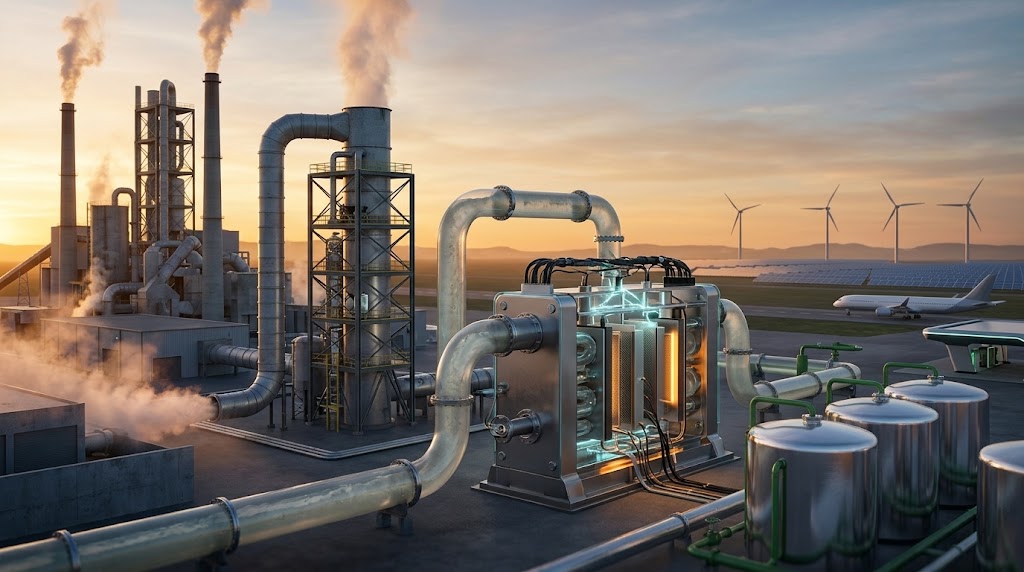
Conventional carbon capture usually traps CO₂, then spends substantial energy releasing and purifying it before conversion. A new generation of reactive-capture systems wants to skip that middle step—feeding carbon-rich liquids directly into electrolysers that make industrial feedstocks.
Don't Store the Carbon—Use It: The New 2026 Technology Turning Factory CO₂ Into Fuel Feedstocks
Carbon capture has always had an awkward problem: after spending energy trapping CO₂, industry often has to spend more energy getting it back out. A new approach called reactive carbon capture wants to remove that step entirely.
By Deep Tech & Sustainability Desk | Thursday, September 3, 2026
Imagine standing beside the exhaust stack of a cement plant, refinery or chemical factory.
A stream of gases pours upward.
Somewhere inside that stream is carbon dioxide.
The conventional climate-tech response sounds straightforward:
capture the CO₂.
But capturing carbon is only the beginning.
In many established solvent-based systems, CO₂ binds chemically to a liquid. If engineers then want concentrated carbon dioxide for storage or conversion, they typically have to heat that liquid so the CO₂ is released again.
Then the gas may have to be:
compressed,
purified,
transported,
and fed into another reactor.
It creates an odd industrial loop.
Spend energy capturing carbon.
Then:
spend energy undoing part of the capture process so you can use the carbon somewhere else.
A newly published Nature Energy perspective argues that a different architecture could become commercially important much sooner than many competing electrified carbon-utilization technologies.
It is called reactive carbon capture, or RCC.
The core idea is beautifully simple:
Don't release the captured CO₂ first. Send the carbon-rich capture liquid directly into an electrolyser and convert the carbon while it is still captured.
The Nature Energy paper, published September 1, 2026, argues that this architecture could potentially bypass thermal regeneration, simplify industrial integration and produce useful low-carbon chemical intermediates from real industrial CO₂ streams—provided several major engineering barriers can be solved.
It is not yet a carbon-recycling revolution operating across factories.
But it may represent one of the most interesting changes in carbon capture in years.
The Problem With Carbon Capture Is Not Just Catching Carbon
Carbon capture is often illustrated as though CO₂ behaves like dust.
Factory exhaust enters a filter.
Carbon gets trapped.
Clean gas leaves.
Reality is harder.
CO₂ molecules must be separated from mixtures that can also contain:
nitrogen,
oxygen,
water,
sulfur compounds,
and other contaminants.
Many industrial capture systems therefore rely on chemical solvents—often amine-based liquids—that selectively bind CO₂.
That binding is useful.
It creates the next problem.
If the carbon is going to be permanently stored underground or converted into another product, engineers generally need concentrated CO₂ again.
So the solvent must be regenerated.
Heat breaks the chemical association and releases CO₂.
The solvent can then be reused.
A recent Nature Sustainability review identifies this CO₂-recovery stage as one of the central energy and cost burdens in conventional capture-and-conversion systems.
The traditional chain can look approximately like this:
Factory exhaust
→ CO₂ capture
→ CO₂-rich solvent
→ heat regeneration
→ concentrated CO₂
→ compression/purification
→ CO₂ electrolyser
→ chemical product
Reactive carbon capture asks:
Why separate the capture system from the conversion system at all?
Carbon Capture 1.0 vs Carbon Capture 2.0
The new architecture shortens the chain.
Instead of regenerating the solvent thermally, the system attempts:
Factory exhaust
→ CO₂ capture liquid
→ electrolyser
→ useful carbon product
→ regenerated capture liquid
→ capture again
That last part is crucial.
The long-term target is a closed loop.
The capture liquid grabs carbon.
Electrochemistry removes or converts that captured carbon.
The liquid is restored sufficiently to return to the absorber.
Then the cycle begins again.
If this works economically, carbon capture stops looking like:
capture → release → process
and begins looking like:
capture → manufacture.
That is a much more interesting industrial proposition.
What Comes Out of the Electrolyser?
This is where the headline needs precision.
Reactive carbon capture does not necessarily turn chimney exhaust directly into a tank of aviation fuel.
At least not in one magical machine.
One of the most attractive early products is carbon monoxide, or CO.
That sounds strange because carbon monoxide is best known as a toxic gas.
Industrially, however, CO is also extremely valuable.
Combined with hydrogen, it forms syngas—synthesis gas.
Syngas can be used downstream to manufacture products including:
synthetic fuels,
methanol,
and other chemicals.
So a more accurate description is:
Reactive carbon capture could turn captured factory CO₂ directly into the building blocks used to manufacture low-carbon fuels and chemicals.
That is still a huge opportunity.
Most industrial chemistry begins with intermediates.
Why Syngas Matters
Modern civilization runs on far more than electricity.
We also consume huge quantities of carbon-containing molecules.
Aircraft need energy-dense fuels.
Ships need fuel.
Chemical plants require carbon feedstocks.
Plastics, solvents and many industrial materials begin with hydrocarbons or other carbon-containing molecules.
Today, much of that carbon ultimately originates underground:
oil,
gas,
or coal.
A circular-carbon system would behave differently.
Carbon would be:
emitted,
captured,
converted,
used,
and potentially captured again.
If the energy driving that cycle came from low-carbon electricity and green hydrogen, fossil carbon could theoretically be displaced in selected sectors.
That is why carbon utilization is attractive.
The objective is not necessarily to eliminate carbon-based chemistry.
It is to reduce how much new fossil carbon has to enter the system.
Why Electricity Is Central to the Idea
An electrolyser uses electricity to drive a chemical reaction that would not otherwise happen spontaneously.
Water electrolysers are already becoming familiar because they split water to produce hydrogen.
CO₂ electrolysers instead use electrical energy to transform carbon-containing molecules into other chemicals.
Depending on:
the catalyst,
electrolyte,
membrane,
voltage,
and reactor design,
different products can potentially be produced.
For reactive capture, the challenge is harder because the carbon isn't entering as a convenient stream of purified gaseous CO₂.
It is embedded in a chemically complicated liquid.
The electrode has to function inside that environment.
And it has to do so:
efficiently,
selectively,
continuously,
and cheaply.
That is why the concept has taken years to develop.
A Major Advantage: Skip the Giant Thermal Regenerator
Conventional solvent regeneration usually requires heat.
Reactive capture attempts to replace part of that thermal process with an electrochemical one.
The September Nature Energy analysis describes RCC as feeding CO₂-rich liquid directly into an electrolyser, thereby bypassing thermal regeneration and simplifying process integration.
That is potentially important for industries trying to electrify.
Instead of:
capture plant + steam system + CO₂ purification + compression + conversion plant,
you could eventually imagine a more tightly integrated:
capture + electrochemical manufacturing system.
The fewer major process steps required, the fewer pieces of equipment must be:
built,
heated,
maintained,
and integrated.
That does not guarantee lower cost.
But it gives engineers something worth optimizing.
The Other Advantage May Be Dirty CO₂
Most laboratory CO₂ electrolysis looks much cleaner than a factory chimney.
Researchers can feed a reactor high-purity CO₂ from a cylinder.
Industry cannot assume that luxury.
Real flue gas can contain relatively dilute CO₂ plus oxygen and other impurities.
Some industrial flue streams contain only around 4–15% CO₂, while oxygen and contaminants can interfere with electrochemical conversion.
The September Nature Energy authors argue that RCC may have comparatively good tolerance to industrial impurities and could produce high-purity gaseous outputs directly from industrial capture streams.
That could be commercially significant.
An elegant electrochemical reactor that works only with laboratory-grade CO₂ is much less useful than one that tolerates what factories actually emit.
Researchers Have Already Converted CO₂ From Simulated Flue Gas
This is not only a theoretical proposal.
In July 2026, researchers reported a related direct reactive-capture system in Nature Communications that performed remarkably well under simulated flue-gas conditions.
Their system used specially selected organic electrolytes to suppress competing reactions.
With a feed containing 15% CO₂ and 8% oxygen, the optimized system maintained operation for more than 100 hours while selectively producing carbon monoxide.
The researchers reported near-quantitative Faradaic efficiency for CO under selected conditions and demonstrated conversion even from streams containing only 1% CO₂ in the presence of oxygen.
Faradaic efficiency is essentially a measure of where the electrons went.
If you supply electricity to an electrochemical reactor, you want those electrons making the desired product—not generating unwanted hydrogen or driving side reactions.
High selectivity therefore matters enormously.
But 100 Laboratory Hours Is Not 10 Factory Years
This is one of the most important reality checks.
Industrial equipment is expected to operate for extraordinary periods.
A commercial electrolyser cannot be impressive for:
one hour,
one day,
or one week.
Companies need systems that survive:
thousands,
tens of thousands,
or potentially many more operating hours,
with predictable maintenance.
Electrodes degrade.
Membranes degrade.
Catalysts change.
Impurities accumulate.
Solvents can attack materials.
Deposits form.
Performance drifts.
A 100-hour laboratory result can demonstrate a mechanism.
It does not establish industrial durability.
This is why the new research emphasizes stability and scale as major barriers to commercialization.
The Cathode Has to Survive the Capture Chemistry
An ordinary CO₂ electrolyser can be optimized for an engineered electrolyte.
Reactive capture creates a more hostile problem.
Capture fluids may contain:
amines,
bicarbonates,
carbonates,
salts,
water,
and various impurities.
Some compounds useful for capturing CO₂ can be harmful to the electrochemical catalyst.
Researchers therefore identify solvent-tolerant cathodes as a critical development target.
That means catalyst scientists cannot work independently from capture engineers.
The solvent that captures carbon best may not be the solvent the electrolyser likes.
The electrode that converts carbon best may degrade inside the capture fluid.
Reactive capture works only when the two systems are designed together.
The Capture Solvent Itself May Need Reinventing
Today's solvent chemistry was optimized primarily for one job:
capture CO₂ effectively.
Future reactive-capture fluids may need to perform two jobs:
Capture CO₂ efficiently from exhaust.
Behave well inside an electrochemical cell.
Those requirements are not necessarily identical.
This could create an entirely new materials industry.
Solvents may be designed not for maximum capture alone but for the full:
capture → convert → regenerate → recapture
cycle.
The Membrane Is Another Hidden Bottleneck
Inside many electrolysers sits a membrane.
It separates chemical environments while allowing selected ions to move through the device.
For reactive carbon capture, bipolar membranes are especially interesting because they can generate acidic and basic conditions on opposite sides of the membrane.
That chemistry can help release reactive CO₂ locally near the catalyst while regenerating the capture solution elsewhere.
But membranes introduce:
electrical resistance,
cost,
durability challenges,
and manufacturing complexity.
A climate technology can fail economically because of a component most consumers will never hear about.
In this case, a thin sheet inside the electrolyser could determine the future of the entire process.
China Has Already Demonstrated a Closed Capture-Electrolysis Loop
Another important 2026 result came from researchers at the Dalian Institute of Chemical Physics and Fudan University.
Their bicarbonate-mediated system integrated CO₂ capture with electrolysis to carbon monoxide.
Instead of producing purified gaseous CO₂ first, the system converted the bicarbonate-rich capture liquid.
Researchers reported 93% CO Faradaic efficiency at 300 mA/cm² in one configuration and demonstrated a closed-loop capture-and-electrolysis cycle using simulated flue gas.
Again, this does not mean a commercial refinery has been converted into a circular-carbon plant.
But it demonstrates that researchers are moving beyond isolated half-reactions and beginning to think in complete process loops.
That matters.
Another 2026 System Put a Dollar Figure on Carbon Monoxide
A separate study published in ACS Energy Letters in March used ammonia to capture CO₂ from simulated flue gas and then electrochemically convert the resulting ammonium bicarbonate into CO.
The researchers reported 85% CO Faradaic efficiency at 100 mA/cm² and estimated a levelized CO production cost of $25.43 per kilomole under their techno-economic assumptions.
Techno-economic analysis is not the same as a commercial invoice.
It depends on assumptions about:
electricity cost,
capital cost,
lifetime,
scale,
and plant utilization.
But this transition from:
“Can the chemistry work?”
to
“What would the molecule cost?”
is exactly what an emerging technology must eventually undergo.
The Economics Depend Heavily on Electricity
This entire concept has one unavoidable appetite:
electrons.
Reactive carbon capture may eliminate some thermal energy requirements.
The electrochemical conversion itself still consumes substantial electricity.
If that electricity comes from an expensive fossil-heavy grid, the economics and climate benefits can weaken rapidly.
If it comes from:
low-cost solar,
wind,
hydropower,
nuclear,
or another low-carbon source,
the calculation changes.
This means RCC plants may eventually be geographically tied to cheap clean electricity.
A steel plant or cement factory with abundant nearby renewable generation could be more attractive than the same industrial source in a power-constrained region.
Carbon utilization becomes an electricity-infrastructure question.
Much like green hydrogen.
Hydrogen Is Often the Other Half of the Fuel Equation
Turning CO₂ into synthetic hydrocarbons generally requires hydrogen.
If that hydrogen is produced from natural gas without carbon management, the final fuel may not be particularly low carbon.
If the hydrogen comes from renewable-powered water electrolysis, the pathway can look much cleaner.
A simplified synthetic-fuel chain might therefore become:
factory CO₂
renewable electricity
green hydrogen
→
syngas
→
synthetic liquid fuel
The carbon supplies the atoms.
Hydrogen supplies additional chemical building blocks.
Electricity supplies the energy.
This is why synthetic-fuel economics are so sensitive to the price of clean electricity and hydrogen.
Can We Really Turn Factory Smoke Into Jet Fuel?
Potentially.
But not directly in a one-step box.
Carbon monoxide and hydrogen can be converted through established industrial chemistry into hydrocarbons.
Processes such as Fischer–Tropsch synthesis have been used for decades to turn syngas into liquid fuels.
A future system could therefore connect:
CO₂ capture
to
RCC electrolysis
to
syngas conditioning
to
synthetic-fuel production.
That could ultimately produce:
aviation fuel,
diesel-like hydrocarbons,
or chemical intermediates.
The new reactive-capture technology concerns the front end of that chain.
It is trying to make getting from dirty industrial CO₂ to useful carbon feedstock cheaper and simpler.
But Burning Synthetic Fuel Releases the Carbon Again
This is another essential sustainability distinction.
If captured CO₂ becomes jet fuel and the fuel is burned, that carbon returns to the atmosphere.
So this is not permanent carbon removal.
It is carbon recycling.
The climate benefit comes from potentially avoiding additional fossil carbon.
Whether the full system is genuinely low carbon depends on:
where the captured CO₂ came from,
how the electricity was generated,
how hydrogen was produced,
conversion efficiency,
transport,
and what would otherwise have happened to the carbon.
Life-cycle accounting matters.
Carbon Storage and Carbon Utilization Are Not Enemies
The climate debate sometimes treats these technologies as alternatives.
Store CO₂ underground?
Or use it?
We will probably need both.
Some captured emissions may be best permanently stored in geological formations.
Other carbon may become valuable feedstock for:
chemicals,
materials,
or synthetic fuels.
The correct choice depends on:
source,
product,
energy supply,
geography,
cost,
and permanence requirements.
Carbon utilization cannot automatically replace geological storage for every industrial emission.
The scale matters.
Cement Is a Fascinating Target
Cement production is especially difficult to decarbonize.
Some emissions come from burning fuel to produce extreme heat.
But another major portion comes directly from chemistry.
Limestone contains calcium carbonate.
When it is converted into lime during cement production, CO₂ is released.
Even if a cement plant used entirely renewable electricity, those process emissions would remain unless the production chemistry changed or the carbon were captured.
This makes cement one potential long-term candidate for carbon capture.
Reactive capture raises an intriguing possibility:
could some of that unavoidable process carbon eventually become feedstock for another industry?
A cement plant would not simply become a building-material factory.
It could potentially become a carbon supplier.
Steel, Refineries and Chemical Plants Could Be Different
Not every exhaust stream is equal.
CO₂ concentration differs.
Pressure differs.
Contaminants differ.
Temperature differs.
Some industrial streams contain relatively concentrated CO₂ and are comparatively easier to capture.
Others are dilute and difficult.
Reactive capture will therefore not have one universal configuration.
The solvent appropriate for a cement plant may differ from the best system for:
steel,
refining,
hydrogen production,
or waste-to-energy.
Industrial carbon capture is likely to resemble water treatment:
different feed streams require different engineering.
What About Capturing CO₂ Directly From the Air?
Reactive capture could potentially intersect with direct air capture, or DAC.
DAC removes CO₂ from ordinary atmospheric air.
That is much harder because atmospheric CO₂ is extremely dilute.
But once captured in a liquid, the same regeneration problem appears:
what do you do with the carbon-loaded solvent?
Integrating direct-air capture with electrochemical conversion could theoretically produce synthetic carbon feedstocks from atmospheric CO₂.
If powered by low-carbon energy, that becomes an especially interesting pathway for aviation fuels.
Aircraft require dense liquid fuels.
Atmospheric carbon could become one source of those molecules.
Then flying releases the carbon back to the atmosphere.
Capture it again.
That is the dream of a circular carbon economy.
We are nowhere near doing it cheaply at enormous scale.
But the chemistry is becoming much less hypothetical.
Why Reactive Capture Could Arrive Before Some More Exotic CO₂ Technologies
The September Nature Energy analysis makes a particularly interesting argument.
Its authors believe RCC could potentially achieve early industrial adoption ahead of some alternative electrified conversion routes, even at current selectivity and voltage levels, if engineers solve durability and scale problems.
Why?
Integration.
Industrial technologies do not succeed only because one reactor has the world's highest laboratory efficiency.
They succeed because they fit into factories.
RCC's potential advantages include:
avoiding thermal regeneration,
tolerating some industrial impurities,
producing high-purity gaseous outputs,
and connecting capture directly with chemical manufacturing.
Sometimes the technology with fewer process steps beats the technology with the most impressive isolated component.
A Useful Warning: This September Paper Is a Perspective, Not a New Factory Demonstration
The fresh Nature Energy publication should be described accurately.
It is a peer-reviewed Perspective from researchers at the University of Toronto and Shell Global Solutions International.
It evaluates existing experimental RCC performance, industrial integration and techno-economic requirements.
It is not announcing that a new commercial RCC factory opened on September 1.
Three co-authors are employees of Shell Global Solutions, which the publication discloses in its competing-interest statement.
That does not invalidate the analysis.
Industrial participation can be extremely valuable in research about scaling chemical processes.
It does mean readers should understand what kind of evidence they are looking at:
an academic-industrial assessment of what must happen for RCC to commercialize—not proof that commercialization has already happened.
Carbon Capture Will Fail If the Equipment Cannot Scale
Electrochemistry works beautifully on small laboratory electrodes.
Factories are not small.
A commercial plant may require vast electrode area.
Flow must remain uniform across large reactors.
Heat must be removed.
Pressure must be controlled.
Membranes must stay intact.
Electric current must distribute evenly.
Maintenance must be manageable.
Manufacturing the electrolyser cannot require absurd quantities of rare materials.
The hardest transition in climate technology is often:
square centimeters → square meters → factory.
Many technologies die somewhere along that journey.
The Technology Must Also Survive Start-Stop Operation
Renewable energy introduces another question.
What happens when electricity is abundant at noon but scarce at night?
An electrochemical carbon-conversion plant ideally would be flexible.
Ramp up when renewable electricity is cheap.
Ramp down when the grid is constrained.
But chemical factories traditionally like steady operation.
Repeated:
heating,
cooling,
starting,
and stopping
can damage equipment and reduce economics.
Future RCC systems may therefore need to combine chemical stability with electrical flexibility.
If they can, they could become attractive consumers of otherwise-curtailed renewable power.
Excess solar at midday?
Convert carbon.
High electricity prices at 8 p.m.?
Reduce production.
That would link climate chemistry directly with smart-grid operation.
Carbon Could Become an Industrial Battery for Renewable Energy
There is a deeper idea here.
Electricity is difficult to store for months.
Chemical fuels are easy to store.
Suppose renewable electricity powers an electrolyser that converts captured carbon into a stable chemical fuel.
Energy has effectively moved from:
electrons
into
chemical bonds.
The resulting fuel can be:
stored,
transported,
and used later.
In that sense, carbon-based synthetic fuels become a form of long-duration energy storage.
Not necessarily the most efficient one.
Batteries are much better for many applications.
But batteries cannot currently power every:
long-haul aircraft,
ocean-going ship,
or high-temperature industrial process
economically.
Molecules remain valuable where electrons are difficult to use directly.
The Most Sustainable Fuel Is Still the Fuel You Don't Need
Synthetic fuels should not become an excuse to ignore efficiency.
Converting electricity into:
hydrogen,
then syngas,
then liquid fuel,
then burning that fuel
loses substantial energy at every stage.
Where direct electrification works, it is generally more efficient.
Electric car?
Battery.
Building heat?
Heat pump.
Many industrial motors?
Electricity.
But certain sectors are far harder to electrify.
Long-haul aviation is the obvious example.
Energy density matters.
Aircraft cannot simply replace hundreds of tonnes of liquid fuel with present-day batteries.
That is where recycled-carbon molecules may be most valuable.
The question should not be:
Can we turn everything into synthetic fuel?
It should be:
Where do we genuinely still need a fuel?
A Future Refinery Could Look Very Different
Picture an industrial complex in the 2040s.
There may still be pipes.
Storage tanks.
Reactors.
Compressors.
Catalysts.
But crude oil may no longer be the only carbon source.
One stream comes from captured factory emissions.
Another comes from biogenic CO₂.
Perhaps another comes from direct-air capture.
Renewable hydrogen enters from electrolysers.
Carbon and hydrogen become:
methanol,
jet fuel,
plastics,
industrial chemicals,
or other molecules.
The refinery has not disappeared.
Its feedstock has changed.
That could be one of the biggest industrial transformations of the energy transition.
Pakistan Could Eventually Have a Stake in This
The technology is early, but the industrial implications are relevant to Pakistan.
Pakistan has:
cement production,
fertilizer manufacturing,
refineries,
large industrial boilers,
natural-gas infrastructure,
and growing renewable-energy potential.
Those industries produce concentrated carbon streams of varying kinds.
Long term, an industrial decarbonization strategy could connect:
solar and wind,
electrolysis,
hydrogen,
carbon capture,
and chemical production.
But the order matters.
Pakistan should not install expensive carbon-conversion equipment simply because it is fashionable.
The economics require:
cheap electricity,
reliable grids,
large utilization,
industrial scale,
and markets for the resulting products.
Without those fundamentals, sophisticated electrolysers become expensive ornaments.
The Gulf May Be an Even Earlier Market
The Middle East has an interesting combination:
large oil and gas infrastructure,
chemical expertise,
refineries,
export terminals,
capital,
excellent solar resources,
and growing hydrogen ambitions.
That means Gulf economies could potentially integrate carbon conversion into existing industrial systems relatively early.
Instead of abandoning chemical manufacturing, these countries could attempt to decarbonize the carbon feedstock itself.
CO₂ plus renewable electricity plus green hydrogen could become a pathway toward:
synthetic fuels,
low-carbon chemicals,
and exportable energy products.
The industrial knowledge already exists.
The challenge is changing where the atoms come from.
Could This Make Carbon Emissions Valuable?
Potentially.
But there is a trap.
If CO₂ becomes valuable feedstock, companies should not be rewarded for deliberately creating unnecessary emissions just so they can sell the carbon.
The highest-value hierarchy remains:
avoid emissions where practical
then
reduce them
then
capture unavoidable emissions
and finally
store or use that captured carbon intelligently.
Carbon utilization makes most sense for emissions that are genuinely difficult to eliminate.
Otherwise we could create a bizarre circular economy where society burns fossil fuels specifically to manufacture the CO₂ needed to claim carbon recycling.
That would defeat the point.
“Carbon-Negative Fuel” Requires Extreme Caution
Another phrase to watch.
A fuel made from captured CO₂ is not automatically carbon negative.
If the carbon came from a fossil-fuel power station and the synthetic fuel is later burned, the carbon still ultimately reaches the atmosphere unless another process captures it.
If the electricity came from coal, the situation could become worse.
If the hydrogen came from unabated natural gas, additional emissions appear.
A legitimate life-cycle assessment must include:
capture,
electricity,
hydrogen,
conversion,
transport,
and final use.
Climate technology should be judged by the entire system.
Not the greenest-looking component.
So What Has Actually Changed in 2026?
Several pieces are beginning to line up.
January: researchers reported increasingly efficient bicarbonate-mediated capture/electrolysis systems and closed-loop operation at device scale.
March: ammonia-mediated RCC research demonstrated capture from simulated flue gas, electrochemical CO production and a detailed economic analysis.
July: researchers demonstrated impurity-tolerant direct conversion from dilute simulated flue gas, including more than 100 hours of operation under selected conditions.
August 25: Nature Sustainability published a major review focused specifically on maximizing conversion enough to achieve a genuinely closed reactive-capture cycle.
September 1: Nature Energy published a Perspective making the case that RCC could be industrialized sooner than some rival electrified approaches if the remaining durability, membrane and scaling problems are solved.
That does not look like a technology arriving overnight.
It looks like a research field becoming an engineering field.
And that transition is often where technologies become interesting commercially.
The Carbon-Capture Question Has Changed
For years, the main carbon-capture question was:
How do we stop CO₂ from entering the atmosphere?
Then came:
Where do we store it?
Reactive carbon capture adds another question:
What if we never turn the captured carbon back into a purified waste gas at all?
Capture it in a liquid.
Move that liquid into an electrolyser.
Turn the carbon into something industry already buys.
Regenerate the capture medium.
Repeat.
The molecule that left one factory as waste becomes the feedstock entering another process.
That is an extraordinarily attractive picture.
But chemistry is unforgiving.
The electrodes must survive.
The solvent must survive.
The membrane must survive.
The whole reactor must scale.
The electricity must be clean and cheap.
The resulting product must compete with fossil-derived chemicals.
And the system must operate not for 100 hours but for years.
Those are enormous requirements.
Yet the research published throughout 2026 suggests scientists are no longer asking only whether reactive carbon capture is possible.
They are increasingly asking:
What specifications would make it commercial?
That is a different phase of technological development.
Don't Store the Carbon—Use It?
Sometimes.
Not always.
Some CO₂ should probably be permanently stored.
Some emissions should never be produced in the first place.
Some industrial processes should be electrified rather than fitted with carbon capture.
But the world will continue requiring carbon-containing:
chemicals,
materials,
and high-energy fuels
for a long time.
Today, we usually obtain those carbon atoms by digging or pumping fossil carbon out of the ground.
Reactive carbon capture points toward another possibility:
use carbon that is already moving through the economy.
Capture it.
Convert it.
Reuse it.
And whenever possible, stop adding new fossil carbon to the loop.
The most exciting thing about the September 2026 research is therefore not a claim that humanity has solved carbon capture.
It hasn't.
It is that the architecture itself is changing.
The old model said:
capture the CO₂, release it again, purify it, compress it, and then decide what to do with it.
The emerging model says:
once you've caught the carbon, don't let it go.
Put it to work.
Frequently Asked Questions
What is reactive carbon capture?
Reactive carbon capture, or RCC, combines CO₂ capture with electrochemical conversion. Instead of thermally regenerating a solvent to release purified CO₂ gas first, the carbon-rich capture liquid is sent directly into an electrolyser.
What was published about RCC in September 2026?
A Nature Energy Perspective published September 1 argues that RCC could potentially reach early industrial adoption ahead of some competing electrified CO₂-conversion pathways if engineers solve stability and scaling challenges.
Does reactive carbon capture eliminate all energy use?
No. It may avoid the energy-intensive thermal-regeneration step used in many conventional capture systems, but the electrolyser itself requires electricity.
Does RCC turn CO₂ directly into petrol or jet fuel?
Usually not in one step. A major early target is carbon monoxide or syngas, which can then be converted into fuels and chemicals through established downstream processes.
What is syngas?
Syngas is primarily a mixture of carbon monoxide and hydrogen. It is an important industrial feedstock that can be converted into methanol and synthetic hydrocarbons.
Why is CO useful if carbon monoxide is poisonous?
Carbon monoxide is dangerous to humans when inhaled, but it is also an important controlled industrial chemical feedstock used in manufacturing.
What does “closed-loop reactive capture” mean?
Ideally, the capture liquid absorbs CO₂, electrolysis converts much of the captured carbon into a product, and the regenerated liquid returns to capture more CO₂.
Has RCC worked experimentally?
Yes. Multiple laboratory systems have demonstrated integrated capture and electrochemical conversion. A July 2026 study reported selective conversion under simulated flue-gas conditions and more than 100 hours of operation in one configuration.
Is the technology commercially mature?
No. Current RCC electrolysers remain less mature than conventional gas-fed CO₂ electrolysers. Stability, membranes, solvent compatibility, electrode durability and scale remain important unresolved issues.
What products can be made from captured CO₂?
Research pathways include carbon monoxide, syngas and potentially downstream products such as methanol, synthetic fuels and other chemicals.
Can captured CO₂ become aviation fuel?
Yes, through additional chemical-processing stages. Captured carbon can contribute to syngas that is subsequently converted into synthetic hydrocarbons. This does not mean an RCC electrolyser directly outputs finished jet fuel.
Is fuel made from captured CO₂ carbon negative?
Not automatically. Climate impact depends on the source of the CO₂, electricity, hydrogen, processing and final use. Burning a synthetic hydrocarbon normally releases its carbon again.
Is recycling CO₂ better than storing it underground?
Neither solution is universally better. Permanent geological storage may be appropriate for large volumes of unavoidable emissions, while utilization may make sense where society needs carbon-containing fuels or chemicals.
Why not just electrify everything instead?
Direct electrification is generally more energy efficient when practical. Carbon-based synthetic fuels are particularly interesting for sectors such as long-distance aviation and certain industrial processes where direct electrification remains difficult.
Does RCC require green hydrogen?
Not necessarily for every electrochemical product, but hydrogen becomes important when converting carbon into many synthetic fuels. The climate benefit is much stronger when hydrogen comes from low-carbon sources.
Could RCC work with direct air capture?
Potentially. Captured atmospheric CO₂ can also exist in carbon-rich liquid streams, and integrated electrochemical conversion is being investigated as a possible way to process such captured carbon.
Why are membranes important?
Bipolar and other ion-exchange membranes help manage chemical conditions inside RCC electrolysers, but their efficiency, durability and scalability can significantly affect system performance and cost.
What is the biggest challenge now?
Not a single challenge. Researchers must simultaneously improve durability, electrode compatibility, capture liquids, membrane efficiency and industrial-scale reactor engineering while achieving competitive economics.
Editorial Note: The September 1 Nature Energy publication is a peer-reviewed Perspective assessing the path toward RCC industrialization, not an announcement of a newly operating commercial carbon-to-fuel plant. The authors include researchers from the University of Toronto and Shell Global Solutions; Shell employee participation is disclosed in the paper's competing-interest statement. Experimental results discussed separately come from peer-reviewed 2026 research.
CO2 to fuel technology, carbon capture electrolysis, factory emissions recycling, reactive CO2 capture, carbon utilization, syngas from CO2, electrochemical carbon conversion, industrial decarbonization
carbon capture technology, industrial electrolyser, green hydrogen, sustainable fuels, carbon utilization equipment, clean chemical manufacturing, electrolysis technology, industrial decarbonization solutions
Carbon Capture, CO2, Synthetic Fuels, Electrolysis, Climate Technology, Industrial Decarbonization, Syngas, Green Hydrogen, Clean Energy, Carbon Utilization