
Tim Cook Is About to Deliver His Last WWDC Keynote. The Stage Has Never Been More Important.
There is a photograph that Apple will not publish, but that every person at WWDC 2026 will understand they are witnessing.
Tim Cook, on the stage at Apple Park's Steve Jobs Theater, delivering the opening keynote of the Worldwide Developers Conference. For the 37th time. For the last time.
Cook steps down as Apple's CEO on September 1, 2026, handing the company to John Ternus — the hardware engineering chief who oversaw Apple Silicon, the M-series chips, and the transition away from Intel that redefined what a laptop could be. Ternus will inherit the iPhone, the Mac, the Apple Watch, the Vision Pro, and whatever iOS 27 becomes — on the day iOS 27 ships, alongside the iPhone 18.
But before any of that happens, Cook has one more show to run. On Monday, June 8, 2026, at 10:00 a.m. Pacific Time, he will walk onto that stage and deliver what may be the most consequential WWDC keynote Apple has staged since the original iPhone announcement in 2007.
Because on June 8, Apple will either prove that it still controls the most important piece of digital real estate on earth — the voice assistant on a billion devices — or it will confirm what the last four years of AI development have suggested: that it fell behind, and is still catching up.
The product on trial is Siri.
Why This WWDC Is Different: The Stakes Are Higher Than Ever
Apple has held 36 Worldwide Developers Conferences since 1987. Each one has introduced software that shaped the next year of Apple's products — from the launch of iOS itself to the introduction of Swift, from Siri's original debut in 2011 to Apple Intelligence in 2024.
WWDC 2026 is different for two reasons that compound each other:
Reason 1: Tim Cook's final keynote as CEO. The transition to John Ternus — Apple's most hardware-centric CEO in years, the man who built Apple Silicon — represents a genuine philosophical shift in the company's leadership approach. Cook's Apple was defined by operational excellence, supply chain mastery, and disciplined market expansion. Ternus's Apple will be defined by whatever he decides to build. WWDC 2026 is the software architecture that Ternus will inherit on September 1. This makes it Cook's parting gift to the company he has run for 15 years — and his clearest statement about where he believes Apple's future lies.
Reason 2: Siri must be reborn. Apple introduced Siri in October 2011, on the iPhone 4S. At the time, it was the most capable consumer voice assistant ever built. By 2022, when ChatGPT launched and the AI assistant era began, Siri had become a running joke — a product that set timers reliably and struggled with almost everything else. Apple Intelligence, introduced at WWDC 2024, was a partial answer: on-device AI features, writing tools, image generation, and a ChatGPT integration that let Siri hand off complex queries. But Siri itself was not rebuilt.
On June 8, Apple rebuilds Siri.
The New Siri: "Campos" — What We Know
Multiple technology publications, including Yanko Design, Laptop Outlet, TechRepublic, and Business Standard, have pieced together the picture of what Apple is building. The project has an internal codename: Campos.
Here is what credible reporting indicates will arrive at WWDC 2026:
A Full Chatbot Interface — With Memory
The new Siri is expected to function as a genuine conversational AI — supporting back-and-forth exchanges with memory of your conversation history, similar to how ChatGPT and Google Gemini work today. Current Siri treats each query as independent; ask "what's the weather in Paris?" and then "what should I wear?" and Siri does not know they are connected.
The new Siri will know. The context persists within a conversation, enabling the kind of multi-step reasoning and follow-up that makes AI assistants actually useful rather than merely functional.
A Dedicated Siri App
Siri is getting its own standalone app, pre-installed on iOS 27, iPadOS 27, and macOS 27. This shifts Siri from a voice-activated interface layer into a full-screen application — a chatbot-style interface that users can open, type into, and interact with as they would with any messaging application.
This is architecturally significant. A dedicated app means Siri can be used without voice at all — removing the primary friction that makes some users prefer ChatGPT's web interface or app for complex queries. If you want to think through something, you can open the Siri app and type.
Siri Extensions: Choose Your AI Model
This may be the most radical feature Apple has ever added to a core platform product. Siri Extensions would allow users to designate which AI model handles specific types of tasks — with Claude (Anthropic), Google Gemini, Grok (xAI), and ChatGPT (OpenAI) reportedly among the options.
The implication is profound: rather than Apple choosing your AI assistant for you, iOS 27 could function as an AI orchestration platform where different models are invoked based on task type. Need creative writing? Route to Claude. Need search and current events? Route to Gemini. Want code? Route to ChatGPT or Grok.
This is Apple acknowledging something it has historically resisted: that it cannot win the AI race alone. But it is doing so in characteristically Apple fashion — not by subordinating itself to any single partner, but by building a platform where multiple partners compete for your attention within Apple's ecosystem.
The strategic genius, if it works, is that Apple keeps the platform relationship. You stay in iOS. The AI providers compete to be useful inside Apple's interface. Apple collects the usage data, maintains the privacy framework, and retains the user relationship.
Google Gemini as Siri's Core Intelligence
Behind the scenes, reports from multiple credible sources indicate that Apple signed a multi-year deal with Google to use a custom AI model derived from Google's Gemini technology as the backbone for Siri's new capabilities.
This is a remarkable development. Apple and Google have been competitors in the mobile operating system market for nearly 20 years — Android vs. iOS, the defining tech rivalry of the smartphone era. For Apple to license Google's core AI technology for Siri is either a pragmatic capitulation to Google's AI superiority or a brilliant competitive play that gives Apple state-of-the-art AI while Google's technology becomes normalized inside Apple's walled garden.
The arrangement reportedly gives Google meaningful search and AI visibility on Apple devices in exchange for providing the AI backbone. It is the most significant Apple-Google cooperation since the original Google Search default deal on iPhone — a deal that has generated billions of dollars for both companies annually.
iOS 27: Everything Else That's Coming
Siri dominates the WWDC 2026 conversation, but iOS 27 is a full operating system update with changes across every corner of the platform.
Systemwide AI Integration
The AI features coming to iOS 27 extend well beyond Siri. Per reporting from multiple sources:
Photos app: Generative AI editing tools that can extend backgrounds (fill in what would be just outside the frame), reframe compositions, and enhance images using on-device and cloud AI. Apple's goal is to make sophisticated photo editing accessible without learning editing software.
Visual Intelligence: Gains the ability to read food nutrition labels and feed data directly into the Health app — a feature that makes iPhone's camera a functional health monitoring tool for diet tracking without any third-party apps.
Wallet: Gets a "Create a Pass" feature that digitizes physical tickets and membership cards from a QR code scan — eliminating the friction of manual data entry for physical loyalty cards, gym memberships, and event tickets.
Safari: Auto-names tab groups, and gets smarter autocorrect that suggests full sentence rewrites rather than single-word corrections — a significant quality-of-life improvement for anyone who uses Safari as their primary mobile browser.
Health app: Contextual insights — patterns identified across sleep, activity, heart rate, and other health metrics — with proactive notifications that surface relevant information at relevant times rather than requiring the user to look for them.
Stability as Strategy
Bloomberg has reported that iOS 27 may prioritize performance improvements, stability, and system optimization rather than dramatic visual redesign. Apple is reportedly working on cleaning up legacy code, improving efficiency, and fixing issues that have accumulated after multiple feature-heavy updates in recent years.
Yanko Design described this as a potential "Snow Leopard moment" — a reference to macOS Snow Leopard (2009), widely considered the best macOS update in history precisely because it shipped zero new features and simply made everything that already existed work better. Snow Leopard followed the visually ambitious Leopard; macOS 27 follows the visually ambitious Liquid Glass era of iOS 26/macOS 26.
If Apple is indeed prioritizing under-the-hood improvement — which the Ternus transition makes strategically logical, since Ternus is fundamentally a product quality person — iOS 27 could be the most reliably fast and stable iOS in years, even without headline-generating new capabilities.
The Foldable iPhone: Software Foundation
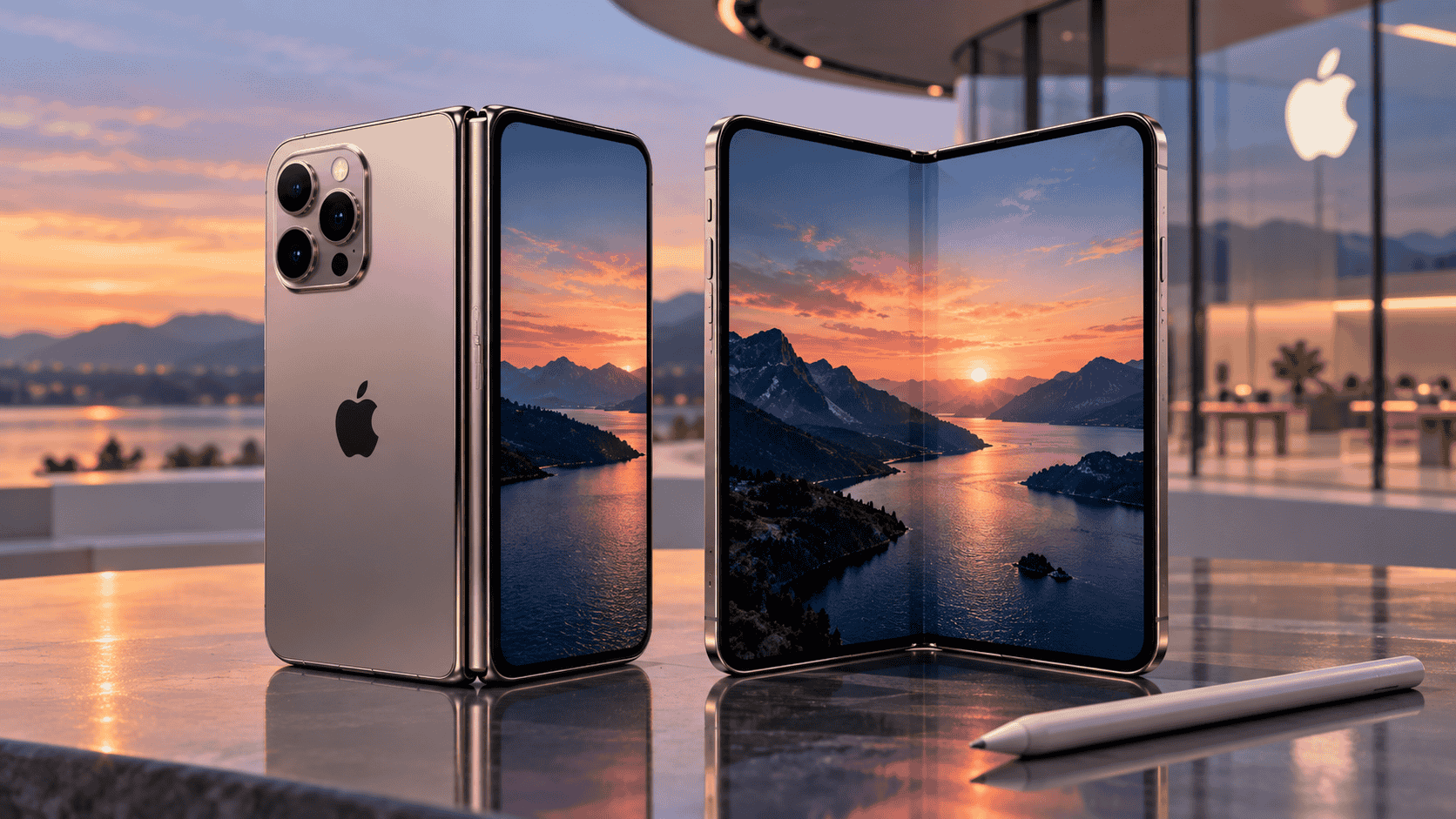
The rumored foldable iPhone — expected at Apple's September hardware event alongside the iPhone 18 Pro — will require software specifically optimized for its form factor. iOS 27 is reportedly laying that groundwork: adaptive layouts, multi-window behaviors, and interface elements that function differently in folded versus unfolded states.
Reports suggest iOS 27 may also include groundwork for a future iPhone Ultra — Apple's rumored top-tier flagship with a larger display and split-screen capabilities. Whether the hardware arrives in 2026 or 2027, the software foundation is being built now.
macOS 27: Tim Cook's Hardware Setup for Ternus
macOS 27 — which will ship alongside iOS 27 in September, following its WWDC preview — is being described as a consolidation release. The Liquid Glass design language introduced in iOS 26/macOS 26 remains; macOS 27 refines and stabilizes it rather than introducing a new visual direction.
More significantly, macOS 27 is reportedly laying software groundwork for touch-enabled Mac hardware — a form factor Apple has resisted for years while the iPad line struggled to capture professional workflows. Ternus, who oversaw the M-series chip transition, may see the touch-enabled Mac as the next hardware platform boundary to cross. macOS 27 is, in this reading, the operating system he needs before he can ship the hardware.
This is the Ternus transition made visible in software: Cook is building the stage; Ternus will perform on it.
The Other Platforms: watchOS, iPadOS, visionOS
All of Apple's operating systems will receive updates previewed at WWDC 2026 and shipping in September:
watchOS 27: New watch faces, including a variation of the Modular Ultra design. Health and fitness tracking refinements. Deeper Apple Intelligence integration for health contextual insights.
iPadOS 27: Closer alignment with iOS 27's AI features. Multi-window improvements that have been long-requested by iPad Pro users who want laptop-like productivity. Potential groundwork for the iPad's role in a touch-enabled Mac future.
visionOS 27: Apple Vision Pro software continues to mature. WWDC 2026 will give developers the frameworks needed to build spatial computing applications for the second generation of the headset, expected sometime in 2026-2027.
How to Watch WWDC 2026
The WWDC 2026 keynote streams for free, globally, on June 8 at 10:00 a.m. Pacific Time (1:00 p.m. Eastern / 6:00 p.m. BST). No registration. No subscription. Just:
Apple's official website (apple.com)
YouTube — Apple's official channel will stream live
Apple TV app — available on Apple TV, iPhone, iPad, Mac
Apple Developer app — for developers who want the Platforms State of the Union and technical sessions
The iOS 27 Beta 1 is expected to drop on the same day for registered Apple developers — meaning by the afternoon of June 8, the most dedicated Apple watchers will already be documenting every new feature in the beta.
What WWDC 2026 Actually Means
Step back from the features and the timelines and the codenames, and WWDC 2026 is about one thing: Can Apple still define the category it created?
The iPhone was the definitive consumer computing device of the 2010s. iOS was the operating system that set the standard. Siri, in 2011, was the voice assistant that made everyone want a voice assistant.
Then OpenAI released ChatGPT in November 2022. Then Google rebuilt its AI strategy around Gemini. Then Anthropic shipped Claude. Then Meta made its AI free for everyone. Then the AI assistant market became crowded, competitive, and fast-moving in a way that Apple's notoriously deliberate product development cycle struggled to match.
Apple's response has been to wait until it could do something right rather than doing something fast. WWDC 2024 brought Apple Intelligence — meaningful but partial. WWDC 2025 brought iOS 26 and Liquid Glass — a visual reinvention but not the AI reinvention users needed.
WWDC 2026 — Tim Cook's last keynote — is Apple's full answer. Siri rebuilt with Google's intelligence. A dedicated app. Multi-model choice. Systemwide AI that extends into Health, Photos, Safari, and Wallet. A foundation for touch-enabled Macs and foldable iPhones.
Apple didn't lose the AI race. It declined to enter until it could do so on its own terms.
On June 8, at 10:00 a.m. Pacific, we find out if the wait was worth it. Tim Cook will take the stage. It will be his last time. And the billion people who carry Apple devices will find out what their phones are about to become.
Related: Apple WWDC 2026, WWDC 2026 announcements, iOS 27, Siri overhaul 2026, Tim Cook last keynote, John Ternus Apple CEO, Apple Intelligence 2026, Siri Google Gemini, iOS 27 features, Apple foldable iPhone software, macOS 27, WWDC 2026 live stream, Siri Campos, Apple model choice AI, watchOS 27, Apple WWDC June 8, Tim Cook last keynote, Apple Intelligence 2026, iOS 27 features, Siri Google Gemini, Apple foldable iPhone software, John Ternus Apple CEO, macOS 27, WWDC 2026 date, Siri chatbot 2026, Apple AI 2026, Siri Campos, Apple model choice AI, watchOS 27, WWDC 2026 live stream


Discussion
Comments
Approved comments are published after moderation to keep discussion useful and spam-free.
No comments yet. Start the discussion below.