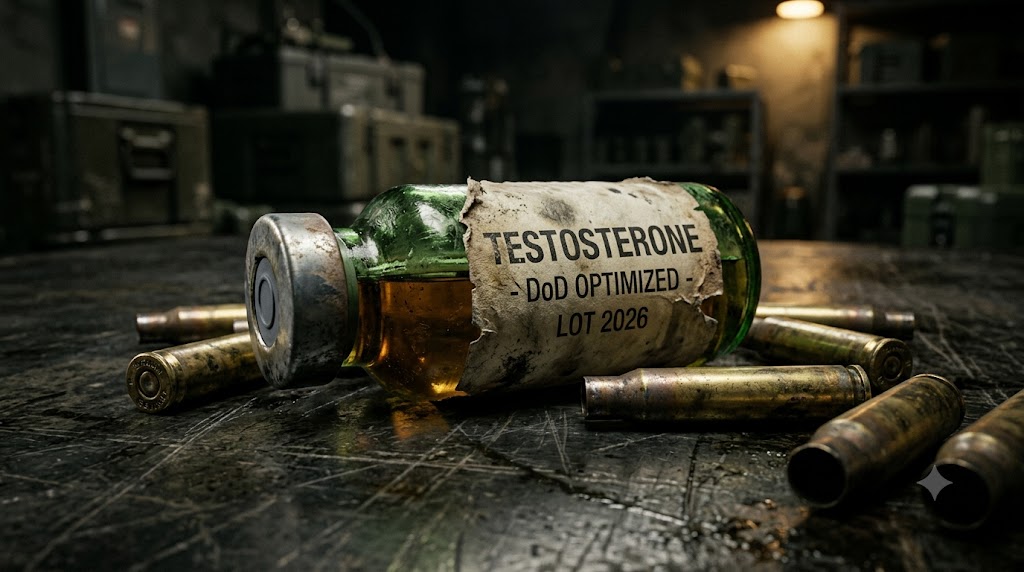
Hegseth wants a “High-T” military; doctors call it a clinical minefield
Mandatory hormone screening sounds like an easy fix for military
lethality—until you look at the endocrinology.
By Clara Marini | July 18, 2026
In a move that has sent shockwaves through both the Pentagon and the medical establishment, Defense Secretary Pete Hegseth has formally proposed a sweeping new readiness initiative: mandatory testosterone screening for all active-duty combat personnel.
The stated goal of the
"High-T Military" directive is to address what the defense leadership
characterizes as a quiet crisis of declining physical lethality, low stamina,
and hormonal deficiencies across the armed forces. Under the draft policy,
service members falling below a specific hormonal threshold would be
fast-tracked for medically supervised Testosterone Replacement Therapy (TRT) or
optimized physical regimens to return them to "peak biological combat
readiness."
To proponents of the
initiative, it represents a cutting-edge application of bio-hacking and
preventative medicine to optimize human capital. To the medical community,
however, it is an unprecedented logistical nightmare and a clinical minefield
that fundamentally misunderstands the basic laws of human endocrinology.
"You cannot treat
the United States Armed Forces like a professional bodybuilding roster,"
says Dr. Ethan Vance, an endocrinologist and former Army medical officer.
"Hormones are not a dial you can just turn up to make a soldier run faster
or shoot straighter without destabilizing the entire system."
As the Department of
Defense prepares to pilot the screening program at select installations,
clinicians, bioethicists, and military analysts are asking a fundamental
question: Is it actually possible—or safe—to build a engineered
"high-testosterone" military?
1. Background & Context: The Lethality Obsession
The push for hormonal
optimization comes at a time when the U.S. military is struggling with severe
recruitment shortfalls and shifting demands for modern warfare. Over the past
decade, internal military health reviews have pointed to rising rates of
obesity, sleep apnea, and metabolic syndrome among active-duty
troops—conditions strongly correlated with low testosterone levels.
At the same time, the
private sector's obsession with longevity, bio-hacking, and direct-to-consumer
online TRT clinics has bled heavily into military culture. For years, service
members have quietly utilized off-label hormone therapies to gain an edge
during demanding deployment cycles or to recover faster from grueling physical
training.
What was once an
underground locker-room trend is now being pushed as official Department of
Defense policy. Proponents argue that if the military can optimize a fighter
jet's avionics or an infantryman's exoskeleton, it should also optimize the
biological engine driving the soldier. The initiative marks the most aggressive
attempt in modern history to systematically intervene in the endocrine profiles
of healthy individuals for geopolitical advantage.
2. Technical Challenges: Endocrinology 101 vs. The Drill
Sergeant
The primary flaw in
the mandatory screening proposal, according to endocrinologists, is the wild,
volatile nature of human testosterone levels.
Unlike blood pressure
or cholesterol, testosterone is highly dynamic. A soldier's hormone levels
fluctuate dramatically based on a vast array of everyday variables.
·
Circadian Rhythms: Testosterone levels naturally peak between 6:00 AM and 8:00 AM
and drop significantly by the afternoon.
·
Sleep Deprivation: Just one week of sleeping less than five hours a night can drop
a healthy young man's testosterone levels by 10 to 15 percent.
·
Physical Stress: Prolonged, intense physical exertion—such as a multi-day field
exercise or Hell Week training—temporarily crashes testosterone production as
the body shifts resources to survival mode.
[Normal Circadian Curve]
AM Peak (High) ----> PM Trough (Low)
[Field Exercise Reality]
Sleep Deprived + High Cortisol = Artificially Low Baseline
"If you test an
entire battalion at 2:00 PM after they’ve been awake for 36 hours on a training
exercise, half of them will clinically present with severe hypogonadism,"
explains Dr. Vance. "If you then put those healthy men on synthetic
testosterone based on that single, flawed baseline, you permanently shut down
their body's natural hormone production. You are creating a medical dependency
where none existed."
Establishing a true,
clean baseline requires multiple blood draws taken early in the morning on
consecutive days under highly controlled conditions—a logistical impossibility
for a global military force of over 1.3 million active-duty personnel.
3. Expert Commentary: The Medical Backlash
The medical
community's response to the Hegseth proposal has been swift and overwhelmingly
critical. Within hours of the draft policy leak, major medical organizations
began organizing resistance.
In an emergency joint
statement, the Endocrine Society and the American Urological Association
strongly condemned the concept of mandatory screening for asymptomatic
individuals:
"Testosterone
therapy is a highly individualized medical intervention designed to treat
specific clinical pathologies, not an operational performance enhancer for
healthy populations. Mass screening of asymptomatic individuals violates
established clinical guidelines and poses an unacceptable risk to patient
safety."
Military ethicists are
equally alarmed. "The line between mandatory military readiness—like
getting an influenza vaccine—and mandatory permanent endocrine modification is
incredibly bright," says Sarah Jenkins, a bioethicist specializing in
defense research. "If a service member refuses TRT because they are
worried about long-term side effects like cardiovascular strain or infertility,
are they face a dishonorable discharge for failure to maintain readiness? That
is a terrifying precedent."
4. Scenario Analysis: How the "High-T" Mandate Plays
Out
To evaluate the true
feasibility and impact of the directive, we can look at three potential paths
this policy could take over the next several years.
The Optimistic Case (The "Precision Medicine" Success)
·
The Math:
The DoD abandons the blunt "everyone gets screened" approach.
Instead, they deploy highly advanced, longitudinal biomarker tracking using
wearable tech and targeted micro-fluidic testing.
·
The Outcome:
The program successfully identifies the small percentage of troops with
genuine, clinically diagnosed hypogonadism caused by traumatic brain injuries
(TBIs) or severe blast exposures. Medically sound, carefully managed TRT
resolves their chronic fatigue and muscle wasting, safely restoring them to
duty and actually extending their military careers.
The Neutral Case (The "Bureaucratic Loophole") — Most Likely
·
The Math:
Mass screening rolls out, but under heavy pressure from military medical staff,
the threshold for mandatory intervention is set so low that very few troops
actually qualify.
·
The Outcome:
The initiative becomes a highly expensive, largely performative paperwork
exercise. Service members learn how to temporarily manipulate their test timing
to avoid flags. A small percentage of borderline cases receive mild lifestyle
interventions, while the defense industrial complex spends millions on
laboratory screening contracts that yield negligible changes in overall combat
capability.
The Pessimistic Case (The "Polycythemia Epidemic")
·
The Math:
The Pentagon enforces a strict, high baseline threshold. Tens of thousands of
healthy but stressed service members are placed on mandatory synthetic
testosterone.
·
The Outcome:
Within two years, military hospitals are overwhelmed by predictable side
effects. Unmanaged TRT causes an epidemic of polycythemia (abnormally thick
blood), violently driving up the risk of strokes, blood clots, and heart
attacks during high-altitude deployments. The synthetic supply chain faces
vulnerabilities, and a sudden logistical interruption leaves thousands of
troops experiencing severe hormonal crashes while deployed forward, completely
crippling unit readiness.
5. Risks & Trade-offs: The Law of Unintended Consequences
The clinical risks of
unnecessary testosterone therapy are well-documented, but their operational
impact in a combat environment is particularly acute.
One of the most
immediate side effects of exogenous testosterone is the suppression of
spermatogenesis, frequently leading to temporary or permanent infertility. For
a young recruit base predominantly in their early twenties, mandatory or highly
pressured participation in such a program presents a massive reproductive
health liability.
Furthermore, synthetic
testosterone drastically increases red blood cell mass. While this initially
improves oxygen delivery to muscles, without careful monitoring and regular
blood donation (therapeutic phlebotomy), it leads to hyperviscosity syndrome.
Imagine a platoon of
infantrymen deployed to a hot, arid environment. They are already dehydrated,
which naturally thickens their blood. Add mass-administered testosterone to the
mix, and you have created a perfect storm for acute deep vein thrombosis (DVT)
and pulmonary embolisms on the battlefield.
Dehydration (Combat Environment) + Polycythemia (Exogenous TRT) =
Severe Thromboembolic Risk
6. Future Outlook: The Bottom Line
If the Pentagon wants
to improve the physical readiness, stamina, and mental resilience of its force,
endocrinologists argue there are far cheaper, completely safe, and highly
effective ways to do it without touching a single syringe of testosterone.
Study after study has
shown that providing soldiers with consistent, high-quality sleep architecture,
optimizing their nutritional intake, and reducing chronic operational stress
naturally normalizes and elevates endogenous testosterone levels.
The Bottom Line:
The "High-T
Military" proposal is an elegant, highly marketable solution to a deeply
complex problem. It treats the human body like a simple machine where you can
inject fuel to get more horsepower.
But the endocrine system is an intricate web of feedback loops. Intervening on a mass scale will almost certainly trigger the law of unintended consequences, exchanging minor readiness gains for massive long-term cardiovascular, reproductive, and logistical liabilities. If the Pentagon truly wants a stronger, faster, more lethal force, it doesn't need to change the hormones in its soldiers' blood—it needs to change the environment in which they live and train.





Discussion
Comments
Approved comments are published after moderation to keep discussion useful and spam-free.
No comments yet. Start the discussion below.