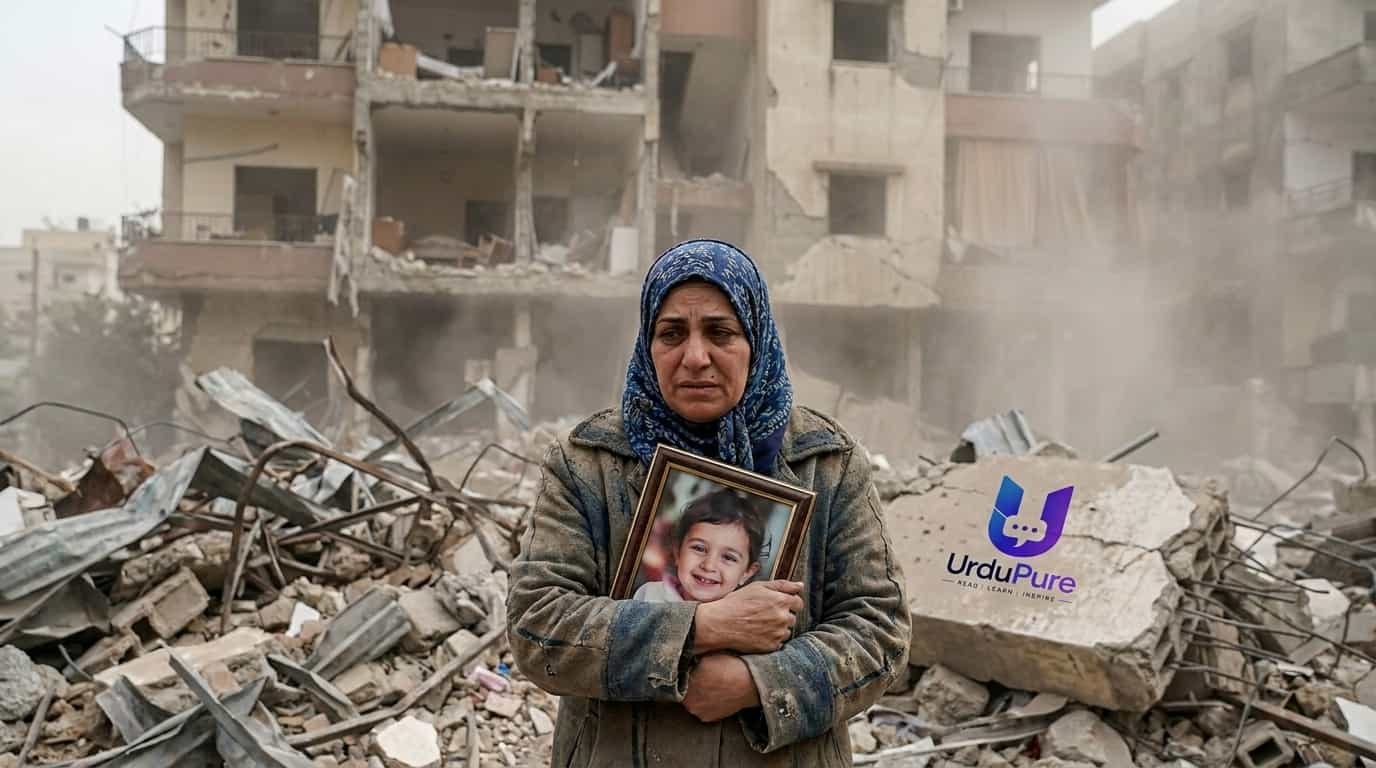
We Named the Operation. We Didn't Name the Children.
The United States military named its operation against Iran Operation Epic Fury.
It is a name that sounds designed for a press release — aggressive, cinematic, deliberately overwhelming. It tells you what the war was meant to project: power, scale, decisiveness. It tells you very little about what the war actually did to the people on the receiving end of that fury.
Saleh Ahmed was not mentioned in the operation's name. He was a Bangladeshi national living and working in Ajman, in the United Arab Emirates. He was a water delivery driver. On February 28, 2026 — the first day of Operation Epic Fury — he was struck and killed by debris from an Iranian missile intercepted over the UAE by air defense systems. He was making a delivery when he died. He was the first confirmed civilian casualty of the war.
He was not the last. He was not close to the last.
As of early May 2026, verified estimates compiled from government statements, health ministries, and human rights reports placed the civilian death toll at a minimum of 2,100 confirmed dead. The total casualty count — military and civilian combined — has exceeded 10,000, with 44,000+ wounded across all parties. The war has produced the largest single displacement of people in Lebanon since the 2006 conflict — more than 1.6 million people have been forced from their homes.
These are not abstract numbers. Every one of them was a person. This article is about some of them.
The Death Toll: What the Numbers Actually Show
The verified casualty data from the 2026 Iran war, as of Day 67 (May 5, 2026), sourced from CENTCOM, the IDF, the Lebanese Health Ministry, Iran's Foundation of Martyrs, and Human Rights Activists in Iran (HRANA):
Iran: Iran's Foundation of Martyrs confirmed 3,468 killed as of April 19 — the official Iranian government figure, which Iranian officials acknowledge is likely an undercount of military casualties due to restricted access and the sensitivity of military death reporting. HRANA, a U.S.-based human rights NGO, independently documented 3,636+ deaths including 1,701 confirmed civilians, 1,221 military personnel, and 714 whose status could not be confirmed. The United States and Israel have cited higher estimates for total Iranian deaths, suggesting the true toll may significantly exceed the official Iranian count.
Lebanon: The Lebanese Health Ministry has confirmed 2,586+ killed and more than 8,000 wounded. Of those killed, the overwhelming majority were civilians in communities in southern Lebanon struck during Israeli operations against Hezbollah infrastructure. Among them is Hassan Badawi.
United States: At least 13 U.S. service members were killed and 381 wounded in the 40 days following the start of hostilities. Their names are on a list maintained by the U.S. Department of Defense and linked to from the Pentagon's official website. Their sacrifice is real and their deaths deserved to be mourned. They are also not the only dead who deserve accounting.
Other countries: Iraq: 117+ killed. Israel: 47 killed. United Arab Emirates: 13. Kuwait: 10. Bahrain: 3. Saudi Arabia: 3. 23 countries in total have sustained fatalities. The war's geographic reach far exceeds its billing as a US-Israel-Iran conflict.
Day One: Saleh Ahmed's Last Delivery
Among the majority of civilian deaths across the Gulf during the war were migrant workers. Saleh Ahmed, a Bangladeshi national, was killed in Ajman, UAE, on the first day of war by debris that fell from an intercepted Iranian missile, according to the Bangladeshi Foreign Ministry. He was delivering water when he was struck.
Saleh Ahmed almost certainly did not understand what was happening when the air defense systems activated above him. He was working. He was, by all available evidence, doing what migrant workers in the Gulf do every day — performing essential labor in a country that needed him to deliver water, even on the morning the region erupted into war.
Just one month into the war, Human Rights Watch warned that migrant workers in Gulf countries face "additional risks" to their lives because of the conflict. Drivers, delivery workers, security guards, chefs, and cleaners were required to continue working despite not being able to afford basic necessities and amid heightened risks.
This is the war's most invisible population of casualties: the estimated 30 million migrant workers living across Gulf Cooperation Council countries, many of them from South Asia and sub-Saharan Africa, who work under kafala sponsorship systems that tie their legal status to their employer. They could not simply leave when the missiles began to fly. Their visa status, their livelihoods, and in many cases their debt obligations — many migrant workers borrow money to pay the recruitment fees that got them their Gulf jobs — kept them in place as the war erupted around them.
The majority of civilian deaths in the Gulf have been migrant workers. The majority of the world's press coverage of the war has not mentioned them.
The Girls' School: The War's Most Documented Atrocity
On a date in the early weeks of Operation Epic Fury, a U.S. airstrike struck a girls' elementary school in Iran.
Congress members Sara Jacobs, Ilhan Omar, and Jason Crow wrote to Secretary of Defense Pete Hegseth on March 12, 2026, expressing alarm about the strike: "We are particularly disturbed by reports of what appears to be the deadliest attack on civilians thus far: a girls' elementary school, where at least 175 civilians, many of them children, were reported killed and 100 children and staff wounded."
The letter noted that the New York Times had reported that a U.S. preliminary investigation found that the United States is responsible for this strike due to outdated targeting data.
Let that finding be stated plainly: The United States military struck a girls' elementary school in Iran. It killed at least 175 people — the majority of them children. And the preliminary finding of U.S. investigators is that it happened because the targeting data was outdated.
The letter to Secretary Hegseth noted that with "reportedly over 1,000 total civilian deaths already and a lack of clarity about the anticipated scale and duration of operations," Congress demanded clear answers on how the Department plans to investigate these reports. As of this writing, no public findings from a formal investigation have been released.
The 175 children killed in that school have not been named in any major U.S. news outlet. The school itself has not been named in U.S. government communications. Operation Epic Fury has been.
Hassan Badawi: The Red Cross Paramedic in the Ambulance
Hassan Badawi, a Lebanese Red Cross paramedic, was killed in an Israeli strike on Sunday, April 12, 2026, in the town of Beit Yahoun in southern Lebanon. Lebanon's health ministry said at least six people were killed on April 12 in the south, including a Red Cross paramedic, after "the Israeli enemy directly targeted a Lebanese Red Cross ambulance team."
Colleagues of Hassan Badawi, who was killed the previous day in an Israeli airstrike, mourned as the family received condolences at their home in Zaldeh, in the Bchamoun area south of Beirut.
Hassan Badawi was wearing a Red Cross vest. He was in a Red Cross ambulance. He was doing the one thing that international humanitarian law places beyond the reach of military targeting: providing emergency medical care in a conflict zone. The protection of medical personnel and medical vehicles is not a preference under the Geneva Conventions — it is a legal obligation binding on all parties to any armed conflict.
His killing was not an isolated incident. According to the Iranian Red Crescent, 307 health, medical, and emergency care facilities have been damaged as of April 3, 2026. Over three hundred medical facilities. In a country whose healthcare system was already under catastrophic strain: the system was reeling from the January 2026 crackdown, when between late December 2025 and late January 2026, anti-government protests had spread to more than 200 cities across Iran following the collapse of the rial and record inflation, with the ensuing crackdown resulting in massacres that left thousands of protesters dead.
When the first missiles struck on February 28, Iran's medical infrastructure was already overwhelmed by protest crackdown casualties. The strikes then damaged 307 more medical facilities. On the second day of strikes, an in vitro fertilization clinic at Gandhi Hospital was hit and seriously damaged, severely injuring at least several medical workers.
These are not collateral statistics. They are the functional destruction of the system designed to keep injured civilians alive.
Lebanon: 1.6 Million Displaced
The 2026 Iran war has not been confined to Iran. Its most severe humanitarian consequences outside of Iran itself have unfolded in Lebanon, where Israeli military operations against Hezbollah targets have displaced more than 1.6 million people — rendering the conflict one of the largest displacement crises in the Middle East since the Syrian civil war.
Lebanon entered this crisis from a position of extreme fragility. The country had been managing the fallout from the 2020 Beirut port explosion, a 2019-2024 financial collapse that destroyed much of the Lebanese middle class, and an ongoing political dysfunction that has kept the country without a functioning government for extended periods. The healthcare system, already strained by years of economic crisis and the 2020 explosion's destruction of key medical infrastructure, has been further overwhelmed.
The 1.6 million displaced include families from villages across southern Lebanon, where Israeli strikes have been concentrated. Many have relocated to Beirut — itself a city straining to absorb internal refugees — or have attempted to cross into Syria, where conditions are scarcely better.
For the displaced Lebanese, the question is not whether they support Hezbollah or Israel or the United States. The question is where they will sleep tonight, whether their children's schools still stand, whether the medication their elderly parents need can still be obtained. These are the human coordinates of the war that the military briefings do not capture.
The Congressional Accounting: What the Letter to Hegseth Demanded
The March 12, 2026 letter from Representatives Sara Jacobs, Ilhan Omar, and Jason Crow to Secretary of Defense Pete Hegseth represents the most formal U.S. government-level accounting for civilian casualties attempted so far.
The letter noted that longstanding U.S. military policy and the law of armed conflict require investigation of civilian harm, and expressed deep concern about reports of U.S. and Israeli strikes that had struck or impacted "numerous civilian sites — including schools, hospitals, gymnasiums, public gathering spaces, and a UNESCO heritage site."
The members demanded specific answers: What investigations had been launched? What accountability mechanisms were in place? What was the anticipated scale and duration of operations that would produce further civilian casualties?
No public response meeting the letter's specificity has been issued by the Department of Defense as of this writing. The letter itself — a document of congressional oversight — was made publicly available on Representative Sara Jacobs' official House website. Its existence, and the silence that followed it, constitute a record.
This is how accountability works — or fails to work — in real time. Elected representatives ask questions. Departments respond or do not respond. Voters note the difference.
The Environmental Cost: What the Strikes Left in the Ground
The human casualties of the 2026 Iran war are measurable, even if imperfectly. The environmental cost is harder to quantify — and may prove to be longer-lasting.
The Center for American Progress, in its April 20, 2026 analysis of the human and environmental costs of the war, documented that civilians have suffered devastating health and environmental costs from the U.S. and Israeli war with Iran, from mass displacement and polluted air and water to long-term health risks for future generations.
When nuclear facilities are struck — as Natanz, Fordow, and Isfahan were struck on February 28 — the environmental consequences include potential release of radioactive materials into soil, groundwater, and air. The IAEA and independent environmental organizations have called for independent assessment of contamination levels at and around the struck sites. As of this writing, independent access to those sites for environmental assessment has been extremely limited.
The strikes on oil refineries in Saudi Arabia — as part of Iranian retaliation — similarly produced fires and chemical releases whose long-term environmental health impact for surrounding communities has not been formally studied.
This is the war's third timeline: not the diplomatic timeline of ceasefires and negotiations, not the military timeline of strikes and counter-strikes, but the environmental timeline — the decades over which contaminated soil and groundwater will affect the health of communities that had nothing to do with starting or choosing this conflict.
What International Humanitarian Law Requires — And What Has Happened
The 2026 Iran war has tested the limits of international humanitarian law (IHL) in ways that demand explicit statement rather than diplomatic euphemism.
The principle of distinction requires all parties to distinguish at all times between combatants and civilians, and to direct attacks only against military objectives. The strike on a girls' elementary school — attributed by a U.S. preliminary investigation to outdated targeting data — raises serious questions about whether this principle was adequately upheld.
The principle of proportionality prohibits attacks in which the expected civilian casualties would be excessive in relation to the anticipated military advantage. An assessment of whether U.S. and Israeli strikes have met this standard has not been conducted publicly by any independent international body.
The protection of medical personnel is absolute under the Geneva Conventions. The killing of Hassan Badawi in a marked Red Cross ambulance is not a gray area. It is a violation of one of the most fundamental rules of armed conflict, and it requires accountability regardless of which party carried out the strike.
The International Criminal Court and UN Special Rapporteurs have jurisdiction to investigate potential violations. Whether investigations with real accountability consequences follow from the evidence already documented is a test of the international legal system that will be watched by every conflict in the decades to come.
What We Owe the People We Don't Name
Operation Epic Fury has a name. It has press briefings and CENTCOM updates and diplomatic communiqués. It has been covered by every major media organization in the world through the lens of strategy, geopolitics, nuclear proliferation, and global oil markets.
Saleh Ahmed, the Bangladeshi water delivery driver, died making a delivery on Day 1 and was not mentioned in any of those press briefings.
The 175 children at the girls' elementary school died because the targeting data was outdated and no one named them in the statement that acknowledged the mistake.
Hassan Badawi died inside a marked Red Cross ambulance and his name was reported in AFP's wire service and the Lebanese press and was not mentioned in any statement from the parties responsible for his death.
The 1.6 million displaced Lebanese are sleeping somewhere tonight that is not home.
The 307 damaged medical facilities are not treating patients.
These are the costs of Operation Epic Fury that are not in the operation's name. They are in the human record. And the human record, unlike military briefings, does not have a version that makes these facts comfortable.
The missiles struck. The fury was epic. The people it fell on had names.
Iran war civilians 2026, Iran war death toll, civilian casualties Iran 2026, Operation Epic Fury civilian deaths, Iran war children killed, Saleh Ahmed Bangladesh Iran war, Hassan Badawi Red Cross, Lebanon displacement 2026, migrant workers Iran war, girls school Iran airstrike, HRANA Iran casualties, congressional letter Hegseth civilian casualties, Iran war human cost, Operation Epic Fury civilian deaths, Iran war children killed, Hassan Badawi Red Cross paramedic Iran war, Saleh Ahmed Bangladesh Iran war, girls school Iran airstrike, Lebanon displacement 2026, Iran war migrant workers, US civilian casualties Iran, HRANA casualties Iran


Discussion
Comments
Approved comments are published after moderation to keep discussion useful and spam-free.
No comments yet. Start the discussion below.