A series of drone attacks targeting Moscow's largest oil refinery has drawn international attention to the growing reach of Ukraine's long-range strike capabilities. While Ukrainian officials described the refinery as a legitimate military-related target, Russian authorities reported attacks on the capital region and activated air defenses. The incidents have raised broader questions about the resilience of Russia's critical energy infrastructure, the effectiveness of modern drone warfare, and the economic implications of repeated strikes deep inside Russian territory. As investigations continue, analysts are examining whether these attacks represent isolated operations or part of a sustained campaign against Russia's logistical backbone. The uploaded source script frames these events as part of a broader pattern of strikes on energy and transport infrastructure.
Drone attacks reportedly struck Moscow's largest oil refinery.
Ukrainian officials described the facility as strategically important to Russia's fuel supply.
Russian authorities activated air defenses in response to the attacks.
Energy infrastructure has become an increasingly significant target during the conflict.
Analysts believe repeated strikes could affect logistics, fuel production, and public perception.
The explosion lasted only a few seconds.
The questions it raised may take years to answer.
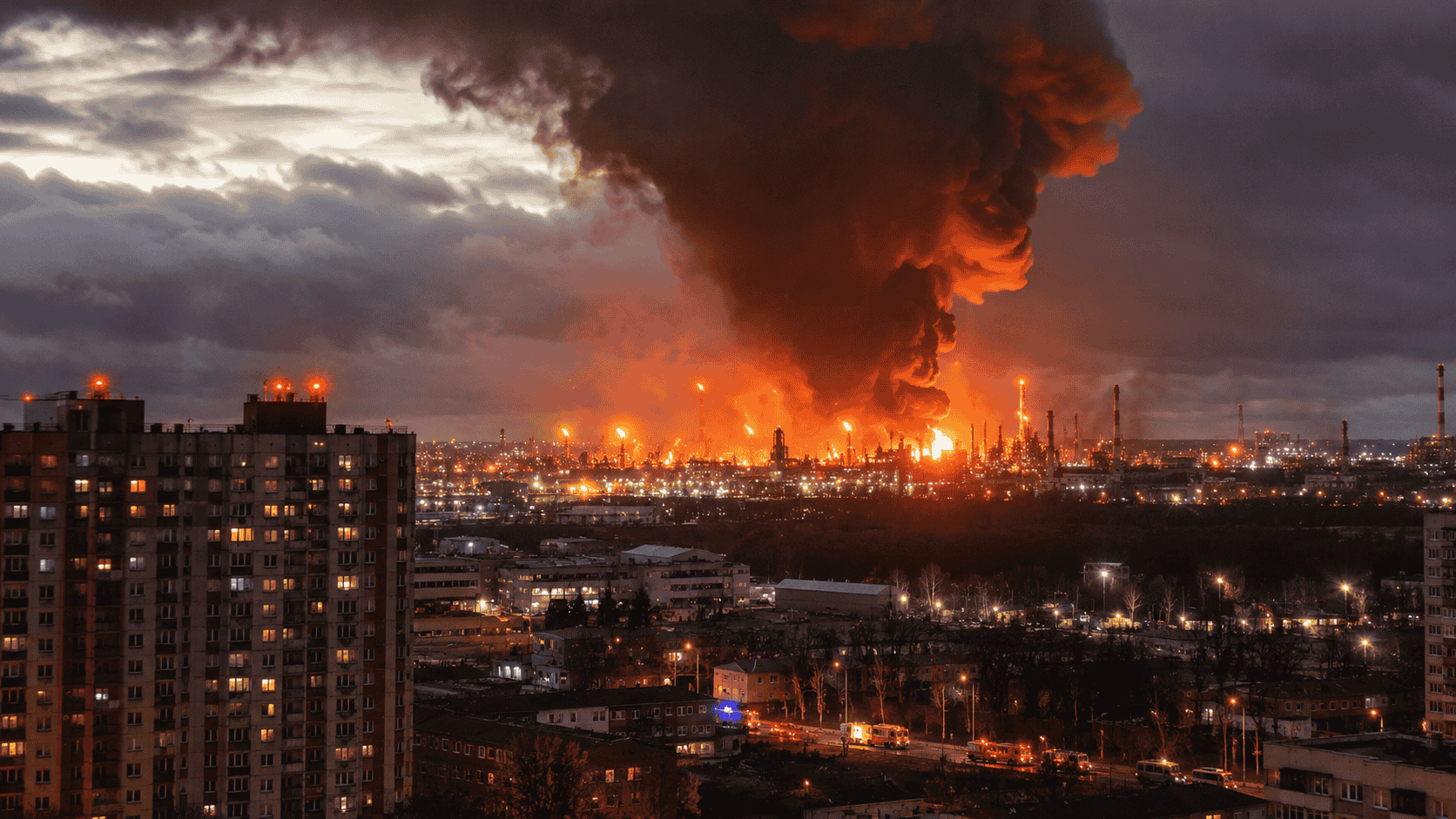
As flames climbed above one of Moscow's most important oil refineries, millions watched videos circulating across social media showing an industrial skyline lit orange against the night.
For many Russians, the images were startling.
For military planners, they represented something far more significant.
The war that had largely remained hundreds of kilometers away suddenly appeared much closer to the country's political and economic center.
Whether the physical damage proves extensive or limited, the psychological impact was immediate.
For much of the conflict, Russia's capital has remained physically distant from the front lines.
While occasional drone incursions have reached the Moscow region, attacks on strategically significant industrial facilities continue to attract exceptional attention because they touch the systems that sustain both civilian life and military operations.
According to Ukrainian officials, the latest operation targeted Moscow's largest oil refinery—an installation that processes millions of tons of crude oil annually and plays a major role in supplying fuel to the capital region. Russian authorities confirmed drone activity in the region while emergency services responded to fires, though assessments of the full extent of the damage have varied.
Beyond the flames lies a larger story.
This is not simply about one refinery.
It is about how modern warfare increasingly targets logistics, energy infrastructure, industrial capacity, and public confidence rather than traditional battlefields alone.
What makes this incident particularly significant is not merely the reported strike itself.
It is where it happened.
Modern conflicts increasingly revolve around disrupting an opponent's ability to sustain military operations. Fuel refineries occupy a central place in that equation because they support transportation networks, aviation fuel supplies, industrial production, and broader economic activity.
Whether viewed through a military or economic lens, attacks on energy infrastructure often generate consequences that extend well beyond the immediate blast zone.
Why This Refinery Matters
Not every refinery carries the same strategic weight.
Large metropolitan regions depend upon a continuous supply of refined petroleum products for transportation, aviation, emergency services, industry, and residential energy needs.
According to the uploaded source, Ukrainian officials described the refinery as supplying a substantial share of Moscow's fuel market and nearby airports, portraying it as a key component of Russia's logistical infrastructure. These characterizations reflect Ukraine's stated assessment and should be understood in that context.
Military analysts have long noted that modern energy infrastructure represents one of the most valuable strategic targets in prolonged conflicts.
Destroying fuel production does not merely interrupt military operations.
It can influence transportation costs, industrial output, supply chains, and public morale simultaneously.
The Bigger Story Begins Here
Viewed in isolation, a refinery fire appears to be an industrial incident.
Viewed alongside months of reported strikes on fuel depots, logistics hubs, bridges, and transportation infrastructure, it becomes part of a broader strategic campaign.
Whether this campaign succeeds will depend not only on the accuracy of future strikes but also on how effectively Russia adapts its air defenses, disperses critical infrastructure, and repairs damaged facilities.
And that is where the story becomes far more complex.
How Ukraine's Drone Campaign Reached Moscow
Only a few years ago, the idea of regular drone attacks reaching the outskirts of Moscow would have seemed improbable.
Today, they are no longer isolated events.
Instead, they have become part of an evolving battlefield where relatively inexpensive unmanned aircraft are increasingly used to threaten infrastructure located hundreds of kilometers from the front line.
Military analysts describe this shift as one of the defining characteristics of modern warfare.
Rather than attempting to seize territory through conventional offensives alone, both sides have expanded efforts to disrupt logistics, industrial production, transportation, and energy networks far behind enemy lines.
The reported refinery strike reflects that broader evolution. Ukrainian officials have portrayed it as part of a campaign targeting infrastructure that supports Russia's military operations, while Russian authorities have emphasized efforts to intercept incoming drones and limit damage.
Energy Has Become the New Battlefield
Throughout military history, armies have depended on fuel.
Modern militaries require it at an unprecedented scale.
Jet aircraft.
Military trucks.
Armored vehicles.
Naval vessels.
Generators.
Rail transport.
Industrial production.
Without refined petroleum products, military operations quickly become more difficult to sustain.
That explains why oil refineries, storage depots, pipelines, and fuel terminals have become increasingly important targets during the conflict.
Rather than focusing exclusively on frontline positions, long-range strikes seek to complicate the logistics that keep military forces supplied.
This strategy aims not only to destroy physical infrastructure but also to increase repair costs, disrupt production schedules, and force additional resources into protecting critical facilities.
Why Moscow's Energy Infrastructure Matters
The Moscow metropolitan region represents one of Russia's largest concentrations of population, government institutions, transportation networks, and industrial activity.
Fuel refined in and around the capital supports:
Civilian transportation
Emergency services
Commercial aviation
Freight movement
Industrial production
Military logistics
According to Ukraine's Security Service (SBU), the refinery targeted in the reported strike plays an important role in supplying fuel to Moscow and surrounding areas. Those assessments reflect Ukrainian official statements; independent verification of the precise operational impact remains limited while investigations continue.
Even temporary disruptions at major facilities can require authorities to adjust fuel distribution, increase imports from other refineries, or accelerate repairs.
A Campaign Rather Than a Single Strike
The reported attack on Moscow's refinery did not occur in isolation.
The uploaded source describes additional reported strikes on fuel storage sites, transport infrastructure, and bridges connected to military logistics. Ukrainian officials have presented these operations as coordinated efforts designed to complicate the movement of supplies rather than simply destroy individual targets.
Military planners often view infrastructure as an interconnected network.
A refinery produces fuel.
Storage depots distribute it.
Railways move it.
Bridges carry it.
Highways deliver it.
Disrupting several parts of that chain simultaneously may have a greater operational effect than damaging a single facility.
Russia's Air Defenses Under Growing Pressure
One of the most closely watched aspects of these attacks is not only whether drones reach their targets, but how Russia's air-defense network responds.
Modern air-defense systems must identify incoming threats within seconds.
They must distinguish drones from civilian aircraft.
They must coordinate radar, command centers, interceptor missiles, and electronic warfare systems.
When dozens of drones approach from different directions, defending every possible target becomes increasingly challenging.
The uploaded script also references circulating videos and reports alleging that some defensive interceptions may have resulted in damage within the Moscow region. These claims have circulated widely online, but the precise causes of specific impacts remain the subject of competing accounts and have not been conclusively established in every case.
That uncertainty illustrates another feature of modern conflict:
Information itself becomes part of the battlefield.
The Economics of Infrastructure Warfare
Wars are fought with weapons.
They are sustained by economies.
Every refinery shutdown, damaged storage facility, or interrupted transport corridor carries financial consequences beyond immediate repair costs.
Potential impacts can include:
Reduced refining capacity
Higher transportation expenses
Increased insurance costs
More expensive security measures
Temporary fuel shortages
Industrial disruptions
The uploaded material cites analyses suggesting that repeated attacks on refining infrastructure have affected Russia's energy sector and export performance. Such broader economic assessments vary among analysts and depend on multiple factors, including global oil prices, sanctions, production levels, and infrastructure damage.
For governments, protecting energy infrastructure therefore becomes both a military and an economic priority.
The Rise of Long-Range Drones
Perhaps the most important lesson from these attacks is technological rather than geographical.
Only a decade ago, conducting precision strikes deep inside another country's territory generally required expensive aircraft or cruise missiles.
Today, relatively low-cost drones have altered that equation.
Modern long-range drones can:
Travel hundreds of kilometers
Navigate autonomously
Carry explosive payloads
Strike infrastructure
Force defenders to expend costly interceptor missiles
This changing balance has encouraged militaries around the world to invest heavily in both offensive drone programs and layered air-defense systems.
The Russia–Ukraine conflict has become one of the clearest demonstrations of this transformation.
Expert Analysis: The Psychological Battlefield
Beyond physical destruction lies another objective.
Psychology.
When attacks occur close to political or economic centers, they influence public perception in ways that frontline battles often do not.
Images of smoke rising above familiar skylines spread rapidly through television broadcasts and social media.
For residents, they may create a heightened awareness that the conflict is no longer geographically distant.
For governments, they increase pressure to demonstrate effective protection of critical infrastructure.
For military planners, they signal that strategic depth is becoming increasingly difficult to guarantee in the age of long-range drones.
Why the World Is Paying Attention
The reported Moscow refinery strike has significance beyond Russia and Ukraine.
Defense ministries across Europe, Asia, and North America are studying similar attacks to understand how future conflicts may unfold.
Questions now being examined include:
Can critical infrastructure withstand repeated drone attacks?
How should cities defend against low-cost unmanned aircraft?
Are traditional air-defense systems sufficient?
How vulnerable are national energy networks?
What lessons apply to other countries?
These are no longer theoretical debates.
They are practical questions shaping military planning around the world.
Historical Context: Why Energy Infrastructure Has Always Been a Prime Target
Wars are rarely won by destroying armies alone.
They are won by weakening an opponent's ability to keep those armies supplied.
Throughout history, military planners have understood that factories, railways, fuel depots, ports, bridges, and refineries are often just as important as tanks or fighter jets.
During the Second World War, Allied bombing campaigns focused heavily on Germany's synthetic fuel industry. Historians widely agree that reducing fuel production severely constrained the mobility of German armored units and aircraft during the later stages of the war.
More recently, conflicts in the Middle East, the Balkans, and the Gulf have demonstrated that attacks on oil facilities can generate military, economic, and psychological consequences simultaneously.
The reported strikes on Russian energy infrastructure fit within this long-established military principle: disrupting logistics to reduce an adversary's operational flexibility.
Why Oil Refineries Matter More Than People Realize
When most people think about an oil refinery, they imagine gasoline.
Military planners see something much larger.
A refinery supports an entire ecosystem.
It produces fuel for:
Fighter aircraft
Military helicopters
Naval vessels
Trucks
Armored vehicles
Emergency services
Civilian transportation
Airports
Industrial manufacturing
Damage to a major refinery does not automatically halt these activities, as countries typically maintain reserves and alternative supply routes. However, repeated attacks can increase logistical complexity, raise operating costs, and require additional security and repair resources.
Can Russia Protect Every Strategic Target?
This question has become increasingly relevant as long-range drones have expanded the geographical reach of the conflict.
Russia possesses one of the world's most extensive integrated air-defense networks.
Yet no country can defend every refinery, bridge, storage depot, power station, railway junction, military airfield, and industrial complex simultaneously.
Modern defense planners face a difficult balancing act.
Protecting one facility often means accepting greater risk elsewhere.
As inexpensive drones become more capable, they force defenders to allocate expensive interceptor missiles, radar coverage, and personnel across a growing number of potential targets.
Military analysts increasingly describe this as a challenge of cost asymmetry—where relatively low-cost offensive systems compel much higher defensive expenditures.
Information Warfare Runs Alongside Physical Warfare
Modern conflicts are fought in two parallel arenas.
The first is physical.
The second is informational.
Within minutes of reported attacks, videos, photographs, satellite imagery, and eyewitness accounts circulate across social media platforms.
Governments release official statements.
Military organizations publish operational claims.
Independent analysts attempt to verify imagery using geolocation and satellite data.
At the same time, misinformation and unverified claims often spread just as rapidly.
For readers, separating confirmed facts from competing narratives becomes increasingly important.
Responsible reporting therefore distinguishes between:
Official Ukrainian statements
Official Russian statements
Independently verified evidence
Expert analysis
Information that remains unconfirmed
That distinction is essential in fast-moving conflicts where investigations may take days or weeks to establish a clearer picture.
What Happens Next?
Several developments are likely to follow the reported refinery strike.
Investigation
Russian authorities are expected to assess the extent of structural damage, operational disruption, and any impact on fuel production.
Repairs
Energy companies typically prioritize restoring critical processing units as quickly as possible, although repair timelines vary depending on the damage sustained.
Enhanced Security
Additional air-defense assets, electronic warfare systems, or physical protective measures may be deployed around strategically important infrastructure.
Military Adaptation
Both Russia and Ukraine are likely to continue adjusting tactics in response to evolving drone technologies and defensive measures.
Modern conflicts rarely remain static.
Each side continually adapts based on operational experience.
Why This Matters
It is tempting to view the reported Moscow refinery attack as simply another headline in a conflict that has produced countless dramatic developments.
That would overlook its broader significance.
The strike illustrates how warfare is changing.
Instead of concentrating solely on trenches and armored offensives, modern conflicts increasingly focus on:
Supply chains
Energy production
Transportation networks
Industrial capacity
Information dominance
Public confidence
Whether measured in military or economic terms, infrastructure has become a central battlefield.
Future Outlook
The strategic contest between offensive drone capabilities and defensive air-defense systems is unlikely to end soon.
Several trends are expected to shape future developments:
Increased Drone Production
Countries around the world continue investing heavily in long-range unmanned systems because they offer relatively low-cost methods of reaching high-value targets.
Stronger Infrastructure Protection
Governments are expected to strengthen defenses around energy facilities, transportation hubs, and industrial complexes through layered security measures.
Continued Technological Competition
Artificial intelligence, autonomous navigation, electronic warfare, and counter-drone technologies are rapidly becoming central elements of national defense planning.
Greater Economic Focus
Future military campaigns may increasingly target economic resilience alongside traditional battlefield objectives.
Frequently Asked Questions
Why was the Moscow oil refinery reportedly targeted?
Ukrainian officials have described energy infrastructure as supporting Russia's military logistics and therefore as a legitimate strategic objective. Russian authorities have emphasized defensive measures and emergency response following reported attacks.
Has the full extent of the damage been confirmed?
No. While fires and emergency responses were reported, complete assessments of operational impact require detailed inspections and official investigations.
Why are drones becoming so important in modern warfare?
Long-range drones can strike targets far from the front line at relatively low cost, forcing defenders to protect a wide range of critical infrastructure.
Do refinery attacks immediately create fuel shortages?
Not necessarily. Large countries generally maintain reserves and alternative distribution systems. However, repeated disruptions can increase logistical pressure and repair costs.
Are energy facilities common military targets?
Yes. Throughout modern military history, fuel production and transportation infrastructure have frequently been considered strategically significant because they support both military and civilian operations.
How do analysts verify attacks?
Analysts often combine satellite imagery, geolocation, official statements, eyewitness videos, and open-source intelligence techniques to assess reported events.
Moscow Oil Refinery Attack, Moscow, Oil Refinery, Ukraine, Russia, Drone Attack, Energy Infrastructure, Military Analysis, Strategic Warfare, Russian Air Defense, Fuel Supply




Discussion
Comments
Approved comments are published after moderation to keep discussion useful and spam-free.
No comments yet. Start the discussion below.