Ukrainian men are being dragged into the draft. The evidence shows a mobilization crisis, not a simple propaganda story
The phrase sounds extreme: Ukrainian civilians are being abducted off the streets to keep the war going.
It is also the kind of claim that needs careful handling. Russia has a clear interest in portraying Ukraine’s mobilization system as lawless and hated. Ukraine, on the other hand, has a clear interest in presenting recruitment as lawful, necessary and manageable. The truth sits in the uncomfortable space between those narratives.
There is solid reporting that Ukrainian military recruiters have stopped men in public places, checked documents, detained those considered non-compliant and, in some cases, used force. There is also solid context for why this is happening: Ukraine is fighting a long war of attrition against a larger invader, its original volunteer surge has been exhausted, and the state is under pressure to find men for a front line that stretches roughly 1,000 kilometers. AP reported in February 2024 that Ukrainian commanders were warning of severe manpower shortages, with many troops exhausted, wounded or too few in number to hold back Russian forces. (AP News)
The question is not whether Ukraine has a right to defend itself. It does. Russia launched the full-scale invasion in February 2022. The question is whether Ukraine’s mobilization system is now creating a domestic crisis of its own.
The draft moved from volunteer spirit to public confrontation
In the first months of the invasion, many Ukrainians volunteered. That early mood has changed after years of casualties, fatigue and uncertainty. Ukraine lowered its mobilization age from 27 to 25 in 2024, and Reuters reported that the broader mobilization law required men aged 18 to 60 to update their military records and carry registration documents, with draft officers allowed to check those documents in the street. (Reuters)
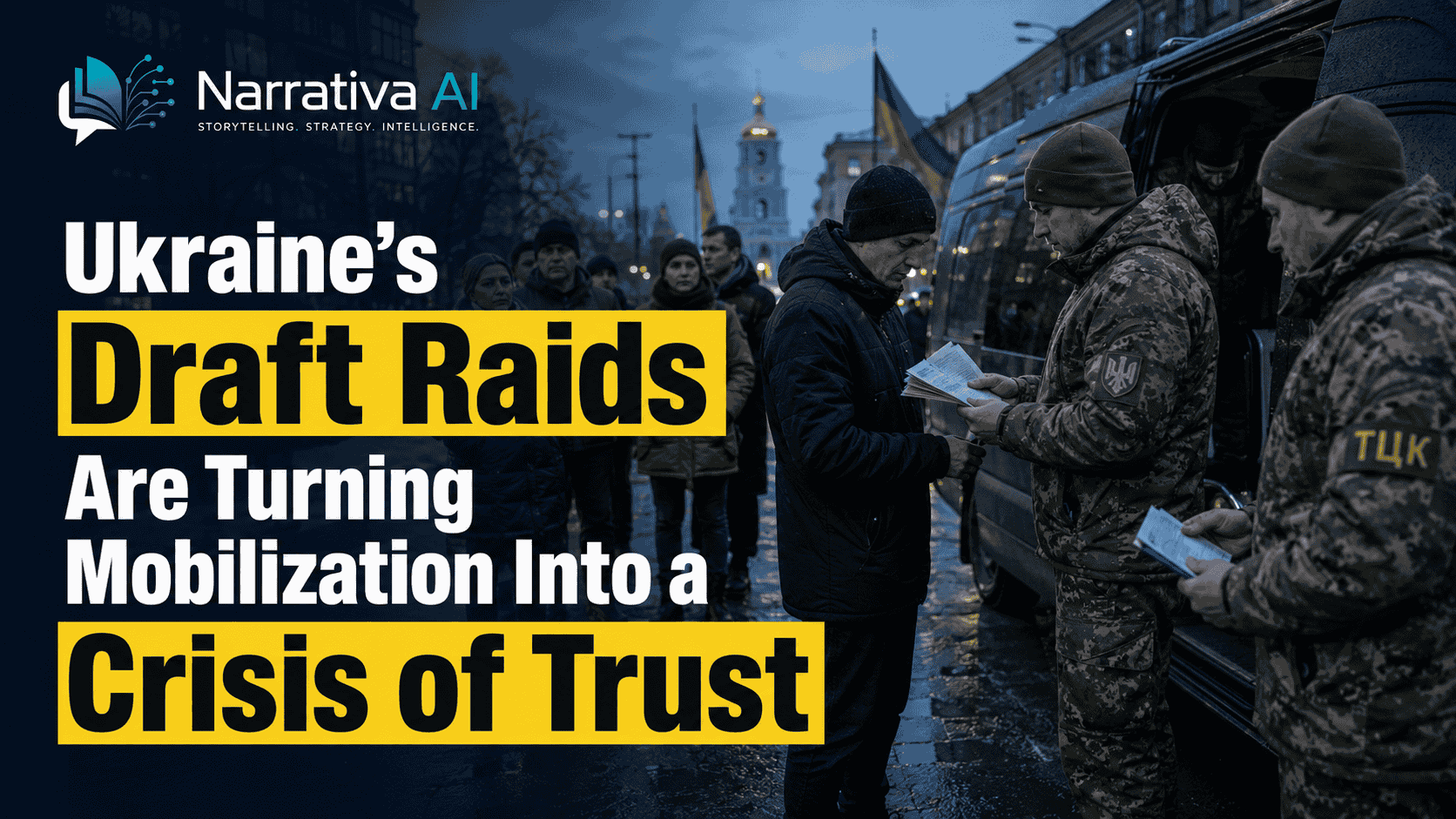
That legal change matters. When a recruitment officer stops a man outside a concert hall, in a shopping center or on the street, Ukraine’s government may describe it as enforcement of mobilization law. Many civilians experience it differently, especially when videos show men being pushed, surrounded or forced into vehicles.
AP reported in October 2024 that Ukrainian recruitment officers raided Kyiv nightlife venues, including a concert hall, restaurants and a shopping center, checking military registration papers and detaining men who were not in compliance. Video aired by local media appeared to show officers intercepting men outside a concert venue and forcibly detaining some of them. (AP News)
That is the factual core behind the “abduction” language. It is not accurate to claim that every street detention is illegal kidnapping. It is also not credible to pretend that the system is only calm paperwork.
“Busification” became Ukraine’s word for forced mobilization
Inside Ukraine, the controversy has produced its own term: “busification.” The word refers to men being loaded into vans or minibuses by recruitment officers and taken to territorial recruitment centers. The term became a symbol of public anger around forced mobilization, even as Ukrainian authorities and pro-government voices warn that Russia amplifies such stories for propaganda. (Wikipedia)
Western outlets have now reported the same pattern. The Financial Times wrote in August 2025 that videos on social media had shown Ukrainian men being picked off the streets and forced into vans, while angry locals pushed back against recruiters. The FT also reported that Ukraine had opened an investigation into the death of a man in Mykolayiv who reportedly jumped from a bridge while trying to flee draft officers. (Financial Times)
That reporting does not prove every viral video. It does prove that the issue is real enough for Ukrainian officials, foreign journalists and ordinary Ukrainians to treat it as a serious crisis.
Ukraine’s top commander Oleksandr Syrsky acknowledged the reputational damage. According to the FT, he said in June that mobilization “should not be a shock for people” and that recruitment centers should not allow “shameful incidents” to occur. (Financial Times)
That is not the language of a government dealing only with fake videos.
The numbers explain the pressure
Ukraine’s manpower problem is severe. Russia has a much larger population, and AP noted that Moscow has far more fighters available. Ukraine’s forces have been fighting for years, and the army needs replacements not only for the dead and wounded but also for exhausted troops who have spent long periods at the front. (AP News)
The Sunday Times reported in 2026 that CSIS estimated Ukrainian forces had suffered between 500,000 and 600,000 casualties since the beginning of the war. Casualty estimates vary and Ukraine does not release full numbers in real time, but even the existence of such estimates helps explain why recruitment has become so politically explosive. (The Times)
The Financial Times reported another important figure: only about 10 percent of Ukraine’s fresh recruits were volunteers, according to Fedir Venislavsky, a member of the parliamentary committee on intelligence and national security. The same FT report cited independent analysts saying Russia was probably recruiting more than 30,000 soldiers every month, mostly volunteers attracted by large bonuses. (Financial Times)
That contrast matters. Ukraine is trying to sustain a defensive war while facing a larger enemy that can recruit heavily through money, coercion and a bigger population base. When voluntary enlistment is not enough, the state turns harder toward compulsion.
Public trust is cracking
The most revealing numbers may not be battlefield figures. They are trust figures.
The Financial Times cited an April 2025 survey by Info Sapiens showing that 77 percent of respondents distrusted Ukraine’s draft offices, even while 93 percent trusted the military as a whole. That is an important distinction. Many Ukrainians still support the army and the defense of the country. Their anger is aimed at how mobilization is being carried out. (Financial Times)
This is why the “pro-war versus anti-war” framing is too simple. A person can support Ukraine’s defense and still oppose being grabbed on the street. A wounded soldier can resent draft dodgers and still understand why civilians fear being sent to the front. A government can need soldiers and still damage public trust through rough enforcement.
The Guardian reported in June 2024 that some Ukrainian men were hiding at home, ordering food instead of going out, and avoiding public life because they feared mobilization officers. It also reported that more than 20,000 men were believed to have fled Ukraine to avoid service, and that at least 30 men had died trying to cross the border illegally, according to Ukraine’s border guard chief. (The Guardian)
Those figures show a society under strain. The choice is not abstract for men of draft age. It is whether to serve, hide, flee, bribe, comply or wait to be stopped.
The law gives the state power. The method creates anger.
Ukraine’s mobilization law gives recruitment officers more tools. Men must update registration data. They must carry military documents. Those who violate the rules can face penalties. Reuters reported that earlier proposals such as asset freezes were watered down after public outcry, but fines and driving restrictions remained part of the framework. (Reuters)
Legally, Ukraine argues that it is enforcing wartime obligations. Morally and politically, the question is whether enforcement has become too arbitrary, too humiliating and too unequal.
Ukrainians often ask why some men are caught on the street while wealthy, connected or politically protected people appear to avoid service. That sense of injustice is corrosive. A draft can be harsh and still accepted if people believe it is fair. Once people believe the poor and ordinary are being hunted while elites escape, trust collapses quickly.
The Guardian reported that Ukraine’s draft had already been criticized as chaotic and tarnished by corruption, with some men hiding or seeking ways to escape the country. (The Guardian)
That is one reason Ukraine has tried to improve voluntary recruitment by letting people apply to specific units and roles. The Guardian reported in July 2024 that Ukraine launched a new recruitment drive allowing people to seek positions matching their skills, partly to address fears of poor training, bad commanders and being sent into trench warfare with little control over one’s fate. (The Guardian)
The shift is telling. Kyiv knows forced mobilization alone is not enough. It needs legitimacy.
Russia exploits the issue, but that does not erase the issue
Ukraine’s officials often warn that videos of recruitment abuses can be manipulated, staged or amplified by Russian propaganda. That warning is reasonable. Moscow has every incentive to undermine Ukrainian morale, encourage draft resistance and portray Kyiv as oppressive.
The Washington Post reported in 2025 that Russia had begun targeting Ukrainian recruitment centers with missiles and drones to disrupt mobilization, while also pushing content around forced recruitment. Ukrainian officials said recruitment centers were hit five times in early July, killing three people and wounding 88, mostly civilians. (The Washington Post)
That context matters. Recruitment centers are not merely controversial offices. They are now also targets in Russia’s war.
But propaganda does not create every grievance from nothing. It feeds on real anger. If recruitment officers are filmed dragging men into vans, Moscow will amplify it. The answer is not to dismiss every complaint as propaganda. The answer is to reduce the abuses, investigate incidents and make the system more transparent.
What the word “abduction” gets right and wrong
Calling every mobilization stop an “abduction” is legally imprecise. Ukraine has martial law, conscription rules and a formal mobilization system. Eligible men can be summoned and, if they violate mobilization rules, detained or taken to recruitment centers.
But the word captures something real about how some civilians experience the process. When a man is surrounded in public, pushed into a van and taken away with little time to contest his status, exemption or medical condition, it looks and feels like seizure by force.
That is why “busification” spread as a term. It describes not only the act but the humiliation.
The sharper question is not whether Ukraine can mobilize. It is whether Ukraine can mobilize without making its own citizens feel hunted.
Why this matters for the war
Ukraine’s army needs manpower. That is not optional. Soldiers at the front need rotation, reinforcement and relief. A state fighting for survival cannot rely forever on the first wave of volunteers.
But coercive recruitment carries its own military risks. Men dragged into service may be less motivated, less trusting and less prepared. Units filled through fear may face discipline problems, desertion risks and morale issues. Heavy-handed recruitment can also deepen the divide between soldiers, civilians and the state.
The Sunday Times reported that Ukrainian recruitment officers themselves are often wounded former front-line soldiers and face public hostility while doing a job many Ukrainians resent. Some officers deny using force, while authorities describe the worst incidents as rare or manipulated. (The Times)
That is another uncomfortable part of the story. The recruiters are not simply villains in a social-media clip. Some are injured veterans trying to fill the ranks after years of war. But the civilians they stop are not simply cowards either. Many are terrified, exhausted, responsible for families or convinced the system is unfair.
War turns both sides of that interaction into people with a reason to feel betrayed.
The credible conclusion
Yes, there is credible evidence that Ukrainian men are being stopped in public, detained and in some cases forcibly taken to recruitment centers. AP, The Guardian, the Financial Times and The Sunday Times have all reported on raids, forced detentions, hiding, draft avoidance and public anger around mobilization. (AP News)
No, it is not credible to reduce the entire issue to “Zelensky abducting civilians to keep his war going.” That phrasing ignores Russia’s invasion, Ukraine’s legal mobilization framework, the military necessity of replacing exhausted troops and the fact that many Ukrainians still support national defense.
The more accurate story is harder: Ukraine is fighting a defensive war it cannot afford to lose, but the longer the war lasts, the more its mobilization system strains public trust. Street detentions, forced van transfers and aggressive recruitment may produce soldiers in the short term. They may also damage the legitimacy that Ukraine needs to keep fighting.
That is the central dilemma. A country can need men for the front and still owe its citizens dignity, due process and fairness.
The war may be decided by weapons, territory and diplomacy. But inside Ukraine, it is also being shaped by a quieter question: how much coercion can a democracy at war use before defense begins to feel like fear?




Discussion
Comments
Approved comments are published after moderation to keep discussion useful and spam-free.
No comments yet. Start the discussion below.