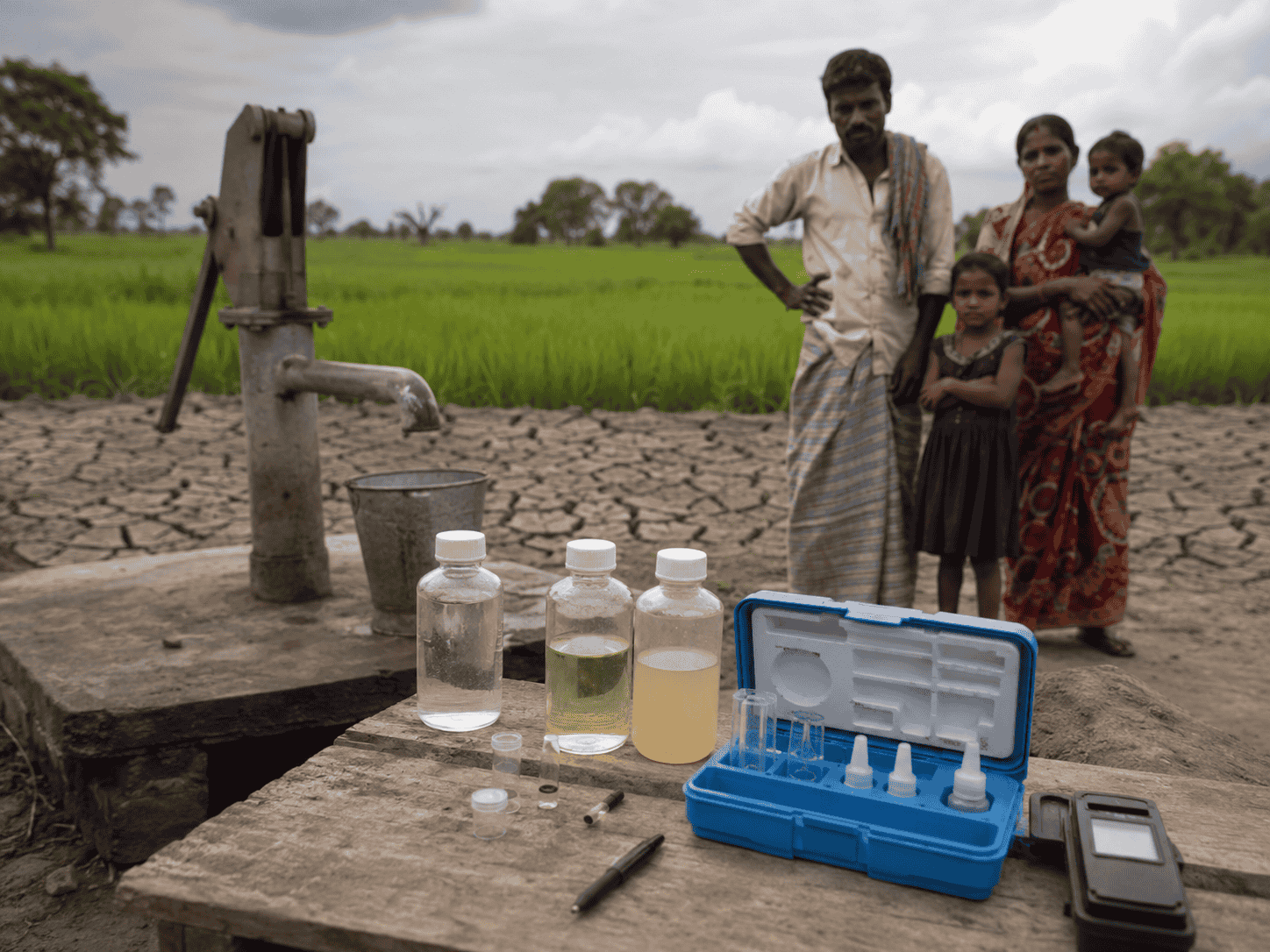
The Region That Can’t Stop Poisoning Itself: Why India Failed Against Its Arsenic Belt
There are disasters that happen suddenly.
An earthquake.
A flood.
A cyclone.
A fire.
Then there are disasters that happen quietly.
Drop by drop.
Glass by glass.
Year after year.
India’s arsenic belt belongs to the second category.
It is not a single village, not one district, and not one broken water pump. It is a vast public-health crisis spread across parts of northern and eastern India, especially along the Ganga-Brahmaputra plains. The uploaded source material rightly frames the issue as a tragedy created by a brutal combination of geography, poverty, groundwater dependence, weak governance, and delayed public action.
The poison is not visible.
It has no smell.
It has no taste.
And that is exactly why it became so deadly.
Arsenic is naturally present in parts of the Earth’s crust, but inorganic arsenic is highly toxic. According to the World Health Organization, contaminated water used for drinking, cooking, and irrigation is the greatest public-health threat from arsenic, and long-term exposure can cause skin lesions, cancers, cardiovascular disease, diabetes, developmental harm, and increased deaths in young adults.
This is why the arsenic belt is not just a water story.
It is a story about illness.
It is a story about poverty.
It is a story about political delay.
And most painfully, it is a story about a preventable catastrophe that was allowed to grow.
What Is India’s Arsenic Belt?
India’s arsenic belt is mainly found across the alluvial plains of the Ganga and Brahmaputra river systems.
The worst affected states include West Bengal, Bihar, Uttar Pradesh, Jharkhand, Assam, Manipur and Chhattisgarh, according to WHO India.
Scientific reviews show that India’s arsenic contamination is especially concentrated in alluvial aquifers in states such as West Bengal, Bihar, Jharkhand, Uttar Pradesh, Assam and Punjab. One major review found that alluvial aquifers account for most arsenic contamination in India, while the Ganga-Brahmaputra-Meghna basin supports hundreds of millions of people and includes some of the most severely affected regions.
This geography matters.
The Himalayas are young mountains. They erode constantly. Rivers carry sediments into the plains. Over time, arsenic-bearing minerals become trapped in underground layers of sand, silt and clay.
Under certain low-oxygen groundwater conditions, arsenic can be released from those sediments into the water.
That means this poison is not always coming from a factory pipe.
In many affected places, it is coming from the ground itself.
But that does not mean the disaster was unavoidable.
Natural arsenic became a human catastrophe because people were pushed into depending on contaminated groundwater without enough testing, monitoring, treatment, or safe alternatives.
The Tube Well Mistake: A Solution That Created Another Crisis
The tragedy began with a good intention.
For decades, rural communities depended on ponds, rivers, streams and other surface-water sources. These sources were often polluted with bacteria, parasites and sewage. Waterborne diseases such as cholera and diarrhoeal illness were a serious threat.
So governments, aid agencies, engineers and communities turned to groundwater.
Tube wells looked like a miracle.
They were cheap.
They were local.
They were easy to install.
They reduced exposure to dirty surface water.
But in arsenic-prone regions, many shallow tube wells pulled water from aquifers that contained naturally mobilized arsenic. India Water Portal notes that earlier efforts to shift people away from unsafe surface water led to the installation of millions of shallow tube wells, but many of these aquifers later turned out to be heavily contaminated with arsenic.
This is the cruel twist.
The system built to save people from one form of contaminated water exposed many of them to another.
And because arsenic has no smell, no color and no taste, families kept drinking it for years.
Some people did not know.
Some knew but had no alternative.
Some were told the water was unsafe but still used it because the nearest safe source was too far away.
This is how a silent poison became part of daily life.
Why India Failed Against It
India did not fail because arsenic is impossible to remove.
India failed because the response was too slow, too fragmented, too dependent on paperwork, and too weak at the village level.
The first failure was delayed recognition.
Arsenic contamination was identified decades ago, especially in West Bengal, but the response did not match the scale of the threat. Instead of treating it like a national public-health emergency, the problem was often managed as a technical water-supply issue.
That was a major mistake.
This was never only about wells.
It was about cancer.
It was about children.
It was about pregnancies.
It was about poverty.
It was about food safety.
It was about rural survival.
The second failure was fragmented responsibility.
In India, drinking water is officially a state subject. The central government provides technical and financial support, but planning, approval, implementation, operation and maintenance are vested with state and union territory governments.
That sounds reasonable on paper.
But in practice, it creates a classic blame game.
The center says states must implement.
States say they need funds, support and approvals.
Departments blame other departments.
Water agencies focus on supply.
Health agencies focus on disease.
Agriculture departments focus on irrigation.
Local bodies lack capacity.
And the poisoned family at the village pump is left waiting.
The third failure was weak monitoring.
Arsenic is not a contaminant that can be checked once and forgotten. It changes from aquifer to aquifer, village to village, well to well, and sometimes over time.
A safe pump today may not remain safe forever.
The Central Ground Water Board’s 2024 groundwater quality report was based on 15,259 monitoring locations across India and found that arsenic was above permissible limits in 3.1% of tested samples. The same official response noted that groundwater quality varies significantly across the country and that contaminants such as nitrate, fluoride, arsenic and uranium appear in isolated pockets.
This proves the problem is measurable.
But measurement alone is not enough.
People need local testing.
They need visible marking of unsafe wells.
They need regular surveillance.
They need real-time public data.
They need water-quality alerts that actually reach villages.
Without that, people keep drinking poison unknowingly.
The Poverty Trap
The arsenic crisis is also a poverty crisis.
A wealthy family can buy bottled water.
A wealthy family can install a private filtration system.
A wealthy family can move.
A poor rural family often cannot do any of that.
If the nearest safe well is far away, a daily water journey becomes a burden.
If the filtration plant breaks down, people return to the old hand pump.
If the piped water supply is irregular, contaminated groundwater remains the backup.
And if the whole village is poor, arsenic becomes normal.
This is where the crisis becomes deeply unfair.
The people most exposed are often the least able to protect themselves.
Long-term arsenic exposure can make people sick, reduce their ability to work, increase medical expenses, damage children’s development, and push families deeper into poverty. WHO says long-term exposure can cause skin changes, skin cancer, bladder and lung cancers, developmental effects, diabetes, pulmonary disease and cardiovascular disease.
That means arsenic does not only poison bodies.
It poisons opportunity.
A sick farmer cannot work properly.
A child with developmental harm may struggle in school.
A young person with visible skin lesions may face stigma.
A family spending money on illness has less money for education, food and mobility.
This is how contamination becomes generational poverty.
The Food Chain Problem India Still Underestimates
Most arsenic discussions focus on drinking water.
That is important.
But it is not enough.
In arsenic-affected regions, groundwater is also used for cooking and irrigation.
That means arsenic can enter crops.
Rice is especially important because it is often grown in flooded conditions and can absorb arsenic from contaminated irrigation water and soil.
WHO explicitly warns that contaminated water used for food preparation and irrigation of food crops poses a major public-health threat from arsenic.
This is one reason India’s response has been incomplete.
Providing drinking water helps.
But if arsenic continues entering food systems, especially rice-based diets, exposure may continue through another route.
A serious solution must connect water policy with agriculture policy.
It must include safe irrigation practices.
It must include crop testing.
It must include farmer education.
It must include food-chain monitoring.
Otherwise, arsenic simply moves from the pump to the plate.
The Government Says Progress Is Happening
To be fair, India has not done nothing.
The Jal Jeevan Mission, launched in 2019, aims to provide safe and adequate drinking water through household tap connections in rural India. The official mission also includes source sustainability measures such as recharge, reuse, water conservation and rainwater harvesting.
The government says arsenic-affected habitations have declined sharply under Jal Jeevan Mission. In a 2026 Parliament response, the Ministry of Jal Shakti said arsenic-affected habitations declined from 14,020 in August 2019 to 314 in January 2026, and that remaining habitations had been provided clean and safe drinking water through community water purifier plants.
That is important progress.
But it should not be treated as the end of the crisis.
Why?
Because coverage on paper does not always mean safe water at the household level every day.
A village may be listed as covered, but the system may be irregular.
A purification plant may exist, but maintenance may fail.
A piped connection may be installed, but the source may still need monitoring.
A water-quality database may be available, but villagers may not know which source is safe.
A filter may work today, but without spare parts and trained operators, it may fail tomorrow.
This is where implementation decides whether policy becomes protection.
Why Technical Fixes Failed
Many arsenic-removal systems have been installed over the years.
Some worked.
Many did not.
The problem is not always the technology itself.
The problem is the ecosystem around the technology.
A filter needs maintenance.
A plant needs electricity.
A testing lab needs trained staff.
A village needs spare parts.
A household needs awareness.
A local government needs accountability.
A state agency needs funding.
A national program needs honest monitoring.
When any part of this chain breaks, the entire solution collapses.
India Water Portal lists mitigation options such as surface-water schemes, piped supply, deep aquifer tapping, household and community filters, and centralized treatment plants. It also stresses the importance of testing every drinking-water source regularly and marking safe and unsafe sources clearly.
That is the practical answer.
But the practical answer only works when governance works.
And governance has been the weakest part of the arsenic story.
The Real Reason India Failed
India failed because it treated arsenic as an engineering problem when it was actually an environmental justice problem.
Engineering can build wells.
Engineering can install filters.
Engineering can lay pipelines.
But justice asks harder questions.
Why did poor villages drink contaminated water for decades?
Why were unsafe wells not clearly marked?
Why were children exposed before adults admitted the scale of the danger?
Why were treatment plants installed without long-term maintenance systems?
Why did water, health, agriculture and rural development departments not act together?
Why was the food chain not treated as urgently as drinking water?
Why did the burden fall most heavily on people with the least political voice?
This is why the arsenic belt is not just a natural disaster.
It is a governance disaster.
The poison came from geology.
But the suffering came from delay.
What Must Happen Now
India can still reduce the damage.
The solution is not mysterious.
First, every drinking-water source in affected districts must be tested regularly.
Second, unsafe wells must be visibly marked and publicly mapped.
Third, piped water must come from safe surface water or confirmed safe aquifers.
Fourth, community purification plants must have maintenance budgets, trained local operators and spare parts.
Fifth, arsenic exposure must be treated as a health issue, not only a water issue.
Sixth, food-chain exposure must be monitored, especially rice and crops grown with contaminated groundwater.
Seventh, village water committees must be trained to test, report and manage sources.
Eighth, independent third-party audits must verify official “safe water” claims.
Ninth, state and central governments must stop hiding behind divided responsibility.
Tenth, affected communities must be treated as citizens with rights, not statistics in reports.
WHO says the most important action in affected communities is prevention of further exposure through safe water supply.
That is the heart of the matter.
Stop exposure.
Then treat illness.
Then monitor relapse.
Then rebuild trust.
Is There Hope?
Yes.
There is hope.
But hope depends on urgency.
India now has better data, better mapping tools, more filtration technologies, more piped-water programs, and more public awareness than it had decades ago.
There are safer wells.
There are surface-water projects.
There are household filters.
There are community systems.
There are researchers, activists, engineers and local leaders trying to solve the problem.
But the arsenic belt cannot be fixed by announcements alone.
It needs maintenance.
It needs monitoring.
It needs political will.
It needs local trust.
It needs health screening.
It needs food-chain action.
And above all, it needs the government to treat poisoned groundwater not as a rural inconvenience, but as a national public-health emergency.
Final Thought
India’s arsenic belt is one of the clearest examples of how a preventable crisis becomes a catastrophe when poverty, weak governance and environmental risk collide.
The arsenic was natural.
The mass exposure was not.
The groundwater was invisible.
The failure was visible.
For decades, millions drank from wells that looked safe, tasted normal and carried poison. The tragedy is not only that arsenic entered the water.
The tragedy is that the warning signs were there.
The science was there.
The suffering was there.
But action came too late, too slowly, and too unevenly.
The arsenic belt does not need pity.
It needs clean water.
It needs honest monitoring.
It needs accountable government.
It needs community power.
And it needs the world to understand that the deadliest disasters are not always the ones that shake the ground.
Sometimes, they are the ones that flow quietly from a hand pump.
India arsenic belt, India arsenic belt, arsenic groundwater India, arsenic poisoning India, groundwater contamination India, West Bengal arsenic crisis, Bihar arsenic groundwater, Ganga Brahmaputra arsenic, arsenic in drinking water, India water crisis, arsenicosis, rural India poisoned water, Jal Jeevan Mission arsenic, arsenic in rice India, public health crisis India, safe drinking water India, groundwater pollution, arsenic health effects, India environmental justice
India, Arsenic Belt, Groundwater, Water Crisis, Public Health, Environment, Pollution, Rural Poverty, West Bengal, Bihar, Jal Jeevan Mission



Discussion
Comments
Approved comments are published after moderation to keep discussion useful and spam-free.
No comments yet. Start the discussion below.