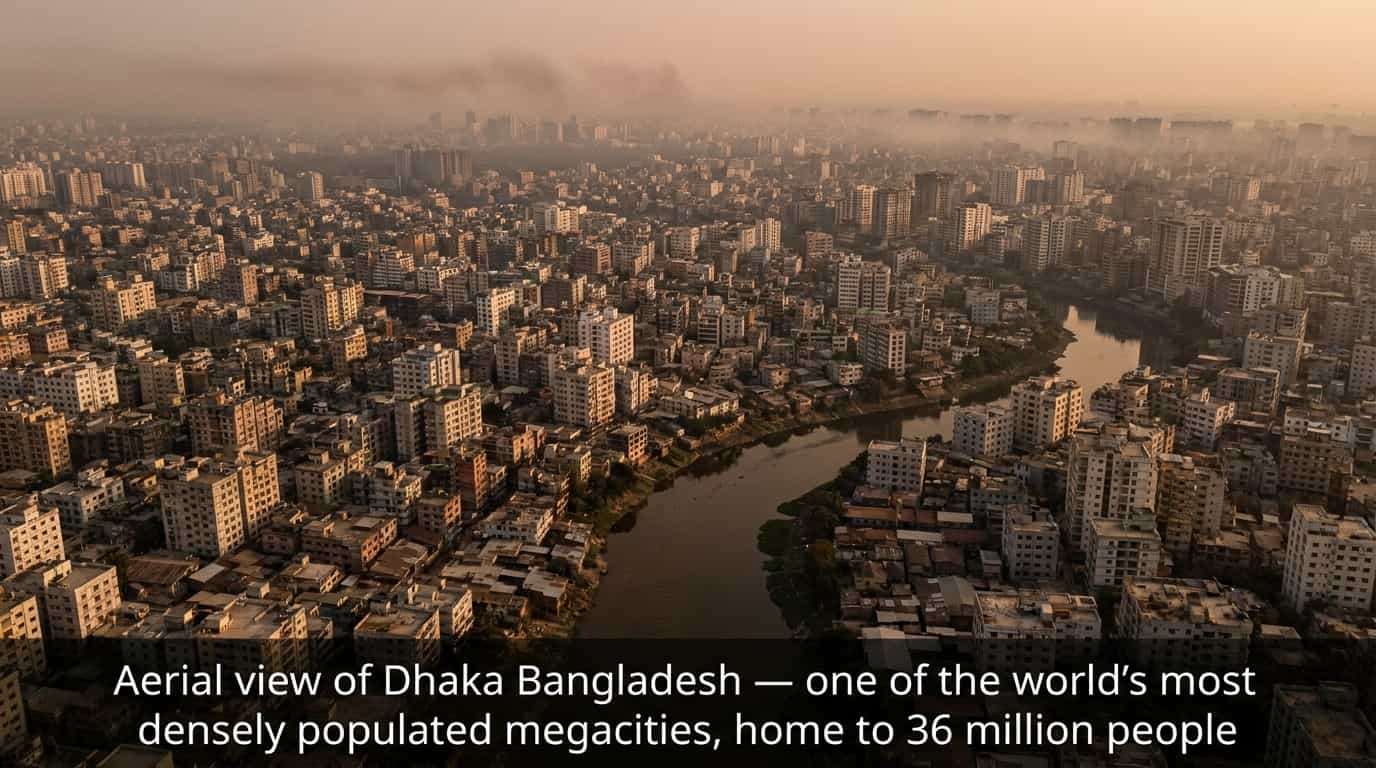
Dhaka: The Megacity of 36 Million People That Is Literally Sinking Into the Ground
There is a number that stops people when they hear it for the first time.
In 1971, when Bangladesh was born out, Dhaka held roughly 1.4 million people.
Today it holds 36 million.
That is not a typo. That is a city that has grown by a factor of twenty-five in fifty years — faster than almost any urban settlement in recorded human history. Faster than Lagos. Faster than Jakarta. Faster, arguably, than any city's infrastructure, water supply, air quality, or political system can rationally absorb.
The result is a place that defies easy description. Dhaka is not simply a poor city, or a polluted city, or a chaotic city. It is all of those things simultaneously, layered over a history of famine and cyclone that has left a psychological imprint on its people as deep as the delta silt beneath their feet.
And the city is, in the most literal sense possible, sinking.
How Fast Is Dhaka Actually Growing? The Numbers Are Extraordinary
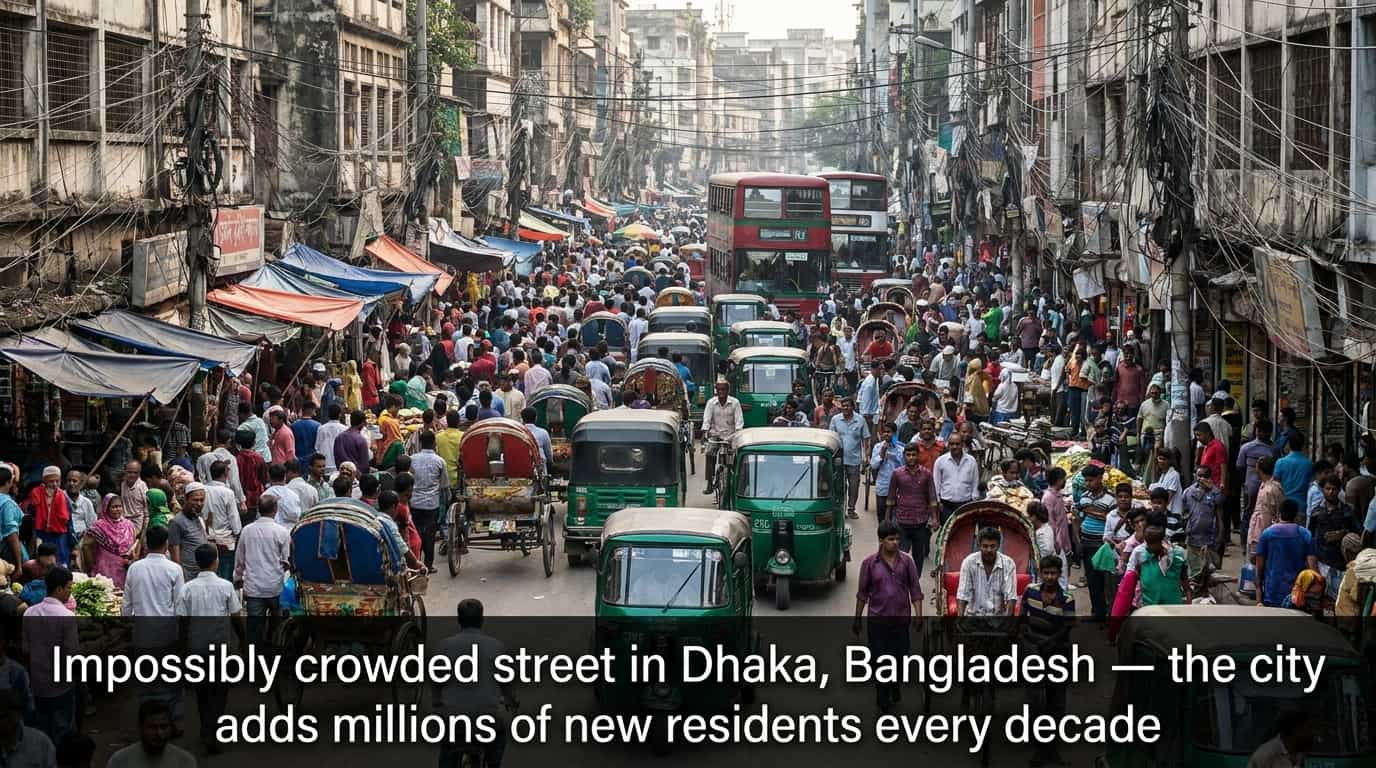
The growth trajectory of Dhaka is worth sitting with, because the raw statistics conceal something even more astonishing than the final number.
In 1950, Dhaka's population was approximately 335,000 people — a mid-sized provincial city by any measure.
By 1975, that number had reached 2.2 million.
By 1995, it was 8 million — a city already overwhelmed, already generating the traffic paralysis and infrastructure crises that would define the following decades.
By 2005: 14 million. By 2015: 20 million. By 2025: 36 million.
At its current density, Dhaka packs approximately 44,500 people per square kilometre in its most crowded districts — making it one of the three most densely populated urban areas on the planet. For comparison, Manhattan — which most people consider extremely dense — holds approximately 27,000 people per square kilometre.
The driver of this compression is not birth rate. It is migration. And the force pushing that migration is not economic ambition alone — it is the systematic destruction of the places these people came from.
Why They Keep Coming: Climate Displacement and the Rural Collapse
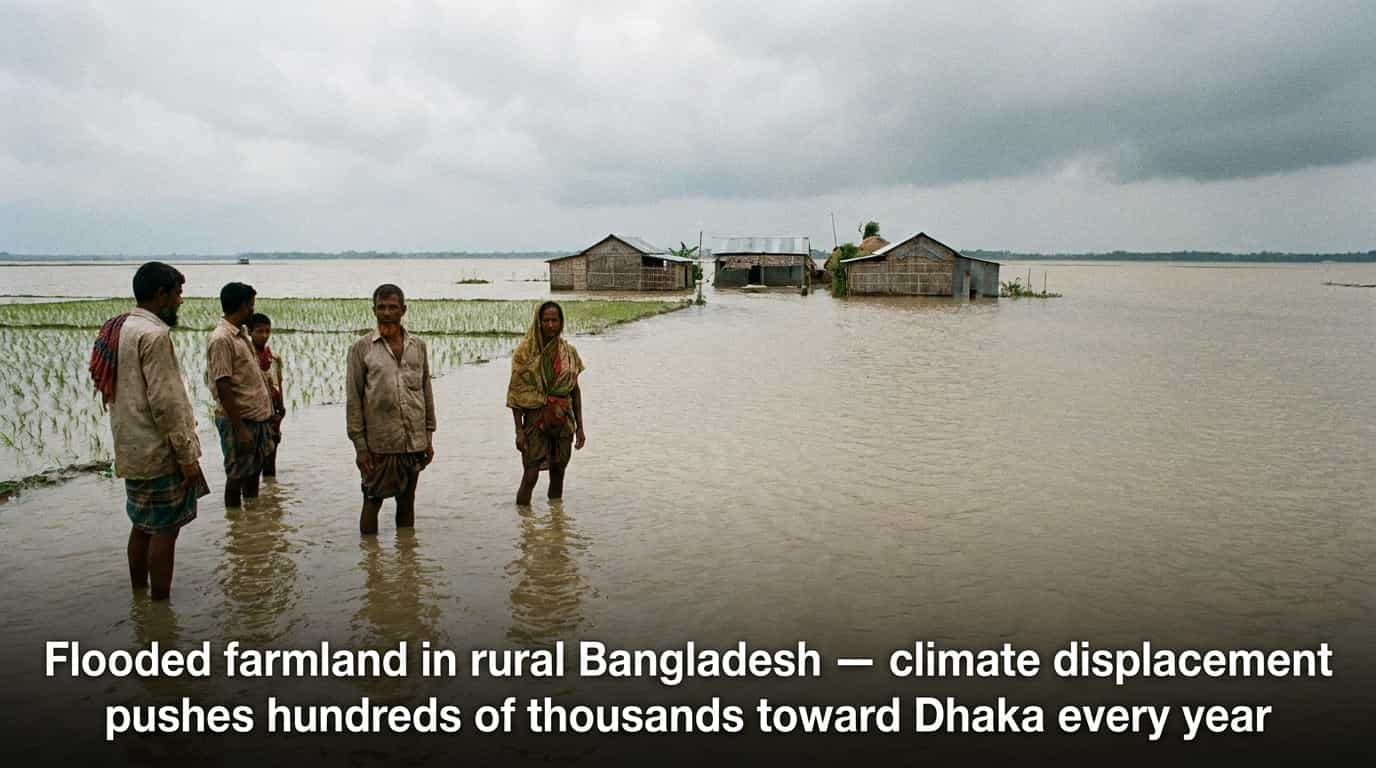
Bangladesh is shaped like a cupped hand receiving water from above and below. The country sits at the convergence of three of Asia's largest river systems — the Ganges, the Brahmaputra, and the Meghna — and roughly one-third of its landmass floods every year in normal monsoon seasons.
In bad years, that figure rises to two-thirds.
The communities most exposed to this flooding are the rural poor — small-scale farmers and fishing families who have worked the delta for generations. But the disruptions they face now are no longer seasonal inconveniences that recede with the rains. They are permanent, compounding, and accelerating.
River erosion alone displaces an estimated 400,000 to 700,000 Bangladeshis annually, according to research from the International Centre for Diarrhoeal Disease Research. These are not people choosing to move. These are people whose land has physically disappeared into the water.
On top of erosion comes saltwater intrusion. As sea levels rise and upstream freshwater flows are disrupted, salt water is penetrating further inland each year — destroying rice crops in coastal districts and contaminating the freshwater sources that village communities depend on.
The 2007 Cyclone Sidr killed more than 3,300 people and destroyed livelihoods across the southern coast. Cyclone Amphan in 2020 affected 13 million people in a single event. After each disaster, a portion of the survivors assess what they have left and make the calculation that Dhaka — with all its chaos and overcrowding and expense — represents a more survivable future than staying.
They are probably right. That is the tragedy.
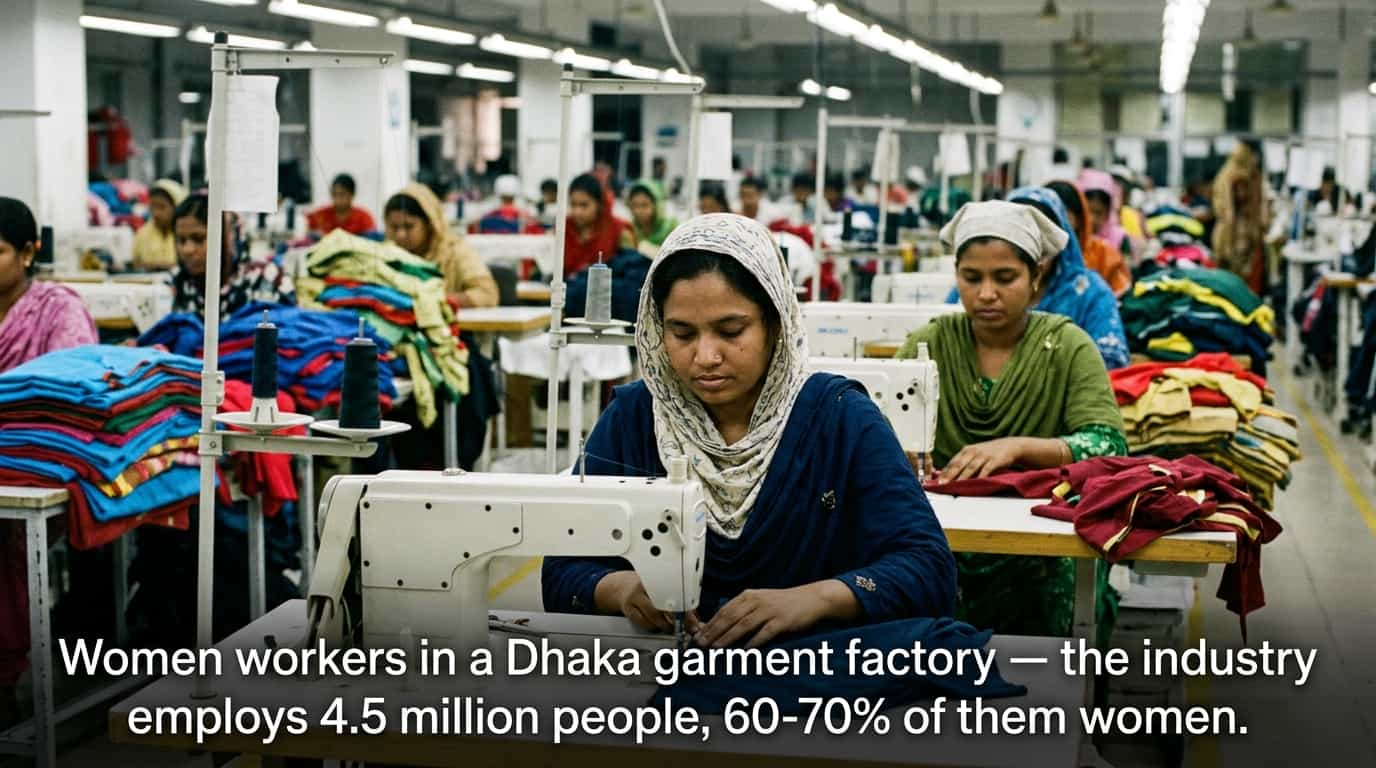
The $50 Billion Industry Built on $95-a-Month Wages
When the rural displaced arrive in Dhaka, most of them end up in one of two places: the informal settlements that ring the city's perimeter, or the garment factories that crowd its industrial districts.
Often, both.
Bangladesh's readymade garment industry is one of the most dramatic economic transformations in modern Asian history. In 1978, the entire sector generated an estimated $600,000 in export revenue. By 2023, it had reached $55.79 billion, accounting for more than 84% of Bangladesh's total export earnings and making Bangladesh the world's second largest garment exporter after China.
The clothes you are almost certainly wearing right now have a reasonable probability of having been made here.
The industry employs approximately 4.5 million workers directly — and an estimated 40 million more in downstream supply chains. Between 60% and 70% of the direct workforce are women, many of them first-generation migrants who came from districts where female employment was culturally restricted. For these women, the garment factory — for all its genuine harshness — represents wages, independence, and urban access that their mothers never had.
The global brands sourcing from Bangladesh include H&M, Zara, Gap, Walmart, Primark, and dozens of others. The price points these brands negotiate squeeze the margins at every level of the supply chain. The people at the bottom of that chain — the women sitting at the sewing machines for 10 to 12 hours a day — earn a minimum wage of approximately $113 per month as of 2024, following protests and a government revision. Before that revision, it was $95.
A country that clothes the world cannot clothe its own workers in anything approaching a living wage.
Rana Plaza: The Day the World Saw the True Cost of Cheap Clothes
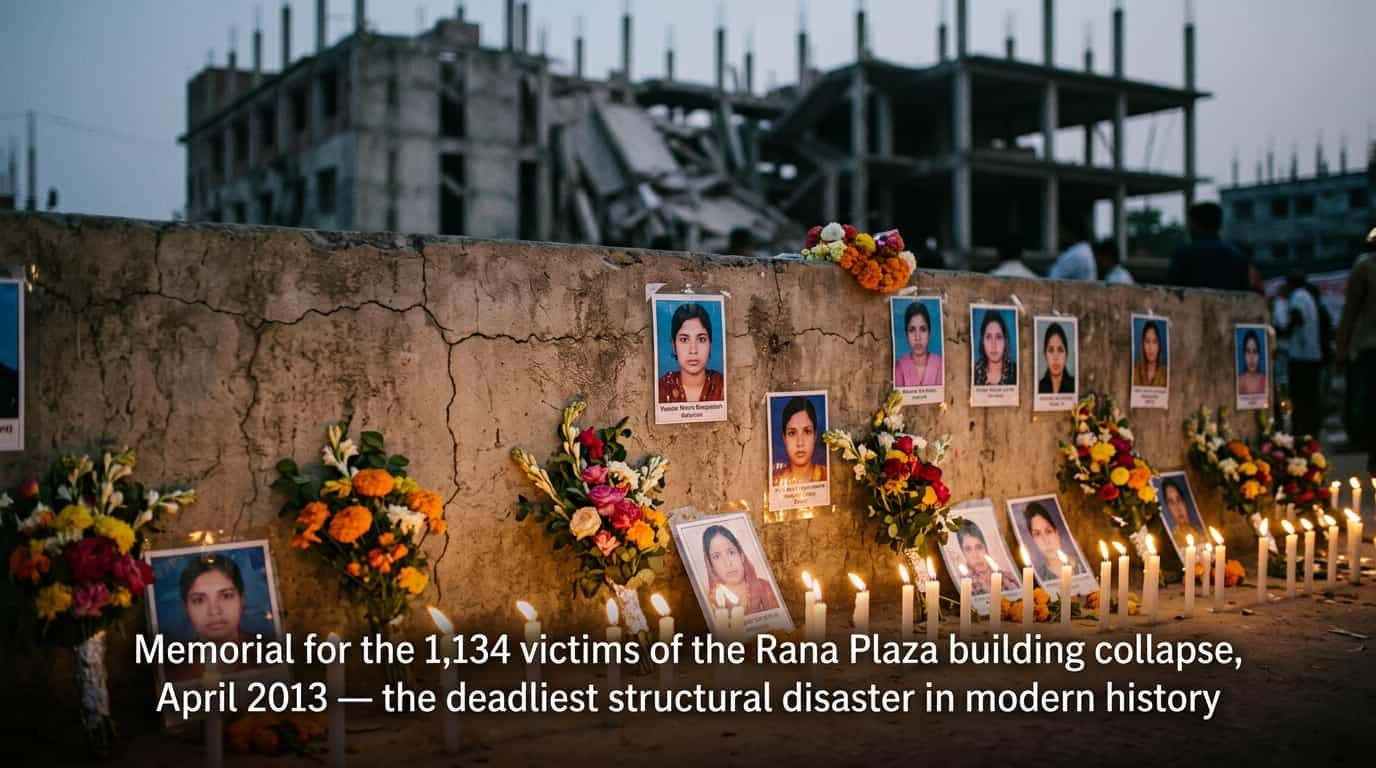
On the morning of April 23, 2013, workers arriving at the Rana Plaza commercial building in Savar — just outside Dhaka — noticed cracks running through the walls and pillars of the eight-story structure.
Some of them reported it. Some of them refused to enter. The owners of the garment factories on the upper floors told workers to go to their machines or lose a month's pay.
At 8:57 AM on April 24, 2013, the building collapsed.
In less than 90 seconds, 1,134 people were killed — the majority of them young women between 18 and 30 years old. A further 2,500 were injured, many with limb amputations. It remains the deadliest structural failure in modern history outside of wartime.
The rescue operation lasted 17 days. Survivors were pulled from the rubble by hand. One woman — Reshma Begum — was found alive after 17 days buried in the debris, her survival a miracle that briefly gave the world something to feel good about amid the scale of the loss.
What the Rana Plaza collapse forced into public view was an entire system of accountability failures: building inspections that didn't happen, safety certifications that were purchased rather than earned, international brands that pleaded ignorance of conditions in their own supply chains, and a Bangladeshi political establishment whose business interests were entangled with the factory owners who had ordered workers into a building that engineers had condemned the previous day.
Some things changed. The Bangladesh Accord on Fire and Building Safety — a legally binding agreement between global brands and trade unions covering factory inspections — was signed in the months following the disaster and has since been expanded and extended. Factory conditions, in many facilities, improved.
But the minimum wage for garment workers in 2013 was $38 a month. The workers who died in Rana Plaza were earning that.
The Air: What 36 Million People Breathe Every Day
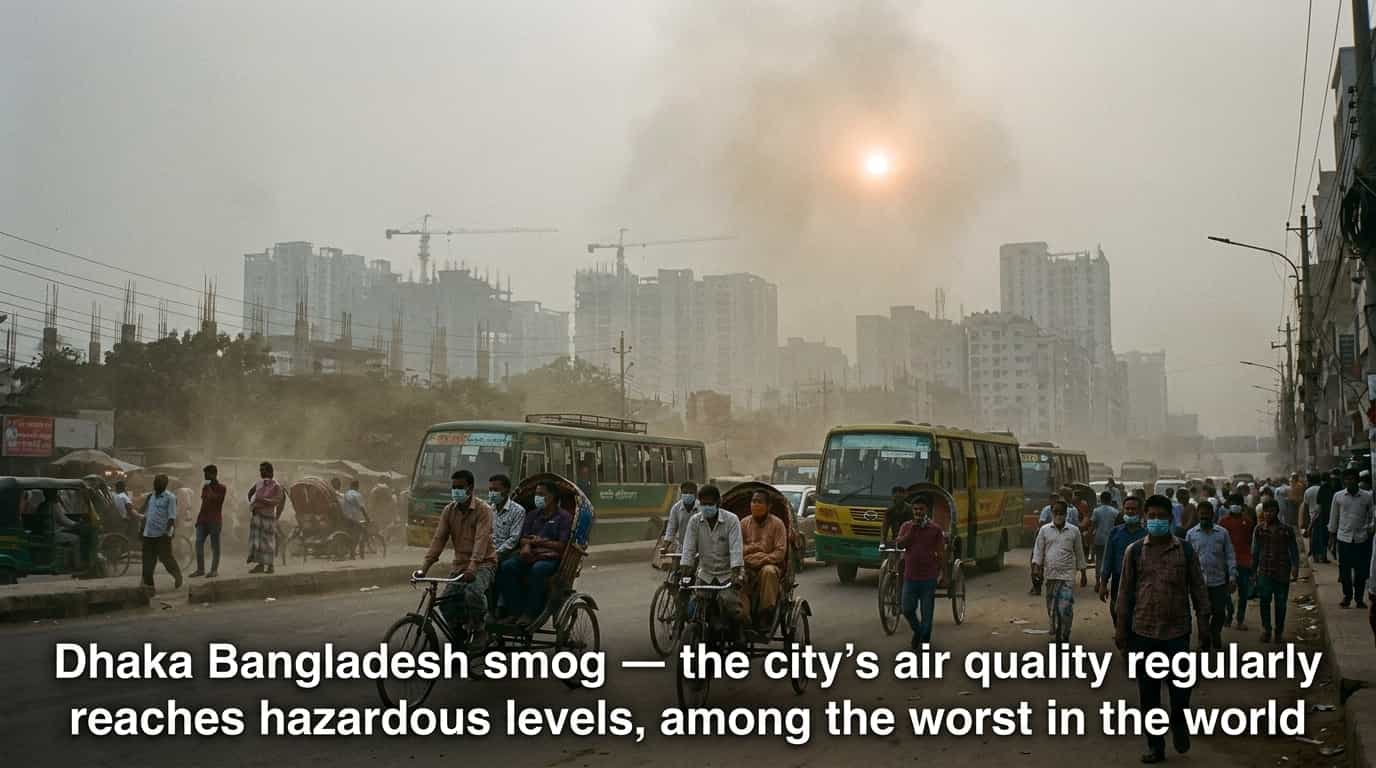
On most mornings in Dhaka, the air you breathe is not air in any conventional sense.
It is a compound. Vehicle emissions from an estimated 1.5 million motorised vehicles competing for road space with another 1 million non-motorised vehicles. Fine particulate matter from the 7,000-plus brick kilns that ring the city's outskirts, burning coal and wood through the dry season to produce the building materials for Dhaka's endless construction boom. Industrial effluent from tanneries and textile dyeing operations. Construction dust from the half-finished high-rises going up on every block.
In May 2026, Dhaka's Air Quality Index regularly exceeded 180 — firmly in the "Unhealthy" to "Very Unhealthy" range — and periodically spiked above 200, entering "Hazardous" territory. On the worst days, Dhaka competes with Lahore and Delhi for the title of the world's most polluted major city.
The World Bank estimates that ambient and household air pollution contributes to more than 159,000 premature deaths annually across Bangladesh. Air pollution costs the Bangladeshi economy an estimated 3.9% to 4.4% of annual GDP — roughly $5 to $6 billion per year in health costs, lost productivity, and diminished human capital.
The people who bear this cost disproportionately are the people who cannot afford to live anywhere else.
The River That No Longer Runs
The Buriganga River was once Dhaka's lifeline.
For centuries, it supplied the city's water, fed its fish markets, and carried its trade. The name Buriganga translates, roughly, as "Old Ganga" — a name that carries the weight of history and reverence.
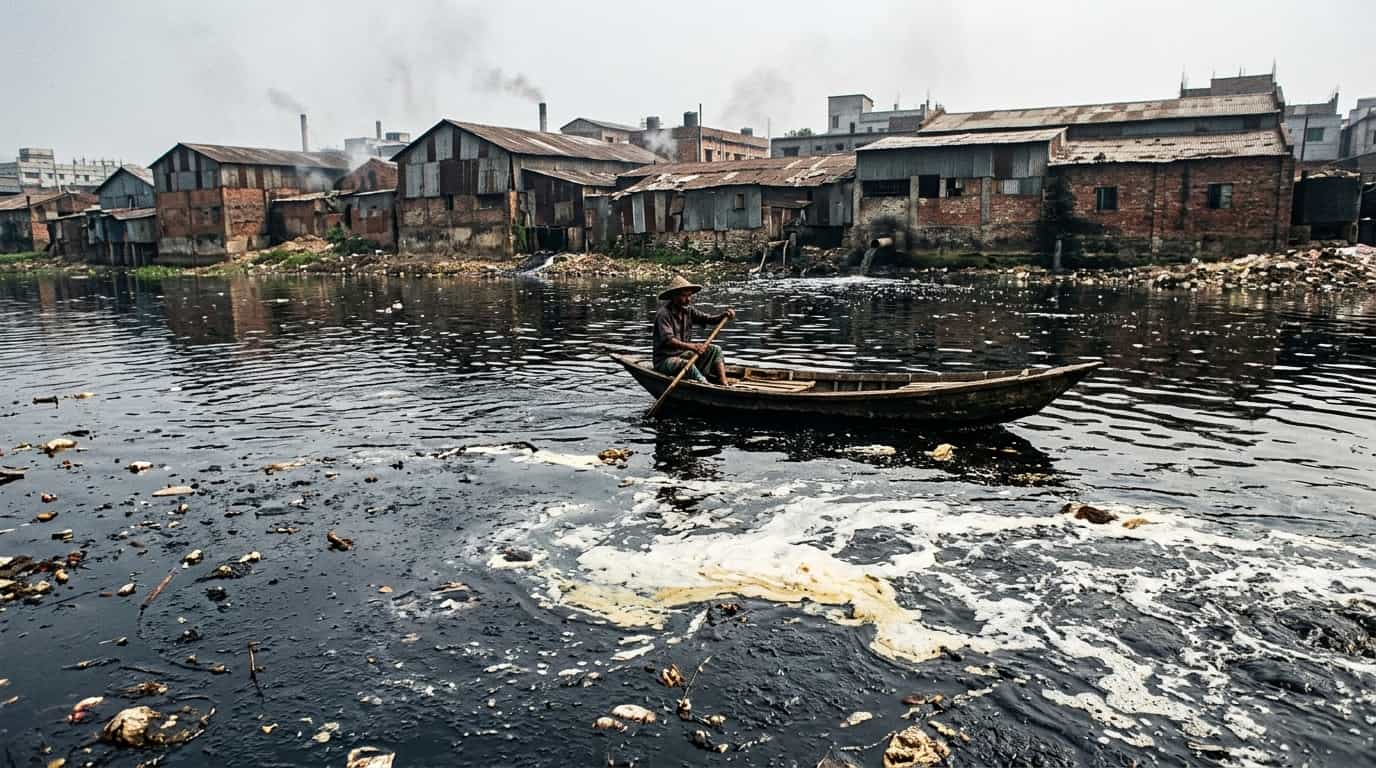
Today, the river is black.
The Buriganga receives an estimated 21,000 cubic metres of untreated industrial sewage every single day. The primary contributors are the leather tanneries of Hazaribagh — for decades the largest tannery district in South Asia, processing animal hides using chromium sulfate and other heavy chemicals before discharging directly into the river system — and the textile dyeing factories that service the garment industry with synthetic dyes containing heavy metals and carcinogenic compounds.
Water testing in the Buriganga consistently finds chromium, lead, cadmium, and mercury at concentrations that are orders of magnitude above safe thresholds. The river's dissolved oxygen levels — the measure of a waterway's ability to support life — are effectively zero in the most polluted stretches. Nothing lives there.
In 2017, the Bangladesh government relocated the Hazaribagh tanneries to a purpose-built estate in Savar — a move that was celebrated and that did reduce direct tannery discharge into the Buriganga. What the relocation did not do was install functional waste treatment infrastructure at the new site. Studies conducted after the move found that heavy metal contamination continued at comparable levels.
The tanneries moved. The pollution followed.
The Arsenic in the Water: A Slow Catastrophe
Of all the water-related crises Dhaka faces, the one that receives the least international attention may be the most insidious.
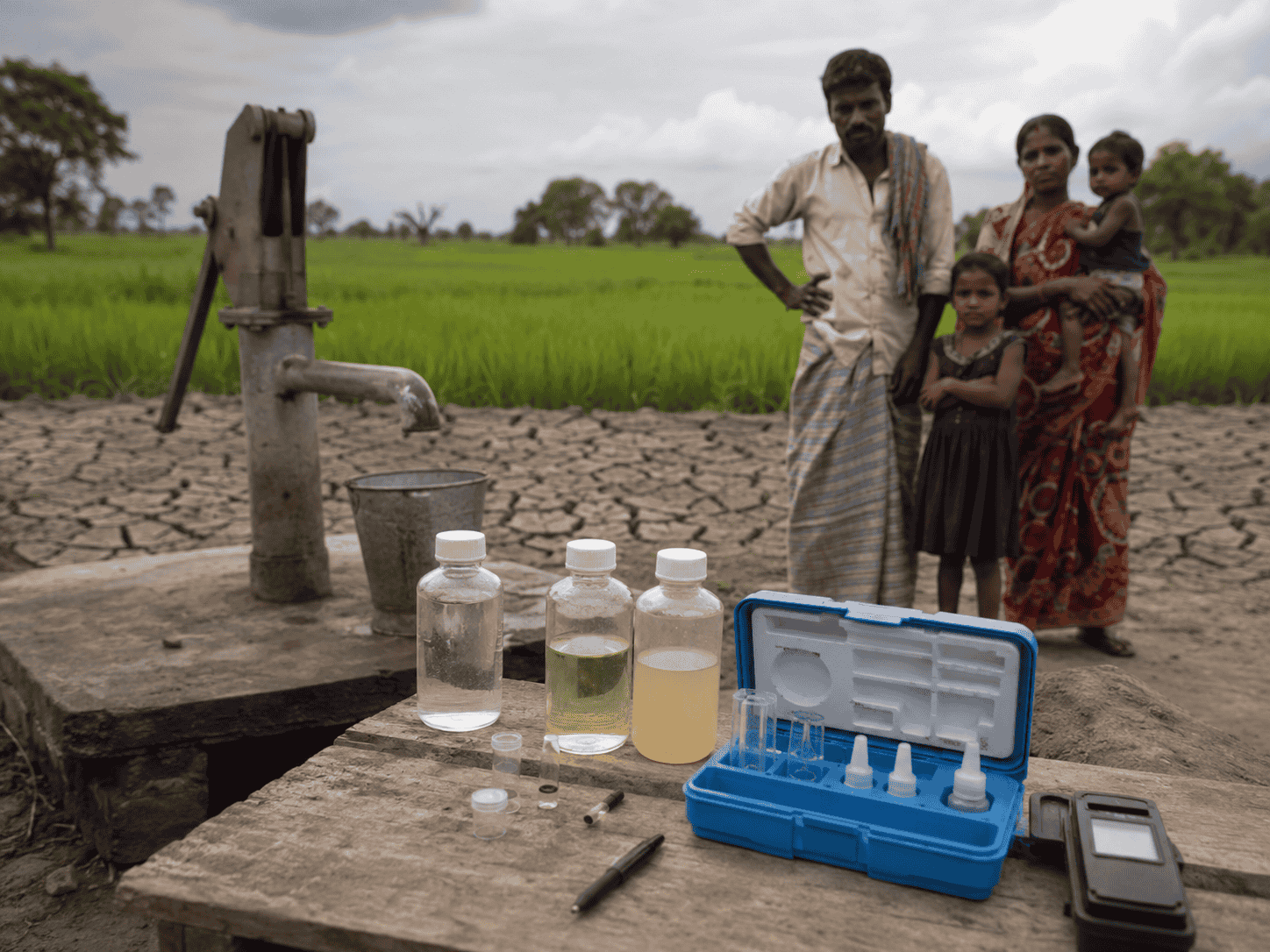
Beneath the surface of Bangladesh lies one of the largest natural arsenic deposits on Earth. As communities across the country — and in Dhaka's expanding periphery — drill deeper tube wells to access groundwater, they are drawing up water laced with naturally occurring arsenic at concentrations that cause arsenicosis: a chronic poisoning condition characterised by skin lesions, peripheral neuropathy, and significantly elevated lifetime risk of cancers of the bladder, kidney, lung, and skin.
The World Health Organization estimates that up to 30 million Bangladeshis are currently exposed to arsenic in drinking water at levels exceeding safe thresholds — one of the largest mass poisoning events in human history, happening slowly, invisibly, and with no clean endpoint.
In Dhaka's slums, the situation is more complex. Approximately 94.8% of slum households access piped water — an achievement that represented genuine public health progress. But nearly 15% experience regular supply disruptions, forcing households to fall back on groundwater sources during outages. And the pipes themselves, laid decades ago in districts where the population has since tripled, lose significant volume to leakage and contamination from inadequate sewage separation.
Safe water in Dhaka is not guaranteed. It is rationed.
The Ground Beneath the City: Dhaka Is Sinking
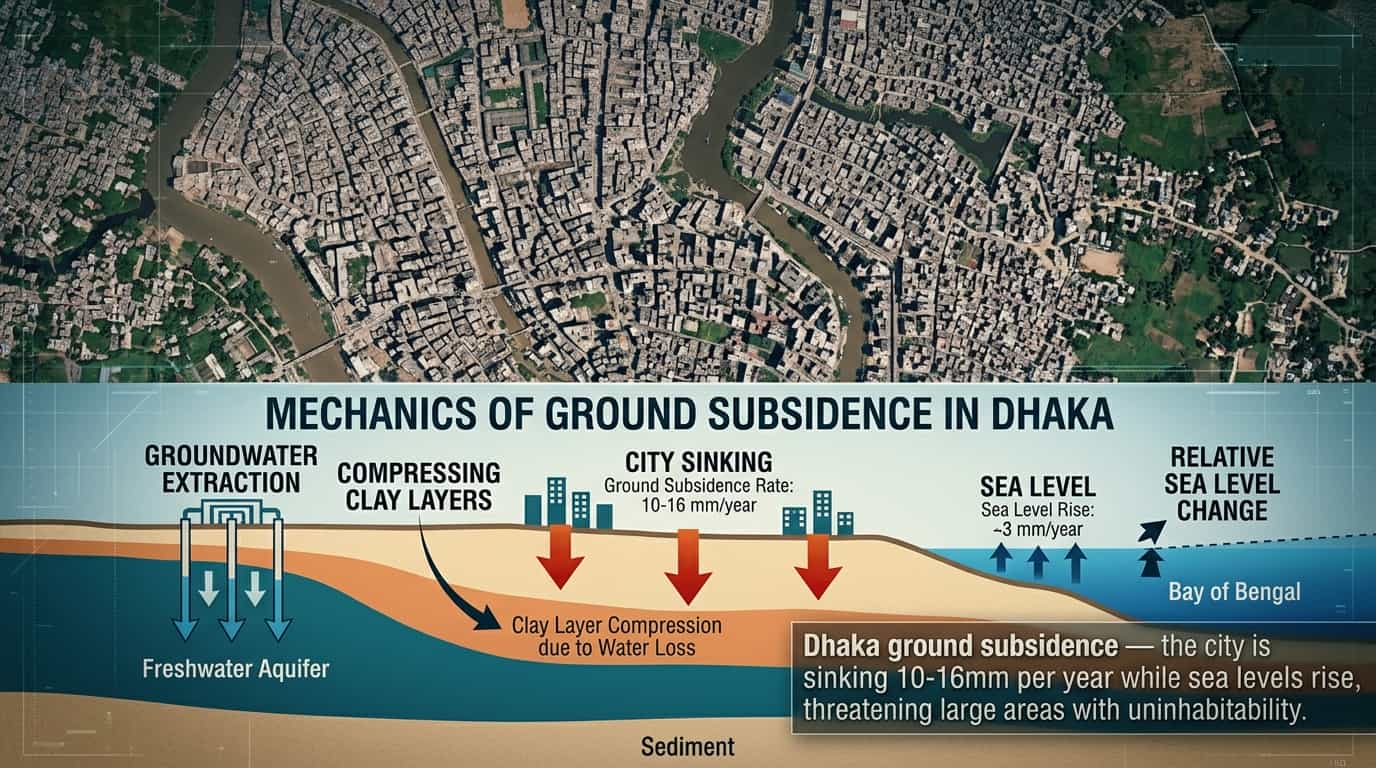
Dhaka is not metaphorically sinking. It is physically, measurably sinking into the ground beneath it.
Satellite-based geodetic measurements have consistently found that Dhaka is subsiding at a rate of 10 to 16 millimetres per year — driven primarily by the massive extraction of groundwater to supply a city that has grown far beyond what its surface water infrastructure can support. The weight of the built environment — the concrete towers, the highway overpasses, the industrial estates — adds additional compressive loading on the soft delta sediments below.
Dhaka currently sits 6 to 8 metres above mean sea level. Global sea levels are rising at approximately 3.7 millimetres per year and accelerating. The combined effect — the city descending while the sea rises — means that the effective difference between Dhaka's elevation and sea level is narrowing by somewhere between 14 and 20 millimetres every single year.
At that trajectory, large portions of the city's lowest-lying districts — which are also, invariably, the districts where the poorest residents live — will face regular inundation within decades. Not from catastrophic flooding events, but from ordinary tides and normal monsoon rains that the city's drainage can no longer handle.
The wetlands that historically absorbed Dhaka's floodwater have been almost entirely destroyed. Between 1988 and 2019, Dhaka lost approximately 70% of its natural wetland area to urban development. These wetlands — which once stored floodwater and released it slowly, buffering the city against inundation — have been replaced with the impermeable concrete surfaces of an expanding metropolis.
The flood defenses the city built were effective when the wetlands still existed. Without them, the defenses are managing water that has nowhere to go.
A History Written in Catastrophe
To understand Dhaka — to understand why its people endure conditions that would seem intolerable to those who have never needed to — you have to understand the history that shaped them.
The Great Bengal Famine of 1770 killed an estimated 7 to 10 million people across Bengal — roughly one-third of the entire population at the time — under the administrative indifference of the British East India Company, which continued extracting tax revenue from a population that was starving. The famine was not a natural disaster; it was a political one.
The Bhola Cyclone of November 1970 struck the coastal delta with a 10-metre storm surge that drowned between 300,000 and 500,000 people overnight — the deadliest tropical cyclone in recorded history.
The 2024 Uprising: When the Streets Finally Broke
The modern chapter of Dhaka's political crisis has been building for fifteen years.
Sheikh Hasina of the Awami League first came to power in 2009. Over the following decade and a half, her government delivered genuine economic growth — Bangladesh's GDP per capita rose from approximately $700 in 2009 to $2,800 by 2023 — while simultaneously dismantling the institutional checks on her own power. The judiciary, the electoral commission, the media — each was progressively brought under Awami League control. Opposition parties were harassed, their leaders jailed. The elections of 2014 and 2018 were widely considered neither free nor fair.
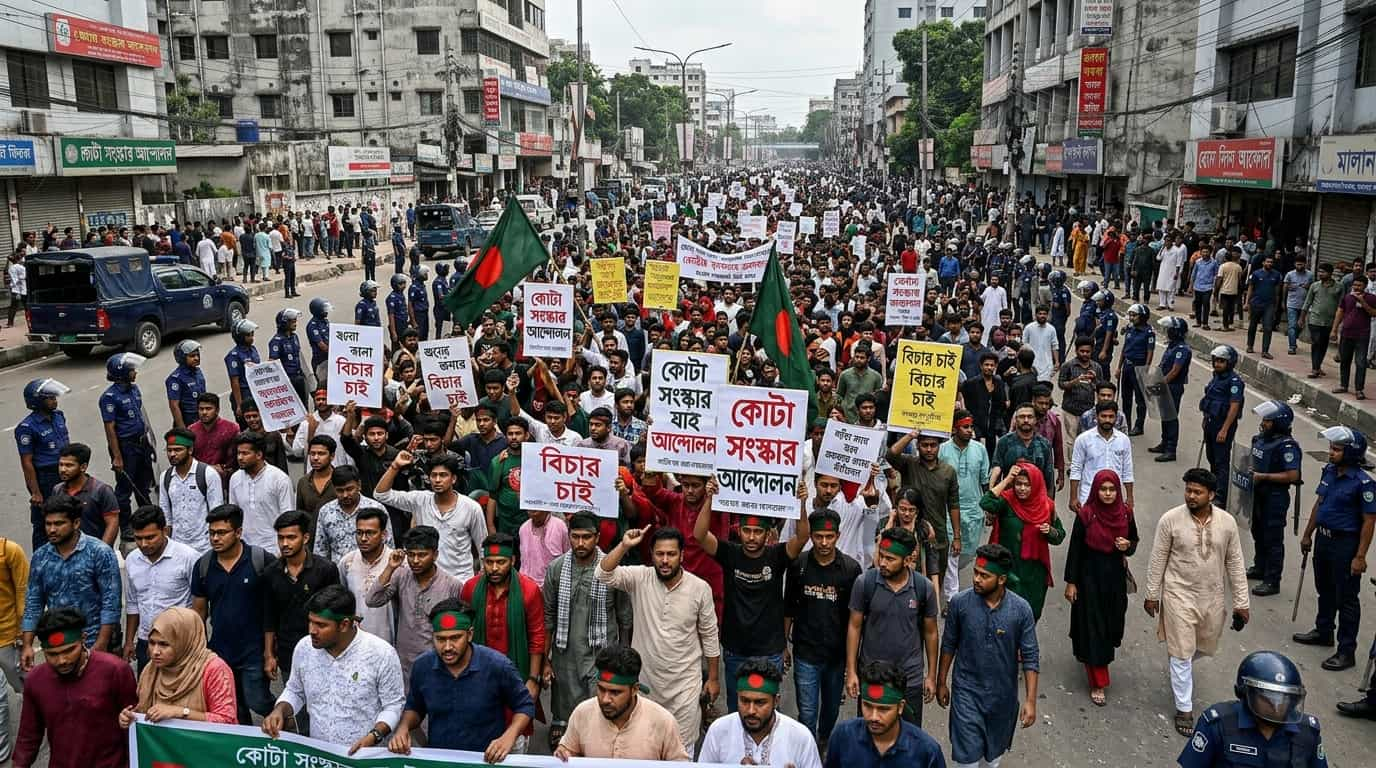
The flashpoint came in June 2024, when the Supreme Court reinstated a quota system reserving 30% of government jobs for descendants of 1971 Liberation War veterans. In a country where government employment represents one of the few pathways to economic security, and where the quota system was widely perceived as disproportionately benefitting Awami League loyalists, the ruling triggered an explosion.
What began as student protests at Dhaka University campuses spread within days to cities and towns across the entire country. The government's response was brutal: security forces opened fire on crowds. Internet and telecommunications services were shut down for days. The Human Rights Support Society estimated that 1,400 people were killed in the crackdown — a figure that included children, who accounted for an estimated 12% to 13% of casualties.
Sheikh Hasina resigned on August 5, 2024 and fled to India, where she remains. She has applied for asylum in the United Kingdom.
The Collapse of Order: What Happened After Hasina Left
When Hasina fled, the apparatus of state that had been built around her personal authority did not transition smoothly into something functional. It fractured.
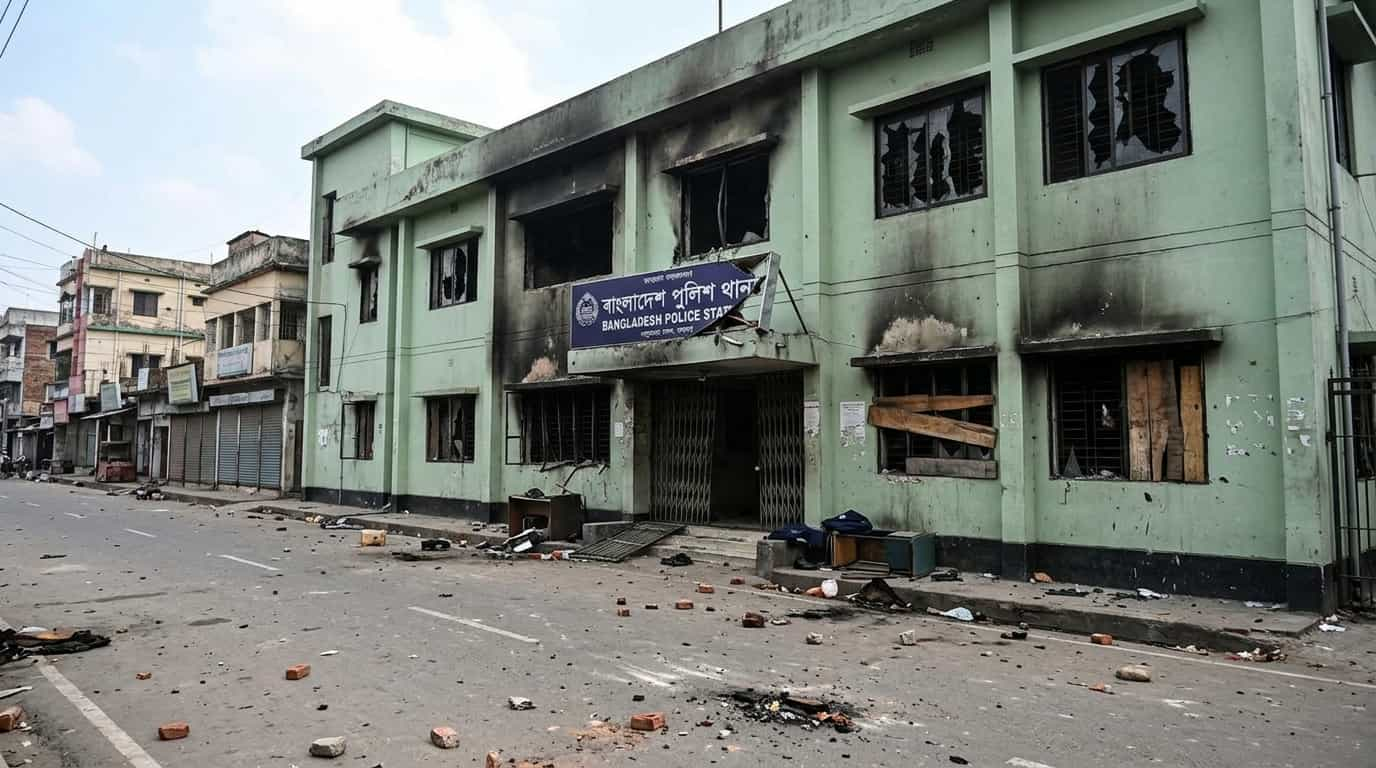
Retaliatory violence against Awami League members and supporters swept across the country. In Dhaka and other cities, crowds attacked 450 of Bangladesh's 639 police stations — damaging or destroying nearly 70% of the country's law enforcement infrastructure in the weeks following the resignation.
The Hindu minority community — approximately 8% of Bangladesh's population and historically among the most vulnerable to communal violence during periods of instability — was heavily targeted. Documented reports from human rights organisations recorded 200 to 300 Hindu homes and businesses attacked or destroyed, along with 15 to 20 temples. Approximately 40 people were injured in documented incidents, though community advocates suggest the actual figures were higher.
With law enforcement largely absent from the streets, organised crime filled the vacuum.
Between August and November 2024, Dhaka recorded 379 murders — an extraordinary figure for a city that, for all its chaos, had previously maintained relatively low homicide rates compared to similarly sized cities in other regions. 65 kidnappings were recorded in the same period. Despite national elections in February 2026 and the formation of a new government, the violence has not fully subsided. In the first three months of 2026 alone, Dhaka recorded an additional 107 murders.
The Nobel Peace Prize laureate Muhammad Yunus, who heads the interim government installed after Hasina's departure, has spoken frequently about the need to rebuild institutions. Rebuilding institutions is considerably harder than describing the need to do so.
The People Who Live Here Anyway
It would be easy, from a distance, to look at everything above and conclude that Dhaka is simply a city in the process of failing.
That conclusion would be wrong. Or at least, it would be incomplete in a way that matters.
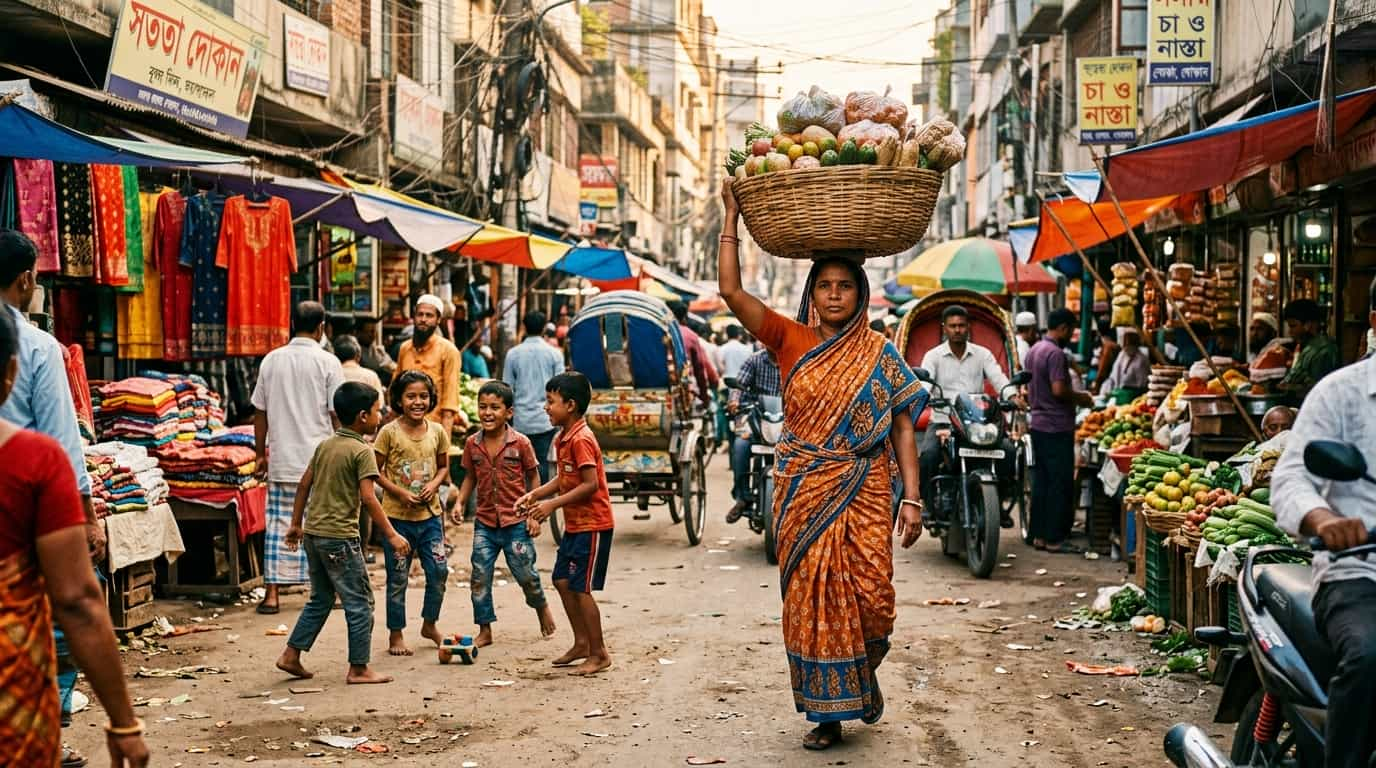
Thirty-six million people navigate this city every single day. They get their children to school. They run small businesses. They save money and send remittances to villages where their parents live. They build mosques and community centres and cricket pitches in the narrow gaps between informal settlements. They protest when their government shoots at them. They rebuild after floods.
The garment workers who march through the streets every few years demanding minimum wage increases — and who have, through sustained collective action, raised that minimum from $38 in 2013 to $113 in 2024 — are not victims waiting to be rescued. They are a labour force that has successfully organised under conditions that would have defeated most.
The engineers and urban planners at BRAC University and BUET who are mapping subsidence rates and designing elevated infrastructure and floating school boats for flood-prone neighbourhoods are not conceding defeat. They are building a more honest relationship with the geography their city occupies.
The women who migrated from Faridpur or Barisal or Sylhet at eighteen, found a factory job, sent money home, and are now learning to use a smartphone to access mobile banking — they are not passive recipients of a system that uses them. They are the system's engine, and increasingly they know it.
Dhaka is not a cautionary tale about what happens when a city grows too fast. It is a more complicated story about what survival looks like when the alternatives are worse — and about the extraordinary human capacity to build a life in exactly the conditions that everyone agrees are impossible.
Dhaka at a Glance: Key Facts
Metric Figure Current population ~36 million (2025) Population in 1950 ~335,000 Population density (peak districts) ~44,500 per km² Annual climate displacement into city 400,000–700,000 people Garment industry export value (2023) $55.79 billion Garment workers ~4.5 million direct Female share of garment workforce 60–70% Garment worker minimum wage (2024) ~$113/month Rana Plaza deaths (April 24, 2013) 1,134 confirmed Daily industrial sewage into Buriganga 21,000 cubic metres Annual premature deaths from air pollution 159,000+ (national) City subsidence rate 10–16mm per year Wetland loss (1988–2019) ~70% Current elevation above sea level 6–8 metres Deaths in 2024 political uprising ~1,400 estimated Police stations attacked (2024) 450 of 639 Murders (Aug–Nov 2024) 379 Arsenic exposure (national) Up to 30 million people
What Would Actually Help: The Interventions That Matter
Dhaka's problems are not mysterious. The solutions are not unknown. What they require is sustained political will, international financial commitment, and the time that climate change is specifically removing from the equation.
Groundwater governance — reducing extraction through piped surface water alternatives — is the single most direct intervention to slow subsidence. The Dhaka Water Supply and Sewerage Authority (DWASA) has surface water treatment capacity; expanding and distributing it is an infrastructure challenge with known solutions.
Wetland restoration and protection — halting the conversion of remaining wetlands to construction land — would restore the city's natural flood buffer. Bangladesh has environmental legislation on the books. Enforcing it against connected developers is a political challenge more than a technical one.
Tannery waste treatment infrastructure at the Savar relocation site should have been built before the tanneries moved. Building it now is an industry accountability question. The brands sourcing leather goods from Bangladeshi tanneries have both the leverage and the responsibility to require it.
Garment industry wages — the minimum wage of $113 per month is still below what independent living wage research identifies as necessary for a family in Dhaka. The brands that benefit from the price differential have the margin to absorb higher labour costs. The workers' organisations that have sustained campaign pressure for two decades have demonstrated they can push that needle.
Climate adaptation financing — specifically, international financial commitments to the most climate-vulnerable nations, which Bangladesh is unambiguously among — remains critically underfunded relative to what the science says is necessary. The countries most responsible for historical emissions are not the ones most exposed to the consequences.
None of this is simple. None of it is fast. All of it is necessary.
A City That the World Depends On
Here is the thing that is easy to miss from a distance.
The crisis in Dhaka is not a localised problem. The supply chains that run through its garment factories thread directly into the wardrobes of consumers in Birmingham and Boston and Berlin and Brisbane. The climate change accelerating its flooding is produced overwhelmingly by emissions from the same wealthy countries whose brands dominate its factory floors.
Dhaka is not a city that the world is watching from the outside. It is a city that the world is participating in — extracting value from, contributing emissions to, and largely failing to compensate for the consequences.
The 36 million people who live there did not choose to be at the intersection of global fast fashion economics, accelerating climate change, and postcolonial political fragility.
But they are. And the city is sinking.
And the question of what obligation the world has to the people of Dhaka is not a sentimental one. It is a structural one — embedded in every cheap garment sold, every tonne of carbon emitted, every international loan issued on terms that prioritise repayment over resilience.
Dhaka is not at the breaking point because its people broke it. It is at the breaking point because the systems that built the modern world ran through it and left.
👉 Also read: How Ancient Civilisations Were Far More Advanced Than We Were Taught
Sources and further reading:
World Bank: Bangladesh Urban Development Reports
International Centre for Diarrhoeal Disease Research Bangladesh (icddr,b): Climate displacement data
Bangladesh Garment Manufacturers and Exporters Association (BGMEA): Industry statistics 2023
World Health Organization: Bangladesh water and arsenic reports
Human Rights Support Society: 2024 uprising casualty documentation
IQAir: Dhaka air quality historical data
Academic literature on Dhaka land subsidence: Auerbach et al. (2015), Nature Climate Change
All statistics cited are sourced from international organisations, peer-reviewed research, or documented journalism. Casualty figures for political events represent best available estimates from human rights documentation and may differ from government figures.
Dhaka megacity crisis, Dhaka, Bangladesh, megacity, climate crisis, urban poverty, garment industry, Rana Plaza, political crisis, sinking cities, South Asia
© UrduPure Narrativa — World Affairs, Reported.


Discussion
Comments
Approved comments are published after moderation to keep discussion useful and spam-free.
No comments yet. Start the discussion below.