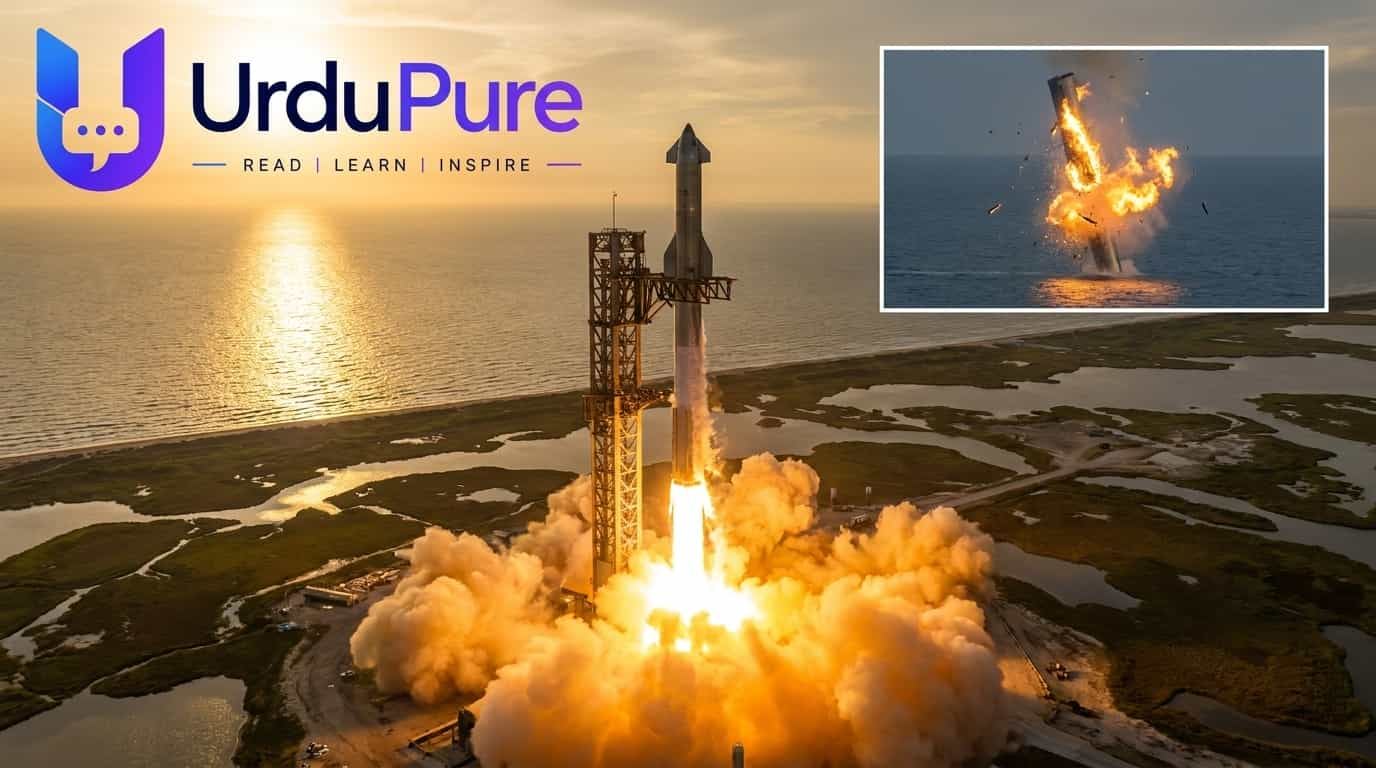
SpaceX Scored a Goal for Humanity. Then the Booster Exploded. Here's What Really Happened on Flight 12.
At 6:30 p.m. Eastern on May 22, 2026, the most powerful rocket ever built by human hands lifted off from Pad 2 at Starbase, Texas.
It cleared the tower in seconds — faster than any Starship before it. The 270-degree roll maneuver registered on cameras across the Gulf of Mexico as all 33 Raptor 3 engines burned simultaneously: roughly 16 million pounds of thrust concentrated in a rocket standing 400 feet tall. One SpaceX engineer watching the telemetry feed had a single thought, which he later posted on X: "This thing is alive."
For approximately the next 66 minutes, SpaceX's Starship Flight 12 — the debut test of the fully redesigned V3 architecture — did almost everything it was supposed to do. The upper stage deployed 22 satellites. It completed a controlled atmospheric reentry. It splashdown precisely in the Indian Ocean, operating on five of six engines after an early Raptor failure, its flight computer autonomously compensating for the deficit with textbook precision.
Then the celebration stopped. Because Booster 19 — the first Super Heavy ever built to V3 specification, the rocket stage that was supposed to separate cleanly and fall controlled into the Gulf of Mexico — had disintegrated in mid-air. One Raptor 3 engine had an energetic event during the boostback burn. That single failure cascaded through 16 neighboring engines. The booster came apart at nearly 1,500 kilometers per hour, 100 meters above the Gulf's surface.
Elon Musk called it "an epic first Starship V3 launch and landing" and said the team "scored a goal for humanity."
On May 27, 2026 — five days later — the Federal Aviation Administration declared the incident a mishap, ordered a full investigation, and effectively grounded Starship indefinitely.
The goal humanity scored is now on pause while the FAA decides what it means.
What Starship V3 Actually Is — And Why This Flight Was Bigger Than It Looks
To understand what Flight 12 represents, you need to understand that SpaceX did not upgrade Starship for this flight. They rebuilt it.
Starship V3 — designated Block 3, comprising Booster 19 and Ship 39 — is not an iterative refinement of the vehicle that flew 11 previous test missions. It incorporates what SpaceX described publicly as "thousands of changes" touching virtually every major system on both stages simultaneously. The redesign is so comprehensive that SpaceX essentially flew an entirely new rocket on May 22.
The key V3 changes:
Raptor 3 engines: The new Raptor 3 saves approximately 1 ton of vehicle-level mass per engine by simplifying the powerplant's design, vehicle-side commodities, and supporting hardware. On a rocket with 33 booster engines and 6 ship engines, the mass savings compound dramatically. Raptor 3 also delivers higher thrust density — more power from a simpler, lighter package. On paper.
Simplified booster aft section: The V3 booster reduced its grid fin count from four to three, but each fin is 50 percent larger and stronger. The complex plumbing of previous versions has been simplified. Fewer parts. Fewer failure modes. (In theory.)
Integrated hot-staging ring: The expendable interstage of previous Starships has been replaced by an integrated design that reduces hardware complexity and improves the hot-staging sequence — the critical moment where the upper stage ignites its engines while still attached to the booster.
Pad 2 at Starbase: Flight 12 was also the first launch from Starbase's second launch pad — an entirely new facility with faster fueling systems and a more durable flame diverter designed for higher launch cadence. SpaceX is building toward a future where Starship launches as frequently as SpaceX now launches Falcon 9 — dozens of times per year. Pad 2 is the first physical step toward that cadence.
Increased propellant capacity: V3 carries more propellant than its predecessors, enabling more demanding mission profiles and longer burn durations.
In-space hardware for orbital refueling: V3 includes new hardware specifically designed for the future capability of refueling in orbit — a critical requirement for NASA's Artemis moon landing missions, which require multiple Starship fuel depots to be positioned in lunar orbit before the crewed landing vehicle can reach the Moon's surface.
The Launch: What Happened in 66 Minutes
T+0:00 — Liftoff from Pad 2
At 6:30 p.m. Eastern (5:30 p.m. CDT), SpaceX confirmed propellant loading completed and initiated the final countdown. After a brief hold at T-40 seconds for final checks, all 33 Raptor 3 engines ignited and Booster 19 with Ship 39 lifted off from Pad 2 — the pad's inaugural launch.
The stack cleared the tower noticeably faster than previous Starship launches. Analysts watching the synchronized video comparison of Flight 11 and Flight 12 noted the V3's improved thrust-to-weight ratio as immediately visible.
T+01:43 — First Engine Anomaly
One outer Raptor 3 engine on the booster shut down for an unknown reason approximately 1 minute and 43 seconds into the flight. This was not catastrophic — Starship is designed to fly on multiple engine failures — but it was the first indication that the new V3 Raptor units had not achieved perfect reliability on their debut.
The booster completed its ascent burn on the remaining engines.
T+02:45 — Hot Staging and Separation
Hot staging and stage separation proceeded nominally. The booster shut down 28 of 33 engines; Ship 39 ignited all six Raptor 3 vacuum engines before flying away on its own trajectory. This is the most technically demanding moment in any Starship launch — the brief window where both stages are simultaneously firing — and it worked.
T+04:00 — Booster Boostback Failure
Booster 19 attempted to flip and initiate its 33-engine boostback burn to reverse course toward the Gulf of Mexico. Several engines failed to relight. The remaining engines tried to shut down. What followed was, per SpaceX analysts on the ground and on social media, a cascade failure triggered by a single Raptor 3 "energetic event" — industry language for an engine that came apart under stress rather than simply failing to fire.
The SpaceEngineer (@mcrs987 on X) published a slow-motion analysis that showed what happened: "One engine seems to have exploded during the boost-back. I think we got to see the consequences of the lack of full blast shielding. Boostback probably would have gone fine minus one engine had this single engine, either E5 or E6, not had an energetic event and took out 16 of its neighboring engines."
The booster came apart at nearly 1,500 km/h, 100 meters above the Gulf of Mexico. The FAA activated a Debris Response Area. No injuries, no property damage. But Booster 19 was gone.
T+08:00 to T+66:00 — Ship 39's Mission
While the booster drama unfolded, Ship 39 continued flying. The upper stage entered coast phase, then executed its payload deployment test — using SpaceX's "PEZ dispenser" mechanism to deploy 22 satellites: 20 Starlink mass simulators and two modified V2 Mini satellites designated "Dodger Dogs," equipped with external cameras and lighting.
The "Dodger Dogs" satellites transmitted imagery of Starship's heat shield back to Earth via the Starlink network — providing visual confirmation of the heat shield's condition during flight for the first time in the program's history. This capability alone was a significant engineering milestone: real-time heat shield inspection from space.
Due to the earlier Raptor vacuum engine anomaly on Ship 39 (a separate issue from the booster failure — one of the ship's six engines had also underperformed), SpaceX opted to skip a planned in-space Raptor relight demonstration.
Ship 39 then initiated atmospheric reentry, using its thermal protection system in deliberate experimental conditions — testing structural stress maneuvers designed to push the heat shield beyond what previous flights had attempted. The heat shield held.
At approximately 7:36 p.m. CT, Ship 39 completed a controlled splashdown in the Indian Ocean. SpaceX declared primary mission objectives achieved.
The FAA Declares a Mishap — And What That Means for Everything
For five days after the flight, the FAA's status was ambiguous. The agency had activated a Debris Response Area, confirmed no public injury or property damage, and said it was "assessing" whether the booster anomaly constituted a mishap requiring formal investigation.
On May 27, 2026, the answer came.
The FAA told TechCrunch: "After a thorough assessment of the operation, the FAA has determined the May 22 SpaceX Starship Flight 12 launch resulted in a mishap."
Under FAA regulations, a mishap determination means SpaceX must:
Conduct a full internal investigation
Identify the root cause of the booster failure
Develop and implement corrective actions
Submit the findings to the FAA for approval
Receive FAA clearance before any subsequent Starship launch
The FAA mishap process typically takes weeks to months, depending on the complexity of the investigation and the completeness of SpaceX's corrective action plan. SpaceX has navigated this process multiple times — most memorably after Flight 1 and Flight 2, when explosive failures required extensive investigations before subsequent launches were approved.
The critical difference in 2026 is timing.
The IPO Stakes: Why the Mishap Investigation Changes Everything
SpaceX's anticipated IPO is expected in mid-June 2026 — approximately six weeks after Flight 12. The mishap investigation, depending on how quickly SpaceX can identify the Raptor 3 engine failure root cause and satisfy FAA requirements, could push Flight 13 well past the IPO date.
This matters enormously for SpaceX's market positioning. The company's IPO prospectus had positioned Starlink Mobile — already supporting 10,354 working satellites — as a core revenue driver, with a working constellation of 10,370 satellites on orbit. The broader Starship program serves as the growth engine for Starlink's next generation (V3 Starlink, which V3 Starship is designed to deploy more efficiently) and as the hardware backbone for future orbital refueling, moon missions, and point-to-point Earth transport.
A Starship that cannot launch before the IPO is not necessarily a crisis — investors in SpaceX have priced in launch delays throughout the program's history. But a Starship under active FAA investigation, with a confirmed booster failure, heading into an IPO roadshow is a different narrative than the "rapid reusability achieved" story SpaceX had hoped Flight 12 would enable.
Elon Musk has publicly stated SpaceX expects to complete roughly 10 more Ship 39-class vehicles and about five more boosters by year-end. That production confidence, combined with the V3 redesign's stated goals, suggests SpaceX is not planning to treat Flight 12 as a setback. But the FAA's timeline is not SpaceX's to control.
What Did Flight 12 Actually Achieve?
Despite the booster loss and the FAA investigation, the honest assessment of Flight 12 is that it achieved most of what SpaceX needed from it. SpaceQ Media's post-flight analysis called it correctly: the flight "validates key upgrades aimed at rapid reusability ahead of future orbital and crewed missions."
Validated on Flight 12:
The V3 architecture can fly. Both stages cleared the tower, completed hot staging, and performed their primary mission objectives. For a totally redesigned vehicle, a first-flight success of this degree is not guaranteed.
Pad 2 works. The new launch facility's debut was clean — fueling, chilldown, and launch operations all functioned as designed. Having two operational launch pads at Starbase is critical for the launch cadence SpaceX needs.
Heat shield imaging works. The Dodger Dogs satellites successfully transmitted real-time heat shield imagery during reentry — a first for the program and a capability that will be essential for rapid turnaround operations.
Ship 39's autonomous engine compensation worked. When one of Ship 39's Raptor 3 engines underperformed, the flight computer autonomously extended burn durations on the healthy engines to compensate. This autonomous failure management is exactly the kind of system reliability that will be required for crewed and cargo missions.
The PEZ dispenser payload deployment worked. 22 satellites deployed successfully. The in-space deployment mechanism is core to Starship's Starlink V3 mission profile.
Not validated:
The Raptor 3 engine's reliability under boostback conditions. The cascading failure during the boostback burn is the most significant technical concern from the flight. If a single engine's energetic event can disable 16 neighbors, the V3 booster's robustness in the boostback phase requires urgent investigation and likely design modification.
Booster recovery. SpaceX had not planned to attempt a Mechazilla (tower arm catch) recovery on Flight 12, given the scale of the V3 redesign. But the booster didn't survive at all, which means the data SpaceX hoped to gather from a controlled water landing (even without a catch) is unavailable.
What Comes Next: Flight 13 and the Road to Orbit
SpaceX's path forward depends almost entirely on the FAA investigation timeline. The company has demonstrated it can move quickly through mishap investigations — the gap between Flight 11 (October 2025) and Flight 12 (May 22, 2026) was the longest in the program's history, suggesting the FAA process for Flight 12 prep was already lengthy.
For Flight 13, SpaceX will need to:
Identify the root cause of the Raptor 3 engine failure (likely the absence of full blast shielding that the analysis suggests was the mechanism)
Implement a design fix or procedural change
Test the fix adequately
Submit to FAA and receive clearance
If the investigation is straightforward — if the Raptor 3 failure is traced to a specific component or design gap that can be fixed without rebuilding the engine architecture — Flight 13 could happen before the end of 2026. If the investigation reveals a systemic issue with Raptor 3's reliability in boostback conditions, the timeline extends significantly.
For context on what's at stake beyond the IPO: NASA's Artemis III crewed lunar landing — which requires a Starship variant to serve as the Human Landing System — has been targeting 2027. Every Starship test flight delay has downstream consequences for that mission date. The 2025-2026 gap between Flight 11 and Flight 12 already pushed timelines. Another extended grounding post-Flight 12 compounds the pressure on the entire lunar architecture.
Gwynne Shotwell's Promise and What It Requires
SpaceX President Gwynne Shotwell's post-flight statement was characteristically forward-looking: "Our collective next flying amongst the stars has become so much closer."
It's a statement that is simultaneously inspiring and subject to the FAA's investigation calendar.
The V3 architecture, even in its imperfect debut, is clearly more capable than what came before it. The ship worked. The pad worked. The payload deployment worked. The heat shield imaging worked. The autonomous engine compensation worked.
One Raptor 3 engine failed. Its failure took 16 neighbors. The booster is at the bottom of the Gulf of Mexico.
The investigation will determine whether that failure was a fluke — a manufacturing defect in a single engine that can be screened out going forward — or a structural issue with the V3 booster's design in boostback conditions that requires more fundamental changes.
Until the FAA has its answer, humanity's goal is on hold.
But the trajectory — literally and figuratively — remains pointed upward.
Starship flight test 12, SpaceX Starship V3, Starship booster explosion, Raptor 3 engine failure, SpaceX FAA investigation mishap, Starship 2026, SpaceX IPO, Booster 19, Ship 39, Starbase Pad 2, Elon Musk Starship, NASA Artemis moon landing, Starship Flight 12 results, SpaceX booster explosion, Raptor 3 engine failure, SpaceX FAA investigation, Starship 2026, SpaceX IPO 2026, Starship Block 3, Booster 19 failure, Ship 39 splashdown, Raptor 3 engine, Mechazilla, Starbase Pad 2, Elon Musk Starship, SpaceX Starlink V3, NASA moon landing Starship






Discussion
Comments
Approved comments are published after moderation to keep discussion useful and spam-free.
No comments yet. Start the discussion below.