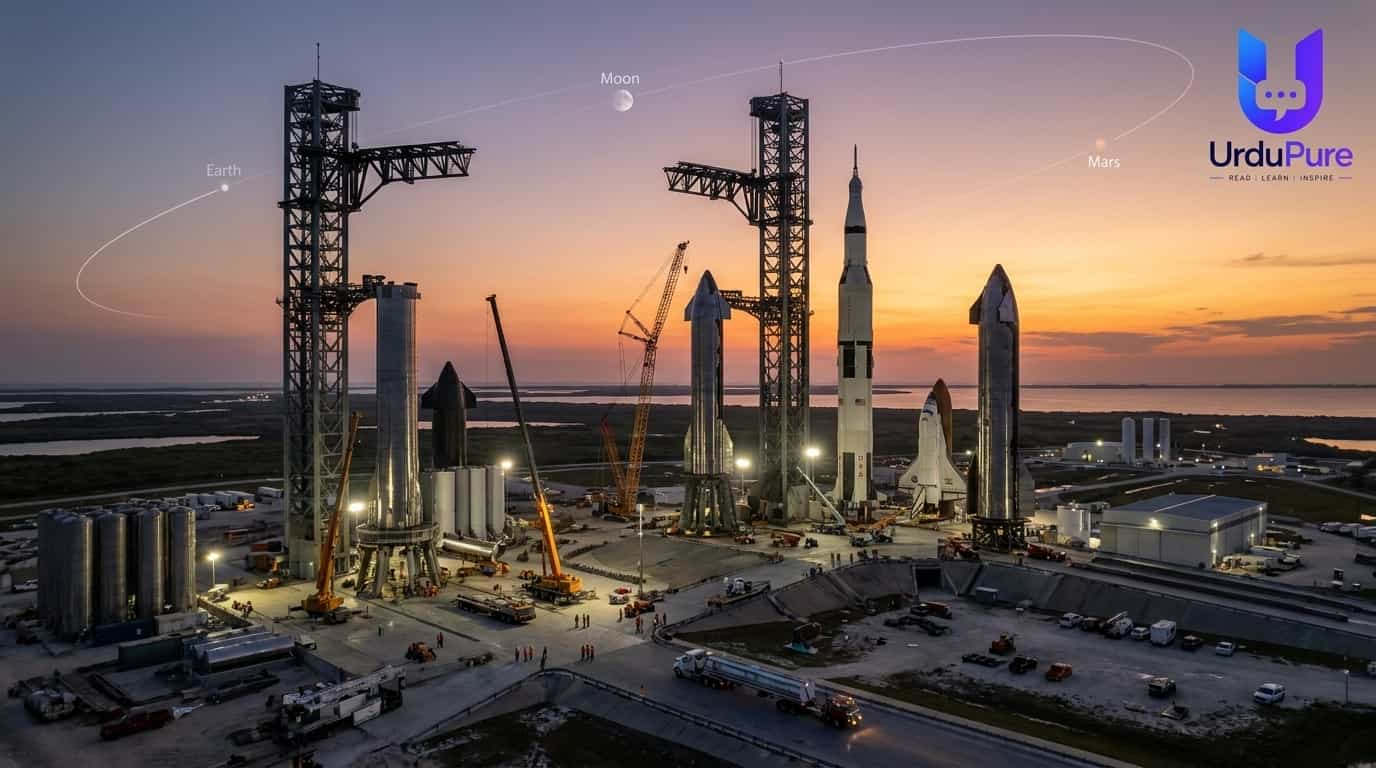
SpaceX's Cape Canaveral Starship Pads: What's Being Built at LC-39A and SLC-37 — and When Starship Actually Launches from Florida
There is a phrase that gets used around Kennedy Space Center and Cape Canaveral that no amount of repetition has managed to make routine: "hallowed ground." It is the phrase Elon Musk reached for when he confirmed SpaceX was building its first Florida Starship launch complex at Launch Complex 39A — the same pad from which Saturn V rockets carried Apollo astronauts to the Moon, from which Space Shuttles departed for thirty years of low Earth orbit missions, and from which Falcon 9 has been launching since 2017.
Now, at that same site, SpaceX is building the most sophisticated launch and catch infrastructure ever attempted — a Mechazilla tower and chopstick arm system designed for Starship V3 and beyond, at a pad that has seen arguably more historic launches than any other single site on Earth. And it is building a second one, five miles away, at Space Launch Complex 37 on Cape Canaveral Space Force Station.
Together, these two Florida sites — combined with the two operational pads at Starbase in Texas — will give SpaceX the capacity to launch Starship up to 146 times per year from US soil, according to FAA projections. That is not a distant aspiration. It is what SpaceX has filed and received regulatory approval to pursue. Here is the complete picture of what is being built, how far along it is, and when Starship first launches from Florida.
Why Florida? The Strategic Case for East Coast Starship Launches
Starbase in South Texas is SpaceX's primary Starship development site, and it will remain the core testing location for the foreseeable future. So why invest the enormous capital and effort required to build two additional launch complexes in Florida?
Orbital Mechanics: Inclinations That Texas Cannot Reach
The latitude of a launch site determines which orbital inclinations a rocket can efficiently reach. Starbase in South Texas sits at approximately 26 degrees North latitude. Launches from Starbase are optimised for orbits at low inclinations — the equatorial trajectories used for Starlink constellation deployment, geostationary orbit missions, and deep space departures.
Kennedy Space Center and Cape Canaveral sit at approximately 28.5 degrees North — a difference that seems trivial but matters. More significantly, Florida launches can fly due east over the Atlantic Ocean, using the full rotational velocity of the Earth to advantage. For certain mission profiles — particularly those requiring higher orbital inclinations for national security payloads, polar orbit staging, or ISS resupply — Florida's location and available launch azimuths are either necessary or more efficient than Texas.
Range Availability and National Security Missions
The Eastern Range — the FAA-controlled airspace and ocean corridor east of Cape Canaveral — is the busiest orbital launch range in the world, supporting dozens of launches per year from multiple operators including ULA, Rocket Lab, and SpaceX's own Falcon 9 operations. Starship's presence in Florida, launching from two pads, would add significantly to that range utilisation while serving both commercial and national security missions that the Department of Defense has indicated it wants to fly on Starship as part of its national space launch portfolio.
SpaceX has explicitly cited national security mission support as a primary rationale for the SLC-37 development: "With three launch pads in Florida, Starship will be ready to support America's national security and Artemis goals as the world's premiere spaceport continues to evolve to enable airport-like operations," the company wrote on social media after receiving SLC-37 approval.
Manufacturing Scale and Redundancy
SpaceX is building a Gigabay — a massive vehicle assembly and refurbishment facility significantly larger than its current Mega Bays at Starbase — at its Roberts Road facility near Kennedy Space Center. At last update, the Florida Gigabay was actually progressing faster than the equivalent structure at Starbase: Florida had reached Level 4 on the western side while Starbase was still at Level 3 overall. This manufacturing facility is designed to support high-cadence Starship production and refurbishment on the East Coast, enabling the combined Texas-Florida launch system to sustain the weekly launch rates SpaceX is targeting.
Launch Complex 39A: The Historic Pad Gets Starship Infrastructure
The History of the Site
Launch Complex 39A's biography is the biography of human spaceflight's greatest achievements. It was built in the 1960s for the Saturn V rocket. Apollo 11 launched from 39A on July 16, 1969. Twelve of the thirteen Saturn V missions that flew to the Moon launched from 39 complex pads. The pad was then converted for Space Shuttle operations and supported 82 of the 135 total Shuttle missions between 1979 and 2011. SpaceX leased 39A from NASA in 2014 and converted it for Falcon 9 and Falcon Heavy operations, launching from it for the first time in 2017.
Starship's infrastructure at 39A is now being built within this extraordinary heritage site — and SpaceX is doing so while maintaining the ability to launch Falcon 9 from the existing pad infrastructure at the same complex. This is not a small logistical feat; the Starship and Falcon 9 launch systems require fundamentally different ground infrastructure, and managing both simultaneously at a single site is an active engineering challenge.
Current Construction Status at LC-39A (May 2026)
The most comprehensive public assessment, published by NASASpaceFlight in January 2026 and updated via satellite imagery through April 2026, reveals the following construction status:
Launch tower: The Mechazilla-equivalent integration tower at LC-39A is structurally complete and has had its chopstick arms installed. The Ship Quick Disconnect (SQD) arm's shoulder section was installed in early 2026, upgraded from the original arm design to match the newer architecture used at Starbase's Pad 2. The tower's integration with the new Starship Orbital Launch Mount (OLM) design — identical to the OLM at Starbase Pad 2, incorporating lessons from all previous pad development — is ongoing.
Tank farm and propellant systems: Newly delivered propellant tanks — for liquid oxygen (LOX), liquid nitrogen (LN2), and liquid methane (LCH4) — are in place. Subcoolers and cryogenic pumps have been installed. Underground plumbing for propellants and the water deluge system (critical for sound suppression and thermal protection during launch) has been largely covered, indicating those sections are approaching completion. Air Separation Units (ASUs) that produce LOX and LN2 from atmospheric air are being installed. Note: not all tank farm components have been delivered or installed, and the propellant supply system is currently at a state where testing of existing systems is underway rather than full commissioning.
Flame trench: Satellite imagery from April 2026 confirmed that work on the flame trench — a critical structure that channels the enormous exhaust blast away from the launch mount during ignition — has been underway since April 2025. The flame trench design mirrors that of Starbase Pad 2, incorporating improvements that reduce pad damage from Starship's 33-engine ignition sequence.
Orbital Launch Mount: The OLM at LC-39A has been installed and is the same new design as Starbase Pad 2 — a significant departure from Pad 1's original launch mount that was damaged in the first Starship test flight in April 2023. Teams continue addressing remaining OLM integration tasks.
Dragon operations transition: SpaceX is actively transitioning all planned Crew Dragon and Cargo Dragon flights from LC-39A to Space Launch Complex 40 (SLC-40), clearing 39A for exclusive Starship operations. In February 2026, SpaceX erected a crane at LC-39A and began work on the crew access arm, either for removal or modification — a visible sign of the operational transition underway.
When Is the First Florida Starship Launch from LC-39A?
The honest answer, based on the most current NASASpaceflight assessment from April 2026: LC-39A is at least six months behind Starbase Pad 2 in infrastructure completion, not including the propellant tank farm systems that are not yet fully installed. Given that Pad 2 completed its first Starship launch on May 22, 2026, and adding the six-month lag, the earliest realistic window for a first LC-39A Starship launch is late 2026 — and that timeline depends on no significant construction delays or regulatory hold-ups from this point.
The FAA has advanced the environmental approval process for LC-39A Starship operations significantly. As of January 2026, the FAA had completed a detailed summary overview ahead of the Final Environmental Impact Statement (EIS), with the Final EIS and a Record of Decision (ROD) expected to be published imminently. The Final EIS will clear the last major regulatory hurdle for up to 44 Starship launches per year from LC-39A. SpaceX has said explicitly: "We plan to complete the Starship launch pad at Pad 39-A this year, and pending the completion of environmental reviews, SpaceX intends to conduct the first Starship launch from Florida from Launch Pad 39-A later this year."
A late 2026 first launch from LC-39A is achievable. It is not guaranteed. SpaceX's record of optimistic timeline projections — particularly for new infrastructure — suggests holding expectations at the wide end of that window.
Space Launch Complex 37: The Second Florida Starship Pad
The Site's History
SLC-37 on Cape Canaveral Space Force Station has its own storied history. It was originally built in the 1960s for the Saturn IB rocket — a smaller sibling to the Saturn V — and supported Apollo programme unmanned test flights. It was later used by United Launch Alliance for its Delta IV and Delta IV Heavy rockets. ULA performed its final Delta IV Heavy launch from SLC-37 in April 2024. The pad then sat idle until SpaceX received approval to develop it for Starship operations — the most dramatic repurposing of a launch complex since the Saturn V pads were converted for Shuttle operations in the 1970s.
Current Construction Status at SLC-37 (May 2026)
SLC-37 is at an earlier stage of development than LC-39A, but construction is progressing actively:
Site clearing and foundation work: Site clearing is underway across the SLC-37 footprint. FAA Obstruction Evaluation filings from January 2026 identified construction of the launch tower and two massive cranes — an LR11000 and larger equipment — indicating tower construction is imminent or has begun.
Launch pad foundation piling: Satellite imagery shows four rows of CFA (Continuous Flight Auger) piles in the area of the primary launch pad location — the deep foundation elements that will support the enormous weight and vibrational loads of a Starship launch mount. A second set of piles below the first launch pad location is planned for the large tank farm that will supply both pads at SLC-37.
Air Separation Unit: A new area adjacent to the entrance road is being cleared for at least one ASU at SLC-37, which will provide LOX and LN2 to the propellant tank farm — the same system being installed at LC-39A and already operational at Starbase.
Environmental approvals: The FAA has already given environmental approval for the start of construction at SLC-37. SpaceX confirmed: "We've received approval to develop Space Launch Complex-37 for Starship operations at Cape Canaveral Space Force Station."
When Is the First SLC-37 Launch?
SLC-37 is realistically a 2027 launch site, not 2026. Construction of the launch tower alone — which at Starbase took approximately 18 months from foundation to operational readiness — will consume most of 2026 even on an accelerated schedule. The propellant systems, ground support equipment, and pad infrastructure that must follow the tower completion add further timeline. A 2027 first launch from SLC-37 is the optimistic scenario; 2028 is the conservative one.
The combined capacity of LC-39A and SLC-37 in Florida, plus Pads 1 and 2 at Starbase, is what SpaceX needs to reach its stated goal of 146 annual Starship launches. That total is not achievable with Starbase alone. It is not achievable with Starbase plus one Florida pad. All four pads in full operation simultaneously — each launching roughly once a week on a shared rotation — is what that number requires.
The Gigabay at Roberts Road: The Manufacturing Engine Behind the Launch Rate
Neither LC-39A nor SLC-37 can sustain a high launch cadence without a high-throughput vehicle assembly and refurbishment capability nearby. SpaceX's Roberts Road facility at Kennedy Space Center is where that capability is being built.
The Gigabay under construction at Roberts Road is designed to be significantly larger than the current Mega Bays at Starbase. While each Mega Bay at Starbase supports a maximum of six workstations for Starship assembly and processing, the Florida Gigabay — when complete — is designed for at least 24 workstations. This four-times multiplication in throughput capacity is the manufacturing infrastructure that makes weekly launch rates physically possible rather than theoretically desirable.
As of January 2026, the Florida Gigabay had reached Level 4 on its western side — ahead of the Starbase equivalent, which was at Level 3 at the same time. The building's structure was progressing quickly under Florida's more favourable construction conditions. This rapid progress is significant: it suggests SpaceX's Florida manufacturing capability will be operational at or before the LC-39A pad reaches full operational status, ensuring the factory and the launch complex can come online together rather than sequentially.
Barges will transport completed Starship stages from the Roberts Road Gigabay to both LC-39A and SLC-37 launch sites — a logistics pipeline that SpaceX has already modelled from its Starbase experience of moving oversized hardware by sea.
The Historical Significance: Apollo Ground to Mars Ground
There is something worth pausing on in the story of what is being built at LC-39A. The pad from which Neil Armstrong and Buzz Aldrin left Earth on July 16, 1969, on their way to the first human landing on the Moon — that same pad is now being prepared for the rocket Elon Musk believes will establish the first human settlement on Mars.
The continuity is not accidental. SpaceX chose LC-39A partly for its engineering suitability and partly for its symbolic weight. "39A is hallowed spaceflight ground — no place more deserving of a Starship launch pad," Musk wrote when construction was announced. The pad that made the first giant leap possible in 1969 is being prepared to host the leap that follows.
Whether that framing holds up to historical scrutiny is a question for the 2040s. What is certain in 2026 is that the concrete is being poured, the towers are rising, and the infrastructure for an East Coast Starship launch programme is measurably, verifiably being built. The FAA has cleared 44 launches per year from LC-39A. SLC-37 is breaking ground for another 76. The Eastern Range is preparing for airport-like operations for the most powerful rocket in history.
Late 2026 is when Starship first launches from the Space Coast — if the infrastructure completes on schedule and the regulatory process clears without delay. That is the next chapter of a story that the pad at 39A has been telling for more than 55 years.
SpaceX is building two Starship launch complexes in Florida: LC-39A at Kennedy Space Center (targeting late 2026 first launch) and SLC-37 at Cape Canaveral Space Force Station (realistic 2027 first launch).
LC-39A's Mechazilla tower is structurally complete with chopstick arms installed. The SQD arm, OLM, flame trench, and propellant systems are at various stages of completion. The pad is approximately six months behind Starbase Pad 2 in overall readiness.
SLC-37 construction has received FAA environmental approval. Foundation piling, site clearing, and ASU preparation are underway. Launch tower construction is imminent.
SpaceX is transitioning all Dragon launches from LC-39A to SLC-40, clearing 39A for exclusive Starship operations — a process actively underway as of February 2026.
The FAA has advanced approval for 44 Starship launches per year from LC-39A and 76 from SLC-37. Combined with Starbase Pads 1 and 2, total approved US Starship launch capacity reaches 146 missions per year.
The Florida Gigabay at Roberts Road — with 24 workstation capacity versus 6 at each current Starbase Mega Bay — was progressing faster than the Starbase equivalent as of January 2026, supporting the manufacturing scale required for high-cadence East Coast launches.
LC-39A launched Apollo missions to the Moon in 1969 and Space Shuttle missions through 2011. Its Starship infrastructure represents the pad's third major lifecycle — from Moon to orbit to, ultimately, Mars.
This article draws on NASASpaceFlight's Florida Starship progress reports (January, April 2026), Starship SpaceX Wiki LC-39A tracking, FAA environmental review documents for LC-39A and SLC-37 approvals, SpaceX's March 2026 public update on Florida site status, SpaceX social media statements on SLC-37 development clearance, and satellite imagery analysis published by Harry Stranger via Planet Labs. All construction status information is current as of May 23, 2026. Infrastructure completion timelines are estimates based on publicly available data and SpaceX's stated schedules, which are subject to change.






Discussion
Comments
Approved comments are published after moderation to keep discussion useful and spam-free.
No comments yet. Start the discussion below.