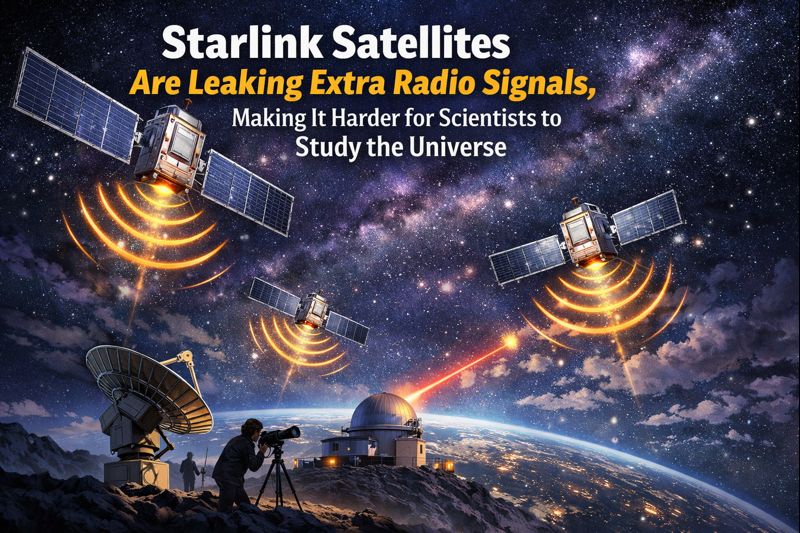
In an era defined by unprecedented technological advancement and the burgeoning commercialization of space, a new challenge has emerged, casting a shadow over humanity's quest to understand the cosmos. The vast constellations of satellites, like SpaceX's Starlink, designed to blanket the Earth with internet connectivity, are inadvertently becoming sources of radio interference, making it increasingly difficult for scientists to listen to the faint whispers of the distant universe.
The Unintended Radiance: Starlink's Leaking Signals
Recent studies and observations by astronomers have confirmed a concerning phenomenon: Starlink satellites are emitting unintended radio signals that fall within frequency bands crucial for astronomical research. These aren't the primary communication signals meant for internet users, but rather "stray" or "leakage" emissions emanating from the satellite electronics themselves.
What Are These Leaks?
- Non-Payload Emissions: These signals originate not from the satellites' primary communication antennas, but from onboard electronics, such as power converters, processors, and control systems.
- Broadband Interference: Unlike targeted radio transmissions, these leakage signals tend to be broadband, spreading across a wide range of frequencies, including those traditionally reserved for passive radio astronomy.
- Low-Level but Pervasive: While individually weak, the sheer number of Starlink satellites (thousands already in orbit, with tens of thousands planned) means their cumulative effect can be significant and widespread.
This "radio pollution" is particularly problematic because it occurs in frequency ranges that astronomers use to detect naturally occurring cosmic phenomena – from the faint hydrogen line that traces the distribution of matter in the early universe to the complex molecules in star-forming regions.
Eclipsing the Cosmos: Impact on Scientific Research
The unintended emissions from Starlink satellites pose a direct threat to the field of radio astronomy, a cornerstone of our understanding of the universe. Radio telescopes are designed to detect incredibly faint radio waves that have traveled billions of light-years to reach Earth. Any artificial interference, no matter how subtle, can drown out these crucial cosmic signals.
Specific Challenges for Astronomers:
- Obscuring Faint Signals: The universe is filled with weak, natural radio emissions. Starlink's leakage adds noise, making it harder to discern these delicate signals from distant galaxies, pulsars, or the cosmic microwave background.
- Loss of "Protected" Bands: Certain radio frequency bands are internationally protected for passive astronomical use. The Starlink leakage is reportedly encroaching upon or occurring within these very bands, undermining years of international agreements.
- Data Contamination: Even if signals aren't completely drowned out, the presence of satellite interference can corrupt data, requiring extensive and often imperfect processing to remove the noise, thus reducing the quality and reliability of scientific observations.
- Impact on Future Discoveries: The continuous increase in satellite numbers threatens to fundamentally alter the "radio sky," potentially preventing future discoveries that rely on pristine radio environments.
Astronomers worldwide, particularly those operating sensitive instruments like the Square Kilometre Array (SKA) or the Low-Frequency Array (LOFAR), are voicing profound concerns. They fear that a critical window into the universe could be significantly narrowed, if not closed, by the proliferation of these radiating constellations.
The Scientific Community's Plea and Calls for Action
Leading astronomical organizations and scientists have been vocal about the issue. The International Astronomical Union (IAU), the American Astronomical Society (AAS), and various national observatories have issued warnings and called for urgent dialogue with satellite operators and regulatory bodies.
Key Concerns and Recommendations:
- Urgent Dialogue: The need for open communication and collaboration between satellite companies and the astronomical community to find technical solutions.
- Design Modifications: Suggestions for future satellite designs to minimize unintended emissions, potentially through better shielding, filtering, or component selection.
- Regulatory Oversight: Calls for national and international regulators (like the ITU – International Telecommunication Union) to consider these impacts when licensing new satellite constellations.
- Long-Term Planning: Emphasizing the need for a sustainable approach to space utilization that balances commercial interests with scientific preservation.
Astronomers acknowledge the benefits of global internet access but stress that this should not come at the irreparable cost of fundamental scientific research. They advocate for a "dark and quiet skies" approach, ensuring that certain parts of the electromagnetic spectrum remain free from anthropogenic interference.
SpaceX's Stance and Mitigation Efforts
SpaceX, the company behind Starlink, has previously engaged with the astronomical community regarding concerns about the visual brightness of its satellites, leading to the development of "DarkSat" and "VisorSat" technologies. While these efforts address optical interference, the radio frequency leakage presents a distinct and arguably more complex challenge.
The company has stated its commitment to working with astronomers and improving satellite designs. However, rectifying unintended radio emissions from thousands of already launched satellites is a monumental task. Future satellite iterations might incorporate better shielding or design choices to mitigate these leaks, but their effectiveness and implementation timeline remain critical questions.
The challenge lies in balancing the drive for global connectivity with the imperative to protect a finite natural resource: the radio spectrum crucial for scientific discovery. SpaceX's Starlink project, while revolutionary in its aim to provide internet access globally, must also contend with its growing environmental footprint, both visual and electromagnetic, in Earth's orbit.
Navigating the Regulatory Cosmos: A Path Forward
The issue of satellite interference transcends national borders and highlights the complexities of governing an increasingly crowded space environment. International bodies like the ITU play a crucial role in allocating frequency bands and developing regulations, but enforcement and adaptation to rapidly evolving technologies present continuous challenges.
Moving forward, a multi-faceted approach will be required:
- Enhanced International Collaboration: Governments, regulatory bodies, satellite operators, and the scientific community must work together to establish best practices and enforceable guidelines.
- Innovation in Satellite Design: Encouraging and incentivizing the development of "astronomy-friendly" satellite technology that minimizes both optical and radio interference.
- Dynamic Spectrum Management: Exploring new ways to manage the radio spectrum, perhaps with adaptive technologies that allow for co-existence where possible, without compromising scientific integrity.
- Public Awareness: Educating the public about the value of astronomy and the threats it faces from space-based infrastructure.
The current situation serves as a stark reminder that as humanity expands its presence and activities in space, careful consideration must be given to the long-term impacts on all aspects of human endeavor, including the fundamental pursuit of scientific knowledge.
Preserving Our Window to the Universe
The inadvertent leakage of radio signals from Starlink satellites represents a significant, unintended consequence of the rapid growth in satellite constellations. While global internet connectivity offers immense societal benefits, it cannot come at the expense of our ability to observe and understand the universe around us. The "dark and quiet skies" are a heritage for all humanity, crucial for both current scientific inquiry and future generations of discoverers.
Addressing this challenge requires more than just technical fixes; it demands a global commitment to responsible space stewardship, fostering collaboration between industry and science, and ensuring that our technological progress does not inadvertently blind us to the cosmos we seek to explore.






Discussion
Comments
Approved comments are published after moderation to keep discussion useful and spam-free.
No comments yet. Start the discussion below.