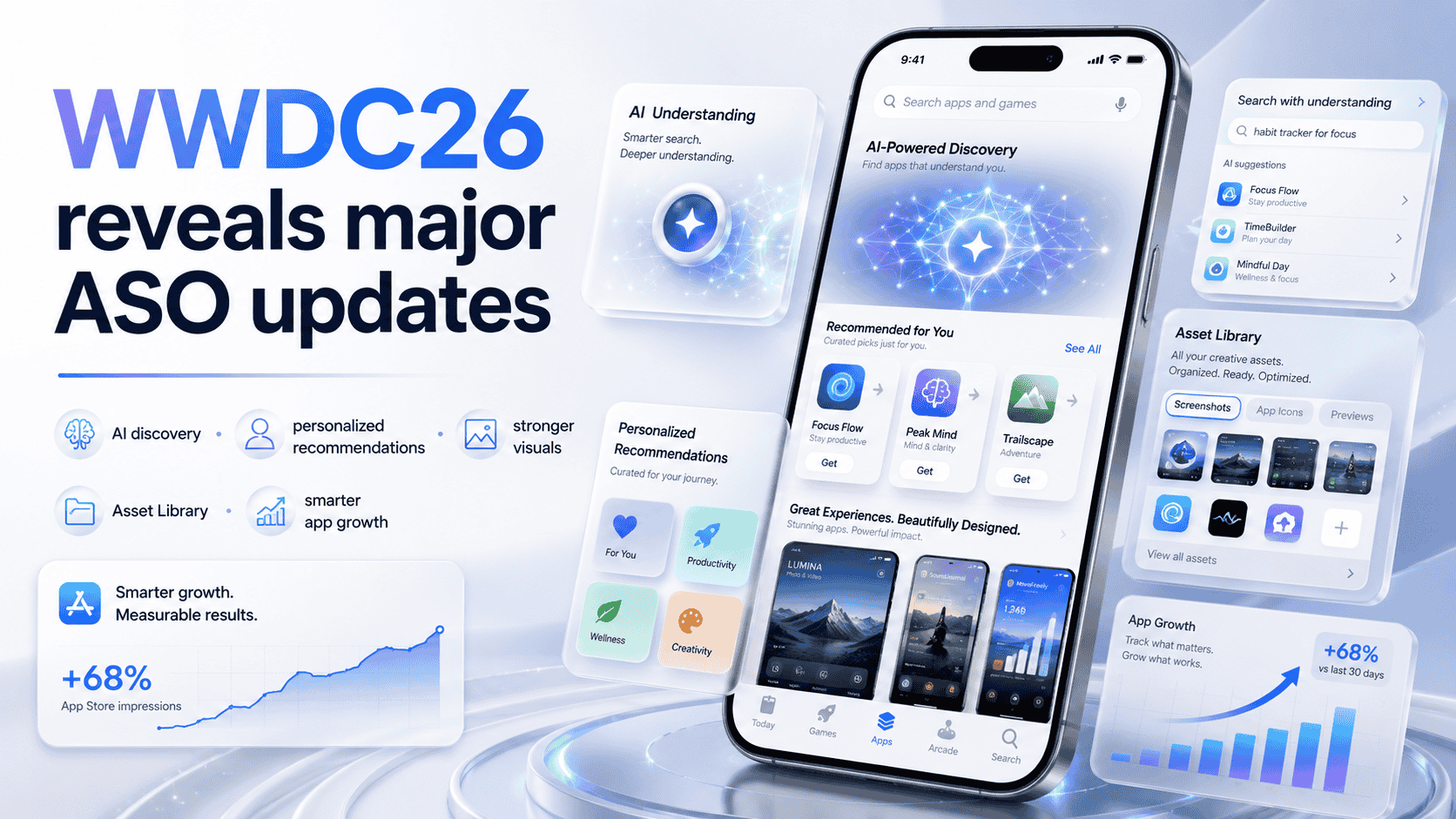
WWDC26 ASO Report: How Apple’s App Store Discovery Is Changing for Developers
Apple’s App Store is no longer just a place where users search for an app by keyword, look at screenshots, and tap install.
After WWDC26, the bigger message is clear:
App discovery is becoming more visual, more personalized, and more AI-assisted.
For app developers, publishers, indie creators, and ASO teams, this is a major shift. Traditional App Store Optimization still matters, but it is no longer enough to think only about keywords, title, subtitle, ratings and screenshots.
Apple is moving toward a discovery system where user behavior, app relevance, creative quality, product page clarity, retention signals and personalization all matter more than before.
In simple words:
The App Store is becoming smarter. And your app listing needs to become smarter too.
Key Takeaways
Apple’s WWDC26 App Store updates point toward a more AI-powered discovery experience.
Personalized Collections will recommend apps based on user interests, app usage, downloads and other App Store signals.
Apple is introducing Asset Library in App Store Connect to manage screenshots, app previews, images and videos in one centralized place.
Product page headers and search result creatives can make App Store listings more visual.
App Store Connect will include product page preview tools so developers can see how visuals and metadata appear before publishing.
Subscription and retention tools are becoming more important for app growth.
Traditional ASO is not dead, but it must now work together with visuals, retention, personalization and clearer app value.
What Changed at WWDC26?
The ASO report summarizes Apple’s App Store direction very well: discovery is becoming less keyword-only and more context-driven.
Apple’s official WWDC26 App Store guide says the App Store will include new Personalized Collections based on user interests. These recommendations can appear in the Apps, Games and Search tabs, and Apple says they may use app usage, downloads and other App Store information to adapt over time.
That means users may increasingly discover apps because Apple understands what they like, what they use and what is relevant to them.
This does not remove keywords.
But it changes the ASO game.
Developers now need to ask:
Does my app clearly communicate what it does?
Does my listing help Apple understand my app?
Do my screenshots and visuals explain the value quickly?
Do users stay engaged after installing?
Does my product page match the right audience?
Is my app positioned clearly enough for recommendation systems?
ASO is moving from simple keyword optimization to full app growth optimization.
1. Smarter App Discovery
The first big update is smarter app discovery.
Before, many developers focused mainly on search rankings. They tried to rank for keywords such as “fitness tracker,” “budget planner,” “photo editor,” or “language learning.”
That still matters.
But personalized discovery means Apple may recommend apps based on a user’s behavior and interests, not only what they type into the search bar.
For example, if someone often uses running apps, meal tracking apps and smartwatch apps, Apple may recommend related health or fitness tools.
If someone plays puzzle games, Apple may recommend similar games or apps with matching behavior patterns.
This means developers should focus more on:
Clear category positioning.
Strong onboarding.
Better retention.
High user satisfaction.
Accurate metadata.
Relevant screenshots.
Good ratings and reviews.
Useful app functionality.
Apple’s direction suggests that the App Store will care more about whether your app is genuinely useful for the right users, not just whether you placed the right keyword in the title.
2. AI-Powered App Understanding
The second major shift is AI-powered understanding.
Apple is increasingly building systems that understand context, user intent and app functionality. The official Apple Intelligence guide for WWDC26 highlights visual intelligence and intents, including ways apps can define entities and enable direct actions from content.
For app marketers, this matters because your app must be easy for both humans and systems to understand.
A confusing app listing can hurt discovery.
If your app description is vague, your screenshots are unclear, your title is generic and your onboarding is weak, Apple’s systems may struggle to understand your app’s real value.
That means ASO writing must become clearer.
Instead of saying:
“The best lifestyle solution for modern users.”
Say:
“Track daily expenses, set monthly budgets and receive spending alerts.”
Instead of saying:
“Your all-in-one productivity partner.”
Say:
“Plan tasks, manage deadlines and organize team projects in one workspace.”
AI-driven discovery rewards clarity.
The clearer your app value, the easier it becomes for both users and discovery systems to understand who your app is for.
3. Large Visual Headers
Apple is also giving developers more visual space.
According to Apple’s WWDC26 App Store guide, developers will be able to use product page headers to build excitement at the top of the product page. Apple also mentions images and videos as creative assets that can be used across product pages, search results, App Store features and Apple Ads.
This is important because the App Store is becoming more visual.
Screenshots were already important.
But now, larger creative areas can help apps communicate faster.
A good header can show:
The main app promise.
A seasonal campaign.
A new feature.
A strong brand identity.
A game atmosphere.
A lifestyle use case.
A visual reason to care.
This gives developers more control over first impressions.
But it also raises the quality bar.
Weak visuals will stand out more.
Strong visuals may improve conversion.
For ASO teams, the creative strategy now becomes as important as the keyword strategy.
4. Enhanced Search Experience
Search results are also becoming more visual.
Apple says creative assets can help apps reach people in relevant search results on the App Store and in the Apple Games app.
This means users may see more than a simple icon, title and screenshot strip.
They may get a stronger visual preview before tapping.
For app developers, this creates a new challenge:
Your search result must sell faster.
A user scrolling through search results may decide in seconds.
That means your visual creative should answer:
What does the app do?
Why should I tap?
Is this app relevant to me?
Does it look trustworthy?
Does it look better than competitors?
Search visibility alone is not enough.
Your search appearance must convert.
5. Centralized Asset Library
One of the most practical WWDC26 updates is Asset Library.
Apple describes Asset Library as a new centralized place in App Store Connect where developers can upload and manage visual elements such as images, videos, app previews and screenshots. Apple says these assets can be used across multiple places in the App Store and submitted independently from an app submission.
This is a big operational improvement.
Before, creative updates could be tied closely to app releases and review workflows.
Now, Apple is making creative asset management more flexible.
For marketing teams, this means:
Easier seasonal campaigns.
Faster visual testing.
Better organization of screenshots and videos.
Less dependency on engineering releases.
More reusable creative assets.
Better planning for Apple Ads and product pages.
This update is especially useful for apps that frequently run campaigns.
For example:
Fitness apps during New Year.
Shopping apps during Black Friday.
Education apps during exam season.
Travel apps during summer.
Games during special events.
Creative speed is becoming a competitive advantage.
6. Smarter Analytics
Apple’s broader direction shows that developers are getting more tools to understand acquisition, conversion, retention and revenue.
This matters because the new ASO is not only about installs.
It is about quality growth.
An app that gets many installs but poor retention may not perform well long term.
Developers need to track:
Product page conversion.
Search performance.
Creative performance.
Retention.
Subscription behavior.
Revenue.
Cohorts.
Install quality.
User satisfaction.
The future of ASO is data-driven.
Developers should not guess which screenshot works.
They should test.
They should not assume one message fits every audience.
They should segment.
They should not only optimize for installs.
They should optimize for engaged users.
7. More Growth Opportunities
WWDC26 also brings opportunities for subscription apps and monetization teams.
Apple’s App Store guide mentions retention messaging, which can reach subscribers when they choose to cancel and remind them of subscription value, including special offers.
This is important because many apps lose users after the first month.
Getting installs is hard.
Keeping users is harder.
Subscription apps especially need to improve:
Activation.
Trial conversion.
Cancellation prevention.
Long-term value.
Plan packaging.
Feature communication.
Apple’s new retention and subscription tools suggest that growth will not stop at the install button.
The real question becomes:
Does the user stay?
Does the user understand the value?
Does the user return?
Does the user subscribe?
Does the user renew?
This is where ASO connects with product strategy.
What Apple Did Not Announce
Apple did not remove traditional ASO. Keyword optimization still matters. App title still matters. Subtitle still matters. Localization still matters. Ratings and reviews still matter. Conversion rate still matters. Retention still matters.
Search ranking has not disappeared. The difference is that these elements are now part of a larger system.
Traditional ASO is becoming one layer of a broader discovery engine.
So developers should not stop optimizing keywords.
They should expand their ASO strategy.
The Big Takeaway
The big takeaway from WWDC26 is this:
Apple is moving App Store growth from keyword-centric ASO to a future built around AI understanding, personalization and creative optimization.
That means developers need to improve three things at once.
First, metadata quality.
Your title, subtitle, keywords, description and category must clearly explain what your app does.
Second, creative quality.
Your screenshots, videos, headers and search creatives must communicate value fast.
Third, user quality signals.
Your app must retain users, satisfy users and deliver real value after installation.
The future App Store will likely reward apps that are easy to understand, visually strong and genuinely useful.
Top Priorities for App Developers in 2026 and 2027
Developers and ASO teams should focus on these priorities.
Product Page Optimization
Your product page should explain the app clearly within seconds.
Users should understand the value without reading a long description.
Focus on:
Clear headline.
Strong screenshots.
Feature benefits.
Social proof.
Simple language.
Visual hierarchy.
Screenshot and Creative Optimization
Screenshots are no longer just app images.
They are sales assets.
Use them to show:
What problem the app solves.
What the main benefit is.
What the user will experience.
Why your app is different.
Test different creative versions when possible.
Video and Header Optimization
If Apple gives more header and video space, use it wisely.
A header should not be decorative only.
It should communicate a clear promise.
For games, show atmosphere.
For productivity apps, show outcomes.
For finance apps, show trust and clarity.
For fitness apps, show transformation.
For education apps, show learning progress.
Retention and Engagement Improvement
Apple’s personalized discovery may increasingly care about whether users actually engage with apps.
So retention matters.
Improve:
Onboarding.
First-session experience.
Push notification quality.
Feature discovery.
User education.
Performance.
Bug fixing.
Subscription value.
Audience Targeting and Personalization
Not every user needs the same message.
Custom product pages and creative assets allow developers to match different audiences.
For example:
One product page for students.
One for professionals.
One for beginners.
One for advanced users.
One for a seasonal campaign.
Better targeting can improve conversion.
Metadata Quality
Your metadata should be clear, accurate and relevant.
Avoid vague language.
Avoid keyword stuffing.
Explain the app in plain words.
Use keywords naturally.
Localize properly for each market.
Keywords and Localization Strategy
Keywords still matter, especially for search.
But localization must be deeper than translation.
Different countries use different search habits.
A keyword that works in the United States may not work in Germany, Japan or Pakistan.
ASO teams should research local language, local competitors and local user intent.
What This Means for Indie Developers
Indie developers should not feel discouraged.
These updates may actually help smaller teams if they move smartly.
A small team can compete by being faster and clearer.
Indies should:
Build strong visuals.
Test product pages.
Write clearer descriptions.
Improve onboarding.
Ask users for reviews ethically.
Track retention.
Create seasonal creative assets.
Use Asset Library when available.
Focus on one strong audience first.
A small app with clear value can still win if it communicates better than a bigger competitor.
What This Means for App Marketers
For app marketers, WWDC26 means the ASO role is expanding.
Marketers now need to understand:
Search optimization.
Creative testing.
Product page conversion.
Apple Ads.
Personalization.
Retention.
Analytics.
User intent.
App positioning.
ASO is no longer only metadata work.
It is becoming a bridge between marketing, product, design, data and growth.
Final Thought
WWDC26 shows that App Store growth is entering a new phase.
The old ASO playbook was mostly about keywords, rankings and screenshots.
The new playbook is bigger.
It includes AI understanding, personalized recommendations, creative assets, visual search results, centralized asset management, smarter analytics and retention-focused growth.
The winners will be apps that are easy to understand, visually convincing and genuinely useful after installation.
For AI-era apps, creativity meets relevance.
Great visuals plus clear value can lead to stronger discovery and faster growth.
Frequently Asked Questions
What is ASO?
ASO means App Store Optimization. It is the process of improving an app’s visibility, product page and conversion rate in app stores.
What did Apple announce at WWDC26 for the App Store?
Apple announced updates including Personalized Collections, Asset Library, product page headers, product page preview tools and creative asset support across App Store placements.
Is traditional ASO dead?
No. Keywords, titles, subtitles, localization, ratings and conversion still matter. But ASO is becoming broader and more connected to visuals, user behavior and personalization.
What is Asset Library in App Store Connect?
Asset Library is a centralized place to manage images, videos, app previews and screenshots for use across App Store placements and Apple Ads.
What are Personalized Collections?
Personalized Collections are App Store recommendations based on user interests, app usage, downloads and other App Store information. Apple says they can appear in Apps, Games and Search tabs.
Why do visuals matter more now?
Apple is expanding creative placements, including product page headers and search result visuals. This means strong creative can influence whether users notice and tap an app.
What should app developers do first?
Start by auditing your App Store listing. Improve metadata clarity, screenshots, product page messaging, retention and creative quality.
Do keywords still matter on the App Store?
Yes. Keywords still matter for search, but they should be combined with better visuals, retention, personalization and clear app positioning.
How can small developers benefit?
Small developers can move quickly, test creative assets, improve product pages and focus on clear value for a specific audience.
What is the biggest ASO lesson from WWDC26?
The biggest lesson is that App Store growth is shifting from keyword-only optimization to AI-assisted discovery, personalization and creative performance.



Discussion
Comments
Approved comments are published after moderation to keep discussion useful and spam-free.
No comments yet. Start the discussion below.